
When Should Product Visibility Drive Your Packaging Choice?
Blister cards are particularly useful when seeing the actual product helps a shopper verify size, shape, color, finish, connector type, component count, or other physical details before purchasing. The best blister-card design does more than expose the product: the thermoformed cavity, product orientation, printed card, and retail display must work together so the important features remain easy to inspect. When engineered correctly, physical visibility removes consumer doubt, eliminates in-store packaging tear-open damage, and speeds purchase decisions.
When Is Product Visibility a Major Packaging Requirement?
In retail merchandising, the decision to showcase a product under transparent plastic rather than enclosing it in a printed carton comes down to a fundamental question: Does inspecting the physical item directly influence the shopper's confidence to buy?
For many technical, cosmetic, and mechanical products, a 2D rendering or photograph on an opaque box fails to communicate critical physical attributes. Buyers want to confirm tangible characteristics with their own eyes before reaching the checkout register:
Physical Confirmation Factors
- • Connector & Port Styles: Verifying USB-C vs. micro-USB or pin formats.
- • Component Geometry: Inspecting curvature, bit profiles, or chuck sizes.
- • Surface Texture & Finish: Evaluating knurling, anodizing, or matte grip.
- • Color Accuracy: Seeing true cosmetic shades, bristle tints, or wire hues.
- • Included Component Count: Counting exact piece quantities in a kit.
High-Visibility Product Categories
- • Consumer Tech: Charging cables, audio adapters, phone mounting brackets.
- • Hardware & Tools: Screwdriver bit sets, utility knives, hex keys, drill sets.
- • Automotive Replacement: Fuses, specialty fasteners, tire valves, sensors.
- • Beauty Accessories: Makeup brushes, tweezers, eyelash curlers, applicators.
- • Craft & Stationery: Precision cutting knives, fountain pen nibs, art clips.
In these categories, direct visual verification removes hesitation. Explore our industry-specific analysis on blister cards for electronics accessories and blister cards for hardware and replacement parts for detailed sector applications.
When Full Product Visibility Is Less Important
True packaging optimization requires acknowledging when a format is not the best fit. Full transparent visibility adds little value—and can even hinder merchandising—under specific commercial conditions:
- Visually Generic Products: Bulk wood screws, standard electrical wire nuts, or plain commodity cables do not offer unique aesthetic or physical differentiation that justifies an exposed blister.
- Heavy Informational or Regulatory Requirements: Pharmaceuticals, chemical additives, or multi-language international products require extensive panel area for instructions, drug facts, and compliance warnings that an opaque carton accommodates more efficiently.
- Light-Sensitive or UV-Degradable Materials: Essential oils, specialty adhesives, or UV-cured resins require full opaque shielding to maintain product stability during extended retail shelf exposure.
- Premium Unboxing & Gift Presentation: When tactile cardboard curvature or an elaborate ceremonial reveal drives luxury perception, paperboard formats like custom pillow boxes or embossed folding cartons deliver superior consumer engagement.
Product Orientation: Decide What the Shopper Needs to See
One of the most common packaging engineering errors is orienting a product inside the cavity based simply on whichever layout minimizes mold depth or cavity footprint.
In retail, product orientation must be dictated entirely by the shopper's evaluation criteria. Consider what the consumer must verify in the first three seconds:
- Connector Faces: For electronic cables and adapters, the working pins or USB-C profile must face forward, not sideways or buried under coiled cable loops.
- Working Tool Ends: The knurled drive head of a ratchet, the hardened edge of a utility knife blade, or the precision tip of a tweezer must be positioned cleanly in the primary sightline.
- Control Panels & Dials: Buttons, digital readouts, and adjustment dials must sit perpendicular to the card face, unblocked by secondary accessories or cords.
- Asymmetric Geometries: Left-handed vs. right-handed grips or specialized bracket offsets must be oriented to make their functional handedness immediately obvious.
"Blister tooling design must start with product orientation before card graphic artwork is ever finalized. If the cavity holds the product backward, no amount of graphic callouts can compensate for the lost visual inspection."
How Blister Geometry Affects What the Shopper Can See
The physical engineering of the thermoformed plastic cavity determines whether the product appears crisp and accessible or distorted and obscured:
- Draft Angles & Optical Distortion: Steep, vertical sidewalls can create optical distortion and wall thinning during thermoforming. Incorporating gradual draft angles maintains uniform plastic gauge and eliminates visual wave distortion.
- Internal Shadowing: Excessively deep cavities can cast dark shadows across the lower half of the product under overhead store lights. Stepping cavity depths and adding reflective card backing eliminates dark zones.
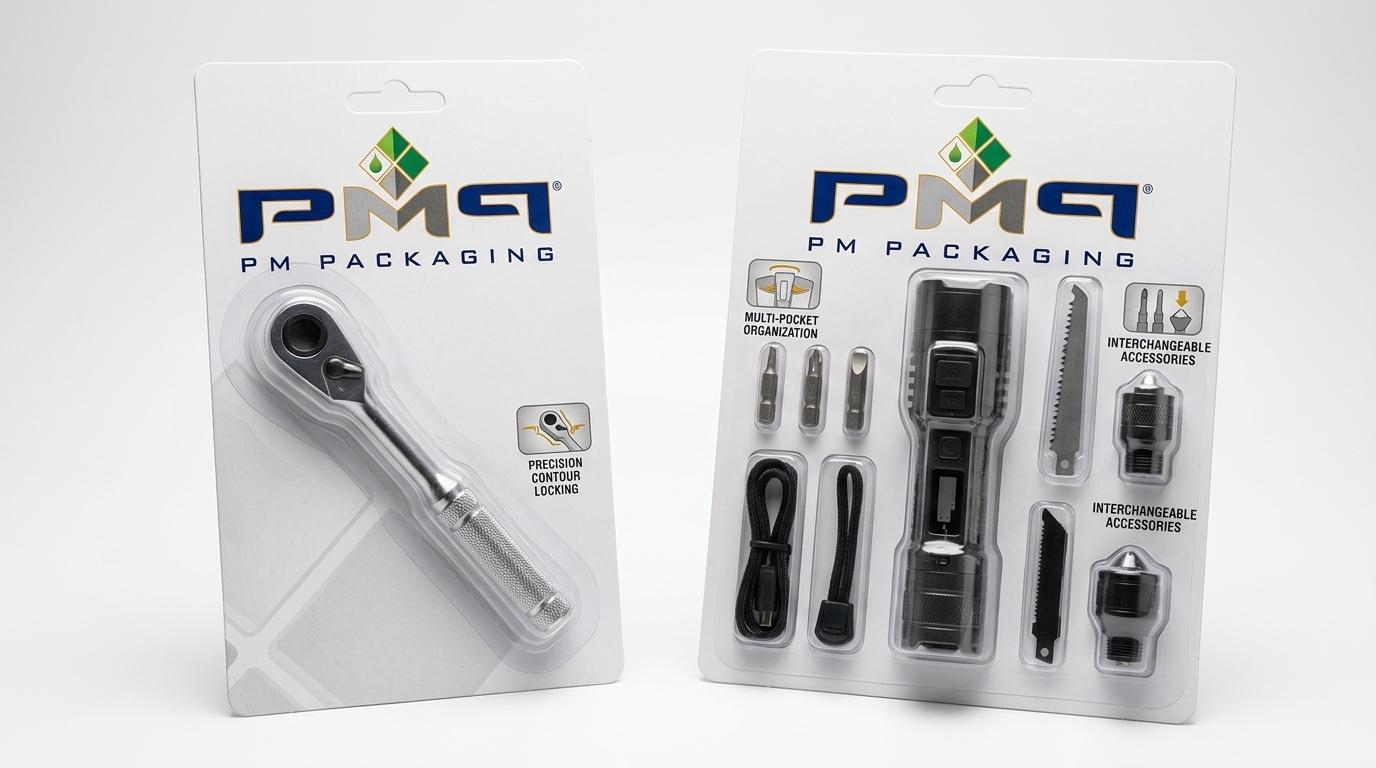
- Precision Form-Fitting Undercuts: When items shift or rotate during freight transit, they settle cockeyed or face-down. Custom CNC tooling incorporates subtle contour undercuts that snap or cradle the item, locking it in a permanent front-facing posture.
Managing Reflection and Glare on Clear Blisters
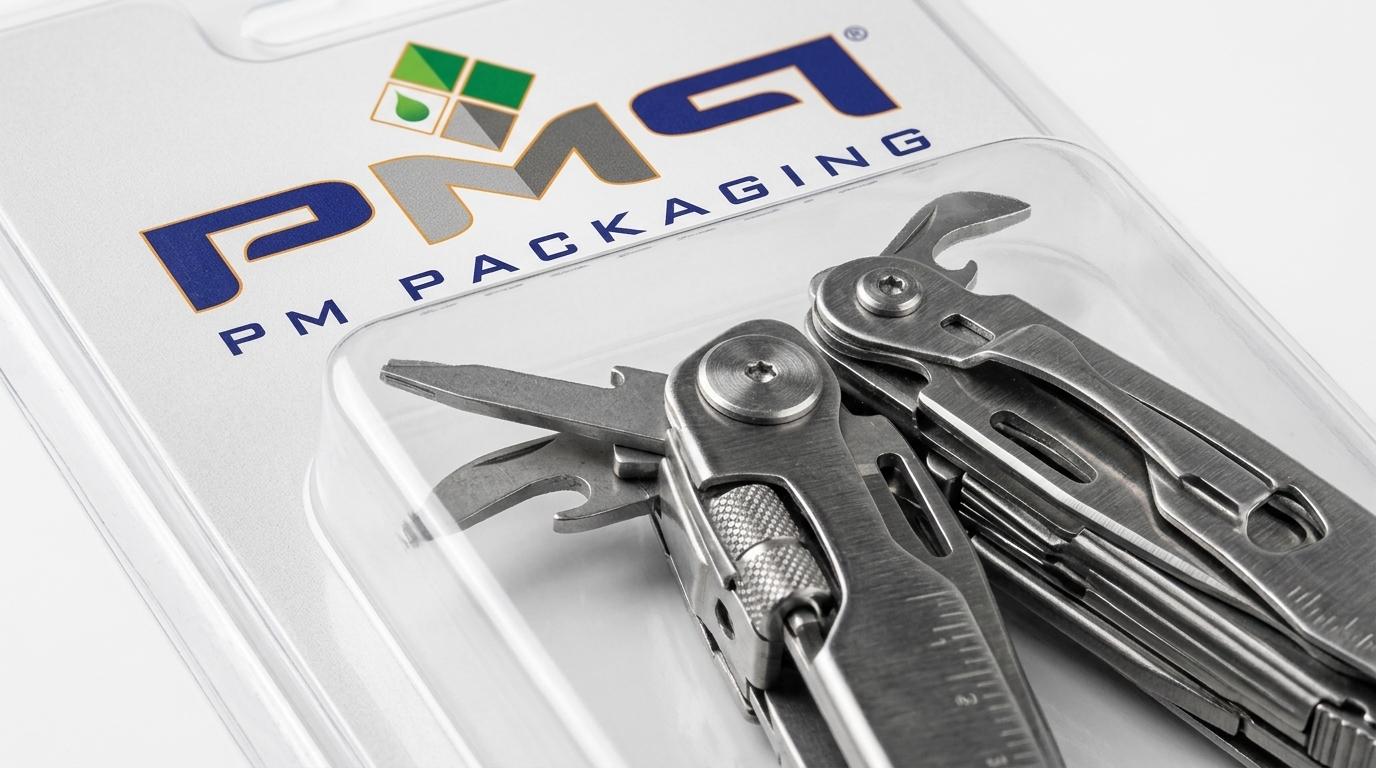
Retail stores feature diverse and unforgiving lighting environments: high-bay LEDs in big-box stores, fluorescent strips in supermarkets, and direct halogen spotlights in specialty boutiques. Because transparent plastic is inherently reflective, curved surfaces act as convex mirrors, reflecting ceiling lights directly into shopper sightlines.
Controlling glare requires deliberate geometric and graphic planning:
- Flat Optical Viewing Faces: Designing the primary front face of the blister as a flat plane rather than a high-radius hemisphere directs overhead reflections upward and downward away from horizontal eye-level sightlines.
- Clear Printed Margins Around the Flange: Placing fine legal copy, tiny barcodes, or dense feature bullets immediately adjacent to the curved perimeter flange creates double-refraction distortion. Critical text should be positioned with adequate margin clearance on flat card panels.
- Virgin Polymer Selection: Utilizing premium virgin thermoformable PET ensures maximum light transmission and zero yellow tint, providing natural color fidelity for the enclosed merchandise.
The Backing Card Can Make the Product Easier—or Harder—to See
A transparent blister does not exist visually in isolation. The printed paperboard card directly behind the plastic cavity serves as the physical canvas and background for the product.
When backing card artwork is improperly conceived, the product effectively disappears:
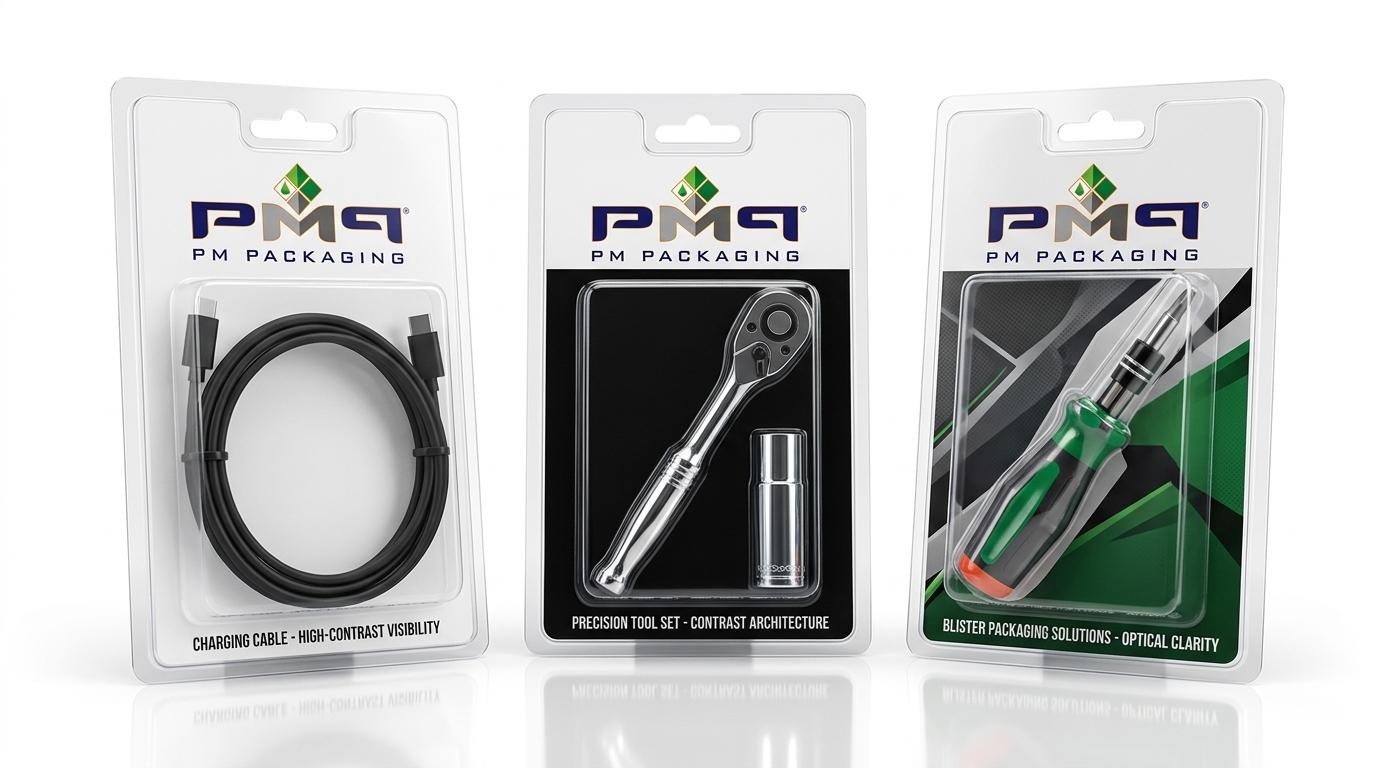
- Dark-on-Dark Confusion: A matte black charging cable or dark carbon-fiber tool placed over a dark navy or charcoal background card loses all silhouette definition. The shopper cannot gauge thickness, length, or build quality.
- Competing Lifestyle Imagery: Placing complex photographic textures (such as workshop benches, outdoor landscapes, or dense action scenes) directly under a transparent cavity creates severe visual noise. The product's edges blend into the photographic background.
- High-Contrast Color Blocking: The most effective packaging designs use a clean, neutral background field (bright white, light silver, or solid contrasting brand color) directly behind the cavity. Saturated brand colors and bold pattern fields are reserved for perimeter headers and side borders.
Design for Three Viewing Distances
Retail shelf visibility operates across three distinct physical distances as a shopper approaches and interacts with the display fixture:
| Viewing Stage | Shopper Focus | Packaging Design Priority |
|---|---|---|
| From Several Feet Away | Brand recognition, product category, SKU color family | Bold brand header, high-contrast silhouette, distinct color band |
| At Arm's Length (Browsing) | Actual product evaluation, physical features, compatibility | Clear cavity inspection, connector orientation, bold spec icons |
| In Hand (Evaluation) | Detailed instructions, technical data, compliance, barcode | Clean reverse card printing, warranty info, organized feature bullets |
Structuring this visual hierarchy prevents the card from becoming cluttered. For a complete analysis of header typography and hang hole positioning, review our guide to how to design the header area of a blister card and our overarching review of blister card packaging design.
How Much Card Space Should Be Product vs. Branding?
Packaging buyers frequently confront a commercial dilemma: Should the blister cavity be as large as possible to maximize product exposure, or should the card prioritize printable branding surface?
Larger Blister Cavity
- + Maximum 3D product exposure and tactile presence.
- + Displays uncoiled cables or fully deployed tool heads.
- − Reduces surface area for printed branding and claims.
- − Increases vulnerability to cavity scuffing during transit.
Compact Blister Cavity
- + Ample card space for graphic hierarchy and certifications.
- + Higher facing density on crowded retail peg hooks.
- − Product must be tightly coiled or partially folded.
- − Less dramatic physical inspection from several feet away.
Balancing this trade-off is critical for store planograms. To examine how card surface dimensions influence overall structural rigidity, see our guide on how card size affects blister packaging performance. If you are evaluating miniature products, consult our companion piece on how blister cards help small products create a larger retail presence.
Showing Multiple Components Clearly
When a product line involves multi-piece sets—such as an interchangeable precision driver with ten bits, or a wireless mic with two lavalier clips and a charging wire—displaying all pieces clearly becomes an engineering puzzle.
If components are dumped loosely into a single large bubble, they slide over one another during shipping, scratching sensitive surfaces and creating a messy presentation. Custom thermoformed tooling solves this through multi-pocket cavity architecture:
- Individual Component Retention: Each bit, adapter, and cord is seated in its own precision-contoured pocket with individual friction retention points.
- Hierarchical Visual Staging: The primary tool or device occupies the dominant central cavity, while accessories are neatly framed in flanking channels. This communicates full kit value without visually confusing the primary offer.
Product-by-Product Retail Visibility Matrix
Different retail products require specialized blister engineering to showcase their unique functional assets:
| Product Category | What the Shopper Needs to See | Blister Cavity Design Priority |
|---|---|---|
| Charging Adapters & Cables | Connector tips, port layout, braided cord gauge | Face connector heads forward; coil cord neatly in lower cavity |
| Drill & Driver Bit Sets | Drive profiles (Torx, Phillips, hex), exact piece counts | Organized parallel pocket lanes with laser-etched card callouts |
| Cosmetic & Makeup Brushes | Bristle contour, density, handle finish, hair softness | Longitudinal cavity with zero bristle compression or bending |
| Automotive Replacement Parts | Mounting bracket geometry, pin counts, included gaskets | Orient critical attachment flanges upright; nest small hardware |
| Precision Craft Accessories | Cutting blade profiles, knurled grip, color options | Snug cavity undercuts that prevent rolling and blade contact |
| Hardware Fastener Assortments | Thread pitch, head diameter, exact count per size | Multi-cell compartmentalized tray preventing cross-cell mixing |
Choosing the Right Blister-Card Construction
Visibility requirements directly influence which structural blister format you should manufacture:
- Single-Seal Face Blister Cards: The thermoformed blister flange is sealed directly to the front face of a heat-seal coated paperboard backing card. Delivers the most cost-effective solution for high-volume automated sealing lines while providing maximum front visibility.
- Fold-Over Blister Cards: A pre-creased card with a die-cut aperture folds over the plastic blister flange, sandwiching it between two paperboard panels. Ideal when heavier products require reinforced perimeter edge support or when two-sided printed graphics are needed.
- Trapped Blister Cards: The plastic flange is trapped between two laminated paperboard plies, leaving only the formed bubble projecting through a precision die-cut window. This eliminates visible plastic perimeter flanges for an exceptionally clean, premium aesthetic.
Maintaining Visibility Across Multi-SKU Product Families
Consumer brands rarely market a single item. Retail catalogs routinely feature 15 to 50 SKUs spanning different sizes, lengths, and colors. The operational challenge is creating a consistent, repeatable visibility architecture across the entire product family.
By standardizing outer card dimensions, keeping brand headers aligned, and utilizing color-coded category bands, brands establish an imposing, cohesive billboard effect on retail peg hooks.
To make multi-variant production economically viable, PM Packaging offers our proprietary qikCombo multi-SKU manufacturing process. qikCombo enables brands to gang multiple card artwork versions and cavity shapes on shared press runs, drastically cutting tooling costs while maintaining flawless color fidelity across your entire retail catalog.
PM Packaging's Custom Blister-Card Capabilities
At PM Packaging, we coordinate custom thermoforming tooling and high-precision paperboard printing under one roof to deliver retail-ready visibility programs:
Thermoforming & Tooling
- • Custom CNC Molds: Engineered with form-fit cavity contours and undercuts.
- • Optical Polish Standards: Crystal-clear PET and RPET thermoforming.
- • Multi-Pocket Configurations: Structured cavities for kit organization.
- • Anti-Static Formulations: Repels store dust and airborne particles.
Printed Card Execution
- • G7 Master Certified Color: Precision printing across all SKU families.
- • Specialty Finishes: High-gloss, soft-touch matte, spot UV, and embossing.
- • Automated Heat-Seal Coatings: Single-seal, fold-over, and trapped styles.
- • qikCombo Press Runs: Combined multi-SKU production efficiency.
Learn more about our complete manufacturing infrastructure on our dedicated custom blister cards solution page.
What to Provide When Requesting a Blister-Card Quote
To help our packaging engineers rapidly evaluate your product visibility requirements and generate accurate dieline prototypes, please provide the following project details:
Visibility Project Intake Checklist:
1. Product Dimensions & CAD: 3D CAD files (.STEP/.IGES) or physical samples for cavity prototyping.
2. Critical Inspection Features: Key connector faces, textures, or cutting edges that must face forward.
3. Product Weight & Center of Mass: Total unit weight for hang tab and card stability engineering.
4. Total Catalog SKU Count: Number of unique parts, lengths, or color variations.
5. Target Card Footprint: Existing retail planogram dimensions or request for optimization.
6. Target Retail Chains: Specific retail guidelines (peg hook spacing, compliance standards).
7. Preferred Blister Construction: Single-seal, fold-over, or trapped blister card.
8. Production Run Volume: Initial rollout volume and estimated annual replenishment reorders.
9. In-Store Launch Date: Critical delivery deadlines for national store rollouts.
Frequently Asked Questions
Why are blister cards good for product visibility?
Blister cards provide 100% optical transparency through a thermoformed plastic bubble while utilizing the paperboard backing as a high-contrast visual billboard. This lets consumers physically inspect product build quality, connectors, and colors before purchasing, eliminating buyer doubt.
How does blister shape affect product visibility?
Cavity draft angles, depth, and wall radii dictate how light interacts with the package. Flatter front faces reduce optical distortion and specular glare from overhead store lighting, while form-fitting contour undercuts hold the product locked upright in its optimal presentation angle.
How should a product be oriented inside a blister package?
A product should be oriented around what the consumer must verify to make a purchase decision—such as connector pin faces, blade edges, drive profiles, or control dials—rather than whichever orientation merely fits the smallest plastic bubble.
How can blister packaging reduce glare at retail?
Glare is controlled by engineering flatter front viewing panels rather than high-curvature domes, maintaining clear card margins around curved flanges, and positioning critical text and barcodes on flat card areas outside reflective plastic curvature.
How much space should be left around the blister cavity?
Adequate margin must be reserved for the perimeter heat-seal flange plus a clear border zone that separates the plastic edge from brand typography. Critical text, logos, and barcodes should never sit directly under or adjacent to the seal flange.
Can multiple products or accessories be shown in separate blister pockets?
Yes. Multi-pocket thermoformed cavities feature individualized compartments for each piece, tool bit, or cable adapter. This prevents loose components from scratching each other during transit while displaying full kit value in an organized layout.
When is a windowed carton better than a blister card?
A windowed folding carton is preferable when a product requires a formal 3D box structure, heavy multi-panel instructions, enclosed interior paperboard trays, or when a brand desires an elegant unboxing experience combined with partial product viewing.
Developing a Retail Blister-Card Program?
"Retail visibility succeeds when thermoformed optical clarity, product orientation, and card contrast operate as an integrated visual system."
PM Packaging can evaluate your product dimensions, visibility requirements, blister geometry, card size, SKU count, and estimated production quantities to engineer an optimized blister-card program tailored to your national retail targets.
Contact our packaging engineering specialists today to review your CAD files, request physical blister prototypes, and receive a comprehensive production quote.