
Hardware packaging is governed by technical selection, concentrated mass, and multi-SKU pegboard density.
Unlike lightweight goods, retail hardware requires packaging that solves four core challenges: supporting dense product weight, keeping components visible for buyer verification, communicating exact technical specifications, and organizing expansive catalogs across crowded pegboards.
For national brands merchandising fasteners, fittings, blades, and rebuild kits across commercial home improvement and automotive chains, custom blister cards deliver the necessary balance of structural support, security, and clear technical communication.
Which Hardware Products Fit Blister Cards?
Blister cards excel for hardware categories where direct visual inspection drives the buying decision. The table below outlines key product categories and their specific packaging considerations:
| Product Category | Commercial Visibility Lift | Critical Structural Concern |
|---|---|---|
| Fasteners & Threaded Rods | Finish, thread pitch, and piece count visible. | High mass density; heat-seal containment. |
| Plumbing Valves & Fittings | Verify angle, thread type, and lumen size. | Bulk weight; pipe-thread callouts. |
| Electrical Accessories | Component visible alongside technical ratings. | Model, amperage, and voltage identification. |
| Replacement Blades & Bits | Cutting geometry and shank diameter visible. | Sharp-edge containment and blade retention. |
| Door & Cabinet Hardware | Architectural finish and hole-spacing visible. | Multi-piece organization and scratch prevention. |
| Repair & Rebuild Kits | Complete assembly visible in one view. | Compartmented cavities preventing missing parts. |
| Automotive Replacement Parts | Physical part matched to removed original. | Part-number hierarchy and vehicle fitment. |
| Small Hand Tools & Gauges | High visual appeal on retail peg hooks. | Center of gravity, hanging balance, and security. |
| Mounting Clips & Brackets | Rapid comparison of hole patterns and angles. | Formed cavity preventing nested shifting. |
| Adapters & Connectors | Immediate technical selection support. | Clear visual differentiation across sizes. |
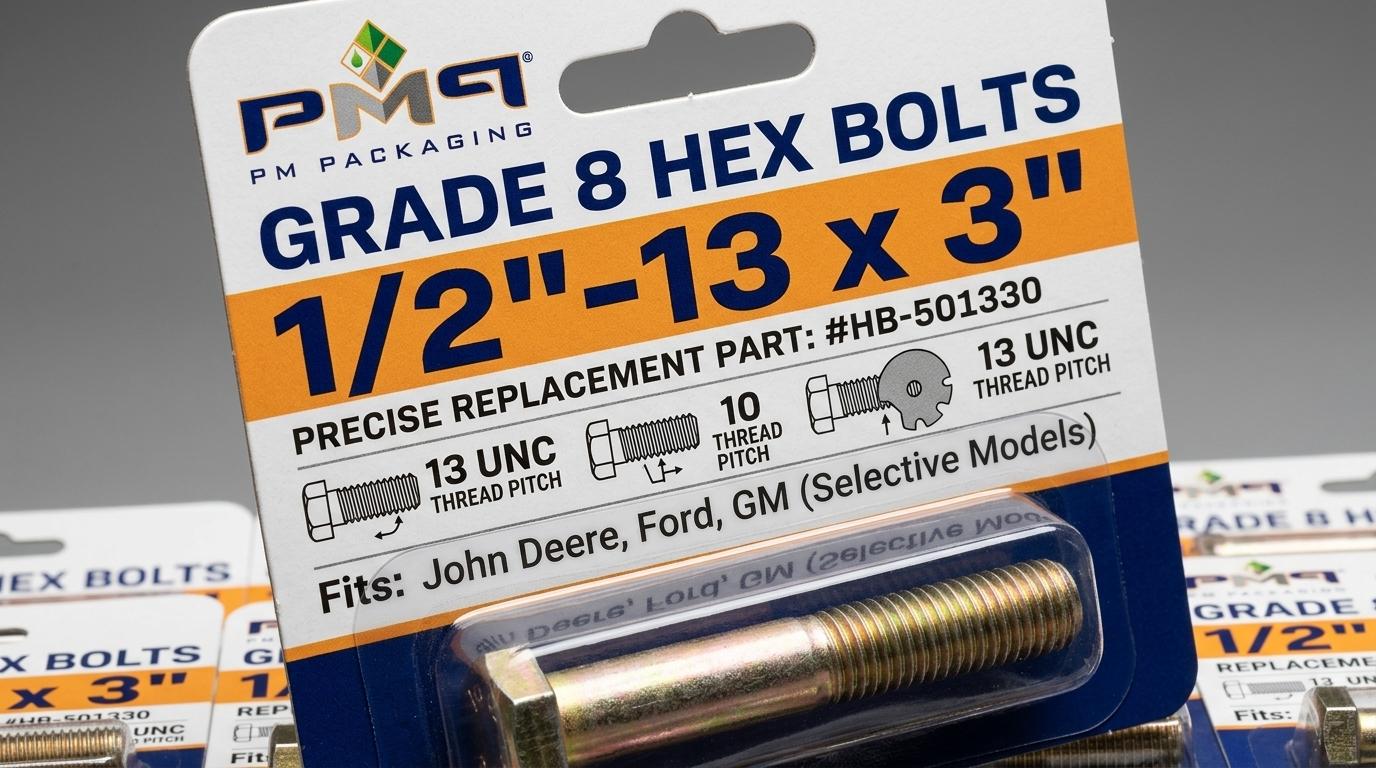
Build the Card Around the Technical Buying Decision
Hardware shoppers are looking to solve a functional mechanical problem. A successful card structure organizes technical data into a disciplined visual hierarchy that answers one core question: "Which one of these nearly identical parts is the one I need?"
1. Brand Mark & Product Family
Anchors brand recognition in the upper corner without encroaching on technical data.
2. Product Category
Immediate aisle-level orientation (e.g., "Grade 8 Hex Bolts" or "Ball Valve").
3. Dominant Sizing & Dimension
Large fractional typography (e.g., 3/8"-16 x 2") readable from several feet away on the pegboard.
4. Part Number & Piece Count
Exact OEM reference numbers and unit quantities for inventory restocking and buyer certainty.
5. Secondary Technical Specifications
Thread pitch, material grade, coating finish, voltage ratings, or vehicle compatibility icons.
Make Similar Hardware SKUs Easy to Scan on the Peg
A single hardware product line may contain dozens of dimensional increments—such as 1/4", 5/16", 3/8", and 1/2" bolt diameters. If packaging layouts vary between sizes, retail pegs descend into visual chaos.
Establishing standardized visual anchors across the card family—such as fixed-coordinate size badges, high-contrast numerical callouts, and distinct application color bands—enables shoppers and retail clerks to scan peg hooks effortlessly. For deeper principles on merchandising headers, review our guide on how to design the header area of a blister card.
Dense Hardware Creates Concentrated Loads
Hardware packaging differs from general retail packaging because metal components create concentrated mass. A compact bolt or brass valve exerts severe shear forces on the heat-seal flange and localized tensile stress on the hang slot.
Structural engineers evaluate board caliper (20pt to 28pt+), vertical grain direction, and hang-slot geometry. Production-representative loaded samples should be tested on retail fixtures to verify header stiffness, hole elongation, and package balance under concentrated loads.
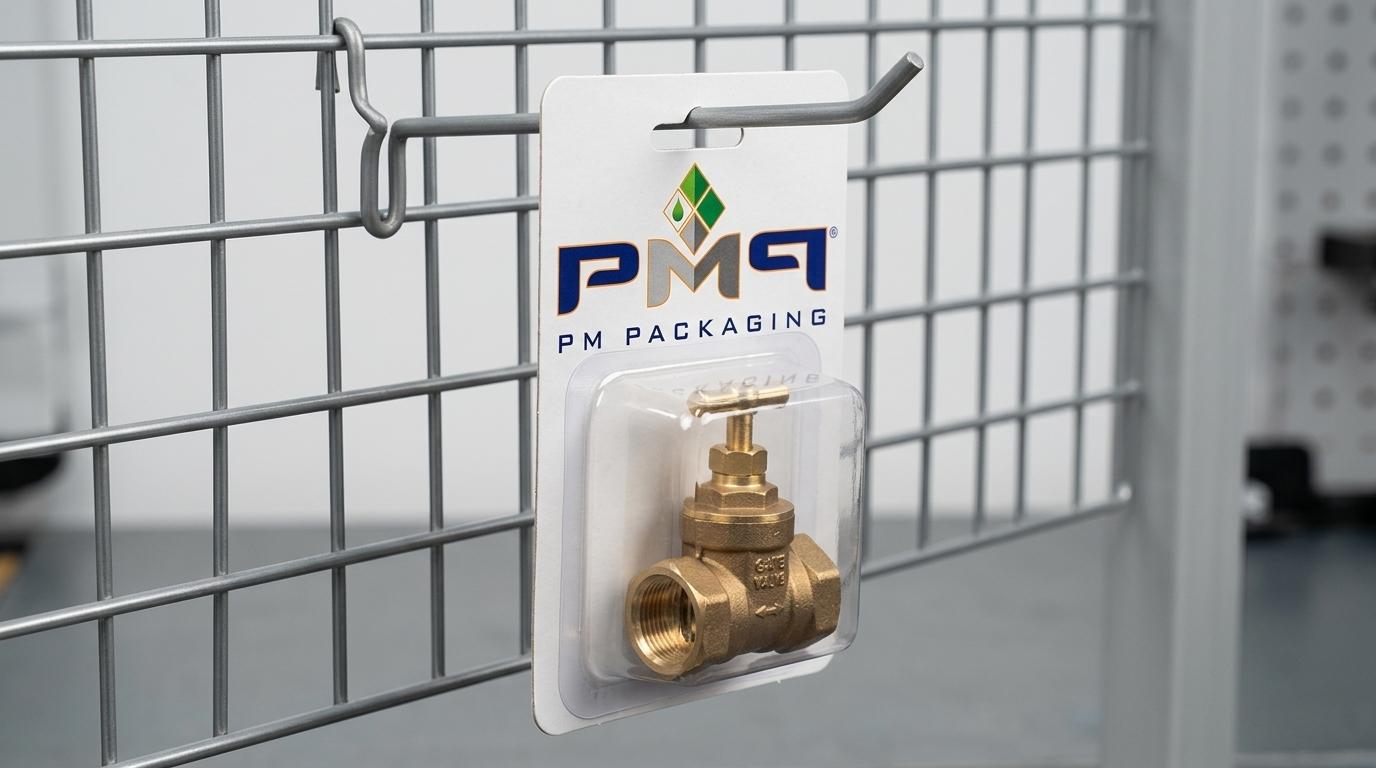
Design the Blister Around Dense and Irregular Hardware
The thermoformed cavity must function as an engineered structural support rather than a loose plastic cover. Five critical thermoforming parameters dictate performance:
- Cavity Depth: Sized snugly to contain the part without excess volume that permits internal movement.
- Contact Points: Contoured pockets restrain heavy components, preventing them from battering cavity walls.
- Projection Limits: Unnecessarily deep blisters waste linear peg depth, reducing units hung per peg.
- Flange Area: Adequate perimeter surface ensures sufficient heat-seal bond strength across the card.
- Orientation: Presents the most recognizable, diagnostic feature forward toward the shopper.
Protect the Blister from Sharp or Protruding Components
Cutting blades, chisels, drill bits, and stamped brackets present sharp contact edges that can puncture thin plastic corners during transit.
Products with sharp edges require stepped cavity shoulders, internal orientation angles, and heavy thermoforming gauges to isolate contact points from vulnerable sealing flanges and corner radii.
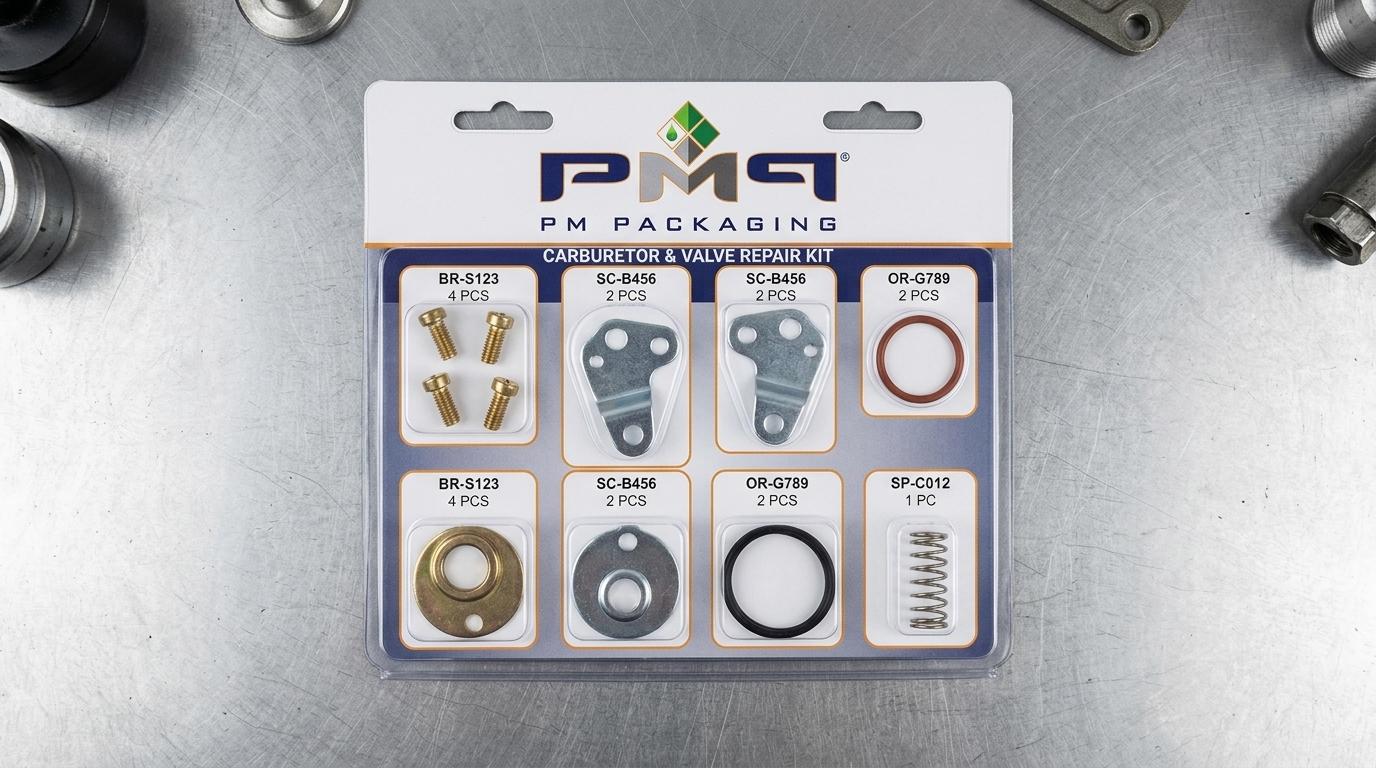
Organize Multi-Component Repair and Installation Kits
For hardware repair kits containing multiple discrete pieces—such as screws, brackets, washers, and O-rings—the packaging must answer: "Are all parts here?"
Multi-compartment blisters feature custom-formed cavities for each component. Compartmenting pieces prevents abrasion, eliminates tangled parts, and provides immediate visual proof that the kit is complete, reducing retail returns.
Single-Seal vs. Fold-Over / Trapped Blister Formats
Hardware packaging programs deploy two primary structural configurations depending on component weight, security objectives, and production velocity:
- Single-Seal Blister Cards: The thermoformed flange heat-seals directly to the coated face of a single paperboard card. Ideal for standard fasteners, plumbing fittings, and moderate-weight parts.
- Fold-Over / Trapped Blister Cards: Sandwiches the thermoformed blister flange between two paperboard plies. This creates double-wall card stiffness, eliminates exposed plastic flange edges, and boosts tear-out resistance for heavy or high-theft items.
Balance Card Size Against Pegboard Assortment Density
When dozens of replacement parts compete for limited pegboard space in retail aisles, card dimensions become a critical commercial driver. A larger card offers more space for technical data, but reduces the number of SKUs a retailer can stock per linear foot.
Card sizing must strike a calculated balance between readable compatibility data and retail fixture density. For technical details on footprint trade-offs, see our analysis on how card size affects blister packaging performance.
Standardize Card Families Across Large Hardware Catalogs
Rather than designing bespoke card dimensions for every individual part number, enterprise hardware brands consolidate catalogs across 3 to 4 standardized card platforms (such as small fastener, medium fitting, repair kit, and tool accessory).
Standardizing card footprints establishes predictable peg spacing, simplifies retailer planograms, and cuts sealing machine changeover downtime. To explore broader portfolio strategies, read our guide on high-volume blister-card packaging for multi-SKU product lines.
Match Production Strategy to SKU Demand
In expansive hardware assortments, demand is rarely uniform. The top 20% of high-runner SKUs generate the majority of volume, while replacement parts form a long tail of lower-velocity items.
High-volume hardware programs optimize total manufacturing costs by combining dedicated production runs for core SKUs with PM Packaging’s qikCombo™ shared-run program for qualifying lower-volume cards (5,000–100,000 units on 20pt single-seal board), minimizing obsolete inventory and setup charges.
What to Provide for a Hardware Blister-Card Review
Packaging engineers should compile these twelve technical specifications when requesting a structural review or commercial quotation:
| Program Specification | Technical Importance | Engineering Impact |
|---|---|---|
| Dimensions (L x W x D) | Dictates card footprint and cavity volume. | Controls blister projection on retail pegs. |
| Product Weight | Governs board caliper and hang hole geometry. | Prevents peg hole tearing and card bowing. |
| Sample or 3D CAD | Enables precise thermoformed contouring. | Ensures snug fit and eliminates rattling. |
| Sharp Contact Points | Identifies potential puncture zones. | Guides cavity shoulder clearances. |
| Component Count | Determines single vs multi-pocket design. | Prevents missing parts in kits. |
| Critical Compatibility Data | Dictates graphic hierarchy and callout zones. | Keeps sizing readable on pegs. |
| Catalog SKU Count | Establishes assortment complexity. | Drives card family consolidation. |
| Annual Volume by SKU | Segments dedicated vs shared runs. | Optimizes print runs and inventory costs. |
| Current Card Dimensions | Identifies existing planogram constraints. | Maximizes retailer fixture fit. |
| Retailer Peg Hook Specs | Defines hang-slot geometry. | Ensures stable hanging balance. |
| Pack-Out Sealing Process | Determines heat-seal coating setup. | Ensures consistent sealing throughput. |
| Master Shipper Pack Counts | Coordinates secondary case packing. | Optimizes pallet patterns and logistics cube. |
Frequently Asked Questions
Are blister cards suitable for heavy metal hardware products?
Yes. Heavy hardware requires heavy-caliper paperboard (20pt to 28pt+), reinforced hang slots, and custom thermoformed cavities that distribute concentrated mass across the heat-seal flange.
How do you prevent blister cards from tearing at the peg hole?
Tear-out is prevented by orienting board grain vertically, specifying sombrero or reinforced delta slots, and balancing the product center of gravity directly below the peg hook.
How should technical compatibility information be organized?
Use a disciplined hierarchy: Brand Mark at top, Product Category, Prominent Sizing Callout (e.g., 1/2"-13 x 3"), Part Number / Piece Count, and Secondary Technical Fitment Icons.
Can several different hardware SKUs share one card size?
Yes. Consolidating expansive catalogs into 3 to 4 modular card sizes standardizes retail pegboard spacing, cuts tooling costs, and streamlines automated packing lines.
How do multi-compartment blisters benefit repair kits?
Individual thermoformed pockets separate screws, washers, and brackets, giving shoppers visual proof that the kit is complete and eliminating missing-part returns.
How do sharp components affect blister cavity design?
Cutting edges and drill bits require stepped cavity shoulders and orientation angles that isolate sharp contact points from thin-draw corners and sealing flanges.
Scale Your Hardware Blister Program
Whether launching a line of precision replacement parts or consolidating an expansive catalog of heavy fasteners across national retail chains, PM Packaging delivers high-performance blister-card converting, custom thermoforming, and multi-SKU production planning.
Coordinate structural card engineering, heat-seal tooling, and SKU portfolio planning with PM Packaging's technical packaging team.