
How Blister Cards Solve the Small-Product Footprint Challenge
Blister cards give physically small products a larger, more functional retail footprint by combining a custom printed paperboard card with a precision-formed blister. The added card area supports branding, product identification, barcodes, instructions, and hanging features while the blister keeps the compact item organized and visible. The objective is not to make an oversized card simply to appear larger, but to create the smallest disciplined package footprint that fulfills the retail program's merchandising, planogram density, and operational requirements.
Why Small Products Often Need a Larger Packaging Footprint
Merchandising physically small products—such as electronic adapters, replacement drill bits, automotive fuses, USB drives, cosmetic tweezers, or specialty fasteners—presents unique commercial challenges that larger consumer goods never face.
When sold loose in bins or packaged in miniature polybags, small items suffer from severe operational handicaps:
- Zero Usable Communication Surface: A one-inch electronic dongle or brass pipe fitting has virtually no printable space for brand logos, UPC barcodes, model numbers, compatibility matrices, warnings, or installation diagrams.
- The Perceived Value Paradox: Consumers subconsciously associate physical package presence with retail value. An uncarded adapter placed in a plastic bag feels like cheap commodity surplus; the exact same component mounted on a structured, beautifully printed blister card justifies premium retail price points.
- Invisibility on Retail Gondolas: Miniature packages get lost on four-foot shelving bays, sliding behind larger cartons or disappearing between peg hooks.
"A blister card provides the communication, hanging, and merchandising footprint that the physical product cannot provide on its own."
Don't Oversize the Blister Card Just to Look Bigger
While expanding the packaging footprint is necessary, arbitrarily making the card as large as possible introduces serious retail and supply chain penalties.
Retail shelf space is an expensive economic resource. If a brand specifies an unnecessarily oversized card for a small accessory, the operational downsides compound quickly:
Retail Store Penalties
- • Consumes valuable planogram pegboard width.
- • Reduces total sellable facings across the aisle.
- • Fewer units fit per peg hook, forcing frequent clerk restocks.
- • Increases risk of card warping under fluctuating store humidity.
Supply Chain Penalties
- • Consumes excessive paperboard substrate and ink.
- • Enlarges master shipping carton cube dimensions.
- • Degrades pallet pack density, shipping mostly empty air.
- • Increases freight and warehouse storage costs per unit.
The engineering objective is not maximum card size, but enough card size to satisfy retail communication and hanging requirements. For a detailed analysis of board stability and dimension planning, consult our technical resource on how card size affects blister packaging performance.
What Determines How Large the Blister Card Should Be?
When our structural packaging engineers evaluate a small product line, we assess eight core commercial parameters to establish the optimal card dimensions:
| Engineering Parameter | Design Impact on Card Sizing |
|---|---|
| Product Dimensions | Establishes minimum thermoformed cavity boundaries and perimeter flange clearance |
| Product Weight & Mass | Dictates upper card margin, hang-hole reinforcement, and vertical stiffness |
| Heat-Seal Flange Width | Demands adequate bonding surface area around the plastic perimeter |
| Brand & Model Hierarchy | Front-panel area needed for brand mark, sub-brand, and primary model title |
| Compatibility & Certifications | Space required for connector badges, MFi logos, or technical specifications |
| Reverse Panel Requirements | Area required for UPC barcode, multi-language copy, and legal warnings |
| Retail Fixture Allocation | Planogram peg spacing (e.g. 2-inch, 3-inch, or 4-inch center-to-center) |
| Master Carton Cubing | Dimensional multiples that pack efficiently into standard corrugated shippers |
The Card Can Be Larger Than the Product Without the Blister Becoming Larger
A critical design principle for small-goods packaging is separating the cavity dimensions from the card dimensions. The thermoformed plastic blister should fit the product snugly, contouring closely around its physical geometry to prevent shaking, sliding, or scuffing during transit.
The paperboard backing card, by contrast, extends outward around the blister to provide the necessary retail billboard area, hang hole clearance, and printed narrative:
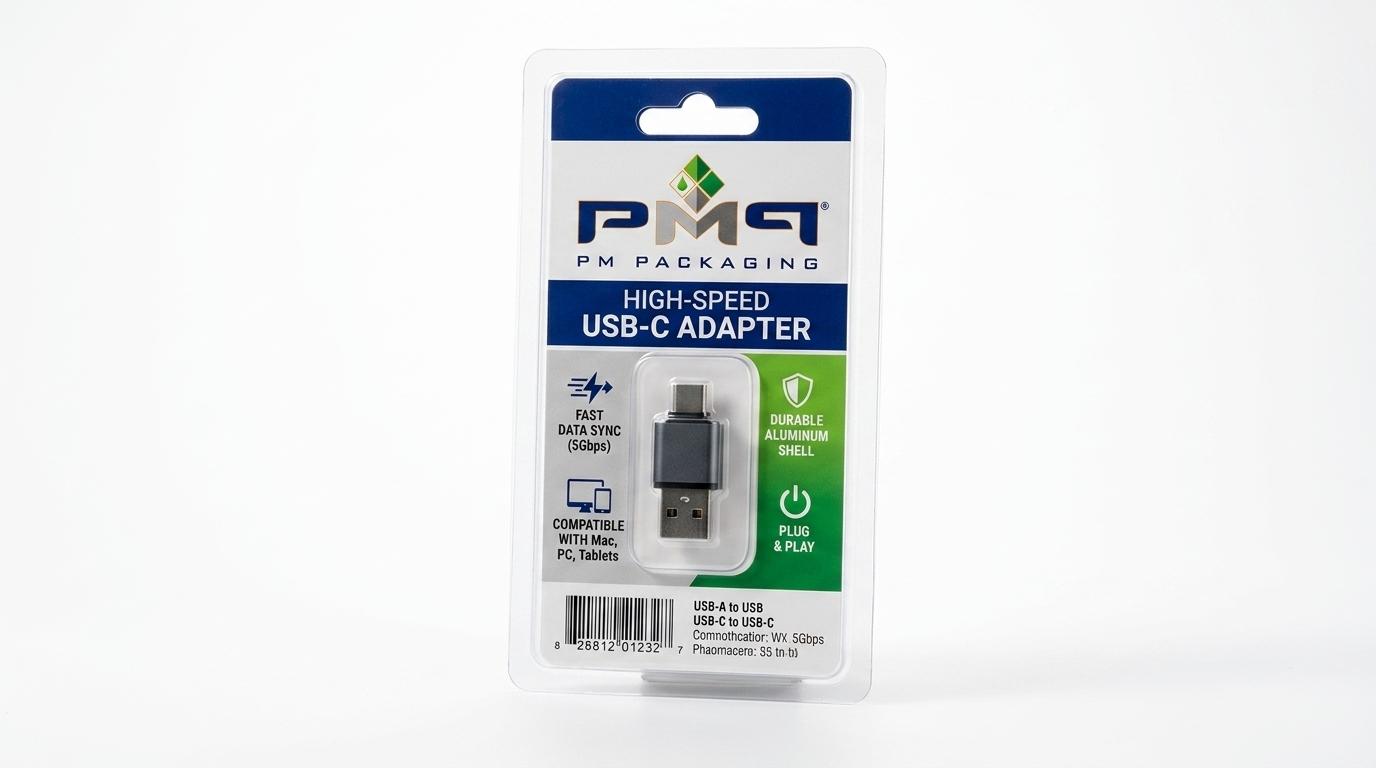
This approach prevents the wasteful "giant plastic bubble" aesthetic that frustrates eco-conscious consumers while delivering all the branding benefits of an expanded retail presence.
Small Product Doesn't Always Mean Lightweight Package
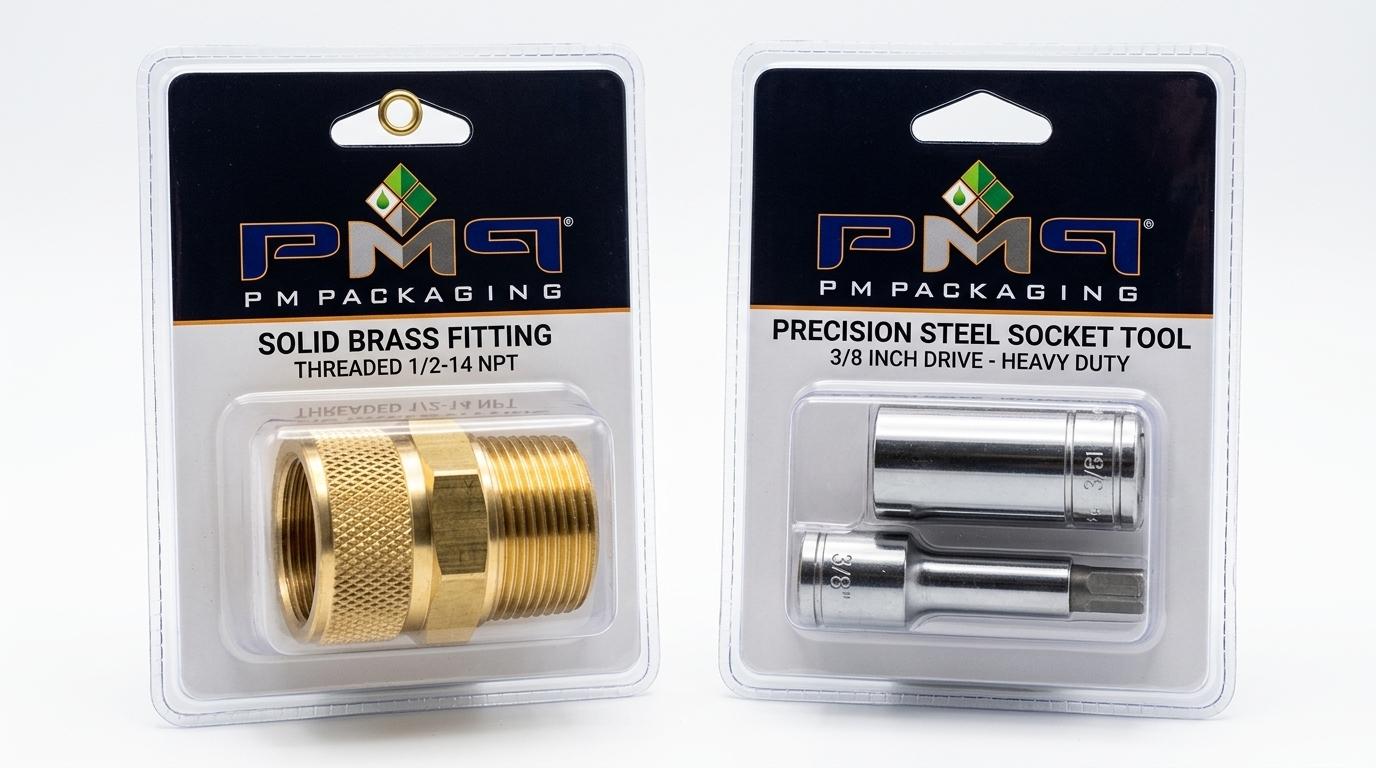
Physical dimensions can be deceptive. A solid brass threaded plumbing nipple, an automotive steel socket tool, or a pack of tungsten carbide cutting bits occupies minimal volume, yet carries substantial mass.
Suspending dense, heavy small products on standard peg hooks introduces severe structural stresses:
- Hang-Hole Tear-Out: Concentrated downward force can tear through thin paperboard margins when customers slide cards along wire peg hooks. Engineering reinforced die-cut delta slots or fold-over double plies prevents hook failure.
- Center-of-Gravity Balance: If a heavy steel component is mounted off-center in the cavity, the package will rotate and hang crookedly on the hook, destroying the visual alignment of the entire pegboard row.
- Grain Direction Alignment: Aligning the paperboard's fiber grain vertically provides maximum structural resistance against bending moments caused by heavy cavity projections.
Larger Retail Presence Has to Be Balanced Against Facing Density
In retail operations, package dimensions directly dictate planogram capacity. Consider the economic equation of pegboard real estate:
Card Width ↔ Peg Spacing ↔ Number of Facings ↔ SKU Count ↔ Total Store Inventory.
If a brand widens its card from 3 inches to 4.5 inches to create a "bolder" graphic header, a standard 36-inch pegboard bar that previously held 12 distinct SKUs now accommodates only 8. Unless those 8 SKUs generate 50% higher sales velocity, the retailer loses revenue per linear foot.
The most successful small-product packaging programs balance presence with facing density, creating clean vertical presence without claiming excessive horizontal shelf width.
Increasing the Physical Handling Footprint of Very Small Items
Compact, high-value items—such as flash memory cards, replacement razor cartridges, precision router bits, and camera adapters—are frequent targets of retail shrinkage and misplacement.
Placing very small items on an expanded card backing provides significant operational advantages:
- Inventory Handling & Scanning: Warehouse and retail associates can rapidly locate, count, and scan carded items without digging through disorganized bins.
- Deterring Casual Concealment: A rigid 4x6-inch blister card is significantly harder to palm, pocket, or conceal than an uncarded 1-inch product, supporting in-store loss-prevention strategies.
- Tamper Deterrence: Heat-sealed perimeter flanges prevent casual in-store opening, ensuring items remain complete and factory-sealed upon purchase.
Small Products Still Need Full Retail Identification
Retail compliance requirements do not shrink when a product shrinks. National retailers enforce stringent packaging standards regardless of product scale:
- GS1 Barcode Quiet Zones: UPC and EAN barcodes require specific dimensional quiet zones around scannable bars to ensure rapid register scanning.
- Model & Part Number Clarity: In technical replacement categories (e.g. automotive sensors, appliance gaskets), customers must match exact part numbers to avoid buying the wrong variant.
- Multi-Language & Regulatory Warnings: Proposition 65 warnings, country-of-origin markings, electrical voltage ratings, and multi-language instructions require substantial back-panel surface area.
Use a Common Card Architecture to Turn Small SKUs Into a Brand Block
Small products rarely sell in isolation; they are marketed as extensive accessory families. The most effective merchandising strategy is unifying diverse items into a commanding "brand block" on retail fixtures.
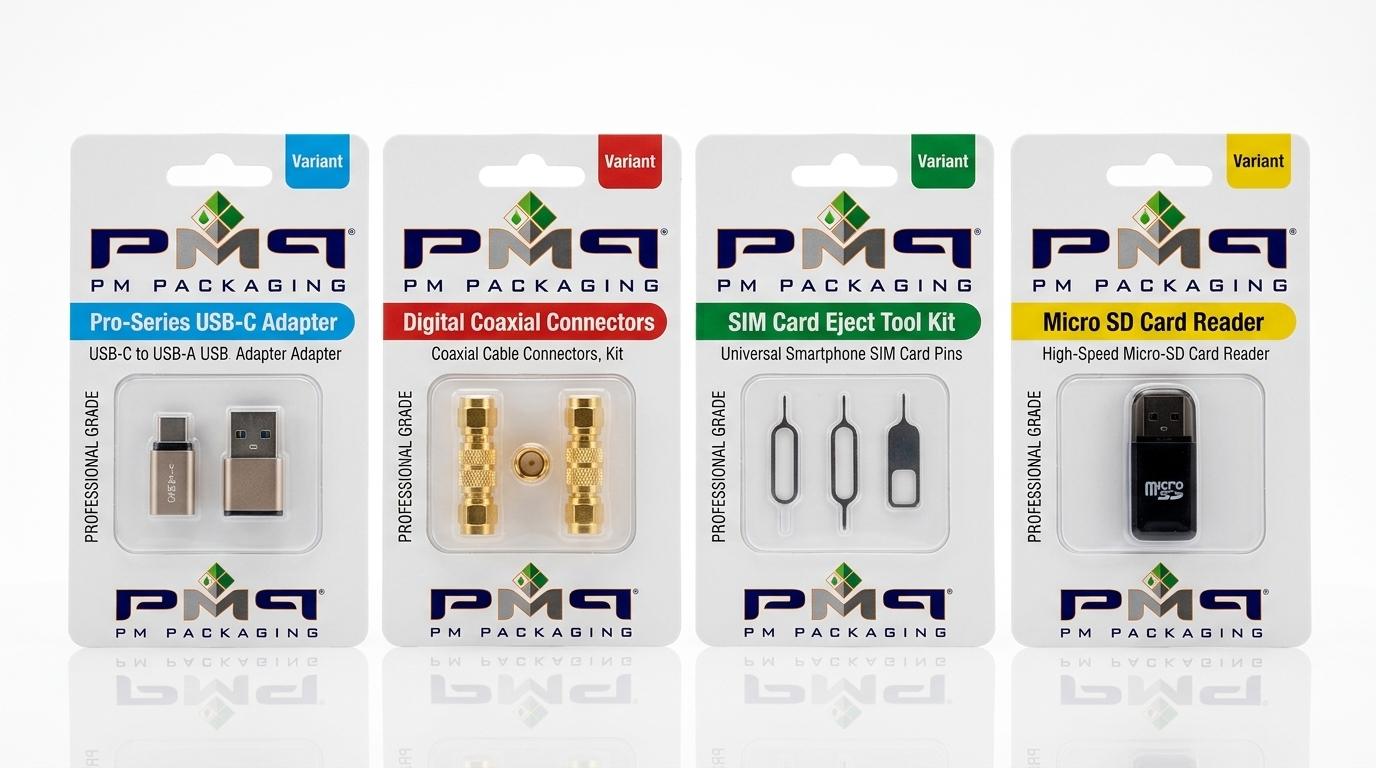
Implementing a standardized card architecture delivers multiple commercial advantages:
- Standardized Outer Footprint: Standardizing card width and height across 20+ SKUs allows retail store clerks to arrange peg rows in perfect grid alignment.
- Color-Coded SKU Differentiation: Utilizing distinct color accent bands on the header area helps shoppers identify variant types (e.g. USB-C vs. Lightning, or metric vs. imperial hardware) at a glance.
- Shared Manufacturing Efficiency: Explore our dedicated guide on high-volume blister card packaging for multi-SKU product lines to learn how standardized footprints slash tooling expenses.
Small-Product Packaging Solutions by Category
| Small Product Category | Why Product Alone Lacks Presence | Blister-Card Design Priority |
|---|---|---|
| Fasteners & Precision Screws | Tiny physical profile; threads hard to distinguish | Clear gauge labeling and multi-pocket piece count organization |
| Electronic Adapters & Dongles | Small footprint; complex compatibility specs | Show connector type clearly; bold compatibility icons on header |
| Automotive Replacement Bulbs/Sensors | Part numbers hard to read on metal base | Prominent vehicle fitment badges and bold part number callouts |
| Cosmetic Tweezers & Applicators | Narrow, slender profile; easily overlooked | High-contrast card background highlighting tip precision |
| Pens, Nibs & Specialty Markers | Similar-looking barrels and casings | Bold color-coded header bands indicating ink color and tip width |
| Craft Knife Blades & Clips | Small, sharp loose components | Puncture-resistant thermoformed cavity with quantity callouts |
| Compact Tool Bits & Sockets | Small volume but dense steel mass | Reinforced hang-hole geometry and centered gravity alignment |
Standardize When Possible, Customize When Necessary
While standardized card platforms yield substantial supply chain efficiencies, brands should not force every single SKU into an identical card if it compromises product integrity.
If a specific tool accessory is three times heavier than the rest of the line, it may warrant a heavier board structure or a fold-over construction. If an item is significantly wider, squeezing it into a narrow standard card creates tight perimeter flange clearances that risk seal delamination. Sourcing teams should establish two or three tiered card sizes to accommodate catalog breadth cleanly.
Producing Multiple Small-Product SKUs Efficiently
Managing 30 or 50 individual small-product packaging runs can generate prohibitive prepress, plate, and changeover costs.
PM Packaging solves this through our proprietary qikCombo manufacturing system. qikCombo enables brands to group multiple card artwork variations, part numbers, and cavity designs onto shared production press sheets. This eliminates redundant setup fees, reduces minimum order quantities per SKU, and guarantees color consistency across your entire product line.
If your brand supplies multiple retailers with customized artwork, explore our insights on blister cards for retailer-specific programs and our enterprise guide to custom blister-card programs for national retail.
PM Packaging's Blister-Card Capabilities for Small Product Lines
PM Packaging delivers complete turnkey manufacturing for high-volume small-product programs:
Structural Card Engineering
- • Custom Footprint Sizing: Engineered around retail planograms.
- • Single-Seal & Fold-Over Styles: Formats tailored to product weight.
- • Reinforced Hang Holes: Delta, sombrero, and round slots.
- • Trapped Blister Cards: Premium flush paperboard finishes.
High-Velocity Manufacturing
- • Custom CNC Thermoforming: Form-fitting cavity contours and undercuts.
- • qikCombo Shared Runs: Multi-SKU gang printing efficiency.
- • Heat-Seal Coatings: High-integrity fiber-tearing seal bonds.
- • G7 Master Color Matching: Unified brand block consistency.
Review our full structural packaging offerings on our custom blister cards solution hub.
What to Provide When Requesting a Quote
When submitting an inquiry for a small-product blister card program, providing structured project parameters enables our engineering team to rapidly model dielines and quotes:
Small Product Program Intake Checklist:
1. Product Dimensions & Weight: Exact size and weight of each small component.
2. Catalog SKU Count: Number of distinct part numbers, sizes, or variants.
3. Target Card Dimensions: Established dielines or request for planogram optimization.
4. Target Retailers: Specific chains and their compliance / pegboard rules.
5. Retail Fixture: Standard pegboard hook, counter PDQ tray, or clip strip.
6. Production Run Volumes: Initial rollout quantity and annual reorder expectations.
7. Preferred Card Format: Single-seal, fold-over, or trapped blister card.
8. Physical Samples / CAD: Product CAD files (.STEP/.IGES) for cavity tooling.
9. In-Store Launch Date: Critical delivery deadlines for store set dates.
Frequently Asked Questions
Why are blister cards useful for very small retail products?
Physically small products lack printable surface area for brand logos, UPC barcodes, model numbers, and compatibility specs. A blister card creates an expanded paperboard canvas that provides this necessary information while elevating perceived product value on store shelves.
How large should a blister card be compared with the product?
The card should be large enough to accommodate the heat-seal flange, hang hole, mandatory regulatory copy, and clear brand hierarchy—without becoming unnecessarily oversized. Oversized cards waste peg space and reduce retail facing density.
Can multiple small-product SKUs use the same blister-card size?
Yes. In fact, standardizing outer card dimensions across multiple small items (e.g. adapters, cables, and tool bits) creates a cohesive 'brand block' on peg hooks and allows shared gang-run printing through PM Packaging's qikCombo process.
How does product weight affect blister-card hang-hole design?
Dense small products (like solid brass fittings or steel sockets) impose high hanging stress. The hang hole must be centered vertically above the product's center of gravity and engineered with adequate upper card margins to prevent tear-out.
Can blister cards help organize small hardware and replacement parts?
Yes. Custom multi-pocket thermoformed cavities organize individual bits, screws, and adapters into designated compartments, preventing components from scratching or shifting during transit.
How does card size affect the number of products that fit on a retail peg?
Card thickness and blister projection depth dictate how many units fit along a peg hook, while card width dictates how closely peg hooks can be spaced horizontally. Disciplined sizing maximizes inventory capacity per retail fixture.
Can PM Packaging produce multiple blister-card SKUs in one program?
Yes. Through our qikCombo manufacturing program, PM Packaging combines multiple card variations and cavity designs into shared production press sheets, drastically reducing tooling and setup expenses for multi-SKU product lines.
Packaging a Large Family of Small Retail Products?
"Small-product merchandising succeeds when card footprints, peg density, and multi-SKU production operate under a single coordinated system."
PM Packaging can evaluate your product dimensions, product weight, number of SKUs, retail fixture requirements, card-size objectives, and production quantities to develop a high-performance blister-card program tailored to your retail targets.
Contact our packaging engineering specialists today to review your accessory catalog, evaluate card footprints, and request a comprehensive qikCombo production proposal.