
Merchandising Electronics Accessories on Retail Pegs
Blister cards are a strong choice for electronics accessories when shoppers need to verify the actual connector, port, cable, or component while also seeing compatibility and performance specifications. The clear blister provides immediate product visibility and protects delicate hardware, while the printed card supplies space for wattage, connector type, cable length, data speed, device compatibility, barcodes, and branding. The structure should also keep the product balanced and secure on retail peg displays.
In crowded retail environments—from big-box consumer electronics chains and department stores to airport kiosks—consumers frequently shop for replacement charging cables, wall power adapters, multiport converters, and memory cards under time pressure. The packaging must communicate critical specifications clearly while withstanding high-touch peg display handling.
When sourcing custom blister card packaging for consumer electronics, structural engineering and graphic clarity must work in perfect coordination. The clear plastic cavity protects delicate contact pins from transit damage and environmental dust, while the printed backing card guides the buyer through key protocol variations like USB-C power delivery ratings, data transfer speeds, and port configurations.
The most effective blister cards bridge the gap between technical engineering and shopper confidence: they make complicated electronic specifications effortless to navigate without cluttering the retail shelf presence.
Why Blister Cards Excel for Retail Electronics Accessories
Consumer electronics accessories face merchandising dynamics unlike standard retail goods. Mismatched purchases lead to high return rates, pegboard space is tightly governed by retailer planograms, and small items carry high shrinkage risks. Blister card packaging resolves each of these core commercial challenges:
360° Visual Pin Verification
Shoppers can inspect actual connector tip geometry (USB-C, Lightning, Micro-USB, HDMI) directly through the clear bubble, which can help reduce compatibility-related purchase errors and return costs.
High-Density Peg Display
Vertical peg hooks maximize facings per square foot of retail floor space, keeping accessory aisles organized, planogram-compliant, and fully stocked for quick replenishment.
Anti-Shrinkage Presence
Generously sized backing cards give small, high-value tech items (such as MicroSD cards and adapters) a broader physical footprint that resists palming and in-store concealment.
Electronics Accessories Commonly Packaged on Blister Cards
Different electronic accessories present distinct packaging challenges based on weight, connector vulnerability, cord length, and specification complexity. Selecting the right card geometry depends directly on how the accessory interacts with retail fixtures and shopper expectations:
| Accessory Category | Primary Merchandising Challenge | Blister Card Structural Solution |
|---|---|---|
| Charging & Data Cables (3ft, 6ft, 10ft) | Loose coils shifting, sagging cords, blocking front copy | Contoured circular winding racetracks with forward-facing connector retention pockets |
| Wall Chargers & GaN Power Blocks | Forward-tilting weight pulling pegboard hooks down | Centered lower cavity placement aligning the center of gravity directly below the hang slot |
| USB & Video Adapters (e.g. HDMI to Type-C) | Shopper confusion regarding input vs. output direction | Clear blister showing both port ends with printed directional arrows on the backing card |
| Multi-Port Hubs & Travel Docks | Port clutter and complex power-throughput specs | Expanded card width with perimeter port callouts mapped directly adjacent to visible ports |
| Memory Cards & Flash Drives | High retail theft vulnerability due to ultra-compact footprint | Oversized card perimeter preventing concealment, with high-visibility storage capacity numerals |
| Replacement Tips & Stylus Nibs | Delicate component loss and model number mismatches | Multi-cavity compartmentalized blister pockets with precise device compatibility charts |
Choosing the Right Blister Card Format for Electronics
When brands design blister packaging programs, selecting the appropriate structural card format determines assembly speed, retail durability, and overall unit economics. Three proven formats dominate consumer technology packaging:
1. Single-Seal (Face-Seal) Blister Cards
Single-seal cards are the classic high-velocity retail packaging format. The thermoformed plastic blister features an outer peripheral flange that bonds securely to the front surface of the printed paperboard card. This format provides an expansive, uninterrupted graphic canvas for brand storytelling, minimizes total packaging tare weight, and maximizes assembly speeds on high-volume automated packaging lines. It is the ideal format for charging cords, compact adapters, replacement tips, and screen cleaning sundries.
2. Fold-Over Blister Cards
Fold-over cards consist of a single paperboard blank scored down the center. During assembly, the card folds over itself to sandwich the plastic blister flange between two paperboard faces, bonding board-to-board around a die-cut front window. This construction provides exceptional structural stiffness and reinforced hang-hole strength, making it the preferred choice for heavier items such as multi-port wall charging bricks, ruggedized outdoor cables, and metal converter hubs.
3. Clamshell Insert Cards
For electronics products requiring total perimeter plastic encapsulation or reclosable functionality, custom printed insert cards are placed inside pre-formed hinged clamshells. Insert cards provide full two-sided color graphics, product specification matrices, and barcode integration while allowing brands to utilize standardized plastic shells across diverse regional accessory lines.
Blister Cards vs. Folding Cartons for Electronics Accessories
Procurement managers and packaging engineers often weigh whether to package accessories on blister cards or inside folding carton packaging or rigid boxes. Both packaging types serve vital functions in the consumer electronics retail landscape, but they target fundamentally different merchandising models:
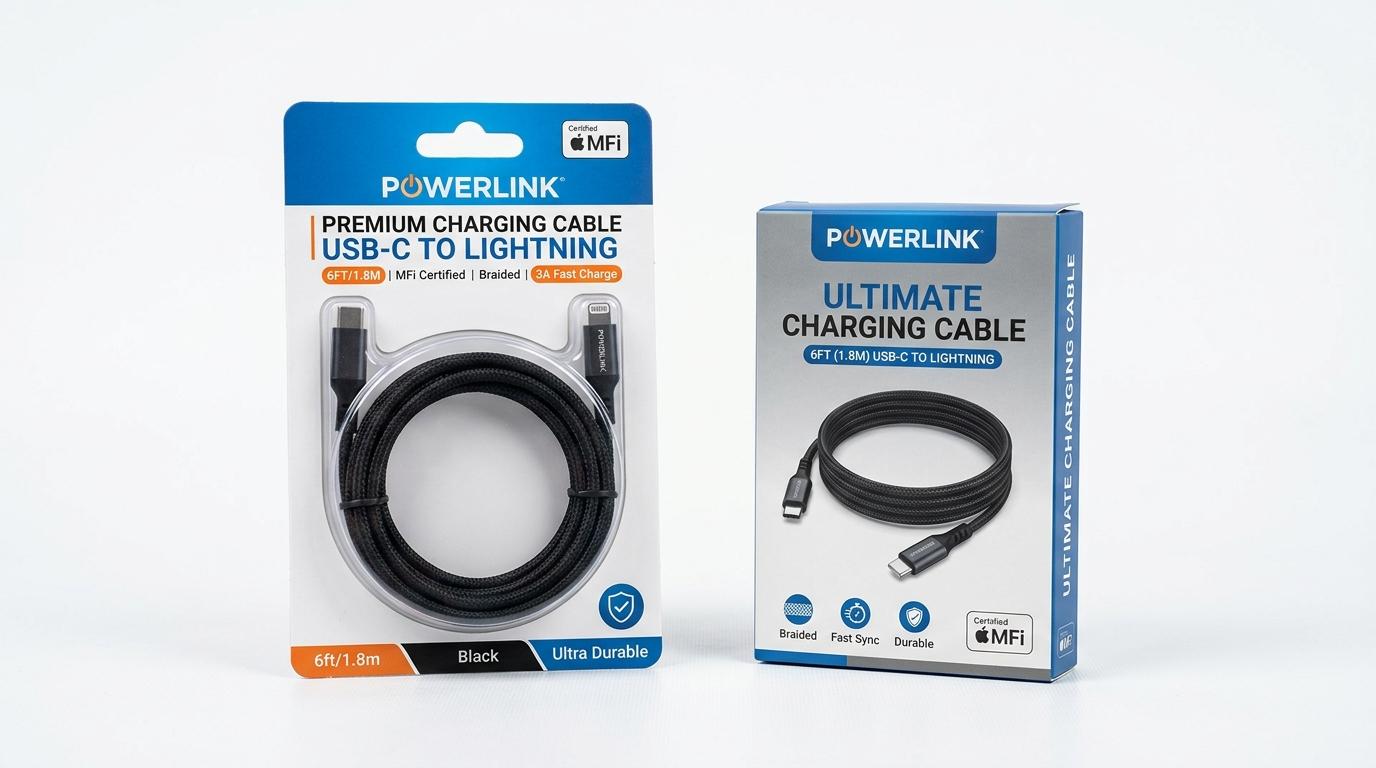
| Decision Criterion | Choose Blister Cards When… | Choose Folding Cartons When… |
|---|---|---|
| Product Inspection | Shoppers must visually confirm connector pin finish, braiding quality, or exact plug style | The product is best showcased through high-end photography or does not require physical inspection |
| Retail Fixture | Merchandising on high-density peg hooks, spinner racks, or side-wing impulse displays | Merchandising primarily on flat retail shelves, gondola display trays, or freestanding tables |
| Accessory Complexity | The item is a standalone cord, plug, or adapter benefiting from rapid visual inspection and spec scanning | The accessory includes multi-piece kits, bundled cords, travel pouches, and thick instruction manuals |
| Theft Prevention | High-theft compact parts require broad card footprints to deter in-store pocketing | Products are housed behind retail security cabinets or large anti-theft keeper boxes |
| Unboxing Experience | Immediate retail access and minimal assembly overhead are prioritized | A multi-stage reveal, internal paperboard caddies, or gift presentation is required |
Retail Information Architecture: Designing for Rapid Specification Scanning
In consumer tech retail, a clear specification hierarchy can make comparison easier and help prevent mismatched purchases and returns. When shoppers can quickly determine charging wattage, connector types, and data transfer speeds, they can choose the right accessory with confidence. Successful blister card layouts follow a structured visual hierarchy:
1. The Header Power Badge (Top 20% of Card)
Position charging wattage (e.g., 20W, 65W, or 100W Fast Charge) and device compatibility icons directly beside or beneath the hang hole. Shoppers flipping through pegboard rows scan headers first. High-contrast typography ensures fast-charging tiers are legible even when lower card portions are partially obscured by front-hanging items.
2. The Mid-Section Visual Window (Center 50% of Card)
Frame the clear blister cavity with uncluttered background graphics. Keep critical text outside the perimeter sealing area. Display connector icons (USB-C to USB-C, USB-C to Lightning) adjacent to the physical connector tips so shoppers can cross-reference the graphic against the real hardware.
3. The Lower Spec Callouts (Bottom 30% of Card)
Use bold, contrasting banners along the bottom edge for cable length (e.g., 3ft / 0.9m, 6ft / 1.8m, 10ft / 3m), braided durability badges, and data speed ratings (480 Mbps vs. 10 Gbps). Standardizing this position creates a uniform visual anchor across your entire product family.
4. The Reverse-Side Regulatory & Spec Matrix
The back of the card provides valuable space for secondary technical details. Panels can be allocated for multi-language compatibility lists, pinout diagrams, warranty conditions, QR codes linking to digital manuals, and reserved quiet zones for applicable regulatory markings (such as FCC, CE, RoHS, or WEEE where required) and retailer-mandated scannable UPC/EAN barcodes. (Note: Specific compliance requirements vary by hardware category, voltage classification, and target market.)
Structural Engineering: Cable Containment & Connector Cradles
Loose wires look sloppy on peg hooks and slide around in transit, scratching the backing card and obscuring critical marketing text. To achieve a pristine presentation, packaging engineers design custom cavity contours tailored to specific accessory dimensions:
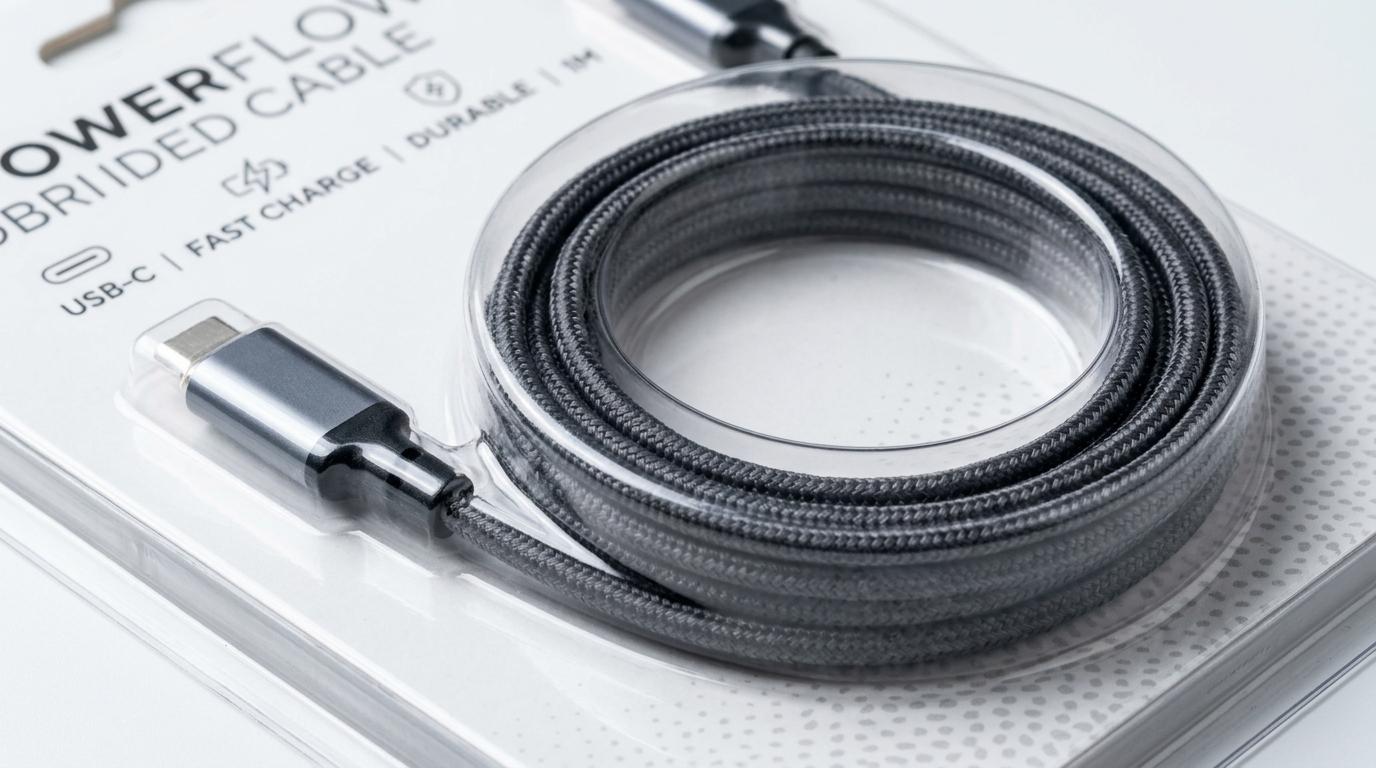
Molded Cable Racetrack Channels
Thermoforming precision circular or oval channels into the blister cavity creates a snug track that contains coiled charging cords under gentle radial tension. This prevents braided or PVC cords from expanding outward, maintaining a tight, orderly loop throughout distribution and handling.
Isolated Connector Pin Cradles
Delicate metal connector tips—such as USB-C shells, Lightning contacts, and HDMI pins—are prone to abrasive wear if allowed to rub freely against paperboard during cross-country freight. We engineer dedicated secondary relief pockets that elevate and lock connector heads face-forward, ensuring the plug remains pristine and immediately visible to shoppers.
Center of Gravity & Pegboard Balance
Power adapters and multi-port charging bricks carry concentrated weight. If the cavity is positioned too far to one side or offset from the hang slot, the package will list or tilt sideways on retail peg hooks, disrupting the visual line of the planogram. Structural dieline development centers the heaviest component directly below the vertical axis of the hang hole, which helps improve balance and maintain upright alignment on retail display fixtures.
Managing Multi-SKU Electronics Accessory Programs with qikCombo™
Consumer electronics brands rarely sell a single accessory. A comprehensive cable catalog alone often spans dozens of variations: 3-foot, 6-foot, and 10-foot lengths; Black, White, and braided gray finishes; and USB-C, Lightning, and USB-A configurations. Sourcing completely separate production runs for every individual SKU can lead to duplicate setup costs, excess inventory, and inefficient order quantities.
To solve this challenge, PM Packaging coordinates multi-SKU blister card programs through our proprietary qikCombo™ production program.
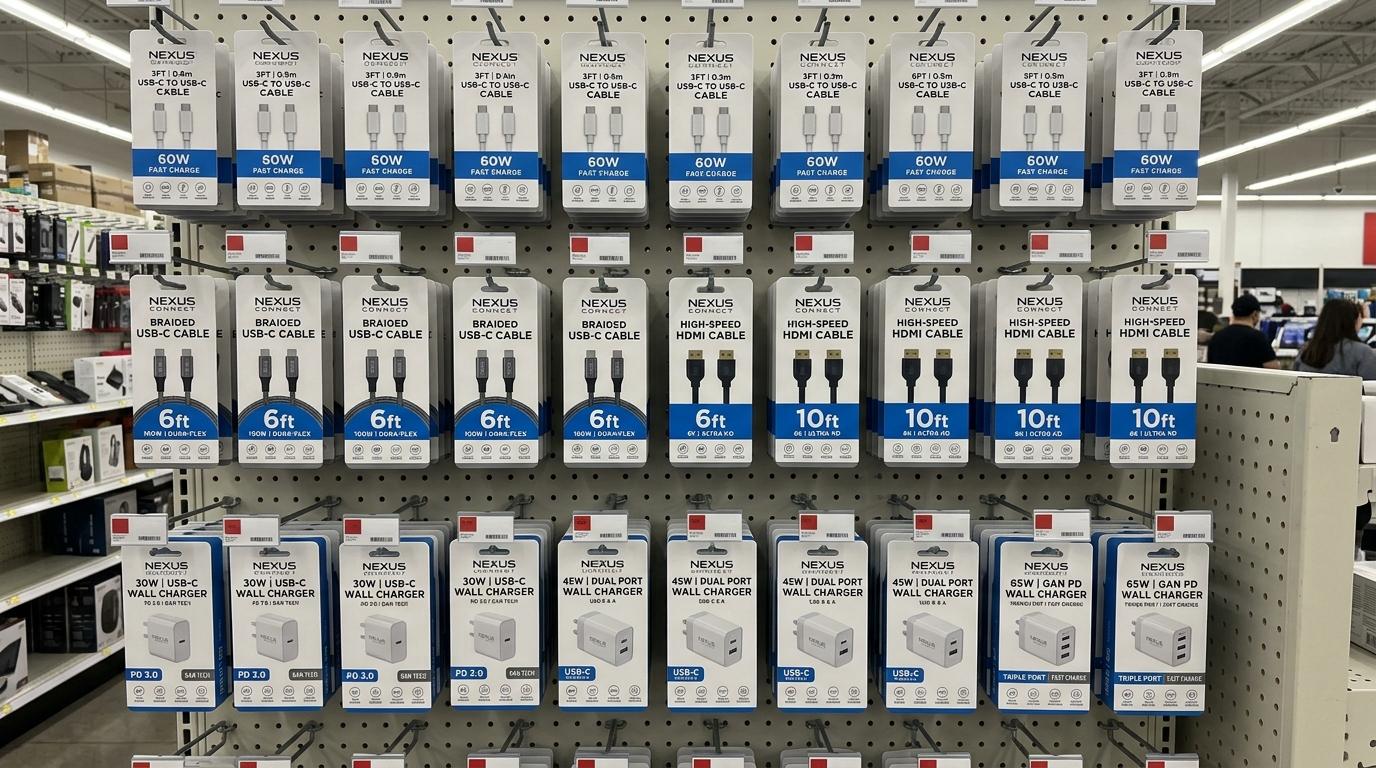
How qikCombo™ transforms electronics accessory procurement:
- Standardized Card Dimensions: Group diverse lengths and adapter models into shared outer dieline sizes
- Shared Press Sheets: Run multiple SKUs, colorways, and languages simultaneously in one press cycle
- Lower Tooling Expenses: Reduce setup duplication and plate preparation overhead across related SKU families
- Flexible Order Volumes: Order in proportion to real-time retail sell-through rather than artificial batch minimums
- Unified Brand Blocks: Ensure identical corporate ink densities and finishes across cables, wall chargers, and docks
- Rapid SKU Resets: Update power ratings, compliance icons, or device models without retooling entire lines
Electronics Blister Card Manufacturing with PM Packaging
At PM Packaging, we engineer and manufacture custom blister card packaging programs built for national retail rollouts, rapid replenishment schedules, and demanding electronic hardware requirements. Our end-to-end manufacturing approach eliminates supply chain friction through proven converting capabilities:
Custom Dieline Engineering & Cavity Coordination
Our CAD structural engineers evaluate cord coil diameters, wall brick dimensions, and pegboard weight distributions to craft precision dielines. We calibrate universal Euro-slots, delta cuts, and round hang holes to ensure seamless compatibility with retail pegboard hardware and anti-theft locking bars.
Advanced Color Management & Print Precision
Consumer tech packaging demands consistent brand equity across SKU families. Our offset lithographic printing processes support rigorous color management and precise registration, ensuring consistent brand hues, crisp technical typography, and scannable high-resolution UPC and 2D barcodes across your catalog.
North American Manufacturing & Nearshore Agility
With headquarters in San Diego and high-capacity manufacturing operations in Baja California, PM Packaging supports North American and nearshore supply chain programs. Our regional manufacturing footprint provides responsive lead times and streamlined logistics compared to extended transoceanic shipping schedules.
Frequently Asked Questions
Why are blister cards preferred over folding cartons for charging cables?
Blister cards allow shoppers to visually confirm connector tips (USB-C vs. Lightning), verify cord braiding quality, and inspect pin configurations directly through clear plastic. This direct visibility eliminates purchase confusion and significantly reduces retail return rates while providing high pegboard display density.
How do blister cards help deter in-store theft on compact accessories?
Compact electronics such as MicroSD memory cards, flash drives, and micro adapters are prime targets for shoplifting. Blister packaging expands the physical footprint of the item across a broad paperboard card, making it difficult to conceal or palm in an aisle while keeping the product readily accessible on open retail pegs.
Can multiple electronics SKUs share the same blister card dimensions?
Yes. Standardizing outer blister card dimensions across 3ft, 6ft, and 10ft cables or diverse adapter styles allows brands to establish uniform retail planograms. Furthermore, shared card sizes unlock PM Packaging's qikCombo™ program, enabling multiple SKUs to run on shared press sheets to reduce setup duplication and plate preparation overhead across related SKUs.
How does packaging design prevent heavy wall chargers from tilting on peg hooks?
Packaging engineers center the thermoformed cavity directly beneath the vertical axis of the hang hole. Placing the concentrated mass of transformers and charging blocks low and centered stabilizes the package’s center of gravity, which helps improve balance and maintain upright alignment on retail display fixtures.
What retail compliance markings should be included on an electronics blister card?
Required markings depend on the specific electronic accessory, its electrical ratings, target geographic markets, and retailer guidelines. Common reverse-panel elements include applicable regulatory or conformity symbols (such as FCC, CE, RoHS, or WEEE where required), country-of-origin labeling, recycling codes, warranty summaries, and scannable retailer UPC/EAN barcodes with dedicated quiet zones. Brands should always verify legal labeling obligations for their specific product categories.
Scale Your Electronics Accessory Packaging Program
Whether launching a standardized multi-SKU charging cable line, upgrading wall adapter presentation, or engineering custom pegboard displays for national retail chains, PM Packaging delivers manufacturing precision and supply chain reliability.
Key Program Evaluation Inputs
When preparing an electronics blister card program for quoting and structural design, brand managers and procurement teams should evaluate eight core specifications:
Ready to optimize your electronics blister packaging? Contact PM Packaging today to discuss your SKU portfolio, request dieline templates, and review production schedules with our structural packaging team.