
How Blister Cards Support Impulse Retail Success
Blister-card packaging supports impulse merchandising by maximizing immediate product visibility, enabling rapid visual comprehension within compressed shopper decision windows, and optimizing facing density across compact retail fixtures. Rather than attempting to force a purchase through emotional marketing graphics alone, an engineered blister card removes buyer hesitation: consumers instantly verify the exact physical accessory, color, connector, or tool profile through a clear thermoformed cavity, while the card header presents vital compatibility and brand identification unobstructed above display tray walls.
Why Blister Cards Work for Compact Retail Products
In retail merchandising, an impulse purchase is an operational outcome rather than an accident. Shoppers waiting in checkout queues or walking primary circulation concourses make fast, low-friction buying decisions when products solve an immediate need and require zero evaluation effort. Compact consumer accessories—such as mobile charging cables, audio adapters, precision hardware bits, and cosmetic applicators—are ideal candidates for this front-end placement.
However, simply enclosing a small item in clear plastic does not generate commercial momentum. Packaging can support impulse-oriented merchandising by organizing information with extreme discipline:
- Immediate Physical Inspection: Clear thermoformed cavities provide 100% transparency, allowing buyers to inspect connector geometries, material textures, and build quality without unsealing the package.
- High Facing Density: A blister card provides a thin physical profile that stacks tightly in counter trays or hangs densely along display fixtures, maximizing sellable units per linear inch of retail space.
- Shrinkage & Tamper Deterrence: In open, high-traffic register zones where staff supervision is divided, heat-sealed blister cards secure small components against theft and casual tampering while preserving an open, accessible display format.
"Packaging does not cause impulse purchases—it eliminates the friction that stops them. If a shopper must turn a box around, hunt for connector compatibility, or guess whether an accessory fits their device, the impulse opportunity is lost."
When Blister Cards Make Sense for an Impulse Retail Program
Sourcing teams and retail brand managers should evaluate whether blister cards represent the optimal structure for their specific SKU portfolio. Blister cards are commercially most effective when a product meets the following qualification criteria:
Ideal Product Characteristics
- • Physically compact: Products requiring minimal cavity depth.
- • Self-explanatory function: Value is understood upon visual sight.
- • Accessible price point: Lower friction, add-on purchasing thresholds.
- • High variant catalogs: Products with multiple sizes, lengths, or colors.
- • Durable construction: Items not susceptible to light impact or vibration.
High-Performing Product Categories
- • Consumer Tech: Braided charging cables, wall adapters, audio dongles.
- • Hardware & DIY: Magnetic screwdriver bits, hex keys, utility blades.
- • Automotive Care: Tire pressure gauges, valve caps, key fob batteries.
- • Beauty & Cosmetics: Tweezers, brow scissors, cosmetic sharpeners.
- • Stationery & Craft: Precision craft knives, correction tape, specialty clips.
In these categories, consumers frequently realize an immediate need while standing in line. A clear, branded blister card packaged for custom blister card programs bridges that realization with a zero-confusion product display.
When Another Packaging Format May Be Better
Blister cards are not universally appropriate for every front-end merchandise program. Brands that understand format boundaries avoid expensive re-tooling and retail rejection. Consider alternative structures under the following conditions:
- When 3D Shelf Presence or Distinct Gift Appeal Is Required: If your product relies on tactile curves, an elegant unboxing ceremony, or gift-ready geometry at checkout, paperboard pillow boxes offer a striking three-dimensional presence. Review our comparative analysis on pillow boxes for checkout and impulse retail programs to explore curved structural options.
- When Multiple Loose Components Need Internal Nesting: Products with multi-piece charging kits, interchangeable tool heads, or sensitive instructional manuals are often better housed in six-panel folding cartons with custom paperboard partitions. See our guide to blister cards vs. folding cartons for small retail products for detailed criteria on structural depth and enclosed volume.
- When Product Weight Exceeds Hanging Fixture Capacity: Heavy brass fittings, large solid metal tools, or bulky accessory bundles can stress hang tabs, causing tears during repeated shopper handling. Heavier products demand self-standing retail cartons or reinforced secondary display trays.
Checkout vs. Regular-Aisle Packaging Requirements
Designing a blister card for a primary category pegboard requires a very different approach than designing for front-of-store impulse fixtures. Understanding these environmental differences is essential for packaging engineers and graphic designers alike:
| Packaging Dimension | Regular Category Aisle | Checkout & Impulse Zone |
|---|---|---|
| Shopper Evaluation Time | 2 to 5 minutes intentional browsing | 3 to 15 seconds incidental queue wait |
| Viewing Angle & Distance | Eye-level straight-on at 3–4 feet | High-angle looking down at counter (1–2 feet) |
| Graphic Density | Detailed specs, warranties, feature tables | One dominant brand mark + bold compatibility badge |
| Fixture Constraints | Standard 4-foot gondola shelf or peg bar | Micro-footprint PDQ tray, sidekick, or register strip |
| Space Cost & Competition | Shared category footprint | Highest-cost revenue per square inch in retail |
Blister Cards for PDQ Counter Displays
Point-of-Sale (POS) counter displays—often structured as corrugated or paperboard PDQ trays—are the most common vehicle for checkout impulse merchandising. However, an improperly dimensioned blister card can ruin a PDQ rollout.
The most frequent point of failure is tray lip height. If a PDQ tray front lip is two inches high, placing a small card inside will completely obscure the lower half of the package. If the product model or brand logo is positioned low on the card, shoppers scanning the counter register see only a blank tray lip and an unidentifiable plastic dome.
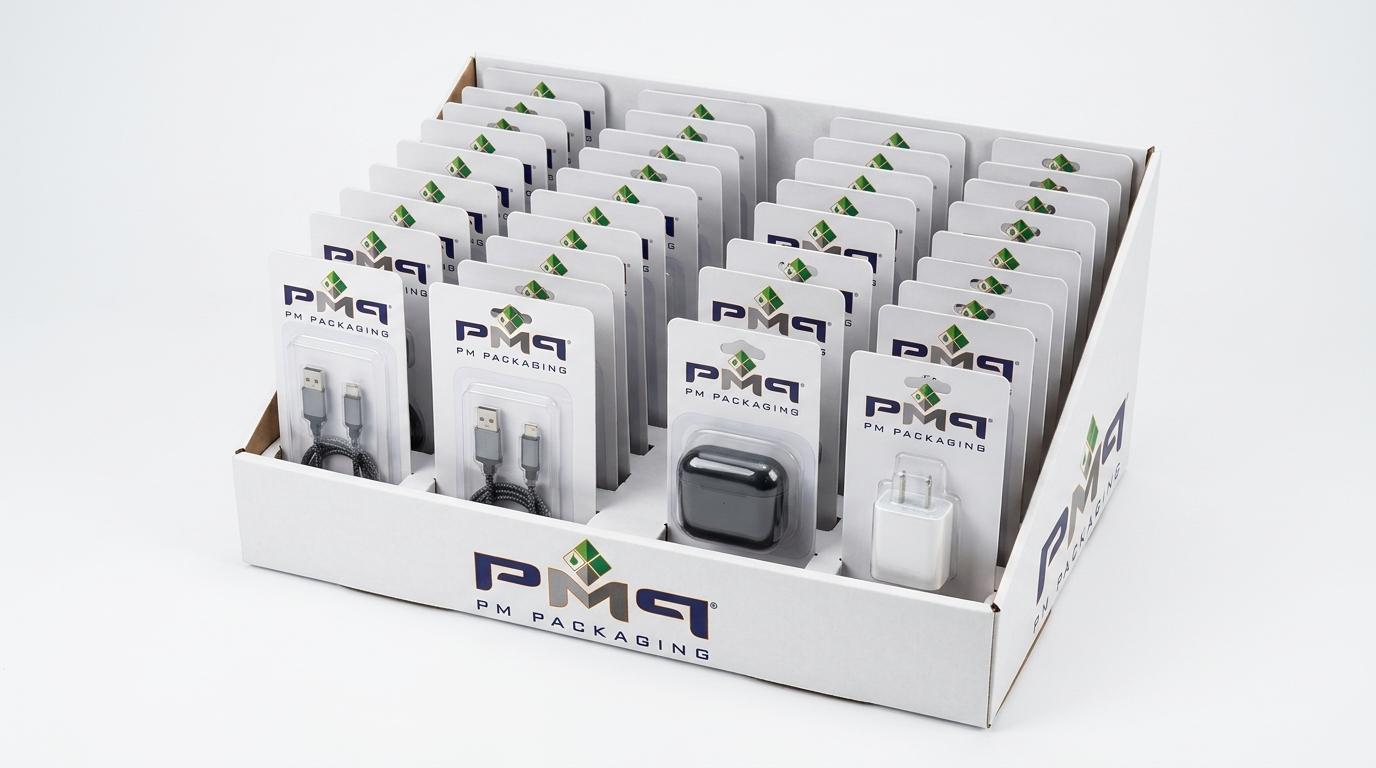
Furthermore, counter trays must be engineered with internal channels or partition lanes. Without base channels, blister cards will slouch forward, slide sideways, or "shingle" over one another as customers pull units from the front row. Maintaining a tidy, upright presentation throughout the entire sales cycle is critical to sustaining sales momentum.
Blister Cards for Clip Strips, Sidekicks, and Hanging Fixtures
When checkout counters lack horizontal surface area, retailers rely on vertical hanging fixtures. Clip strips hang directly beside cash registers or endcaps, while sidekicks (power wings) mount to the sides of gondola endcaps facing main perimeter aisles.
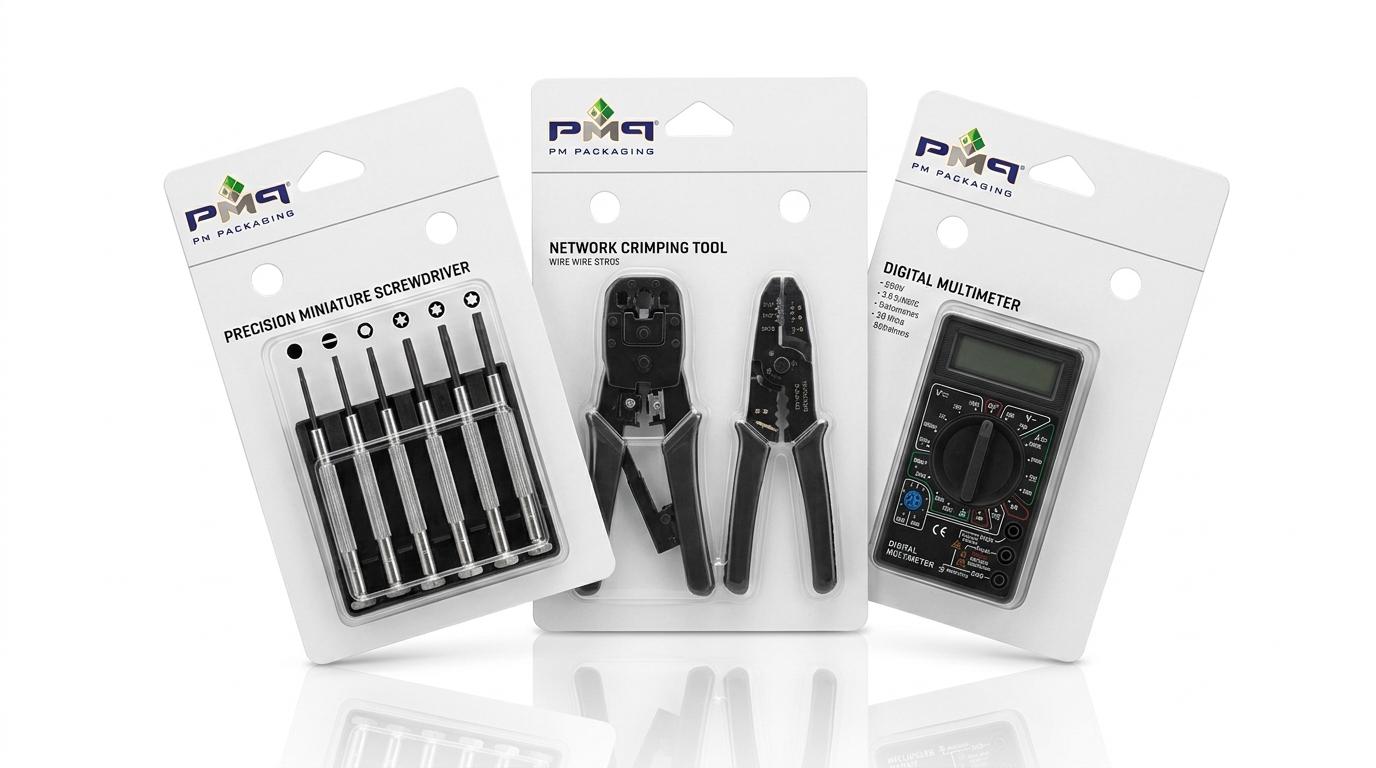
Hanging fixtures place unique structural demands on blister cards. On a clip strip, shoppers pull forward or twist the card to detach it from the hook prong. If the hang area is undersized or die-cut with poor edge clearance, the paperboard tears, dropping the product to the floor and resulting in store damage markdowns.
Retail Fixture Engineering Parameters
Every retail fixture format requires specific packaging engineering adjustments to balance card footprint, product retention, and store clerk replenishment:
| Retail Fixture Format | Blister Card Engineering Requirement | Commercial Retail Consideration |
|---|---|---|
| Checkout Counter PDQ | Header artwork sits fully above the front tray lip; base fits lane dividers | Maximizes units per register inch without hiding product identity |
| Front-End Merchandising Tray | Standardized card widths across multiple lanes for modular packing | Allows stores to adjust SKU mix dynamically based on sales velocity |
| Register Clip Strip | Reinforced die-cut hang area; centered center-of-gravity to prevent tilt | Resists repeated customer tugging and rapid replenishment without tearing |
| Gondola Sidekick (Power Wing) | Compact vertical card length; front-facing rigidity to resist curl | Fits within shallow 4-inch to 6-inch side-mounted wire baskets |
| Front-End Pegboard Hook | Sombrero (delta) slot allows smooth forward sliding on double-wire hooks | Facilitates first-in, first-out stock rotation during store restocks |
| Dump Bin / Register Caddy | Impact-resistant flange seals; perimeter blister flanges absorb shock | Prevents cavity delamination when cards are jostled in loose bin displays |
| Cross-Merchandising Secondary Fixture | Instant compatibility badge; bold contrasting background colors | Communicates complementary utility outside the primary destination aisle |
Designing Card Dimensions Around Facing Density
In national retail programs, packaging size directly governs store economics. Checkout counter real estate is strictly rationed by store planograms:
If a brand specifies a blister card that is 4.5 inches wide, a standard 12-inch wide counter tray can accommodate only two facing lanes. By optimizing internal cavity nesting and reducing perimeter card margins to 3.5 inches, that exact same 12-inch tray accommodates three full facing lanes. That simple 1-inch dieline adjustment increases front-facing variety and total display capacity by 50% without demanding another square inch of counter space from the retailer.
Key Dimensional Factors Influencing Facing Density:
- • Blister Cavity Projection: Deep thermoformed bubbles force wider tray spacing and reduce the number of cards that fit per depth lane. Flatter cavity profiles increase total unit capacity.
- • Flange Seal Width: Heat-seal flanges must provide sufficient bonding surface while minimizing wasted card perimeter.
- • Replenishment Intervals: Displays that hold too few units sell out rapidly during peak shopping hours, leading to empty out-of-stock facings before store clerks can restock.
Keeping Branding Visible Above Display Walls
Conventional packaging lore often insists on placing all key graphics rigidly in the "top one-third" of a card. In real-world retail execution, dogmatic placement rules often fail because display tray front lips vary dramatically between retailers.
Instead, graphic hierarchy must be engineered in direct alignment with the physical display structure:
- Measure Finished Sightlines: Determine the exact tray lip height and shopper viewing angle. Primary brand marks, product titles, and critical connector badges must sit above this sightline threshold.
- Coordinated Header Hierarchy: Explore our dedicated guide on how to design the header area of a blister card and our deep dive into blister card packaging design to structure typography, brand contrast, and hang hole placement effectively.
Engineering Hang Areas Around Product Weight
A blister card suspended on a clip strip or peg fixture must maintain its structural geometry under constant gravitational load and dynamic shopper handling. Packaging engineers must evaluate:
- Center-of-Gravity Alignment: The hang hole must align vertically with the product's center of mass. If a heavy cable head or brass tool shifts the center of gravity to one side, the card hangs crookedly, ruining planogram alignment.
- Hole-to-Edge Margins: Die-cutting a hang slot too close to the upper card edge invites tear-out. Maintaining adequate paperboard margins ensures tear resistance even when shoppers handle the product repeatedly.
- Card Rigidity and Warp Resistance: Changes in relative humidity can cause thin cards to curl. For comprehensive guidance on paperboard stability, consult our technical resource on how card size affects blister packaging performance.
Reducing Purchase Friction With Clear Product Identification
The primary failure mode of checkout packaging is ambiguity. When a customer considers an impulse purchase—such as a replacement phone cord—they need immediate verification of technical specs:
Is this USB-C to USB-C, or USB-A to USB-C? What is the cable length? Does it support fast charging? If the card uses tiny, dense technical paragraphs, the customer hesitates and puts the card back. By orienting the thermoformed cavity so the actual connector tips face front and centering bold, graphic compatibility icons on the header, buyer doubt is eliminated in seconds.
Managing Multi-SKU Impulse Assortments
Most checkout displays are not dedicated to a single product. Retailers maximize return on counter space by offering an assortment: 3-foot cables, 6-foot cables, USB-C adapters, and dual-port car chargers in a shared 4-lane PDQ tray.
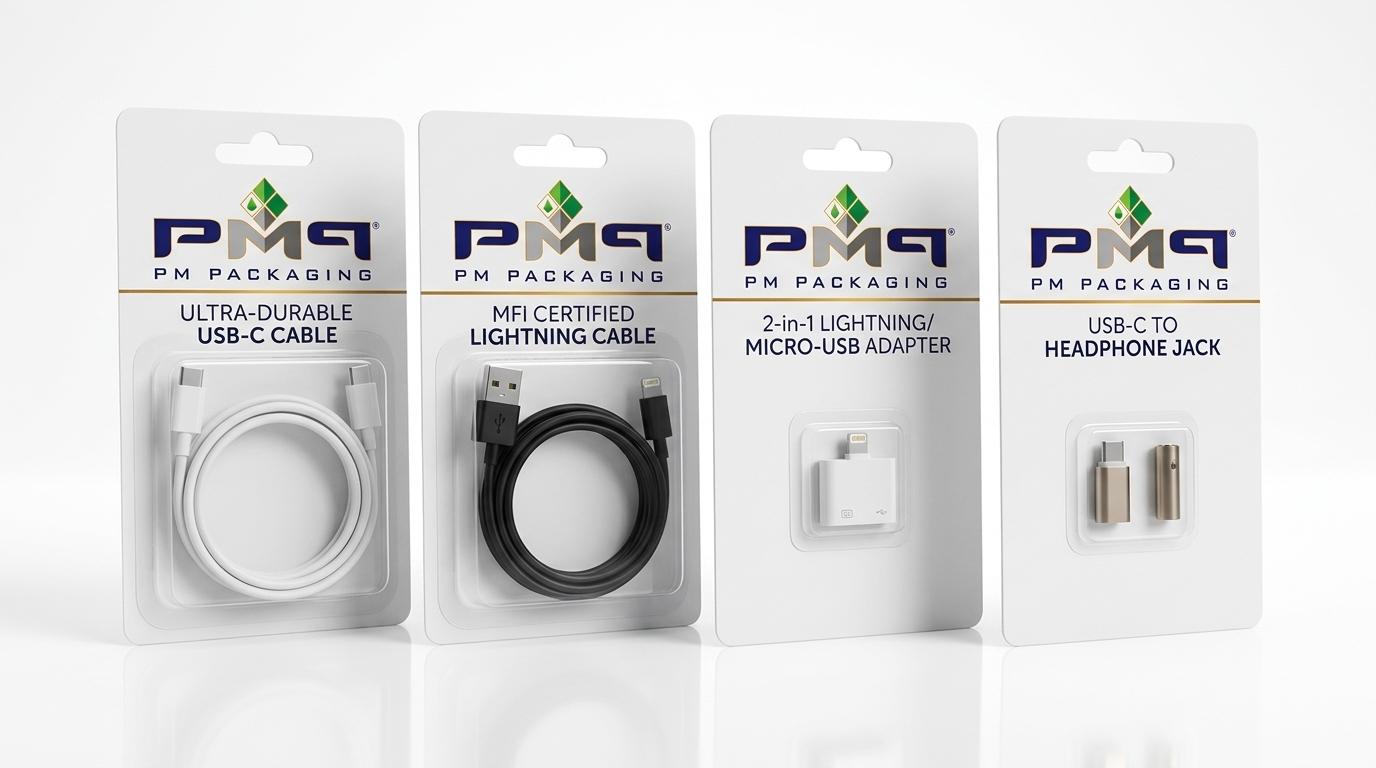
Managing multi-SKU retail programs requires standardized card engineering:
- Uniform Outer Footprint: Keeping outer card width and height identical across SKUs allows retail clerks to interchange lanes freely based on store-level replenishment needs.
- Shared Production Runs via qikCombo: Producing multiple low-volume SKUs individually can result in prohibitive tooling and plate setup costs. Through PM Packaging's proprietary qikCombo multi-SKU manufacturing capability, brands can combine multiple card variations into shared production press sheets, drastically lowering unit costs while maintaining precise color consistency.
Cross-Merchandising Complementary Products
Impulse merchandising extends beyond cash registers. Secondary cross-merchandising positions complementary products in adjacent retail departments—for example, hanging blister-carded AA batteries directly beside battery-powered toys, or displaying magnetic charging cables next to car dashboard mounts.
Because cross-merchandised products sit outside their home category, the blister card must carry all communication context. The packaging must explain in a fraction of a second why this accessory complements the primary purchase adjacent to it.
Designing the Blister Card and Display as One System
One of the most costly mistakes in retail packaging procurement is sourcing blister cards from one vendor and point-of-sale display trays from another. When components are developed in isolation, tolerance stack-up frequently leads to disaster:
- The thermoformed blister flange catches on the interior tray divider walls.
- The loaded card height exceeds the master shipper carton clearance by an eighth of an inch.
- The front lip of the display tray inadvertently obscures the product name or barcode.
- Print colors between the card header and the display tray fail to match under store lighting.
PM Packaging eliminates these supply-chain disconnects. Because we manufacture both custom printed blister cards and custom in-store counter displays, our structural dieline engineers co-develop the entire system simultaneously. Learn more about unified fixture execution in our technical guide to coordinating blister cards with counter and floor displays.
Planning Pack-Out and National Retail Distribution
A successful impulse rollout requires seamless execution from the production line through distribution center fulfillment to the retail counter:
Pre-Packed Display Trays (RRP)
Blister cards are packed into custom PDQ trays at the contract packager, enclosed in protective shippers, and sent to retailers ready to place directly onto the counter. Minimizes in-store clerk labor and guarantees perfect planogram presentation. For co-packer integration details, review our guide to blister card fulfillment for co-packers.
Replenishment Master Cartons
Stores retain the permanent counter display and order reorder case-packs of individual blister cards. Master cartons are sized with precise interior cell dividers to prevent card edge abrasion or cavity denting during pallet transit.
PM Packaging's Blister Card + Display Capabilities
PM Packaging delivers complete turnkey manufacturing for high-velocity retail programs. Our facilities coordinate every production stage under strict ISO and G7 quality standards:
Blister Card Production
- • Single-Seal & Fold-Over Cards: Engineered for automated or semi-automated heat-sealing.
- • Trapped Blister Cards: Flange enclosed between die-cut paperboard plies for maximum clean presentation.
- • qikCombo Press Runs: Shared manufacturing for multi-SKU retail catalogs.
- • Custom Die-Cut Hang Tabs: Precision delta, round, and euro slots.
In-Store Retail Displays
- • Countertop POS Units & PDQs: High-impact retail-ready counter trays.
- • Sidekick & Power Wing Fixtures: Endcap-mounted displays with wire or peg hooks.
- • Rapid Prototyping: Full-scale physical mockups to evaluate sightlines and card fit.
- • Assembly & Kitting Support: Turnkey pack-out coordination for national store rollouts.
What PM Needs to Evaluate an Impulse Blister Program
When submitting an initial inquiry for an impulse retail packaging program, providing structured project specifications allows our engineering team to generate precise dieline prototypes and cost models:
Project Specification Intake Checklist:
1. Product Dimensions & Weight: Exact length, width, depth, and gram weight of each SKU.
2. Catalog SKU Count: Number of distinct part numbers, colorways, or accessory variants.
3. Target Retailers: Specific chains (e.g., Target, Walmart, Best Buy, auto parts, convenience chains).
4. Store Door Count: Total store rollout quantity and distribution center locations.
5. Preferred Card Footprint: Established dielines or request for structural optimization.
6. Display Format: Counter PDQ tray, register clip strip, sidekick, or hanging pegboard.
7. Units Per Display: Desired facing count and total unit capacity per counter fixture.
8. Production Run Volume: Initial rollout volume and projected annual reorder cadences.
9. Sealing & Pack-Out Method: In-house packaging line, automated heat-sealer, or co-packer.
10. Target Retail In-Store Date: Critical delivery deadlines for store set dates.
Frequently Asked Questions
Are blister cards suitable for checkout counter displays?
Yes. Blister cards are one of the most effective packaging formats for checkout counters because their compact, vertical profile maximizes facing density in narrow PDQ trays while clear thermoformed plastic cavities provide instant product visibility for impulse shoppers.
Can blister cards be pre-packed directly into PDQ counter trays?
Yes. Pre-packing blister cards directly into retail-ready PDQ trays at your manufacturing facility or co-packer is standard practice for national retail programs. This eliminates store-clerk setup time and ensures cards remain upright and organized upon arrival.
Can blister cards be used reliably on clip strips and sidekicks?
Yes, provided the hang hole and upper card margin are structurally engineered for hanging tension. Centering the hang hole over the product's center of gravity and maintaining sufficient edge clearance prevents cards from tearing or hanging crookedly.
How large should a blister card be for an impulse retail product?
An impulse blister card should be as compact as possible while still accommodating the thermoformed cavity, heat-seal perimeter, die-cut hang hole, and required brand identification above the display tray lip. Overly large cards reduce the number of sellable facings that fit onto the counter.
Can multiple blister-card SKUs share one retail display tray?
Yes. In fact, most checkout counter displays hold an assortment of complementary items. By standardizing outer card dimensions across all SKUs, brands can divide trays into modular lanes that store clerks can replenish independently.
What is the difference between single-seal and fold-over blister cards?
A single-seal blister card seals the thermoformed plastic flange directly to a heat-seal coated paperboard backing. A fold-over blister card features a hinged, pre-creased card with a die-cut aperture that folds over the plastic flange, sandwiching it between two paperboard panels for enhanced edge strength and dual-sided printing.
Can PM Packaging manufacture both the blister cards and the retail counter displays?
Yes. PM Packaging manufactures both printed blister cards and custom retail point-of-sale displays. Co-engineering both components ensures perfect dimensional tolerances, flawless card lane fit, and identical color reproduction across all printed surfaces.
Planning a National Checkout or Impulse Rollout?
"Impulse merchandising succeeds when packaging dielines, thermoformed cavities, and counter fixtures operate as a single coordinated system."
PM Packaging provides comprehensive structural engineering and high-volume manufacturing for national retail programs. From custom blister cards and qikCombo multi-SKU runs to custom printed PDQ counter trays and fulfillment-ready pack-outs, our team aligns every detail to your retailer's compliance standards.
Contact our packaging engineering specialists today to review your product specifications, request physical blister prototypes, and receive a comprehensive production quote.