
How Case Packs, Inner Packs, Master Cases, and Retail Displays Work Together
Case packs, inner packs, master cases, and retail displays should be engineered as one packaging hierarchy rather than as separate components. Retail display capacity should help determine replenishment quantities; inner packs should match how distribution centers and stores handle partial cases; master cases should protect those quantities efficiently in transit; and all dimensions should support palletization and shelf requirements. Coordinating these levels reduces leftover inventory, repacking, wasted freight cube, and store-level handling.
When packaging levels are designed in silos, brands frequently encounter friction: mismatched replenishment multiples, poor shelf or display fit, crushed master shippers, and wasted trailer cube. High-efficiency packaging programs avoid these issues by engineering backward from retail display and shelf constraints while verifying freight and pallet logistics.
The Master Packaging Hierarchy: An Operational Flow
GS1 standards structure packaging across functional tiers, where merchandising displays integrate into the flow at specific operational nodes:
| Hierarchy Level | Core Function | Primary User | Key Engineering Question |
|---|---|---|---|
| 1. Retail Unit (Each) | Consumer branding, shelf facing, primary barcode (UPC-A) | Shopper | Does it optimize planogram facings while protecting product? |
| 2. Inner Pack (Bundle) | Fractional grouping, scuff barrier, DC pick unit | DC Pickers & Stockers | Does it match display lane capacity to prevent backroom orphans? |
| 3. Master Shipping Case | Transit containment, top-load ECT strength, tracking labeling | Freight & DC Receiving | Can it survive stacking compression while meeting retailer and workplace handling weight limits? |
| 4. Pallet Unit Load | Trailer cube density, Ti/Hi interlocking, racking stability | Fleet Operations | Does it maximize usable pallet cube while avoiding overhang and maintaining load stability? |
| ★ Point-of-Sale Display | Rapid restocking, multi-facing merchandising, promo impact | Store Associates | Can store associates restock the unit quickly and cleanly without damaging merchandise? |
Primary units consist of folding cartons or blister cards. PDQ trays travel in shippers, while floor displays ship as dedicated pallet unit loads.
Case Pack vs. Master Case: Clarifying the Terminology
In purchase orders and ERP systems, case pack and master case represent distinct concepts:
- Case Pack: The numerical count and spatial arrangement of saleable items (e.g., "24 units arranged 4×6"). It establishes ordering increments, retail velocity, and inventory turnover.
- Master Case: The physical corrugated container—specified by board caliper, flute profile, internal dimensions, and Edge Crush Test (ECT) rating—built to protect that case pack in transit.
The Dimensional Cascading Effect: Packaging Mathematics
Packaging operates under dimensional cascading: a fractional shift at the unit level multiplies across master shippers, frequently disrupting pallet density.
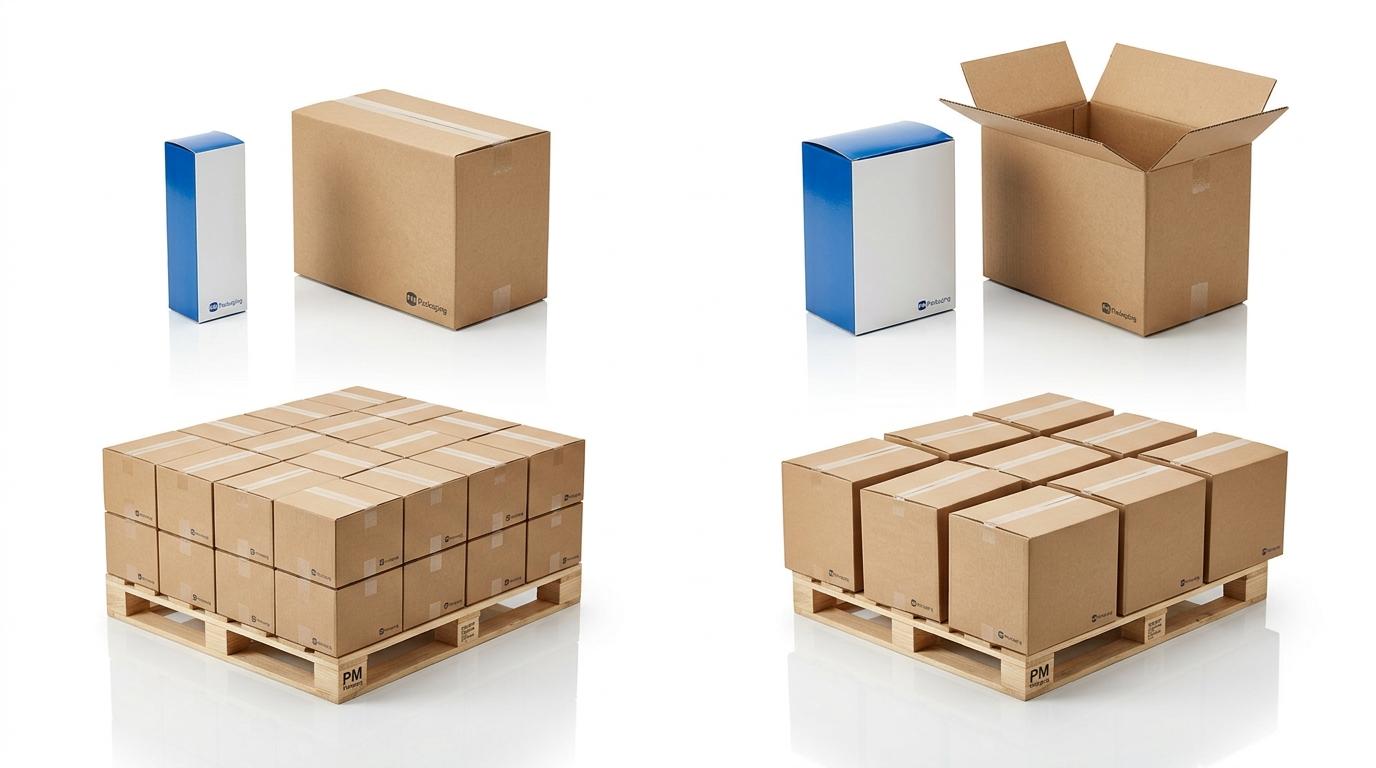
Dimensional Cascading: Minor alterations in unit carton dimensions multiply across master cases, altering pallet Ti/Hi and trailer volume utilization.
Illustrative Engineering Example: The 0.20-Inch Multiplier
As an illustrative example, consider a carton measuring 2.5" W × 1.5" D × 6.0" H packed 24 units per case (4×6). In a representative 48×40 pallet layout, this arrangement might achieve 20 cases per layer (Ti = 20). Stacked 8 layers high (Hi = 8), the pallet carries 160 cases (3,840 units) without pallet overhang.
Widening the carton by 0.20 inches (to 2.70") expands case width from 10.0" to 10.8". In this specific scenario, that change disrupts the case pattern on the pallet, reducing layers from 20 to 15 cases. At 8 tiers, the pallet carries 120 cases (2,880 units)—a 25% reduction in freight density for that configuration. While actual pallet patterns vary by shipper geometry, the example illustrates how minor primary packaging changes cascade into warehouse density and shipping cube.
Three Standard Packaging System Architectures
Architecture A: Direct-to-Shelf (Carton → Master Case → Pallet)
For high-velocity goods (grocery, household). Omits inner packs. Cartons pack directly into an RSC shipper of 12 to 24 units. Associates slice cases open to hand-stock shelves, maximizing packing line speed.
Architecture B: DC Pick-and-Pack Split (Carton → Inner Pack → Master Case → Pallet)
For cosmetics and convenience retail. Units group into 6-count inner cartons; four inners form a 24-unit case. At DCs, workers pick 6-packs into mixed totes, preventing store overstock while protecting carton surfaces. See our guide on when programs need inner packs.
Architecture C: Merchandised Retail-Ready (Carton → Display Shipper → Pallet)
For club stores and endcaps. The master shipper converts into a display via tear-away hoods or tray-and-shroud construction. Stockers place the full tray on shelves in seconds. Review comparisons in our guide to shelf-ready vs. display-ready packaging.
Designing Backwards from the Retail Endpoint
High-efficiency packaging programs engineer backward from shelf constraints to the primary carton:
- 1. Planogram Footprint: Shelf depth, facing width, and vertical clearance define allowable display dimensions.
- 2. Sales Velocity: Slower-moving products may benefit from smaller replenishment quantities, while high-velocity products may justify larger case packs to reduce restocking frequency.
- 3. Stocking Protocol: Design tool-less or easy-open features when retailer guidelines restrict utility knives on the sales floor.
- 4. Case Weight: Align gross shipping weight with retailer, carrier, and workplace ergonomic handling requirements.
- 5. Pallet Cube: Model case dimensions on standard pallets to maximize usable pallet cube, maintain load stability, and avoid pallet overhang.
Display Capacity vs. Replenishment Geometry: Aligning Pack Multiples
Whenever practical, pack quantities should divide cleanly into the quantities stores actually replenish:
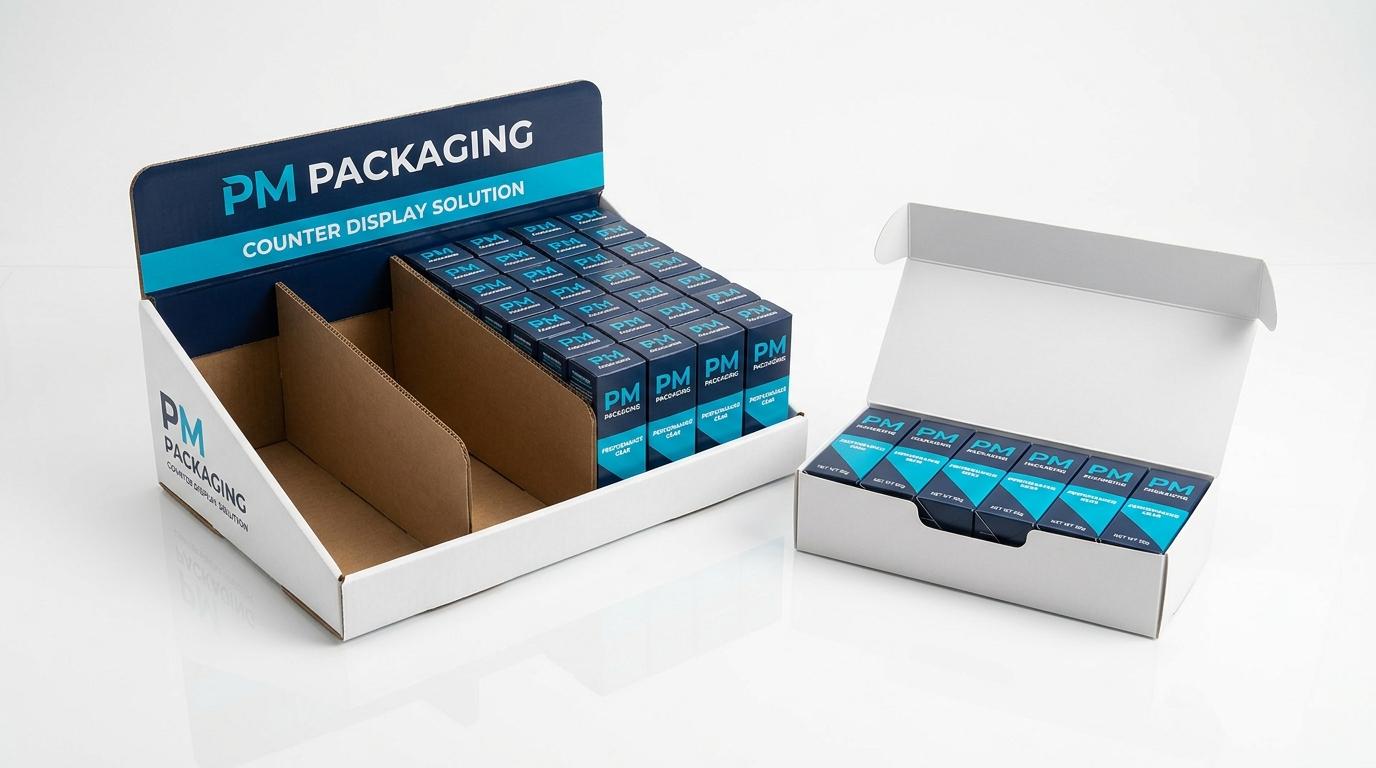
Replenishment Geometry: Engineering a 6-count inner pack to refill one lane of a 24-unit counter display eliminates orphan backroom inventory.
Where store operations support it, aligning one inner pack with one display lane can simplify replenishment and reduce loose backroom units. For example, a 4-lane counter display holding 6 units per lane (24 total capacity) can be paired with a master case holding four 6-unit inner packs. When a lane empties, an associate refills it in a single motion with zero leftover units.
If that same 6-unit lane were replenished using 10-count inner packs, refilling one lane would leave 4 loose cartons in the backroom. These orphaned units are prone to being scuffed, misplaced, or forgotten, creating inventory count discrepancies and cluttering storage space.
Case-Pack Economics: Balancing Unit Cost Against Velocity
Case pack quantities balance manufacturing throughput against retail inventory turnover:
Higher-Quantity Cases (e.g., 24–48 Units)
- Pros: Often lowers corrugated material cost per unit, supports rapid automated case packing, and reduces pallet touches.
- Cons: Can strain store backrooms for slower SKUs, increase days-of-supply, and risk exceeding retailer or workplace manual handling limits.
Lower-Quantity Cases (e.g., 4–12 Units)
- Pros: Better matches low-velocity shelf capacity, supports faster inventory turns, and allows full-case restocking without holding backroom inventory.
- Cons: Higher corrugated material usage per unit, increased packaging touches, and potentially higher freight handling frequency.
Straight Packs vs. Mixed Assortment Cases
Straight Packs: Master shippers contain a single SKU. This setup offers maximum automated packing line speeds, simplified inventory tracking, and lower pack-out complexity.
Mixed Assortments: Master cases combine coordinated variants (such as multiple colors, flavors, or related accessory SKUs). Mixed cases add complexity because inventory, labeling, and pack-out operations must coordinate multiple variants within the same shipping hierarchy. However, for smaller retail footprints or promotional programs, mixed cases allow stores to merchandise a full product line without purchasing full master cases of each individual SKU.
Palletization as a Primary Constraint: Ti/Hi & Stacking Strength
Master case engineering must account for dynamic warehouse stacking and transit:
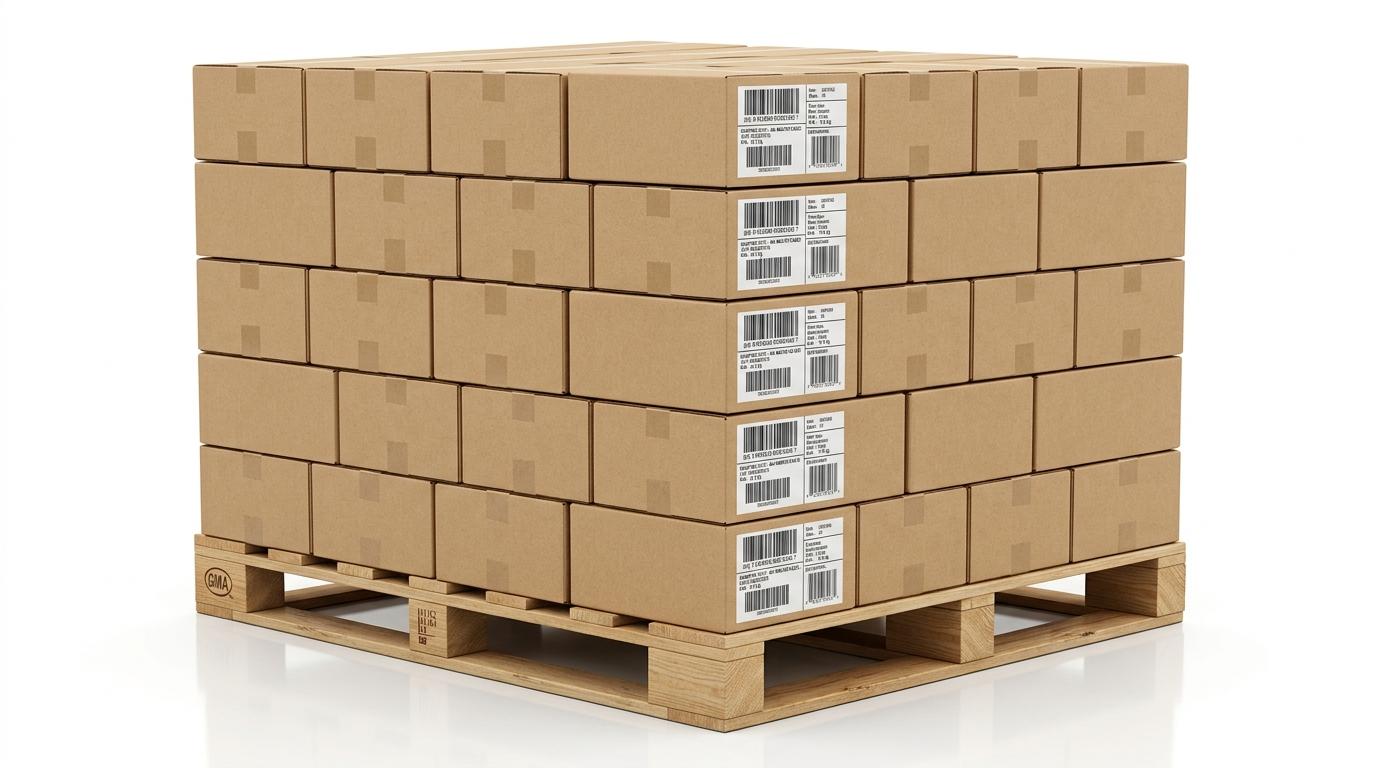
Unit Load Optimization: Precision pallet patterns on a standard 48×40 pallet avoid edge overhang and preserve vertical stacking strength.
- Pallet Layer Patterns: Pallet patterns should be validated for stability and compression. Alternating patterns or column stacking can be selected depending on whether load interlock or vertical column strength is the primary engineering priority.
- Avoiding Pallet Overhang: Allowing shipping cases to overhang the pallet edge significantly reduces box compression strength and increases the risk of transit damage to bottom-tier cases.
- Surface Protection: In densely packed shipping cases, transit vibration can cause carton scuffing on printed finishes. Evaluating protective coatings helps safeguard retail appearance, as detailed in our guide to scuff-resistant packaging coatings.
When Can a Packaging Level Be Eliminated?
Efficient packaging systems use the minimum number of packaging levels required to satisfy protection, handling, inventory velocity, retail replenishment, and merchandising requirements:
- Eliminate inner packs when full cases move directly to the sales floor or when internal partitions or banding within the master case can provide necessary separation without an added box.
- Eliminate separate master cases by using shelf-ready or display-ready shippers that serve as both the transit container and the retail merchandising structure.
- Retain inner packs when operational benefits justify them—such as distribution center pick-and-pack splits, fractional store replenishment, moisture or environmental barriers, or surface protection for delicate finishes.
Seven Common Packaging Hierarchy Pitfalls to Avoid
1. Mismatched Display Multiples
Supplying replenishment quantities that do not divide cleanly into display capacity leaves loose orphan units in backrooms.
2. Overweight Master Cases
Exceeding retailer or carrier ergonomic weight guidelines can trigger handling surcharges and increase carton drop damage.
3. Pallet Edge Overhang
Allowing cases to overhang pallet edges significantly reduces vertical stacking strength and increases transit failure risk.
4. Barcode Hierarchy Collisions
Printing unit barcodes on master shipping cases can cause automated scanners to register full cases as single retail units.
5. Exceeding Shelf Depth Limits
Sizing displays deeper than the retailer's planogram permits causes shelf overhang, aisle hazards, or program rejection.
6. Excessive Shipper Void Space
Improperly sized master cases leave empty void, increasing freight costs and reducing top-load box compression strength.
7. Underestimating Transit Humidity
Specifying corrugated that does not account for environmental moisture can lead to box fatigue and stacking failure in humid transit corridors.
The 10-Point Technical Packaging System RFQ Checklist
Before initiating structural engineering and tooling, compile these essential system specifications:
| Parameter | Input | Engineering Impact |
|---|---|---|
| 1. Unit Dims | L × W × D + caliper | Primary carton die-cutting and inner pack sizing |
| 2. Unit Weight | Net filled product weight | Master case pack count aligned with handling weight limits |
| 3. Case Pack | Target units per case / required order multiple | Aligns store inventory turns and order minimums |
| 4. Display Type | PDQ tray, floor stand, SRP | Replenishment lane width and header structure |
| 5. Shelf Limits | Max shelf depth, facing width, clearance height | Ensures display tray fits shelf without overhang |
| 6. Pallet Standard | Standard 48×40 or program pallet | Ti/Hi interlocking pattern without overhang |
| 7. Pallet Height | Maximum pallet height permitted by distribution program | Allowable Hi tier count and freight cube |
| 8. Stacking Time | DC stacking tiers and transit conditions | Required corrugated ECT compression rating |
| 9. Barcode Level | Program-required barcode symbologies | Labeling compliance across packaging levels |
| 10. Packing Method | Manual vs. automated line | Flap styling, auto-bottoms, and fold tolerances |
Partner with PM Packaging for Unified Packaging Systems
Optimizing your packaging hierarchy requires coordinating structural design across primary, secondary, and tertiary levels. PM Packaging works with brand owners and packaging engineers to align each tier: from high-graphic folding cartons and blister cards to inner packs, engineered corrugated shippers, counter display trays, and contract packaging fulfillment.
Ready to Optimize Your Packaging Hierarchy?
PM Packaging can evaluate the retail unit, inner-pack quantity, case pack, display capacity, master-case dimensions, and pallet requirements together so the packaging hierarchy supports production, distribution, and store replenishment.