
A brand with one product can optimize one package. A brand with 40 SKUs faces a compounding inventory challenge where each flavor, scent, size, color, retailer version, and seasonal promotion creates another finished carton stock that must be forecasted separately.
By standardizing the primary box into a common structural platform and shifting changing graphics, barcodes, and variant messaging to a custom printed paperboard sleeve or belly band, brands convert isolated inventories into a pooled physical asset with PM Packaging.
Does the primary box really need to carry all of the SKU differentiation?
In many packaging programs, the answer is no. Instead of absorbing high minimum order quantities, long plate lead times, and massive obsolescence risk on fully printed primary cartons, growing consumer brands use custom paperboard packaging sleeves manufactured by PM Packaging as an agile inventory-management strategy.
Standardize your packaging platforms with PM Packaging.
The Problem With Making Every Primary Carton SKU-Specific
Consider a product family containing 12 variants. Structurally, every package may be identical—sharing the same length, width, depth, board grade, insert, closure, master case, and pack-out line setup. Only the printed graphics change.
If each variant receives a fully printed primary carton, procurement ends up managing 12 separate finished inventories: 12 forecasts, 12 reorder points, 12 production runs, 12 artwork files, 12 opportunities to overbuy, and 12 packaging SKUs that can become obsolete overnight if ingredients, claims, or retailer guidelines shift.
As detailed in PM Packaging's guide on packaging large retail assortments with core, seasonal, and promotional SKUs, standardizing physical platforms and controlling variation through secondary components protects working capital and eliminates scrap.
What Does a Generic-Box-and-Sleeve Program Look Like?
Common Primary Box
Handles structural and protective stability:
- Product containment and physical protection
- Internal insert and cradle retention
- High-speed erect and pack-out line performance
- Common universal brand marks and core color
SKU-Specific Sleeve
Handles agile marketing and product data:
- Flavor, shade, scent, or size naming
- Product photography and promotional callouts
- Seasonal artwork, retailer logos, and club bundles
- Variable barcodes, nutrition, and regulatory panels
Strategic Advantages of Delayed SKU Differentiation
1. Reducing Obsolete Printed Carton Inventory
Printed packaging inventory carries a unique risk: one formula tweak, barcode update, or regulatory change can make an entire warehouse run obsolete. As explored in PM Packaging's analysis of large-scale folding carton production with multiple print versions, moving variable information to a sleeve isolates obsolete inventory risk to a small paperboard wrap while keeping the underlying boxes 100% usable.
2. Smaller Board Area Means Lower Write-Off Costs
A full folding carton contains six panels plus glue flaps and closure tabs. A sleeve wraps an existing package, consuming significantly less paperboard area. Discarding 10,000 obsolete sleeves is a fraction of the cost of scraping 10,000 complete custom folding cartons.
3. Concentrating Purchasing Volume Into One Specification
Instead of buying five fragmented orders of 20,000 to 100,000 cartons across five variants, procurement can purchase 300,000 identical common boxes. This unlocks top-tier volume pricing, streamlines board staging, and simplifies press scheduling.
4. Creating a Repeatable Packaging Platform
The primary box establishes the permanent physical standard: board caliper, insert geometry, glue seams, and master shipper cube. Then, distinct color-coded sleeves turn that single platform into core lines, holiday editions, club packs, and retailer-exclusive SKUs without modifying carton tooling.
5. Mitigating the Risk of Long-Tail and Niche SKUs
Specialty flavors or niche configurations often suffer from poor inventory turns when ordered in full carton minimums. A generic box platform allows brands to produce small, targeted sleeve runs for long-tail variants without carrying dedicated cartons.
6. Eliminating Post-Holiday Packaging Waste
As outlined in PM Packaging's guidance on high-volume gift packaging for holiday retail programs, seasonal cartons have a hard expiration date. Pairing an evergreen primary box with a removable holiday sleeve ensures that unsold boxes remain active inventory in January.
7. Accelerating Fast-Track Product Launches
Marketing teams can launch new flavors or promotional collaborations in weeks rather than months. If the new item fits the existing box platform, teams only need to design, proof, and print a custom sleeve rather than engineering an entire packaging structure.
8. Painless Product Discontinuations
When a slow-moving SKU is retired, remaining common primary boxes are simply repurposed for active items. Only the retired variant's sleeves need to be recycled, dramatically lowering portfolio maintenance costs.
9. Turnkey Retailer-Exclusive Customization
When national mass merchants or club stores demand unique pack counts, bundle graphics, or exclusive barcodes, a branded paperboard sleeve provides channel differentiation without splitting your core manufacturing run.
10. Postponement and Agile Delayed Differentiation
Delayed differentiation allows brands to keep inventory uncommitted in a central warehouse until final retail purchase orders arrive. Applying the appropriate sleeve at pack-out aligns packaging consumption directly with real-time customer demand.
11. Hedging Against SKU-Level Forecast Errors
When Variant A unexpectedly outsells Variant B by 300%, printed cartons for Variant B sit idle while Variant A runs out of boxes. With generic boxes, physical inventory is pooled and can be reallocated instantly to whichever sleeve is selling.
12. Freeing Up Working Capital
Capital tied up in printed cartons that can only be used for a single slow-moving SKU is unproductive capital. Pooling carton stock into a shared structural asset maximizes packaging inventory turnover and liquidity.
Engineering Sleeve Programs for Production Reality
Generic Does Not Have to Mean Unbranded
The underlying primary box can carry universal brand marks, core flood coats, embossed logos, and corporate sustainability statements. The sleeve simply layers on the SKU-specific naming, color coding, and imagery.
Sleeves Deliver Full Premium Finishing
Moving differentiation to the sleeve does not compromise luxury. PM Packaging manufactures paperboard sleeves with metallic hot foil stamping, multi-level embossing, spot UV gloss, soft-touch lamination, and precision die-cut reveal windows.
Full Sleeves vs. Belly Bands
A full sleeve provides extensive surface area for product photography, ingredients, and regulatory disclosures. A narrower belly band is an ultralight solution for gift messaging, seasonal accents, or multipack bundling.
Friction Fit Is a Precision Engineering Requirement
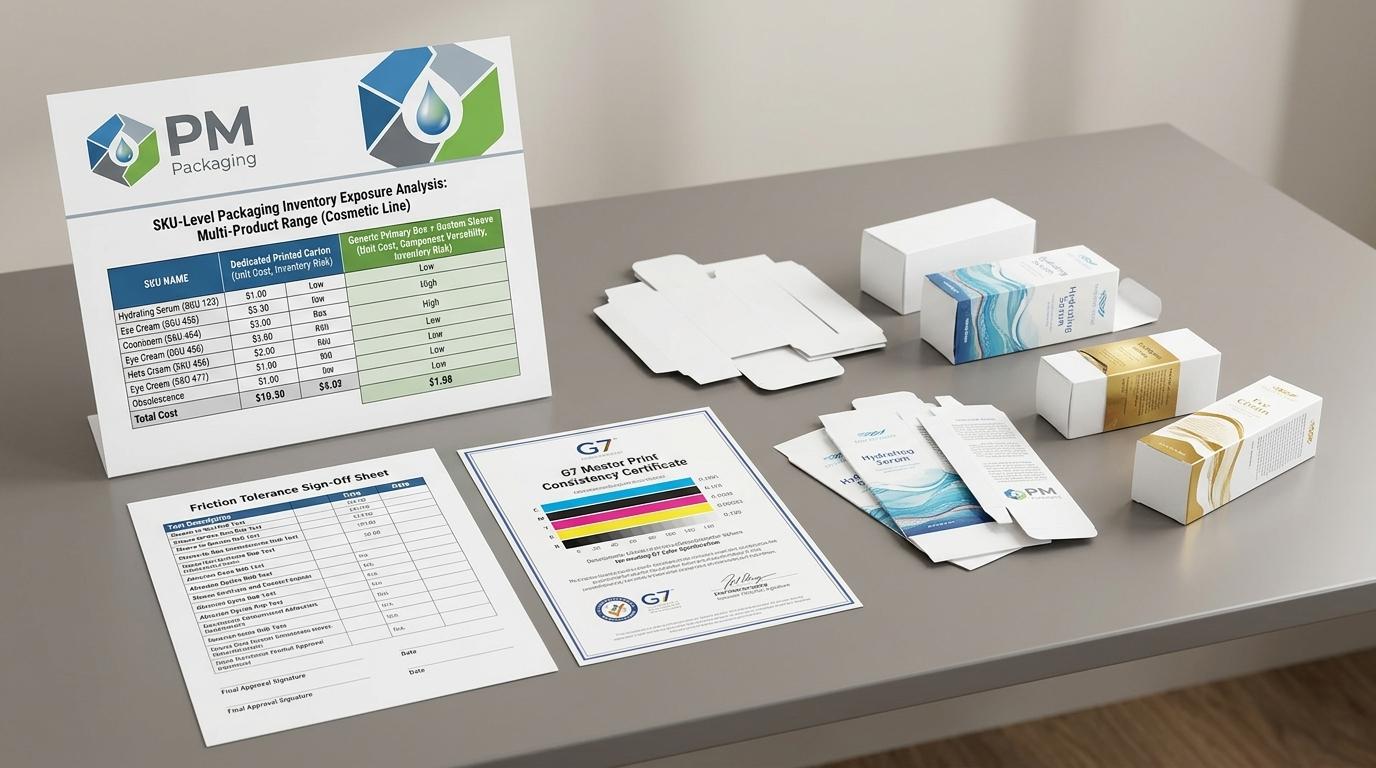
A sleeve must not slide off during transit, nor should it bind or crush the primary box during pack-out. PM Packaging engineers precise friction tolerances based on paperboard caliper, scoring depth, and surface varnish slip coefficients.
Operational Visibility on the Packing Floor
As noted in PM Packaging's review of folding cartons for high-volume consumer product programs, visually similar variants must be unmistakable during packing. Sleeves should include prominent human-readable codes and SKU markers on glue seams to prevent packing mismatches.
Total Packed Cost Modeling
A complete business case models the entire system: common box manufacturing cost + printed sleeve cost + manual or automated sleeve application labor versus dedicated carton write-offs, plate charges, and holding costs.
Develop a Multi-SKU Sleeve Program With PM Packaging
PM Packaging designs, engineers, and manufactures custom paperboard packaging sleeves, belly bands, and standardized primary cartons for multi-SKU retail, cosmetic, specialty food, and consumer goods brands.
PM Packaging sleeve and box capabilities:
- Full-coverage carton sleeves, belly bands, & tray slide-overs
- Solid Bleached Sulfate (SBS), recycled kraft, and SFL microcorrugated stocks
- Precision friction dieline calibration for effortless manual or automated pack-out
- Hot foil stamping, multi-level embossing, spot UV, & soft-touch coatings
- Die-cut display windows, thumb notches, & integrated hang tabs
- Inventory consolidation modeling, gang-run planning, & G7 color consistency
PM Packaging evaluates your active SKU counts, annual volume by variant, historical obsolescence scrap, and fulfillment workflow to engineer a high-efficiency packaging platform.
Managing a Large Product Family With Separate Printed Cartons?
Stop tying up working capital in dozens of isolated carton inventories that risk obsolescence with every formula or regulatory update.
Standardize your core packaging platform, concentrate purchasing volume, and deploy custom printed sleeves for agile SKU differentiation.
Achieve maximum inventory flexibility and commercial scale.
Managing a large product family with separate printed carton inventories by SKU? Contact PM Packaging to evaluate a standardized primary-box and custom paperboard sleeve program around your SKU mix, annual volumes, inventory exposure, and pack-out requirements.