
A large folding-carton program becomes significantly more complex when the total quantity is divided among many printed versions.
A single physical carton may need different artwork for flavors, scents, sizes, languages, retailers, regions, seasonal promotions, or product claims. The production challenge is therefore not only manufacturing enough cartons. It is controlling which artwork belongs on which structure, how many units of each version are required, which dielines can be shared, how proofs are approved, and how outdated printed packaging is prevented from returning to production.
The central buyer question is: "How should a large folding-carton program be managed when the physical cartons have many SKU, flavor, regional, language, retailer, seasonal, or promotional print versions?" In commercial shorthand: we need to manufacture many different printed versions without losing control of artwork and inventory.
This guide details how brands establish SKU version matrices, separate structural variation from graphic variation, maximize shared dielines, enforce rigorous artwork change control, forecast version-level demand, and minimize obsolete printed inventory.
What Counts as a Print Version in a Folding-Carton Program?
In folding carton production, two cartons may be structurally identical—sharing the exact same paperboard caliper, cutting dieline, score locations, and glue tabs—while representing entirely different products. A "print version" exists whenever graphic content changes, requiring dedicated prepress files, printing plates, and inventory tracking:
Product Line Extensions
Flavors, scents, color shades, cosmetic formulations, or model numbers.
Language & Regulatory Variants
Bilingual French/English for Canada, Spanish for Mexico, or regional compliance panels.
Retailer-Specific Graphics
Club-store exclusive callouts, retailer item numbers, or dedicated co-branding.
Seasonal & Promotional Graphics
Holiday graphics, limited-edition runs, sweepstakes codes, or promotional bonus callouts.
Barcode & UPC Identification
Unique GS1 barcodes and ingredient lists even when front-panel graphics appear similar.
Multi-Pack & Bundle Callouts
Twin-pack, bonus size, or starter kit graphics on standard carton blanks.
Start With a Version Matrix Before Production Planning
Managing multiple carton versions without a centralized control document leads to prepress errors, mixed cartons on the packing line, and incorrect inventory counts. Before releasing purchase orders, packaging teams should build a comprehensive version control matrix:
| Version / SKU | Shared Structure? | Unique Artwork Elements | Quantity / Demand Pattern | Approval Owner |
|---|---|---|---|---|
| SKU-A01: Lavender | Yes (Dieline D-101) | Purple accent tint, lavender imagery, unique UPC-A. | High runner / steady monthly reorders. | Brand Manager |
| SKU-A02: Eucalyptus | Yes (Dieline D-101) | Green accent tint, botanical artwork, unique UPC-A. | Medium runner / bi-monthly replenishment. | Brand Manager |
| SKU-A03: Bilingual Can. | Yes (Dieline D-101) | English/French dual-language text, bilingual drug facts. | Regional volume / quarterly production. | Regulatory Compliance |
| SKU-A04: Holiday Cedar | Yes (Dieline D-101) | Gold hot-foil accent, festive graphic, promotional code. | Single seasonal run / high obsolescence risk. | Marketing Lead |
| SKU-B01: Club Twin-Pack | No (Dieline D-204) | Double-width carton, club retailer badge, master UPC. | Retailer campaign / contract specific. | Retail Sales Director |
Separate Structural Variants From Graphic Variants
The foundational rule of multi-SKU carton programs is recognizing that a new artwork file does not automatically require a new structural package. Brand teams frequently treat every new product introduction as a ground-up packaging project, multiplying structural dielines needlessly.
Sourcing teams must clearly differentiate:
- Structural Variant: A distinct physical dieline requiring separate cutting dies, creasing matrices, stripping tools, and folder-gluer setups.
- Print Variant: A change in printing plates, inks, or varnish layers applied to an existing, standardized structural blank.
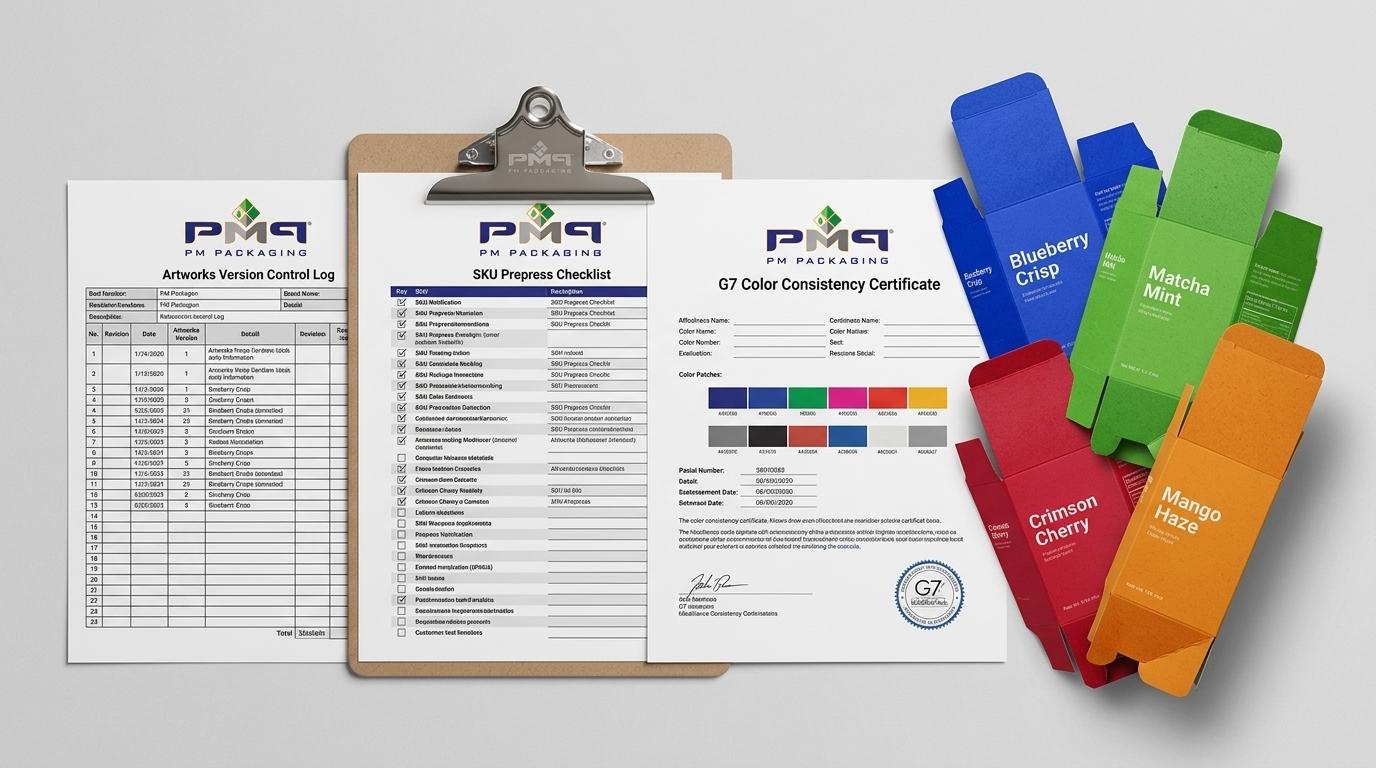
When multiple products share the same outer physical dimensions, standardizing the structural dieline allows the manufacturer to reuse cutting tooling and folder-gluer setups, isolating changeovers strictly to prepress plates and ink washes.
When Can Multiple Versions Share the Same Dieline?
Sharing a structural dieline across multiple print versions is commercially realistic when the underlying products meet common physical parameters:
- Identical Primary Containers: Different scents, shades, or formulas housed in identical bottles, jars, or tubes can share the exact same carton structure.
- Common Closure Style: All variants use the same tuck format, such as straight tuck or auto-bottom lock, matching automated cartoning machinery or packing station protocols.
- Uniform Secondary Packaging: Shared outer carton dimensions allow the brand to standardize master shipping cases, pallet patterns, and retail shelf footprint across the entire product line.
Where multiple versions genuinely share a structural dieline, common tooling may reduce unnecessary structural duplication and simplify inventory handling on the packaging line.
When Should Versions Use Separate Structures?
While structural standardization is efficient, forcing dissimilar products into an ill-fitting carton introduces serious operational risks. Separate structures are justified when:
- Product Dimensions Differ: An oversized carton allows the product to shift during transit, risking internal scuffing, glass breakage, or retail carton crushing.
- Loaded Weight Changes: A heavier concentrated liquid or glass jar requires heavier paperboard caliper or a snap-lock / auto-bottom base to prevent bottom fallout, whereas lightweight dry goods require only a simple tuck.
- Retail Channel Mandates: Club store retail channels may require integrated hang tabs or fifth panels that standard retail drug and grocery shelves reject.
Artwork Version Control Becomes a Production Requirement
In high-version printing programs, artwork management operates as a critical quality control gate. A structurally flawless folding carton printed with an outdated ingredient panel or mismatched UPC is total scrap.
Dieline-to-Artwork Matching
Prepress teams must verify that artwork layers align precisely with the active mechanical dieline revision. If bleed margins, glue tab keep-out zones, or score clearances shift between structural revisions, unverified artwork will result in ink bleed onto glue seams or unprinted borders.
Revision Control
Brand teams must enforce disciplined file naming standards (e.g., SKU_Variant_RevC_2026.pdf) and strictly quarantine superseded artwork files. Outdated digital assets must be purged from shared portals to prevent older artwork from being mistakenly sent to plate output.
Approval Responsibility
Establish explicit sign-off ownership for every version. Marketing signs off on hero graphics and branding; regulatory reviews ingredient lists and drug facts panels; supply chain validates scannable GS1 barcodes and carton piece counts.
Forecast Demand by Version, Not Only Total Carton Volume
Sourcing teams often communicate an aggregate number: "We need 2 million cartons across 12 SKUs." However, customer demand is never distributed equally across versions.
In consumer product lines, the 80/20 rule typically applies: two or three core versions drive 70% of total volume, while niche, regional, or seasonal variants split the remainder. Forecasting each version independently prevents overproducing slow-moving SKUs while under-producing high runners.
Different Version Types Create Different Inventory Risk
Inventory exposure varies dramatically depending on the commercial role of each printed version:
| Version Type | Demand Pattern | Primary Risk |
|---|---|---|
| Core Everyday SKU | Steady, predictable reorders throughout the year. | Stockout risk if production batch sizes lag consumption. |
| Seasonal Promotion | Narrow 8-to-12 week selling window. | High obsolescence risk; unsold cartons cannot be repurposed next year. |
| Retailer-Exclusive | Tied to a single customer purchase agreement. | Immediate inventory write-off if the retailer delists or alters order quantities. |
| Regional / Multilingual | Tied to specific geographical distribution centers. | Inventory misallocation; stock stranded in the wrong regional warehouse. |
| Trial / Launch Flavour | Unproven consumer adoption. | Premature overproduction before consumer reorder rates are validated. |
How Should Production Runs Be Sequenced Across Versions?
Efficient multi-version production is a scheduling discipline. The packaging manufacturer evaluates commonalities across the program to organize production runs:
- Substrate Continuity: Grouping versions that share identical paperboard grades (e.g., 18pt SBS) minimizes substrate changes and sheet feeder adjustments.
- Dieline Commonality: Running cartons that use the same cutting die sequentially eliminates full die-cutter changeovers, requiring only plate and ink adjustments on press.
- Ink Sequencing & Wash-Ups: Transitioning from lighter process inks to darker spot colors reduces wash-up duration on offset presses.
Brand Color Must Remain Consistent Across Different Graphics
A consumer product line featuring 20 different flavors must still look cohesive when displayed side-by-side on a retail shelf. While background graphics, fruit illustrations, or fragrance bands differ, core brand equity elements must remain uniform:
- G7 Color Standards: Utilizing G7 calibration ensures uniform neutral gray balance and tonal reproduction across separate press runs, keeping master brand colors consistent regardless of which version is running.
- Standardized Brand Panels: Keeping brand logos, taglines, and company info panels in fixed positions and standard corporate spot inks prevents visual clutter across the lineup.
Control Barcodes, Languages and Retailer-Specific Copy
Small text elements cause major retail disruption if mismanaged. In multi-version programs, each version carries distinct data points:
- Scannable Barcode Verification: Each SKU must carry its certified GS1 UPC or EAN barcode, printed with sufficient optical contrast to ensure scannability at retail point-of-sale.
- Regulatory Statements: Ensure country-of-origin markings, bilingual product descriptions, and mandatory safety notices are reviewed and approved by compliance specialists before plate production.
- Retailer-Mandated Codes: Verify that club-store item numbers, vendor codes, or customer-specific carton markings are segregated so retailer-exclusive packaging cannot be delivered to standard retail channels.
Prevent Obsolete Printed Carton Inventory
The greatest commercial hazard in multi-version programs is printed packaging obsolescence. When a brand prints large batches of 30 different versions to achieve unit price breaks, sudden changes can turn warehouse inventory into scrap:
- Regulatory Ingredient Updates: A minor reformulation or updated warning label immediately renders on-hand printed inventory unusable.
- SKU Rationalization: Retailers frequently drop underperforming SKUs during annual category resets, stranding specialized packaging.
- Revision Run-Out Strategy: When releasing revision B, establish a firm run-out plan for revision A inventory rather than switching artwork overnight, protecting working capital.
Example: One Carton Structure Across a Multi-Flavor Consumer Product Line
Consider a hypothetical commercial program: an organic herbal tea company sells eight distinct botanical blends. All eight teas are packaged in identical 100g tea bags housed in an 18pt SBS straight tuck folding carton.
Instead of treating each tea blend as a separate structural development project, the brand implements a multi-version control architecture:
- Unified Dieline: All eight blends share Dieline D-302. Cutting dies and folder-gluer setups remain fixed across all production runs.
- Prepress Version Matrix: Each flavor has a unique digital artwork ID (e.g., TEA-CHAM-V4, TEA-PEPP-V2) linked to unique UPC barcodes and specific spot background colors.
- Tiered Forecasting: Chamomile and Peppermint are ordered in monthly runs of 100,000 units, while seasonal Spiced Chai is ordered in a single Q4 release of 25,000 units.
- Packing Floor Simplicity: Because all cartons erect with the same tuck dimensions, the contract packager's cartoning line runs uninterrupted without physical tooling changes.
When Total Manufacturing Throughput Becomes the Bigger Question
Artwork version control does not replace the need to evaluate whether the complete converting route can support the required physical carton volume.
If your primary operational challenge is assessing equipment capacity across printing, die-cutting, folding-gluing, and pack-out cadence for an established core carton, read our operational guide to evaluating high-capacity folding carton manufacturing for an established brand.
Questions to Ask Before Awarding a Multi-Version Carton Program
Packaging buyers should review these operational questions with their supplier before launching a multi-version folding carton program:
- ✓How many distinct physical dielines are required across the product line?
- ✓How many total print versions exist, and which versions share the same structure?
- ✓Who on your team has final sign-off authority for artwork proofs, barcodes, and regulatory copy?
- ✓How are superseded artwork files archived and quarantined to prevent reprinting old versions?
- ✓Are any versions tied to exclusive retailer agreements, seasonal windows, or bilingual markets?
- ✓What is the projected annual consumption for each version, and which represent high runners?
- ✓How will the manufacturer sequence production runs across versions sharing common paperboards?
Planning a Large Multi-Version Folding-Carton Program
Multi-version folding carton manufacturing succeeds when brand managers, prepress specialists, and converting operators maintain clear separation between structural standardization and graphic variation.
Contact PM Packaging to review your SKU portfolio, evaluate shared structural dielines, establish version matrices, and align production schedules across all your printed carton versions.
Organize Your Multi-Version Carton Program
Discuss your SKU count, shared structural dielines, artwork approval workflows, and version-specific production scheduling with PM Packaging.