
A high-volume folding-carton program should be engineered around the complete path from carton manufacturing through product pack-out, distribution, retail presentation, and repeat production.
Carton style, paperboard, inserts, score and fold behavior, case quantities, packing method, and downstream logistics can all affect program performance when repeated across large quantities. The goal is not simply to create an attractive paperboard carton. It is to create a repeatable packaging specification that fits the product, converts consistently, works with the actual packing process, protects the product through distribution, and can be reordered without unnecessary operational complexity.
The primary commercial question is: "How should a high-volume consumer-product folding-carton program be engineered for efficient manufacturing, pack-out, distribution, and repeat production?" In buyer shorthand: how should the ongoing carton program work as a unified physical system?
This guide examines how consumer goods brands choose practical structural formats, specify functional paperboard grades, engineer internal retention inserts, align carton geometry with manual or automated packing lines, optimize master shippers, and evaluate total program costs.
What Makes a Folding-Carton Program “High Volume”?
In folding carton converting, "high volume" is not defined by an arbitrary threshold of total units. Instead, a program becomes operationally significant when packaging decisions are repeated frequently enough that small fractional differences compound into major commercial impacts across materials, converting throughput, packing labor, and warehousing.
Evaluating a high-volume program requires looking beyond total annual carton demand:
- Release Quantities & Cadence: A program ordering 100,000 cartons per month operates under different manufacturing conditions than one placing a single annual order of 1.2 million units.
- Physical Structural Diversity: Whether the program utilizes one standardized structural dieline or divides volume across multiple distinct package shapes.
- Pack-Out Method: Whether cartons are erected and filled manually by contract packagers or fed through high-speed automated cartoning machines.
- Seasonality: Volume spikes tied to retail promotional windows, holidays, or category resets that place concentrated demands on converting schedules.
Start With the Product and Pack-Out Process
Successful folding-carton engineering begins by defining the physical container and the packing environment before drafting graphics or selecting paperboard caliper:
| Program Input | Packaging Decision | Operational Impact |
|---|---|---|
| Product Dimensions | Length, width, and depth (L × W × D) internal clearance. | Controls usable internal volume, board footprint, and sheet layout. |
| Product Weight | Paperboard caliper, closure style, bottom lock format. | Prevents bottom fallout and dictates score memory requirements. |
| Pack-Out Method | Manual folding vs. mechanical cartoner carton erection. | Determines crease stiffness, squareness tolerances, and assembly labor. |
| Retail Orientation | Vertical shelf facing, hanging hole, or horizontal tray. | Governs panel layout, center-of-gravity stability, and front display area. |
| Insert Requirement | Internal paperboard partitions, collars, or die-cut trays. | Dictates internal carton clearances and pack-out insertion sequences. |
| Distribution Environment | Master shipper density, pallet layer stacking, freight routes. | Influences secondary outer protection and top-load compression resistance. |
Select the Simplest Carton Structure That Meets the Requirements
Complexity adds cost and friction. In a high-volume program, buyers should select the simplest structural style that fulfills mechanical, protection, and merchandising needs. Standard carton styles can be explored across PM Packaging's folding carton catalog:
Straight-Tuck and Reverse-Tuck Cartons
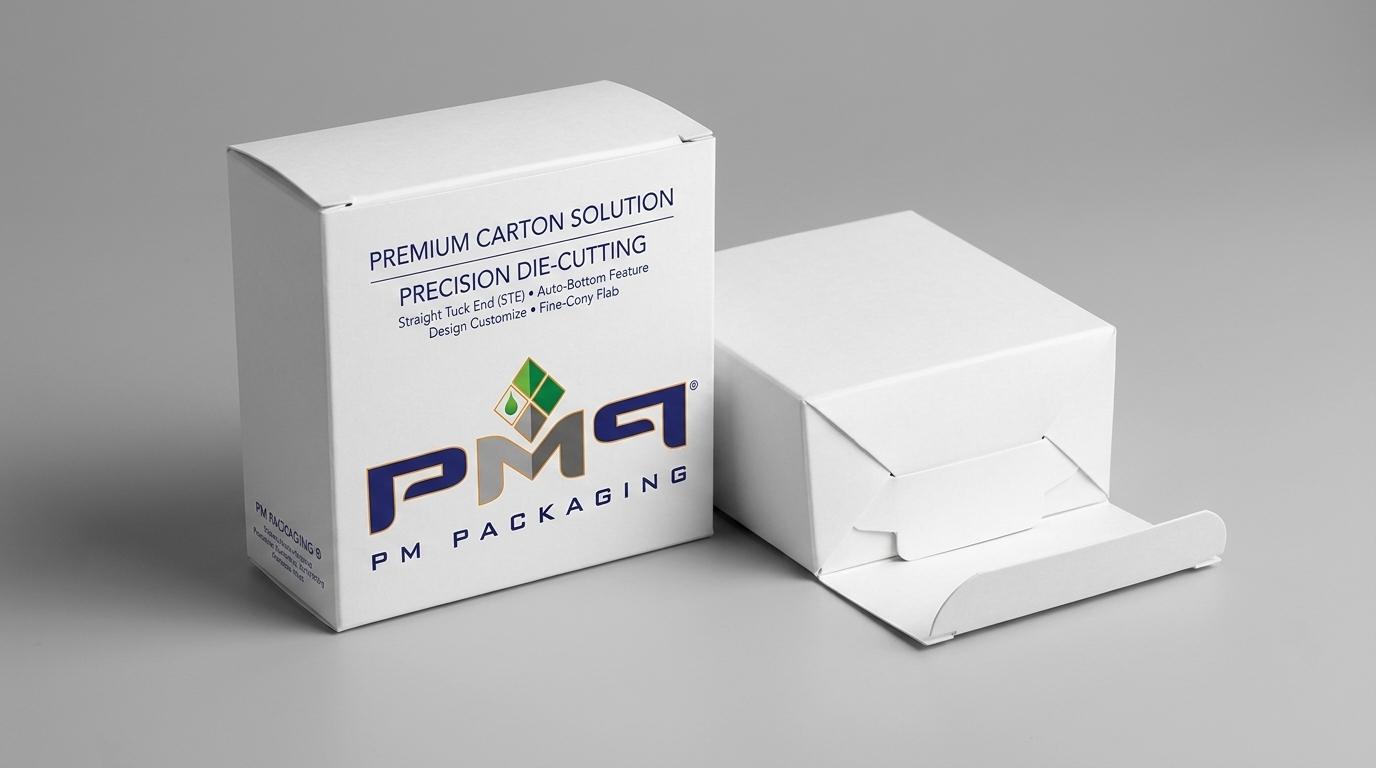
Tuck-end cartons are the workhorse of consumer packaging. In a straight tuck end (STE), top and bottom flaps tuck from the same panel, providing a smooth face and clean front. In a reverse tuck end (RTE), flaps tuck from opposite faces, allowing optimal sheet interlocking on press to minimize trim waste. Both styles run efficiently on horizontal cartoning lines.
Auto-Bottom Cartons
Auto-bottom (crash-lock) cartons have pre-glued bottom flaps that snap into place automatically when the flat blank is pushed open. While requiring a dedicated folding-gluing pass during converting, auto-bottom cartons significantly reduce assembly labor during manual pack-out, making them ideal for high-volume hand-packing operations.
Snap-Lock Bottom Cartons
Also known as 1-2-3 bottoms, snap-lock cartons feature four interlocking flaps folded manually without adhesive. They provide a sturdy, reliable base for moderate-weight consumer products when pre-glued auto-bottom machinery is unnecessary.
Sleeves and Specialty Structures
When a primary product (such as a tub, tray, or bottle) already provides self-supporting structural integrity, a paperboard sleeve offers branding, barcoding, and tamper resistance while consuming less paperboard than a fully enclosed carton.
Match Paperboard to the Product and Manufacturing Process
Paperboard selection involves balancing carton stiffness, print reproduction, folding performance, and material efficiency. Sourcing teams should select from proven commercial grades documented in custom folding carton manufacturing:
Solid Bleached Sulfate (SBS)
Virgin bleached fiber with a bright white interior and clay-coated exterior. Delivers high tear resistance and clean score bends. Widely used in cosmetics, personal care, pharmaceuticals, and packaged foods.
Clay Coated Newsback (CCNB)
Recycled newsprint interior with a coated white top surface. Provides economical stiffness for large-volume household goods, hardware, and dry packaged goods.
Coated Recycled Board (CRB)
100% recycled paperboard supporting corporate sustainability mandates. Balances structural stiffness with dependable printing surfaces for retail consumer staples.
Paperboard caliper (e.g., 16pt, 18pt, 20pt, 24pt) should be chosen based on product mass and carton dimensions. A heavier caliper is not automatically superior; excessive caliper increases board costs, stiffens scores unnecessarily, and can induce machine jams on automated packing lines.
Design Around the Actual Packing Method
Packaging engineers must design carton blanks around the realities of the packing station, differentiating between automated mechanical cartoning and manual fulfillment:
Automated Cartoning
Packaging can be engineered around the requirements of automated cartoning equipment. High-speed cartoning machines use vacuum cups to pull flat cartons from magazines and erect them in a fraction of a second. Consistent score pre-breaking during folding and gluing ensures low opening resistance, preventing suction cup misfeeds. Squareness tolerances and flap angle consistency must remain tight to ensure pushers insert products cleanly without snagging carton borders.
Manual and Co-Packer Pack-Out
In manual packing, labor ergonomics dictate carton design. Auto-bottom lock styles allow packers to erect cartons in a single squeeze motion. Thumb notches on tuck flaps facilitate swift closure, and generous lead-in angles prevent flap buckling, helping packing lines maintain high throughput.
Engineer Inserts With the Outer Carton
Internal paperboard inserts should never be treated as an afterthought. Designing inserts and outer cartons together as a unified system delivers several operational benefits:
- Product Retention & Positioning: Die-cut collars and platforms lock bottles, tubes, or multi-component items firmly in place, preventing movement during transit.
- Eliminating Void Space: Proper internal engineering minimizes overall package cube, reducing unnecessary paperboard use and freight volume.
- Swift Pack-Out Assembly: Simple, one-piece folding inserts that self-locate inside the carton prevent labor bottlenecks on the assembly floor.
Evaluate the Carton and Master Case Together
The carton is only one part of the secondary packaging system. Designing folding carton dimensions to nest perfectly inside corrugated master shipping cases maximizes pallet utilization:
- Eliminating Master Case Slack: Internal empty space inside master shippers allows cartons to vibrate and scuff in transit. Snug case packs protect carton surfaces and corners.
- Top-Load Compression Alignment: Aligning carton vertical corners directly beneath master case load lines helps share vertical stacking forces during warehouse pallet storage.
- Pallet Cube Optimization: Adjusting carton dimensions by fractions of an inch can often increase cartons per layer or cases per pallet, yielding significant annual freight savings.
Establish Repeatable Quality Requirements
For an ongoing high-volume program, quality control is defined as repeatable compliance with an approved master specification across recurring production runs. Key control points include:
- G7 Color Standards: Calibrating offset lithography to G7 gray-balance targets ensures uniform brand color appearance across repeat runs.
- Score Crease Integrity: Regular die-rule maintenance ensures scores remain sharp and uniform without cracking coated paperboard fibers.
- Fiber-Tear Adhesive Bonds: Confirming manufacturer glue seams achieve 100% substrate fiber tear so cartons do not separate in transit.
- Optical Barcode Verification: Ensuring GS1 and UPC barcodes maintain scannability contrast to prevent distribution receiving rejections.
Testing Should Match the Actual Product and Distribution System
Testing should be defined around the specific product, carton geometry, packing method, and anticipated supply chain hazards. Depending on program scope, packaging teams evaluate:
- Structural CAD Prototyping: Producing plain sample blanks on sample tables to confirm physical product clearance, insert fit, and closure security.
- Packing Line Trials: Running sample quantities through actual manual lines or mechanical cartoning equipment to validate erection behavior and feed reliability.
- Distribution & Transit Trials: Conducting test shipments or formal distribution testing coordinated as part of project scope when required by retailer routing guidelines.
Standardization Can Reduce Program Complexity
When a brand manages dozens of related product offerings, standardizing structural specifications reduces tooling duplication and inventory management overhead:
- Shared Structural Dielines: Allowing multiple product fragrances or shades in identical containers to share one common cutting die.
- Common Board Calipers: Standardizing on a single substrate specification (such as 18pt SBS) across product tiers to streamline raw material procurement.
- Uniform Pack-Out Procedures: Keeping closure styles identical so packing line operators do not need separate setup instructions between product runs.
Evaluate Total Program Cost, Not Only Carton Unit Price
Procurement teams often focus narrowly on the carton unit purchase price. However, in large commercial programs, secondary operational costs frequently exceed unit print savings:
- Packing Line Downtime: Inconsistent carton scores that cause automated cartoning jams cost far more in lost line productivity than a fractional cent saved on board caliper.
- Assembly Labor: Choosing an auto-bottom carton may carry a slightly higher converting cost, but saves significant labor minutes during manual pack-out.
- Freight & Pallet Efficiency: Right-sizing carton footprints to maximize cases per pallet lowers per-unit shipping costs throughout the entire distribution network.
What Information Should a Buyer Bring to a Folding-Carton Manufacturer?
To engineer an efficient high-volume folding-carton program, procurement teams should assemble the following technical inputs:
- ✓Product Specifications: Exact dimensions, weight, fragility, and container material (glass, plastic, metal).
- ✓Existing Structural Dielines: Current CAD files or physical samples if re-engineering an established package.
- ✓Paperboard Preference: Substrate grade (SBS, CRB, CCNB) and target caliper range.
- ✓Annual Volume & Release Cadence: Projected yearly consumption and typical order shipment sizes.
- ✓Packing Line Details: Manual bench pack-out vs. mechanical cartoning machinery specifications.
- ✓Finishes & Coatings: Protective aqueous coatings, Spot UV, embossing, or window requirements.
- ✓Secondary Distribution: Master case pack counts, pallet stacking criteria, and delivery locations.
Example: An Established Personal-Care Product Line
Consider a hypothetical commercial program: an established consumer brand manufactures a daily facial cleanser housed in a 200ml plastic pump bottle. The program runs year-round without promotional launch events, producing 1.8 million cartons annually.
The packaging team engineers the carton system around ongoing manufacturing efficiency:
- Straight Tuck Structure: A straight tuck end format is chosen to match the brand's continuous-motion automated horizontal cartoner.
- Calibrated Substrate: 18pt SBS C1S is selected, balancing clean clay-coated print reproduction with reliable score memory during high-speed vacuum carton erection.
- Integrated Pump Collar Insert: A simple paperboard collar locks around the pump neck, preventing actuation and head movement without adding plastic wrap.
- Optimized Case Pack: Cartons nest 24 units per master corrugated case, optimizing pallet footprint for full truckload freight without wasted cube.
When the Packaging Challenge Is a National Premium Retail Launch
A high-volume carton program and a national retail launch are related but different problems. When a premium product must reach a large retail network on a fixed launch date, packaging must also be coordinated with launch quantities, displays, channel requirements, premium surface protection and rollout timing.
If your primary challenge centers on coordinating premium cartons, rigid presentation boxes, counter PDQs, and distribution schedules for a fixed rollout window, read our operational guide to planning luxury packaging for a national retail product launch.
Build a Folding-Carton Program Around Operational Requirements
High-volume consumer packaging succeeds when structural design, converting repeatability, pack-out ergonomics, and distribution efficiency work together as an integrated system.
Discuss your product dimensions, carton style, paperboard requirements, estimated quantities, pack-out method, inserts, retail requirements, and distribution conditions with PM Packaging to engineer a scalable folding-carton program.
Engineer Your High-Volume Folding Carton Program
Connect with PM Packaging's packaging engineering specialists to audit structural dielines, paperboard calipers, cartoning automation compatibility, and master case logistics.