
Dedicated manufacturing capacity is not necessary for every packaging program.
It becomes worth evaluating when the cost and risk of competing for ordinary open press availability begin to outweigh the flexibility of standard purchase-order scheduling. When an enterprise program features predictable recurring demand, immovable retail delivery deadlines, high replenishment velocity, or catastrophic stockout consequences, transitioning to structured capacity planning can protect both revenue and retail relationships.
The central commercial question is: "When does our packaging demand become predictable, large, time-sensitive, or strategically important enough that ordinary open scheduling is no longer sufficient?"
This guide provides a strategic decision framework to help brand owners, operations directors, and procurement leaders determine when a packaging program justifies reserved production capacity.
What Does "Dedicated Manufacturing Capacity" Actually Mean?
In packaging manufacturing, "dedicated capacity" does not imply purchasing an entire printing press or cordoning off a factory floor exclusively for one brand.
Depending on the manufacturer and the specific program requirements, dedicated or reserved capacity refers to structured commercial and operational arrangements, such as:
- Recurring Production Windows: Agreed, recurring calendar blocks reserved on primary converting equipment (e.g., the second week of each month).
- Forecast-Based Capacity Reservation: Converting capacity scheduled in advance based on rolling demand forecasts rather than spot purchase orders.
- Synchronized Material Planning: Pre-arranged paperboard or corrugating substrate allocations aligned with planned manufacturing runs.
- Scheduled Replenishment Programs: Contractual release cadences where finished goods are manufactured in steady batches and shipped against consumption triggers.
Rather than an all-or-nothing proposition, dedicated capacity represents a spectrum of collaborative planning that elevates a brand above open spot-market scheduling competition.
Dedicated Capacity Is About Schedule Certainty, Not Just High Volume
A common packaging misconception is that dedicated capacity is purely a function of order size. In reality, volume alone is rarely the deciding factor.
Consider how two different packaging programs interact with manufacturing scheduling:
Large One-Time Project (2M Units)
A massive one-off promotional drop produced once with flexible delivery timing rarely justifies recurring reserved capacity. It simply requires bidding open production time on an availability calendar.
Moderate Recurring Program (100k Units/Mo)
A consumer goods line requiring 100,000 units every month with tight delivery windows benefits immensely from reserved capacity, because a two-week schedule delay halts downstream filling operations.
The strategic justification for dedicated capacity arises from the intersection of volume, cadence, predictability, delivery urgency, and business risk.
Recurring Demand Is the First Major Signal
The clearest operational indicator that a program may justify reserved capacity is steady, predictable recurrence.
When a brand reorders packaging on an ongoing weekly, monthly, or quarterly cadence, operating under transactional purchase orders creates unnecessary friction:
- Lead-Time Volatility: Lead times on the open market fluctuate between 4 and 10 weeks depending on overall plant utilization.
- Repetitive Administrative Overhead: Procurement teams must constantly issue quotes, verify lead times, and monitor open scheduling queues.
- Production Smoothing: Recurring capacity allows the converter to level-load manufacturing, reducing setup waste and stabilizing delivery flow.
Recurring demand transforms packaging from a transactional purchase into a vital utility that demands structured schedule certainty.
Fixed Retail Dates Increase the Value of Capacity Certainty
In retail distribution, delivery deadlines are rarely negotiable. Major commercial retail programs operate under rigid, immovable calendar constraints:
National Planogram Resets: National retail resets require thousands of display shippers or retail trays to arrive at distribution centers within strict, mandatory delivery windows.
Coordinated Product Launches: New product rollouts supported by national media campaigns cannot tolerate late secondary packaging.
Club Store Feature Rotations: Pallet displays and club multi-packs must arrive on designated drop dates to secure agreed floor placement.
When missing a delivery date results in severe retail chargebacks or canceled distribution, the value of reserved manufacturing capacity far outweighs the cost of open-market scheduling risk.
Predictable Forecasts Make Capacity Reservation More Practical
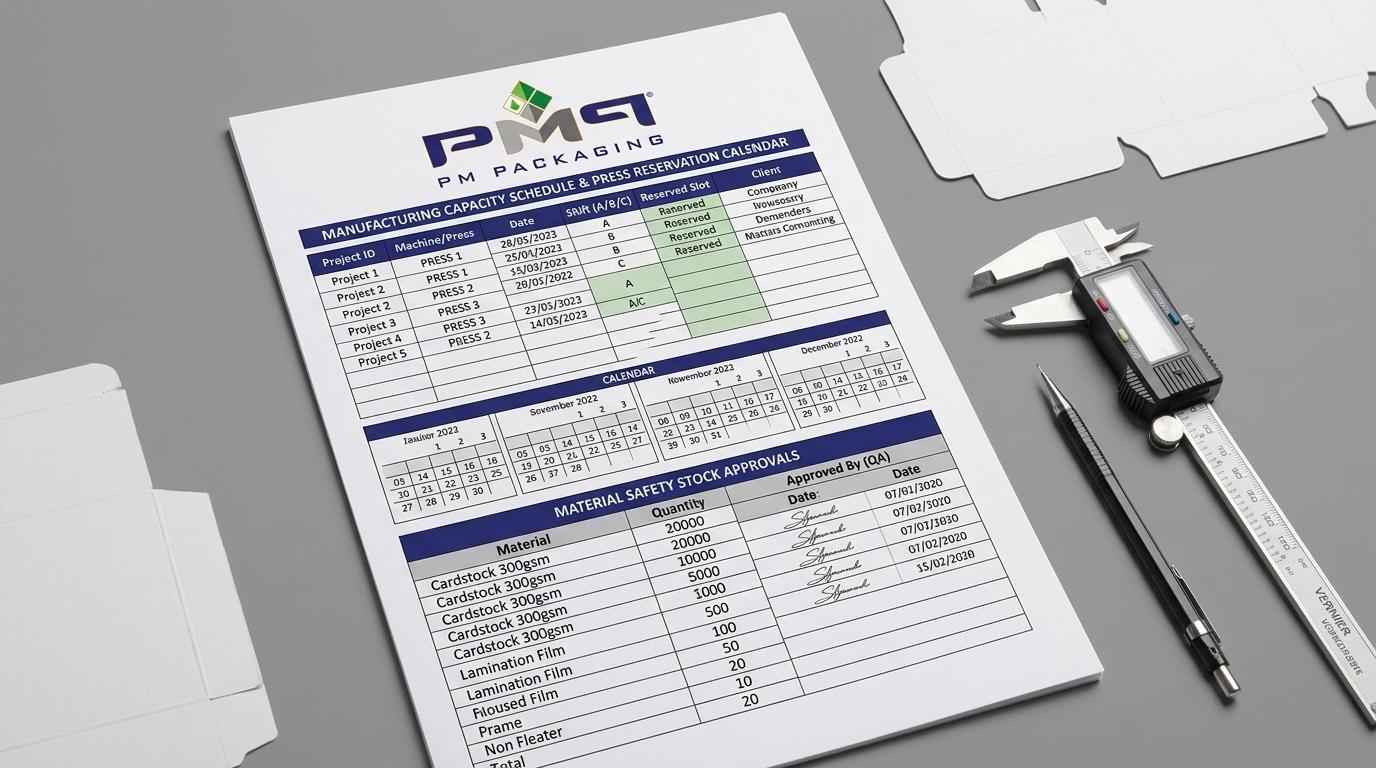
Dedicated capacity is a two-way commitment. A manufacturer can only reserve machine slots and allocate labor if the brand can provide reasonably reliable demand visibility.
Programs best suited for capacity reservation maintain structured forecasting tools:
- 12-Month Rolling Forecasts: Providing a macro view of anticipated monthly volume consumption.
- 90-Day Locked Production Horizons: Firming upcoming production batches so raw materials can be ordered and converting slots confirmed.
- SKU Demand Categorization: Distinguishing stable core SKUs from volatile promotional variants.
If demand is completely erratic and unforecastable, reserving fixed production blocks becomes inefficient for both the brand and the manufacturer.
Seasonal Peaks Can Create Scheduling Competition
During late summer and autumn, packaging manufacturers experience industry-wide surges in production demand as thousands of consumer brands prepare for fourth-quarter retail promotions.
On open scheduling boards, jobs compete directly with every other customer order. Under heavy scheduling pressure, open lead times can double, leaving late orders vulnerable to delays.
A structured capacity agreement incorporates seasonal peak requirements into annual production schedules early, ensuring that production hours are reserved before industry-wide capacity constraints peak.
High Replenishment Frequency Can Change the Economics
For brands with continuous product fulfillment, warehouse space is at a premium. Storing three months of finished cartons or corrugated displays consumes massive warehouse square footage and ties up working capital.
High replenishment frequency transforms the economic calculation:
- Frequent, Smaller Batches: Producing in synchronized 2- to 4-week cycles allows the brand to minimize packaging inventory carrying costs.
- Schedule Dependency: Because inventory buffers are lean, any production delay immediately threatens filling line continuity.
When inventory holding strategies shift toward lean replenishment, dedicated capacity provides the reliable production heartbeat necessary to prevent stockouts.
Stockout Consequences Matter
The justification for dedicated capacity is fundamentally an exercise in risk management. What happens to your enterprise if secondary packaging arrives 10 days late?
Low-Risk Scenario (Standard POs)
Internal warehouse re-boxing or secondary utility shippers where a slight delivery delay causes minor operational reshuffling but zero lost sales or retail penalties.
High-Risk Scenario (Dedicated Capacity)
Retail primary packaging or promotional display shippers where a delay shuts down automated contract filling lines, causes missed on-shelf dates, and incurs severe retail chargebacks.
When the financial consequence of an operational stockout dwarfs the administrative investment of capacity planning, reserving manufacturing time becomes a vital commercial safeguard.
SKU Complexity Can Consume Reserved Capacity Faster Than Expected
Reserving machine capacity requires calculating the impact of product variation. A dedicated 40-hour production block will produce far fewer finished cartons if the program includes 15 distinct SKUs requiring frequent plate washes and die changeovers.
When structuring dedicated capacity for complex portfolios, brands should evaluate:
- Changeover Dwell Time: Ensuring reserved blocks account for makereadies, ink changes, and tooling swaps.
- Structural Standardization: Standardizing dielines across product variants to maximize productive machine uptime.
For in-depth strategies on managing large multi-SKU print portfolios, read our guide on large-scale folding carton production with multiple print versions.
Material Planning May Need to Accompany Capacity Planning
Reserving press time provides no protection if raw paperboard or corrugated liners are sitting on backorder at a paper mill.
A complete capacity reservation strategy links machine scheduling directly to raw material availability:
Paperboard Mill Forecasting: Providing paperboard mills with projected monthly tonnage for SBS, CRB, or CUK substrates 60 to 90 days in advance.
Approved Substrate Alternatives: Pre-qualifying secondary board grades so production can proceed without delay if a primary paperboard grade faces extended mill lead times.
Staged Raw Inventory: Staging raw board at the converting facility ahead of reserved production windows.
Synchronizing raw material supply with converting schedules ensures that machine blocks operate at maximum efficiency.
Dedicated Capacity Does Not Replace Forecasting
Reserving manufacturing capacity is not an operational magic wand that eliminates the need for internal planning discipline. In fact, a dedicated capacity arrangement demands greater organizational rigor:
- Artwork Readiness: Approved artwork files, color targets, and prepress sign-offs must be finalized before the reserved machine block arrives.
- Timely Release Instructions: Production release quantities must be confirmed within agreed lead-time thresholds.
- Accountability for Idle Time: If a brand fails to release jobs for a reserved block, machinery sits idle, creating operational inefficiencies.
Dedicated capacity is a partnership model that succeeds through disciplined communication and mutual operational commitment.
When Dedicated Capacity May NOT Be Necessary
To ensure capital and resources are deployed effectively, brands should recognize when standard open purchase-order scheduling remains the superior choice:
Unpredictable Spot Demand: Programs where order timing is completely erratic and cannot be forecasted 60 days ahead.
Flexible Delivery Windows: Products that maintain substantial warehouse safety stocks and can tolerate delivery adjustments without operational disruption.
Standard Commodity Packaging: Standard brown master shippers or common stock boxes that are readily available from multiple regional suppliers.
One-Off Pilot Runs: Initial product trials or short test runs where long-term production requirements are still undefined.
For these operational profiles, the flexibility and zero-commitment nature of standard purchase orders provide better commercial agility.
A Practical Dedicated-Capacity Decision Matrix
Use this qualitative decision matrix to determine whether your packaging program characteristics align with standard scheduling or justify evaluating dedicated capacity:
| Program Characteristic | Standard Scheduling May Be Sufficient | Dedicated / Reserved Capacity Worth Evaluating |
|---|---|---|
| Demand Cadence | Occasional or irregular spot orders | Predictable recurring weekly/monthly releases |
| Forecast Visibility | Low or short-term (under 30 days) | High (rolling 90-day to 12-month visibility) |
| Retail Delivery Dates | Flexible warehouse delivery windows | Immovable planogram resets or launch dates |
| Peak-Season Exposure | Level demand year-round | Substantial Q3/Q4 volume concentration |
| Stockout Impact | Minor operational delay; low cost | Halted filling lines, lost sales, retail penalties |
| SKU Complexity | Low SKU count with minimal changeovers | Multiple SKUs with predictable changeovers |
| Material Needs | Readily available commodity substrates | Specialized board grades or long mill lead times |
| Replenishment Cadence | Infrequent (1-2 times per year) | Continuous (bi-weekly, monthly, or pull-based) |
Strategic Decision Matrix: Assess program characteristics to determine the appropriate capacity management model.
What to Define Before Discussing Capacity Reservation
Before initiating discussions with a packaging manufacturing partner regarding reserved capacity, assemble the following operational parameters:
- Projected annual demand and target order replenishment cadence
- Historical demand variability and projected peak monthly volume
- Complete active SKU count and shared dieline distribution
- Packaging structural formats (folding cartons, displays, SFL)
- Required paperboard substrates and specialty finish coatings
- Target retail distribution center arrival dates and launch milestones
- Internal forecast horizon (rolling 90-day, 180-day, or 12-month)
- Downstream packing line impact if packaging is delayed
Defining these parameters allows the packaging engineering team to structure production windows and material allocations tailored directly to your supply chain requirements.
Start With a Capacity Audit Before Reserving Capacity
Before exploring structured capacity reservations, procurement and operations teams must first verify that prospective converters operate the fundamental converting capacity and equipment balance to support your program.
Before discussing reserved production capacity, procurement should first verify the supplier's realistic available capacity, bottlenecks, and material constraints. Read our complete due-diligence framework on what procurement teams should know about packaging production capacity.
Planning a Packaging Program That May Need Dedicated Capacity
When structuring a commercial manufacturing partnership for high-volume consumer goods, collaborate closely with your packaging converter to align production schedules with demand realities:
An illustrative consumer brand consuming 100,000 packaging units every month with fixed quarterly promotional surges cannot afford the uncertainty of open-market scheduling queues. By defining recurring production windows, pre-allocating paperboard substrate stock, and establishing clear forecast horizons, brand owners convert supply chain vulnerability into reliable operational performance.
PM Packaging partners with commercial brands to engineer scalable folding cartons, single-face laminate corrugated packaging, and high-impact retail displays. Learn more about our manufacturing capabilities on our Folding Cartons and In-Store Displays solution pages.
Transform Packaging Capacity Into a Strategic Asset
When high-velocity consumer goods demand schedule certainty, moving beyond transactional open scheduling protects retail delivery windows and preserves product margins.
By aligning rolling forecasts with structured manufacturing windows and substrate availability, enterprise brands secure dependable packaging supply across every retail replenishment cycle.
Evaluating whether your high-volume packaging program justifies reserved manufacturing capacity? Contact PM Packaging to discuss your replenishment cadence, peak seasonal requirements, and production schedules. Our team can help structure an optimized manufacturing plan.