
Packaging production capacity should be evaluated as the amount of usable manufacturing time available for a specific program—not as a supplier's advertised machine speed or annual plant output.
Procurement needs to map the package through printing, laminating or finishing where applicable, die-cutting, folding/gluing or other converting steps, then determine which operation is most constrained during the required production window. SKU changeovers, material availability, existing production commitments and release timing can reduce usable capacity further. A credible RFQ response should therefore show how the supplier plans to fit the requested volume through the complete manufacturing route.
Technical capability answers whether a converter can manufacture the package. This audit assumes technical capability is already confirmed and focuses specifically on whether sufficient usable production capacity exists to deliver your volume on schedule.
Start With the Required Production Window, Not an Annual Capacity Number
When suppliers submit RFQ responses, they often quote impressive annual metrics: "We produce 250 million cartons annually" or "Our plant operates 150,000 square feet of converting capacity." To a procurement professional, these macro statistics provide little actionable insight.
An annual capacity figure does not prove that the converter has open machine hours during the specific three-week window when your product launch inventory must be converted. If a supplier's plant is running at 95% utilization with holiday retail programs during September and October, their theoretical annual volume is irrelevant to your October 1st launch deadline.
A rigorous capacity audit begins with your required operational parameters:
- Total Program Volume: Total units required for the initial award.
- Volume Breakdown by SKU: Distinct run quantities across each artwork and structural variant.
- Production Window: Specific calendar start and completion dates when converting must occur.
- Required Delivery Dates: When finished packaging must arrive at co-packers or filling lines.
- Staggered Releases vs. Single Run: Whether goods are delivered in one bulk shipment or drawn down across monthly releases.
Evaluating capacity against a defined calendar window anchors the sourcing discussion in real plant scheduling realities.
Map the Complete Manufacturing Route for the Package
Commercial packaging manufacturing is not a single process; it is a sequence of discrete, interconnected machine operations. A folding carton or SFL box must travel through several machine centers before becoming a finished container.
| Production Step | Required for This Package? | Capacity Question to Ask |
|---|---|---|
| Pre-Press & Plate Making | Varies by artwork status | Are approved digital art files, color separations, and plates ready before press scheduling? |
| Sheetfed Offset / Flexo Printing | Yes | How many net press hours are required, and what open press time exists in the requested window? |
| Single-Face Lamination (SFL) | Where fluted strength is specified | Does laminating printed sheets to single-face corrugated web create a separate scheduling bottleneck? |
| Specialty Finishes (Foil, UV, Emboss) | Where decorative finishes are required | Does off-line foil stamping or screen coating add extra machine passes to the production timeline? |
| Flatbed / Rotary Die-Cutting | Yes | Is die-cutting capacity more constrained than press time, and is the cutting die verified? |
| Window Patching | Where product windows are specified | Does window patching equipment have available open line hours before cartons move to gluing? |
| Folder-Gluing / Converting | Yes | Can finished blanks move through high-speed folder-gluers within the requested schedule? |
| Kitting & Fulfillment | Where pack-out is included in scope | If display assembly or contract packing is part of the award, does labor capacity match? |
Mapping this route allows procurement to pinpoint exactly which machine center dictates the true pace of production.
The Bottleneck Determines Effective Capacity
A fundamental principle of manufacturing operations is that the total throughput of any multi-stage converting system is strictly governed by its slowest or most constrained operation—the bottleneck.
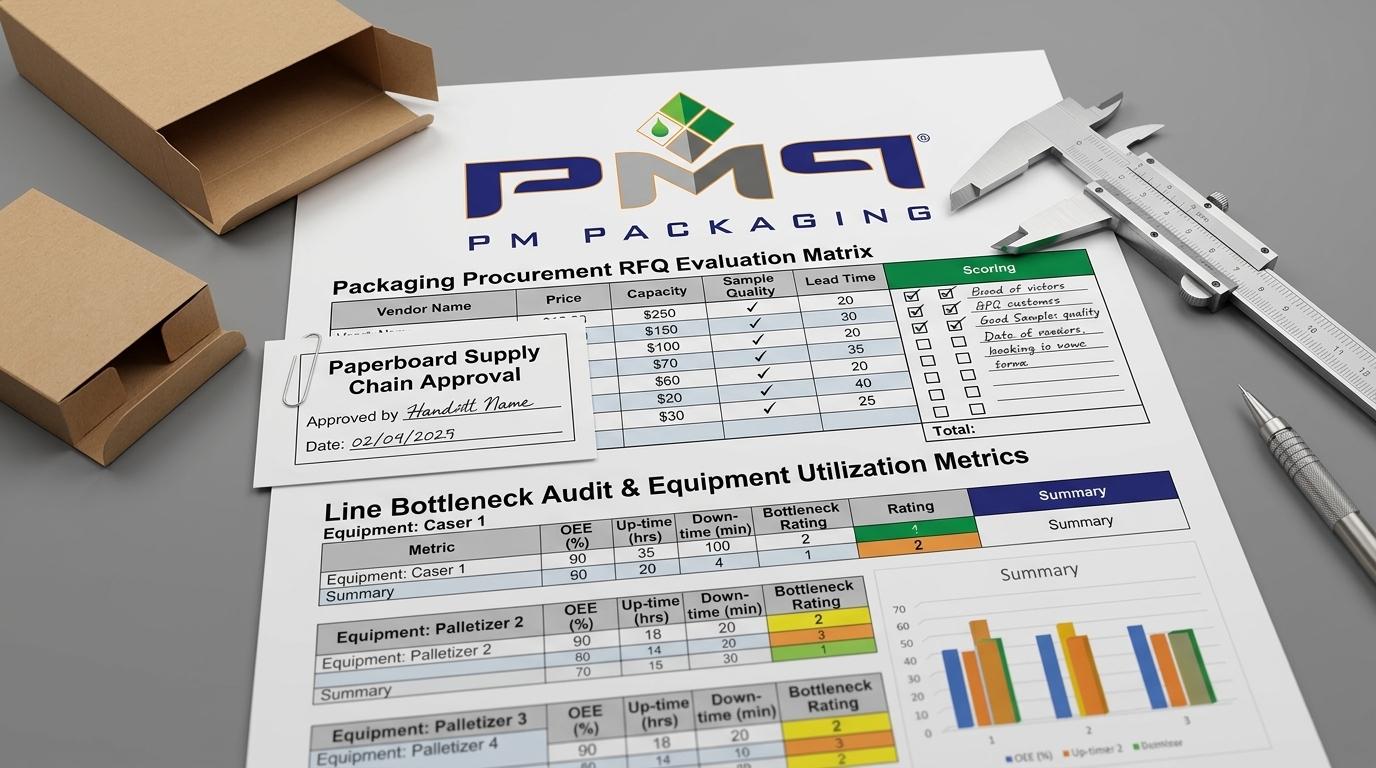
In packaging procurement, buyers frequently audit the printing press and assume that if press time is open, the job will finish on schedule. In practice, printing is rarely the primary constraint in a modern converting facility. A supplier may have 40 open hours on a 6-color offset press, but their high-speed folder-gluers or precision flatbed die-cutters may be backlogged with work for the next four weeks.
If printed sheets sit on staging skids waiting for an open die-cutter, production halts. Effective capacity must therefore be measured at the bottleneck operation for that specific package structure.
Distinguish Theoretical Capacity From Available Capacity
To evaluate supplier proposals objectively, procurement teams must distinguish between theoretical machine capacity and actual usable capacity:
- Theoretical Capacity: What a machine could produce if it ran at maximum rated speed 24 hours a day, 7 days a week, with zero setup time, zero maintenance, and zero scrap. This metric is purely aspirational.
- Available Capacity: The realistic manufacturing time remaining on a specific machine center during your designated production window after subtracting existing committed jobs, scheduled preventive maintenance, make-ready setups, and planned shift breaks.
Conceptual Available Capacity Framework
Available Production Window (Hours)
– Existing Committed Client Jobs
– Scheduled Preventive Maintenance & Cleaning
– Estimated Setup & Make-Ready Time (by SKU)
– Planned Downtime & Shift Transitions
= Potentially Usable Capacity for the Program
Asking suppliers to frame their capacity around net available machine hours separates realistic partners from over-promising vendors.
Multi-SKU Programs Consume Capacity Through Changeovers
One of the most common oversights in packaging procurement is treating volume aggregates as uniform production runs. Producing 200,000 units of a single folding carton is an entirely different operational task than producing 200,000 units split across twelve distinct product SKUs.
In a multi-SKU program, machine changeovers consume a significant portion of total production time:
- Press Wash-Ups & Plate Changes: Swapping printing plates, re-aligning color registration, and re-balancing ink densities for each artwork variant.
- Die-Cutting Make-Readies: Re-positioning cutting dies, leveling counter plates, and setting up waste stripping pins.
- Folder-Gluer Adjustments: Re-configuring folding belts, glue guns, and compression aprons for differing carton profiles.
If an RFQ contains multiple SKUs, procurement must require suppliers to account for changeover durations in their production plan. A supplier that assumes zero setup downtime between variants will fall behind schedule on the plant floor.
Ask for Capacity by Bottleneck Operation, Not Only by Press
When issuing an RFQ or conducting supplier interviews, structure your capacity questions around the constrained converting centers rather than generic press speeds.
High-value procurement questions include:
- "Based on this carton dieline and flute profile, which machine center in your plant represents the bottleneck operation?"
- "How many net production hours are scheduled for that specific machine center during our required three-week production window?"
- "How many total changeovers are planned for our SKU assortment, and how many hours of setup time have you budgeted?"
- "If this program requires off-line foil stamping or window patching, are those machine centers owned internally or outsourced?"
Probing downstream converting operations ensures that the supplier has evaluated the complete manufacturing sequence required to deliver your goods.
Material Lead Time Can Reduce Effective Capacity Even When Machines Are Open
Converting capacity is useless without substrate on the floor. A packaging supplier may have completely clear press and die-cutting schedules, but if the specified 20pt SBS paperboard or specialty holographic foil requires four weeks for mill delivery, production cannot begin.
Procurement teams must audit raw material timing:
- Is the specified paperboard or linerboard stock kept in standard inventory, or is it custom-ordered from the paper mill?
- What is the confirmed mill lead time for the raw substrate, including freight to the converting facility?
- When is the absolute latest date that purchase orders and final artwork approvals must be released to ensure board arrives before the scheduled press window?
- Does the converting schedule include sufficient buffer to allow paperboard sheets to acclimatize to plant humidity before printing?
Verifying raw material delivery dates ensures that scheduled machine time translates into actual converted packaging.
Evaluate the Release Pattern, Not Only the Total Award
How your organization plans to pull finished packaging significantly alters the required manufacturing capacity. Procurement must clearly communicate the expected delivery schedule in the RFQ scope:
- Single Launch Run: 100% of the volume converted and delivered at once, requiring a dedicated, contiguous block of press and die-cutting time.
- Staggered Monthly Releases: A master production run manufactured and held in regional warehousing, with scheduled releases delivered to co-packers weekly.
- Rolling Short-Run Production: Continuous smaller production runs converted dynamically against monthly rolling forecasts.
Clarifying release expectations allows the supplier to model whether the program requires a single massive capacity allocation or an ongoing, balanced production cadence.
What Capacity Evidence Should Procurement Request in an RFQ?
Rather than accepting vague verbal assurances that "capacity will not be an issue," procurement should require specific operational commitments in the supplier's RFQ response.
| Capacity Question | Why It Matters | Acceptable Supplier Response |
|---|---|---|
| Proposed Manufacturing Route | Identifies every required machine center | Step-by-step process outline from pre-press to finished converting |
| Identified Bottleneck Operation | Confirms supplier understands the narrowest constraint | Program-specific analysis of the most constrained machine center |
| SKU Changeover Allowance | Measures realistic setup burdens across variants | Documented changeover time assumptions and run sequencing plan |
| Raw Material Lead Times | Verifies substrate availability against schedule | Confirmed paperboard or corrugated delivery dates from partner mills |
| Proposed Production Window | Connects available machine hours to delivery dates | Firm calendar production window with confirmed release dates |
| Program Constraints & Assumptions | Reveals operational risks before award | Clearly stated assumptions regarding artwork sign-off, proofs, and release sizes |
Requiring documented assumptions eliminates ambiguity and creates mutual accountability before commercial agreements are executed.
Capacity Should Be Evaluated Against a Real Production Specification
A capacity audit is only as reliable as the technical brief provided by the buyer. If procurement issues a vague inquiry asking for pricing and capacity on "500,000 folding cartons" without providing CAD dielines, caliper specifications, or print finish requirements, the supplier's capacity model is purely speculative.
To obtain a dependable capacity plan, procurement should provide:
- Validated structural CAD dielines with exact dimensions and glue flap geometry.
- Specified paperboard or corrugated substrate grades and calipers.
- Number of process and spot colors, coatings, and specialty foil or emboss embellishments.
- Exact SKU breakdown, version counts, and anticipated reorder frequencies.
- Pack-out methods (automated cartoner vs. manual loading) and shipping configuration.
Clear technical specifications allow converters to simulate exact press sheet layouts, number of die cavities per sheet, and accurate machine running hours.
Pilot Production Can Validate Assumptions Before a Large Award
Where program scale and timeline permit, executing a representative pilot production run before authorizing mass production provides invaluable operational validation.
A pilot run allows both procurement and the converter to:
- Measure actual make-ready times against pre-bid estimates.
- Verify true die-cutting speeds and blank stripping accuracy.
- Test converted carton feeding and glue seam behavior on live contract packaging lines.
- Identify unforeseen converting friction before hundreds of thousands of units are converted.
Validating machine behavior on a smaller test batch prevents costly surprises during high-volume commercial execution.
Capacity Risk Changes During Seasonal Peaks
Production capacity in the commercial packaging industry fluctuates heavily throughout the calendar year. The late summer and autumn months (August through November) represent the industry's peak converting period, driven by holiday retail build-ups, back-to-school drives, and annual promotional sets.
If your program's manufacturing window falls squarely into this seasonal surge, procurement must audit capacity with heightened rigor. Plant schedules that appear open in March may be completely committed by September. Confirming formal production windows well in advance of peak season protects your launch from being bumped by existing annual contracts.
Do Not Substitute “Equipment Redundancy” for a Capacity Plan
Suppliers often reassure buyers by highlighting equipment redundancy: "We operate two identical presses and two die-cutters, so your capacity is guaranteed." While equipment redundancy is valuable for business continuity and disaster recovery, it is not a substitute for a scheduled capacity plan.
If both redundant presses are already booked with work for other clients, having two machines does not solve your scheduling constraint. Redundancy provides operational insurance against mechanical breakdown; it does not create unallocated production time out of thin air.
Procurement must evaluate how the supplier intends to schedule the work across its active fleet rather than assuming redundancy equates to open availability.
Example: Evaluating Capacity for a Multi-SKU Folding Carton RFQ
Consider an enterprise consumer products brand evaluating suppliers for an upcoming retail program requiring 300,000 folding cartons divided across six SKUs (50,000 units each), sharing a common 18pt SBS substrate and straight-tuck footprint.
The procurement team conducts a structured capacity audit:
- Route Mapping: The converting sequence is mapped: sheetfed offset printing (6 colors + aqueous coating) → flatbed die-cutting → high-speed folder-gluing.
- Bottleneck Identification: While the supplier operates two large-format presses with ample open time, their high-speed folder-gluers are operating near peak capacity. The folder-gluer is identified as the critical constraint.
- Changeover Calculation: The six SKUs share a single common cutting die, eliminating die changeovers. However, five print plate changes and five folder-gluer setup adjustments are required. The supplier budgets four hours of make-ready time into the schedule.
- Substrate Verification: The supplier confirms that standard 18pt SBS is held in master inventory, eliminating paper mill lead-time delays.
- Window Commitment: The supplier reserves a specific five-day converting block in late August, guaranteeing delivery to the brand’s co-packer by September 10th.
By auditing the bottleneck, calculating changeovers, and verifying substrate availability, the procurement team awards the business with full confidence in production feasibility.
Questions Procurement Should Ask Before Awarding Capacity
Before awarding a high-volume packaging contract, review this critical capacity checklist:
- What is the proposed manufacturing route for this specific package structure?
- Which converting step represents the bottleneck operation?
- How many net available machine hours are open on that bottleneck during our required production window?
- How much make-ready and changeover time has been budgeted for our SKU assortment?
- What is the confirmed mill delivery lead time for our specified paperboard or linerboard?
- What specific calendar dates are proposed for printing, die-cutting, and gluing?
- Does the converting schedule conflict with seasonal retail production surges?
- What operational assumptions could cause the proposed schedule to shift?
- If contract packing or kitting is included in scope, does assembly labor match the output?
Supplier Qualification Is a Separate Decision
Confirming that a packaging converter has sufficient machine time during your required production window is essential, but capacity alone does not prove the supplier is ready to manage an enterprise-scale program.
A converter with open machines can still fail if its specification governance is loose, tooling records are disorganized, quality inspection is inconsistent, or program communication is opaque. To evaluate a packaging manufacturer's complete operational system, read our comprehensive guide on qualifying a packaging supplier for national-scale production.
Audit the Capacity Required by the Actual RFQ
Rigorous packaging procurement looks beyond aggregate plant claims to examine the specific manufacturing path your package must travel. By identifying downstream bottlenecks, calculating SKU changeover burdens, and verifying raw material lead times against firm production windows, sourcing leaders protect their organizations from costly launch delays and secure reliable manufacturing partnerships.
Discuss your packaging specification, quantity by SKU, required delivery dates, production cadence, materials and finishing requirements with PM Packaging so the program can be evaluated against an appropriate manufacturing route.