
Some products reach a point where a conventional folding carton no longer provides the desired stiffness or dimensional stability, but the brand still needs the package to look like polished retail packaging rather than transportation corrugated.
The packaging problem is therefore not simply: "How do we make the carton stronger?" It is: "How do we add structural performance while protecting the visual brand experience?" When a package must support substantial physical weight, wider panel dimensions, or complex internal components, standard paperboard often bends or buckles, yet transitioning to industrial brown corrugated sacrifices the photographic imagery and crisp retail typography essential to consumer sales.
Single Face Lamination (SFL) resolves this fundamental tradeoff. By uniting a flat, high-definition printed retail-facing liner with an engineered fluted structural medium, SFL provides the structural depth and panel stiffness of corrugated board alongside the refined graphic fidelity of premium folding cartons.
This article explores how packaging engineers and brand managers harmonize physical strength with high-end retail presentation across the individual retail package.
Why Structural Performance and Retail Presentation Can Compete
In consumer packaging design, engineering priorities and marketing ambitions frequently pull in opposite directions:
Engineering & Operations
- Panel stiffness and deflection resistance
- Dimensional stability under handling
- Internal product retention and fit
- Transit durability and impact dissipation
Brand & Marketing
- Photographic reproduction fidelity
- Crisp typography and color consistency
- Specialty finishes and tactile coatings
- Expansive graphic billboard surfaces
The commercial package has to satisfy both stakeholders. A structurally rigid box that looks industrial and dull fails on the retail shelf; an aesthetically breathtaking carton that bows, splits at the score lines, or sags when lifted by the shopper fails just as decisively.
When Folding Carton Structure Starts to Become Limiting
Solid paperboard substrates—such as Solid Bleached Sulfate (SBS) and Folding Boxboard (FBB)—offer exceptional print smoothness and clean die-cutting for compact, lightweight goods. However, as packaging requirements scale upward, paperboard exhibits distinct physical limits.
Key indicators that a folding carton is reaching its structural limits include:
- Increasing Package Dimensions: As face panels expand, the unassisted beam stiffness of solid paperboard decreases rapidly across wider spans.
- Larger Unsupported Panels: Broad surfaces without internal reinforcement become prone to dishing inward under fingertip pressure.
- Increased Product Weight: Heavier products exert continuous static pressure on bottom panels and side closures, causing creases to fatigue.
- Sidewall Bowing: Vertical walls bow outward when products shift during handling, disrupting retail planogram alignment.
- Need for Additional Internal Support: When heavy accessories, multi-piece kits, or internal batteries require rigid partitioning that paperboard cannot support.
For an in-depth exploration of when to transition from standard folding cartons to laminated structures, see our companion guide on when a brand should consider Single Face Lamination.
How SFL Combines a Printed Surface With Fluted Structure
Single Face Lamination operates by joining two distinct material layers into a unified board:
The Printed Liner
The outer layer is an independently sheet-fed paperboard liner. Because it is printed prior to lamination on sheet-fed offset presses, it delivers rich color reproduction, tight registration, and flawless surface finishes without the washboard ridges characteristic of direct-print corrugate.
The Fluted Layer
Beneath the printed liner lies an exposed single-face corrugated structure composed of an interior liner and fluted wave medium. The arches of the fluting introduce structural depth, high bending stiffness, and impact dampening without the excessive mass of solid fiberboard.
This combination proves especially valuable when neither lightweight paperboard alone nor transportation-oriented corrugated alone matches program requirements. Fine microflutes—such as F-flute and E-flute—maintain a sleek folding-carton profile while substantially elevating panel rigidity.
Large Graphic Panels Create Structural Challenges
In modern retail environments, large package surfaces provide valuable graphic real estate. Brands utilize wide face panels for lifestyle photography, detailed feature diagrams, technical specifications, and regulatory messaging.
However, larger panels are structurally vulnerable. Without sufficient internal stiffness, expansive printed surfaces are susceptible to:
- Bowing and Dishing: Broad panels flex inward or outward under slight handling pressure, distorting printed artwork and logos.
- Warping From Environmental Moisture: Changes in ambient retail humidity can cause asymmetrical expansion between outer ink layers and inner board fibers.
- Loss of Carton Squareness: Unsupported large faces compromise 90-degree corner folds, resulting in cartons that look trapezoidal or misaligned on retail shelves.
Coordinating structural geometry with graphic design ensures that broad printed panels remain optically flat, crisp, and dimensionally stable throughout the retail life cycle.
Design the Structure Around the Loaded Product
A carton that appears pristine when empty may deform completely once the actual product is placed inside. Packaging engineers must design the structural architecture around the physical characteristics of the loaded item:
- 1Product Weight & Center of Gravity: Heavy or off-center internal components (such as motors, power bricks, or metal hardware) exert concentrated forces that cause package tipping or sidewall strain.
- 2Load Concentration Points: Protruding brackets, knobs, or feet direct product momentum onto tiny surface areas, risking punctures through outer liners.
- 3Product Orientation: Orienting the product inside the carton to align with the fluting direction ensures that natural product stiffness complements rather than opposes package geometry.
The essential design standard is straightforward: The package must remain visually presentable after the product is loaded and handled.
Use Inserts Where Structural Support and Presentation Intersect
Within an individual retail package, internal inserts are not mere void fill; they are the primary structural bridge between the product and the outer carton walls.
For high-performance retail packages, custom SFL or corrugated inserts deliver critical functions:
- Product Positioning: Locking the hero product firmly in the visual focal center of the package for a deliberate, premium reveal upon opening.
- Movement Control: Eliminating internal shifting that could cause friction wear or impact damage against the outer carton.
- Interior Organization: Housing cables, accessories, hardware packets, and documentation in dedicated sub-compartments.
- Panel Support: Backing wide display panels from the inside, preventing inward flexing when consumers pick up the box from retail shelves.
By utilizing clean bleached white microflute or printed liner inserts, brands create an unboxing presentation that reinforces the exterior branding.
Branding Features Must Be Considered Structurally
Distinctive visual branding features enhance retail appeal, but each feature alters the carton's physical geometry:
Die-cut apertures that showcase the physical product remove structural material from the display face. When placed near corners or edges, they can cause localized panel buckling under load.
Plastic or die-cut board handles allow convenient consumer transport for bulky items, but they concentrate dynamic lifting tension into small panel zones that require internal reinforcement tabs.
Beveled edges, curved score lines, or multi-faceted panels create distinctive retail silhouettes, but require careful dieline engineering to avoid weakening primary folding hinges.
These features are often highly effective for retail conversion; the key is evaluating their structural consequences during early dieline development rather than patching weaknesses after production.
Select Finishes That Work With the Structure
Specialty coatings and tactile embellishments elevate brand perception, but they must be selected to endure the realities of high-volume converting, folding, and retail handling:
- Scuff-Resistant Aqueous Coatings: Satin or matte aqueous finishes protect heavy ink coverage from rubbing during packing and transit, while reducing glare under bright retail aisle lighting.
- Spot Gloss UV Effects: Applying high-gloss UV selectively over brand logos or product photography creates rich visual contrast while maintaining a durable, slip-resistant matte background.
- Foil Stamping & Embossing: Metallic foils add luxury cues, but should be positioned away from major folding scores where die pressure and heat could fracture board fibers.
Maintain Graphic Consistency at Commercial Scale
In large retail programs, packages are produced across high-volume press runs. Preserving consistent brand appearance across repeated production requires rigorous prepress and pressroom controls:
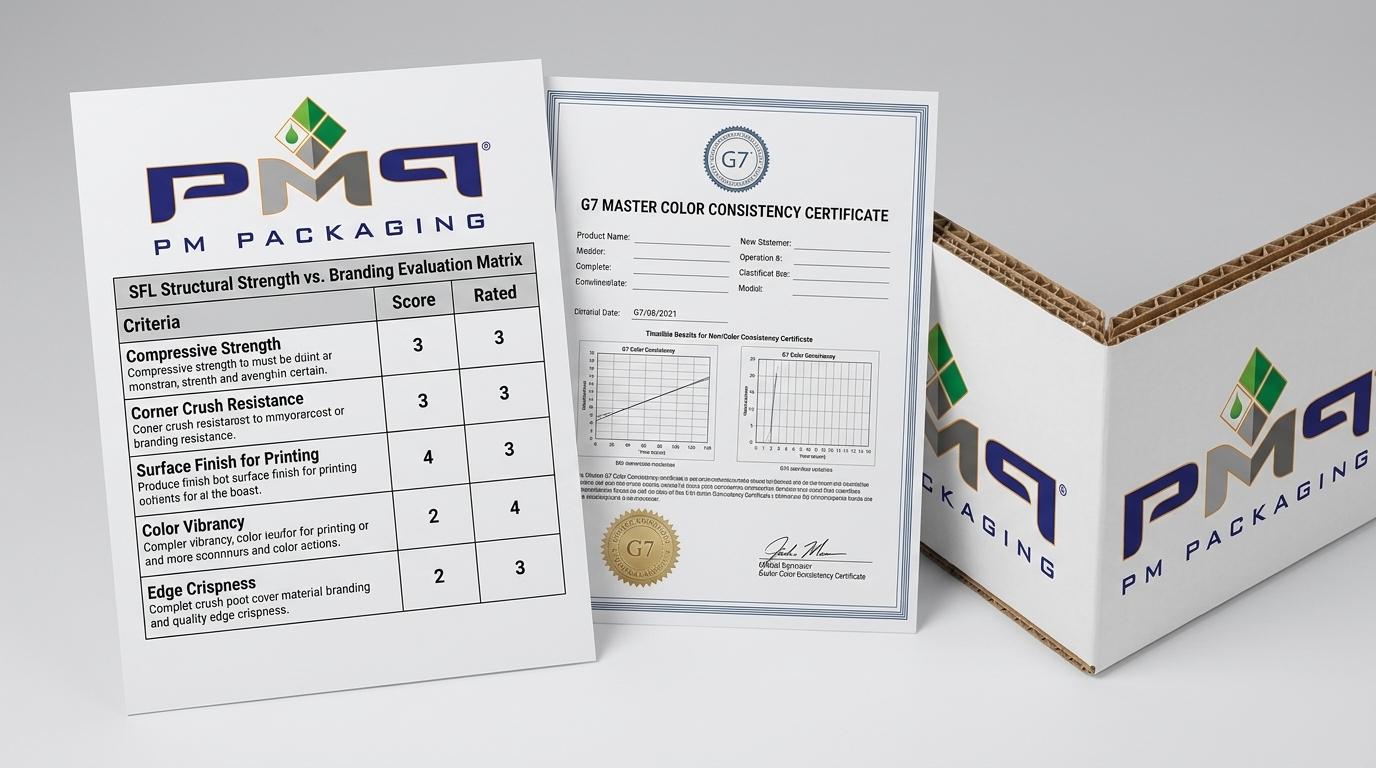
- Approved Physical Color Targets: Standardized print targets and drawdowns ensure ink color matches approved brand standards across separate manufacturing lots.
- Sheet-to-Board Lamination Registration: Precision optical alignment ensures printed typography, borders, and logos register accurately with die-cut scores and perimeter edges.
- Liner Substrate Uniformity: Consistent paperboard brightness and coating holdout prevent unexpected shifts in gloss or ink absorption between production batches.
More Structure Should Not Automatically Mean More Material Everywhere
When a prototype carton exhibits flex or handling weakness, a frequent mistake is to indiscriminately add material throughout the entire package—upgrading to heavier flute profiles, adding thick double-wall layers, or increasing paper caliper everywhere.
Indiscriminate over-engineering inflates packaging costs, increases shipping mass, and makes folding flaps stiff and difficult to assemble. Instead, structural performance is most efficiently enhanced through targeted engineering:
- Optimized Flute Profile: Selecting fine E-flute or F-flute provides the necessary beam strength without bulky, heavy board calipers.
- Localized Flap Reinforcement: Doubling board layers only at high-stress locking tabs or carry points while keeping broad panels lightweight.
- Load-Distributing Inserts: Transferring internal stresses to vertical corners rather than forcing the outer box to carry all product weight.
To explore the operational strategies for optimizing material efficiency at scale, see our guide on how high-volume SFL programs balance board strength and shipping weight.
Structural Performance Cannot Destroy the Retail Experience
A package can technically survive rigorous handling, but if the consumer requires utility blades, struggles with tear-away panels, or damages the box trying to open it, the brand experience is damaged at the moment of truth.
Balanced structural engineering prioritizes consumer convenience alongside strength:
- Engineered Perforations & Tear Strips: Clean, easy-opening tear strips that unseal reinforced flaps without shredding printed graphics.
- Intuitive Thumb Notches: Subtle, accessible cutouts that signal where to open the carton without requiring prying fingers.
- Reclosable Tuck Features: Enabling consumers to reuse the sturdy retail box for organized home or workshop storage.
Illustrative Example: Balancing Strength and Branding for a Premium Retail Package
Consider an illustrative commercial scenario: A consumer brand is launching a premium retail countertop appliance requiring an expansive 16-inch display face, high-contrast photography, and an internal insert to support a concentrated product load.
The Packaging Challenge
- • Panel Span: Broad 16" x 12" front graphic billboard.
- • Product Weight: Concentrated internal component causing localized strain.
- • Folding Carton Limit: Prototype paperboard carton exhibited front panel dishing and score fatigue when handled.
- • Retail Goal: Flawless photographic gloss presentation on department store shelves.
The SFL Solution
- • Outer Carton: E-flute SFL with a coated sheet-fed litho liner.
- • Surface Finish: Scuff-resistant satin aqueous coating with spot UV.
- • Internal Support: Microflute insert securing the concentrated component and backing the front face.
- • Flute Orientation: Vertically oriented to eliminate panel bowing.
The result: Panel dishing was eliminated, the package maintained crisp 90-degree corners, and the printed graphics presented a pristine, luxury retail appearance on the shelf.
*Note: Figures are conceptual and illustrative of packaging engineering principles, not contractual guarantees.
When Pallet Stacking Becomes the Primary Structural Risk
Package-level stiffness and warehouse pallet compression are fundamentally different engineering challenges. If your primary structural failures involve lower cartons crushing in transit, cumulative vertical pressure across pallet tiers, master-case deformation, or extended warehouse stacking, the package cannot be solved in isolation.
If cumulative master-case and pallet loads become the primary structural risk, package-level stiffness alone is not enough. The package, case and pallet should be evaluated as one compression system.
See our complete technical guide to SFL packaging for pallet stacking and vertical compression to learn how load paths move through the entire packaging-to-pallet system.
Planning SFL Packaging That Needs Both Strength and Branding
Developing an SFL packaging program that harmonizes structural performance with premium retail branding requires gathering key program specifications:
- Loaded product dimensions, total weight, & center of gravity
- Target retail package dimensions & shelf facing requirements
- Desired graphic billboard areas & photography specifications
- Brand color targets, PMS spot colors, & visual hierarchy
- Internal insert positioning, accessory layout, & reveal stages
- Surface finish preferences (matte, gloss, spot UV, foil stamping)
- Product load concentration points & internal contact surfaces
- Anticipated production volume & replenishment schedules
- Retail distribution channels & handling environments
- Appropriate flute profile & liner substrate selection
PM Packaging works directly with consumer brands to engineer custom Single Face Lamination packaging that delivers both structural stiffness and high-impact retail presentation. Learn more about our manufacturing capabilities on our Single Face Lamination solution page.
Engineer SFL Packaging for Strength and Branding
Packaging should never force a compromise between structural reliability and brand presentation.
By unifying high-resolution offset lithographic printing with engineered corrugated fluting, Single Face Lamination enables brands to protect heavy and bulky products while commanding premium retail presence at commercial scale.
Planning a large-scale SFL package that needs to combine strength with high-quality branding? Contact PM Packaging to discuss your product specifications, retail requirements, and manufacturing volumes. Our structural and graphic engineering teams can help bring your packaging program to life.