
An SFL carton may appear structurally sound as an individual unit but behave very differently near the bottom of a loaded master case or pallet.
In large-scale retail distribution, lower packages do not experience downward forces in isolation. They endure cumulative, sustained vertical load generated by cartons stacked above, corrugated master shippers, multiple pallet tiers, and extended warehouse storage dwell time. The primary engineering question is not: "Is this carton strong?" It is: "Where does the vertical load move through the complete packaging system?"
Single Face Lamination (SFL) provides a robust combination of offset litho print quality and fluted board structure. However, preventing lower-tier package crushing across commercial supply chains requires examining the entire vertical load path from the top pallet layer down to the pallet deck boards.
This technical guide analyzes how the primary retail carton, internal insert, master shipper, and pallet pattern function as an integrated structural system to withstand vertical compression at scale.
Stacking Performance Is a System Property
Vertical compression strength cannot be reduced to board weight or material caliper alone. Increasing the flute thickness of an individual retail carton will not prevent bottom-tier damage if the master case has excessive void space, or if the pallet pattern causes corner columns to hang unsupported.
True stacking performance depends on the interaction of multiple interdependent variables:
- Internal product dimensions, rigidity, and weight distribution
- Individual SFL primary carton dieline and vertical panel geometry
- Internal insert structural alignment and vertical load-bearing capacity
- Master shipping case dimensions, board grade, and dimensional fit
- Case pack count and orientation of primary packages within the shipper
- Pallet pattern configuration (column-aligned vs. interlocked layers)
- Pallet stacking height and cumulative tier weight
- Warehouse dwell time, ambient humidity, and storage conditions
When bottom-tier cartons deform, the solution is rarely to simply purchase heavier board throughout. It requires identifying exactly where vertical forces are breaking through the packaging system.
Map the Vertical Load Path
Every pound of downward pressure from stacked pallets must find a physical path to the ground. In packaging engineering, mapping the vertical load path means tracing how gravity and dynamic transit vibrations travel through each physical layer of the assembly.
In an engineered distribution system, vertical forces transfer through:
- Master Case Vertical Corners: The four vertical corners of the corrugated shipping container carry up to two-thirds of the case's total top-to-bottom compression resistance.
- Primary Carton Vertical Corners: When cartons are tightly nested within the master case, the vertical corners of the primary SFL cartons act as rigid internal columns.
- Vertical Insert Walls: Internal partitions and folded support pedestals that transfer load from the top of the retail carton directly to the base.
- Product Contact Points: Rigid internal products (such as metal bodies or chassis) that naturally resist compression when properly cradled.
The governing principle of load-path engineering: The packaging system should transfer vertical force through structurally aligned corners and reinforced vertical columns, rather than allowing compressive weight to rest on unsupported horizontal panels.
Corners and Vertical Panels Often Matter More Than Broad Faces
In distribution packaging, vertical corners provide disproportionate structural stability. When a box is subjected to top-to-bottom compression, the broad face panels tend to bow outward or dish inward long before the folded 90-degree corners yield.
Key structural geometry factors include:
When individual retail carton corners align directly underneath the vertical walls or corners of the carton above, vertical force flows cleanly through reinforced paperboard columns.
Tall, slender carton walls buckle under lower loads than square, compact panels. Incorporating internal step-scores or stiffening flanges helps broad vertical panels resist lateral deflection.
Placing large die-cut display windows, cutouts, or perforation lines across or adjacent to vertical corner scores fractures the primary load path and causes premature corner collapse.
Flute Orientation and Structural Geometry Affect Stack Behavior
In fluted packaging, board physics are highly anisotropic: corrugated media possesses substantially greater compression strength parallel to the flutes than perpendicular to them.
How flute choices affect stacking performance:
- Vertical Flute Alignment: To maximize top-to-bottom compression resistance, flutes must run vertical—parallel to the height dimension of the carton. Horizontal flute orientation severely compromises vertical stacking capability.
- Flute Profile Characteristics: B-flute provides greater vertical arch height and cushioning for heavy goods, while E-flute provides a tighter pitch that offers high panel crush resistance and a smoother printed surface.
- Unsupported Span Limits: As panel width increases relative to height, fluting alone cannot prevent center dishing without internal insert backing.
These structural factors interact dynamically. Selecting an appropriate flute profile must be evaluated in conjunction with panel dimensions, product geometry, and master case configuration.
Inserts Can Participate in the Vertical Load Path
While individual retail packages utilize inserts primarily for product positioning and presentation, in a stacked distribution environment, inserts can be intentionally engineered to participate in the vertical compression structure.
Load-bearing insert mechanisms include:
- 1Vertical End-Support Columns: Folded corrugated end-caps that span the full interior height of the carton, transferring downward force directly from the top lid to the bottom panel.
- 2Internal Center Partitions: Dividing inserts that act as internal load-bearing walls, cutting broad, unsupported panel spans in half and preventing center-panel dishing.
- 3Folded Platform Bridges: Engineered platforms that cradle the product while locking against carton sidewalls, converting downward shock into lateral tension.
An insert only improves stacking performance when it is deliberately designed with vertical column alignment. If an insert collapses or folds under downward pressure, it provides zero compression benefit to the outer box.
The Master Case Is Part of the Compression System
A structurally adequate retail carton can still arrive crushed at retail if its master shipping case fails to support it correctly. The master shipper is not merely an outer wrapper; it is the outer structural chassis of the distribution pack.
Critical master-case design parameters include:
- Eliminating Internal Void Space: Any empty headroom between the top of primary cartons and the master-case top flaps allows the master shipper to deform before the internal cartons can engage their own structural strength.
- Dimensional Nesting & Fit: Primary cartons must fit snugly within the shipper. Loose fitting allows primary cartons to tilt off-axis, disrupting vertical column alignment.
- Primary Carton Orientation: Arranging retail cartons upright inside the case so their vertical flutes and corners align with the master case's vertical walls creates a composite load-bearing structure.
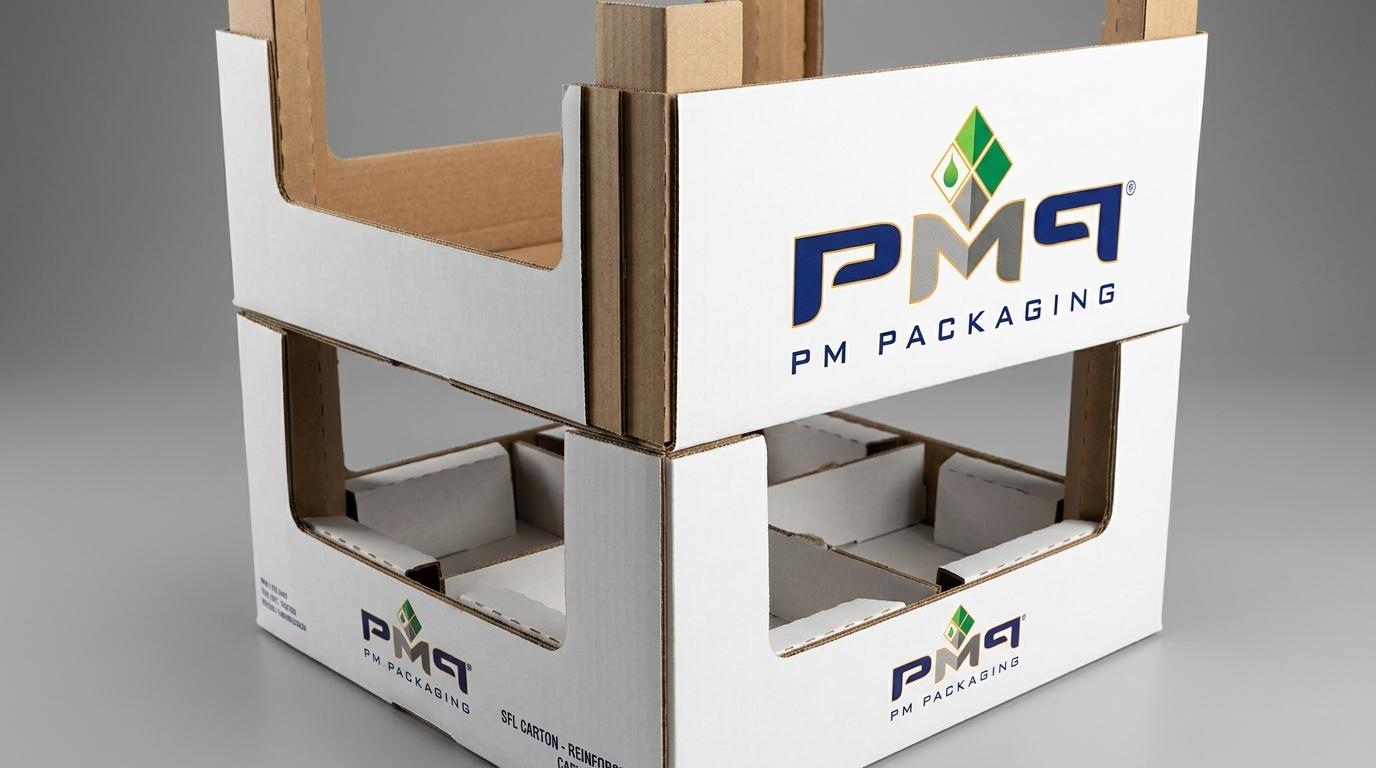
Pallet Pattern Changes How Vertical Load Is Distributed
How cases are arranged on the pallet footprint directly dictates how compression forces are transmitted through the stack:
Column-Aligned Stacking
Cases are stacked directly on top of one another with corners aligned. This configuration maximizes vertical compression resistance because corner columns bear down directly on the corners beneath them. However, column stacks require stretch-wrapping or strapping to maintain pallet stability during transport.
Interlocked (Cross-Stacked) Pattern
Cases are rotated layer by layer to interlock like brickwork. This provides superior pallet stability and prevents shifting during transit. However, interlocking places the vertical corners of upper boxes over the weaker center panels of lower boxes, substantially reducing effective compression strength.
Neither pattern is universally superior; the optimal configuration depends on whether transit stability or warehouse stacking compression is the primary constraint of the retail program.
Avoid Pallet Overhang and Unsupported Case Edges
One of the most common causes of lower-tier carton failure in commercial warehousing is pallet overhang: allowing master shipping cases to extend beyond the perimeter edges of the wooden pallet deck boards.
Pallet overhang creates severe structural penalties:
- Loss of Deck Support: When a case overhangs the pallet edge by even one inch, its outer load-bearing corner rests on open air. The entire vertical load of that corner is transferred inward onto the case's bottom score line.
- Sharp Compression Reduction: Unsupported perimeter corners can reduce a carton's effective stacking strength by up to 30% or more, leading to lower-layer creasing and pallet lean.
- Forklift & Rack Impact: Overhanging boxes are exposed to direct scraping and punctures from adjacent pallet loads, racking uprights, and forklift tines.
Storage Duration Changes the Stacking Requirement
Packaging materials experience creep—a progressive, time-dependent deformation under sustained static load. A pallet load that holds securely for 48 hours may slowly bow, sag, or buckle after 30 to 90 days in a distribution center.
Storage duration variables that alter structural requirements include:
- Warehouse Dwell Time: Seasonal retail programs often store fully palletized goods for multiple months prior to retail rollout, requiring higher safety margins against material creep.
- Ambient Humidity Fluctuations: Cellulose paperboard fibers absorb atmospheric moisture in non-climate-controlled warehouses, significantly softening fluted mediums over time.
- Repeated Handling & Restacking: Moving pallets between distribution tiers introduces dynamic shock cycles that accelerate paper fiber fatigue.
Separate Internal Product Load From External Compression Load
Packaging engineers must clearly distinguish between two fundamentally different types of physical stress:
Internal Product Load
The physical force exerted outward and downward by the packaged product itself against its interior carton walls. This includes concentrated pressure points, product shifting, and kinetic drop impacts.
External Compression Load
The cumulative downward pressure transmitted from above through master cases, upper pallet tiers, and stretch wrapping onto lower-tier packages during warehousing and transport.
A package can experience both forces simultaneously. For detailed engineering on managing internal product loads and heavy items inside primary packaging, see our companion guide on SFL packaging for heavy products displayed on retail shelves.
A Strong Individual Carton Can Still Fail in a Weak Master Case
To see how system dependency functions in practice, consider a common distribution failure scenario:
Conceptual System Failure Breakdown
- • Individual Carton: Engineered E-flute SFL carton with excellent panel stiffness (adequate).
- • Internal Insert: Molded corrugated insert securing product geometry (adequate).
- • Master Shipping Case: Master carton sized 1.5 inches too tall, creating excessive vertical headspace and poor carton nesting (weak).
- • Pallet Configuration: Pallet layout resulted in 1-inch edge overhang on two sides of the pallet deck (weak).
- • Result: Bottom-tier master cases sagged into the void space, unsupported overhanging corners collapsed, and bottom-layer primary retail cartons suffered severe sidewall bowing.
*Note: This is a conceptual illustration of structural system dependency, not actual customer data.
In this scenario, upgrading the primary carton board would not solve the problem. The failure originated entirely in the master-case dimensional fit and the pallet footprint layout.
Common Stacking Failure Modes
Diagnosing stacking issues requires examining where deformation physically occurs across the packaging system:
| Failure Mode | Area to Review | Key Question |
|---|---|---|
| Lower package bows | Vertical load path | Is compression passing through supported areas? |
| Corner crush | Corner alignment | Are package and case corners aligned? |
| Master case deformation | Case geometry | Is excessive void or poor fit reducing support? |
| Pallet instability | Pallet configuration | Are cases supported and aligned? |
| Bottom-tier damage | Cumulative load | Is the system appropriate for the stack condition? |
| Insert deformation | Internal structure | Is the insert intended to carry vertical load? |
Evaluate the Complete Loaded Configuration
Structural packaging should never be evaluated solely from empty CAD samples or standalone carton compression tests. The complete loaded packaging system should be evaluated against the handling, storage, and distribution conditions expected in the program.
A comprehensive system evaluation incorporates:
- Actual Loaded Product: Evaluating the carton with real product weight, hardware, and accessories installed.
- Production-Grade Inserts: Testing the actual insert dieline to ensure internal fold tabs do not buckle under load.
- Intended Master Case Pack: Verifying case pack quantity, internal snugness, and closure flap sealing.
- Full Pallet Tier Stacking: Building multi-layer pallet loads to observe corner column alignment, stretch wrap tension, and bottom-layer behavior under full cumulative weight.
When Strength + Branding Is the Primary Problem Instead
If your packaging is not failing because of cumulative pallet compression and the real challenge is simply obtaining greater carton rigidity while maintaining premium retail graphics and shelf appearance, that is a different packaging problem.
If the primary challenge is increasing carton rigidity while preserving premium retail graphics and shelf appearance, see our guide to balancing SFL structural strength and retail branding.
Planning SFL Packaging for Pallet Stacking and Compression
Engineering a dependable SFL retail packaging system for high-volume warehousing and distribution requires gathering comprehensive program parameters:
- Loaded retail package weight & center of gravity
- Primary retail package dimensions & orientation
- Case pack count (units per master shipping carton)
- Master shipping case dimensions & board grade
- Units and master cases per pallet tier
- Intended pallet stacking pattern (column vs. interlock)
- Expected pallet stack height & tier count
- Anticipated warehouse storage dwell time & environment
- Current damage patterns or bottom-tier failure points
- Annual program production volume & distribution cadence
PM Packaging partners with commercial brands to engineer integrated packaging systems—from SFL retail cartons and structural inserts to master shippers and pallet configurations—designed for reliable distribution performance. Learn more on our Single Face Lamination solution page.
Engineer SFL Packaging for Pallet Stacking and Compression
Retail packaging must deliver brand impact on store shelves, but it must first withstand the physical realities of multi-tier warehouse distribution.
By mapping vertical load paths, aligning flute profiles with compressive forces, engineering load-bearing inserts, and coordinating master cases with pallet layouts, brands protect lower-layer packages from deformation throughout commercial supply chains.
Contact PM Packaging to evaluate your package dimensions, master cases, and pallet configurations. Our structural engineering team can help develop an SFL packaging system designed for dependable vertical compression performance across your distribution network.