
When a product needs more rigidity than conventional paperboard provides, the natural reaction is often to add material everywhere.
At high volume, however, every unnecessary ounce of packaging is multiplied across thousands or hundreds of thousands of units. The engineering objective should never be "Build the strongest possible carton." It should be: Use enough material and structural geometry to meet the performance requirement without carrying unnecessary package weight or shipping volume.
Packaging development teams face continuous tension between product protection and distribution efficiency. Under-engineering leads to broken cartons, sagging panels, and retail dissatisfaction. Over-engineering, on the other hand, locks brands into inflated raw material expenses, oversized master cases, lower pallet density, and severe freight surcharges across an annual program.
Achieving true structural efficiency requires balancing multiple program variables:
- Product dimensions & center of mass: How the physical product distributes weight against the packaging walls.
- Flute profile selection: Balancing structural caliper and rigidity against material thickness and surface smoothness.
- Unsupported panel spans: Eliminating broad, flexible surfaces through engineered folds and internal contact points.
- Targeted localized reinforcement: Adding structural support specifically where stress concentrates rather than overbuilding the entire blank.
- Dimensional right-sizing: Eliminating excess void space to optimize master-case utilization and freight cube.
Single Face Lamination (SFL) provides a powerful platform for structural efficiency. By combining high-resolution litho-printed paperboard liners with engineered corrugated fluting, brands can achieve targeted rigidity with minimal total mass.
More Board Does Not Automatically Mean Better Packaging
In structural packaging design, performance is derived from geometry, folds, corners, flute depth, product fit, and internal inserts—not raw material caliper alone. A flat, solid paperboard sheet resists bending only through thickness. In contrast, Single Face Lamination creates an engineered I-beam structure: two liner faces separated by fluted arches that provide high section modulus with minimal solid mass.
Simply increasing board caliper across an entire package to solve a localized problem creates compounded supply chain penalties:
- Excess Material Cost: Buying and converting tons of unnecessary fiber across large annual manufacturing runs.
- Added Package Weight: Multiplying dead freight weight across every shipment from converting plant to retail store.
- Inflated Package Dimensions: Heavier board grades increase carton fold radii, enlarging external carton dimensions.
- Diminished Pallet Density: Slightly thicker cartons lead to larger master cases, reducing the total units that fit on a standard 48x40 pallet.
- Elevated Freight Surcharges: Lower cube utilization translates directly into more trucks, containers, and higher carbon emissions.
Start With the Actual Failure Mode
Structural optimization begins by identifying the precise failure mode the packaging must overcome. Different structural problems require fundamentally different engineering solutions:
- Panel Bowing: When large, flat sidewalls bulge outward under internal product shifting, the solution is often an internal partition or fold crease, not a heavier overall board grade.
- Bottom Deformation: When heavy products cause bottom flaps to sag on the retail shelf, the solution is a reinforced auto-lock bottom or internal support platform rather than upgrading the top and side panels.
- Handle Stress: In cartons featuring carry handles, concentrated lifting forces tear the handle cutouts. Reinforcing the handle area with a localized patch or folded flap resolves the risk without altering the rest of the carton.
- Corner Impact Damage: Dropping or edge impacts are best mitigated by snug interior product nesting that isolates the product from the outer corners.
Treating every structural issue with the blunt tool of heavier board wastes material and misses the underlying mechanical cause.
Flute Profile Influences Both Structure and Package Mass
Selecting the right flute profile in Single Face Lamination is a foundational decision that governs both structural stiffness and finished package weight.
In commercial retail packaging, flutes balance depth, weight, and surface printability:
| Flute Profile | Structural Characteristics | Mass & Converting Considerations |
|---|---|---|
| F-Flute (Microflute) | Thin profile with high flute count per foot; excellent resistance to panel puncture; sharp folding lines. | Lowest thickness profile; smooth litho print surface; compact nested blanks and high pallet density. |
| E-Flute (Standard Retail) | Superior panel stiffness and bending resistance; robust feel on retail shelves; excellent corner column definition. | Moderate caliper; excellent strength-to-weight balance for consumer electronics, hardware, and cosmetics. |
| B-Flute (Heavy Duty) | Greater sectional depth and cushioning capacity; designed for dense, heavy consumer goods. | Higher board caliper; requires larger master cases and increases total shipping mass. |
Choosing an oversized flute when a microflute like E-flute or F-flute would satisfy the structural requirement adds unnecessary dimensional bulk and shipping mass across hundreds of thousands of retail units.
Use Geometry Before Simply Adding Material
Smart packaging engineering leverages geometric shaping to build rigidity into a carton before considering heavier paperboard calipers:
- Strategic Creases & Fold Lines: Adding an intentional score line or bevel across a large flat panel breaks the unsupported span into two smaller, rigid facets, dramatically increasing bending stiffness.
- Locking Tabs & Friction Flaps: Interlocking closure flaps that seat firmly into side slots prevent panels from separating under internal movement.
- Corner Geometry: Chamfered or multi-panel corner structures create multiple vertical fold lines that distribute stress more effectively than simple 90-degree corners.
- Snug Product Fit: When the carton fits the primary container snugly, the product itself prevents the box walls from collapsing inward, allowing for a lighter outer board.
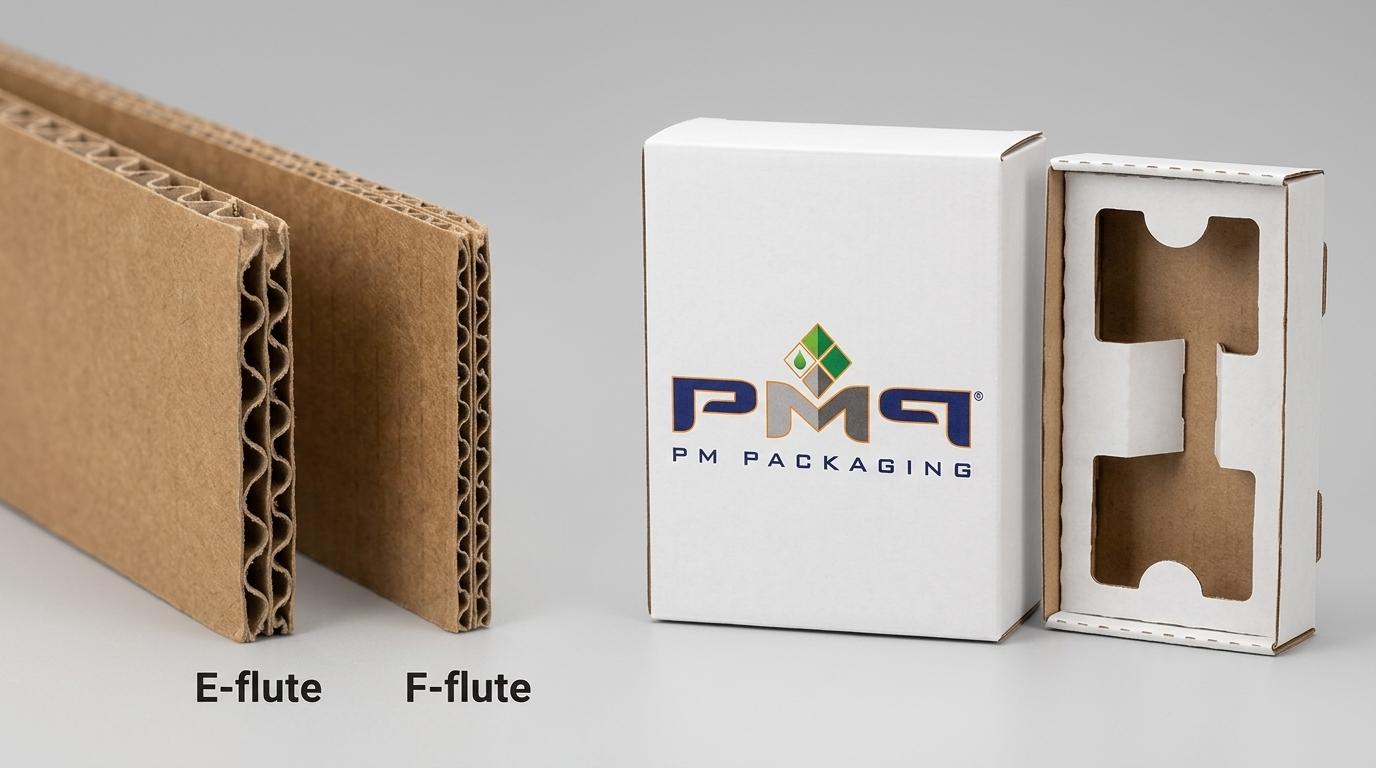
Structural Precision at Volume: Precision die-cutting and fluted lamination allow packaging engineers to target structural reinforcement where loads concentrate, eliminating excess material mass.
Add Reinforcement Where the Load Actually Occurs
The cornerstone of lightweight, high-performance packaging is: PUT STRUCTURE WHERE THE LOAD OCCURS.
Rather than increasing paperboard weight across 100% of the dieline, targeted structural reinforcement focuses strength strictly on vulnerable contact zones:
- Doubled Rollover Panels: Extending end flaps or top headers so they fold back 180 degrees creates a double-thickness wall along perimeter edges where handling stress is highest.
- Integrated Support Platforms: Incorporating folded step platforms into the base dieline to cradle heavy components, transferring weight directly to the floor.
- Localized Corner Bracing: Utilizing triangular corner posts or folded corner gussets that reinforce structural joints without thickening the large broad faces.
This localized approach yields cartons that survive rigorous retail distribution while keeping the overall package light and nimble.
Inserts Can Improve Structural Efficiency
In a structurally efficient packaging system, the internal insert is an active structural partner. The engineering question is: Can the insert support and stabilize the product efficiently enough that the exterior carton does not need to be overbuilt?
Strategic insert engineering enhances total package efficiency by:
- Controlling Internal Movement: Firmly locking heavy items (such as metal tools, glass bottles, or electronic batteries) into custom cavities prevents them from gaining momentum and battering outer carton panels during transit.
- Distributing Concentrated Weight: Spreading point loads across a wide folded paperboard platform prevents dense, sharp product edges from puncturing the carton face.
- Reducing Unsupported Outer Spans: Internal partitions act as cross-braces that support exterior walls from the inside, eliminating panel flexing on retail shelves.
- Enabling Lighter Outer Cartons: When the insert absorbs internal dynamic stresses, the primary outer box can utilize a lighter, more economical SFL or folding carton construction.
Right-Size the Package Around the Product
Oversized packaging is one of the largest sources of waste in commercial retail programs. Designing excess void space into a carton not only requires extra board and filler material, but it also creates structural vulnerability: unsupported air pockets allow exterior panels to crush under handling.
Right-sizing delivers compounded supply chain benefits:
- Board Area Reduction: Shaving fractions of an inch from length, width, and depth reduces square footage of paperboard converted per carton.
- Shipper Cube Optimization: Smaller retail cartons require smaller master shipping cases, eliminating filler dunnage and reducing corrugated box costs.
- Pallet Fit & Density: Right-sized cartons fit standard 48x40 pallets modularly, allowing more units per tier and maximizing shipping container cubes.
- Dimensional Freight Savings: Modern freight carriers bill based on dimensional weight (DIM weight). Eliminating shipped air directly lowers parcel and LTL freight costs.
High Volume Multiplies Small Material Decisions
In low-volume or limited-edition runs, carrying an extra ounce of paperboard per carton has negligible commercial impact. In large-scale, high-volume retail programs, however, small material decisions multiply dramatically across annual production runs.
Hypothetical Engineering Model
The Multiplication of Material Mass
Consider a high-volume retail program producing 500,000 units annually. If a structural redesign right-sizes the carton, optimizes the flute profile, and eliminates redundant void space, removing just 0.10 lb (1.6 oz) of unnecessary packaging material per unit:
*Note: This is an illustrative mathematical example demonstrating the scaling effect of material efficiency, not a specific PM Packaging customer result.
Removing tens of thousands of pounds of unnecessary dead weight reduces raw material consumption, lowers transportation fuel requirements, and maximizes warehouse storage density.
Standardize Efficient Structures Across Product Families
High-volume consumer brands often manufacture multiple SKU variants within a single product family. Creating completely bespoke packaging sizes for every variant inflates tooling investments and fragments procurement.
A platform standardization strategy consolidates these variables:
- Shared Outer Shells: Standardize on 2 or 3 common exterior carton footprints across a family of 10+ SKUs, using identical flute specifications and cutting dies.
- Modular Internal Cavities: Differentiate product variants through modular interior inserts tailored to individual product dimensions.
- Procurement Efficiency: Consolidate board procurement into larger sheet volumes on identical fluted board stock, reducing plate setup and changeover downtime.
Caution: Standardization should never force structurally different products into the wrong package. A 5 lb power tool and a 1 lb accessory should not share the same flute construction simply for standardization's sake.
Shipping Weight Is Only One Part of the Equation
While reducing excess packaging mass is a critical commercial goal, aggressive lightweighting can become counterproductive if pushed too far. Packaging that is stripped of essential fiber to meet an arbitrary weight metric often fails in the field.
Excessive lightweighting introduces severe operational risks:
- Crushed or Scuffed Retail Cartons: Compromising carton stiffness leads to damaged cartons on retail shelves, harming brand equity and triggering retailer discounts.
- High Return & Damage Rates: Products broken during transit quickly erase any freight savings gained from lighter board.
- Difficult Pack-Out & Filling Jams: Flimsy paperboard blanks lack the structural integrity required to feed smoothly through high-speed automated cartoning equipment.
The Core Rule: The goal is never minimum possible board weight. The goal is minimum practical material while still meeting the performance requirement.
When Vertical Stacking Becomes a Separate Engineering Problem
Structural efficiency optimizes the individual package and its material mass. However, if cumulative vertical load from master cases, pallet tiers, or warehouse storage becomes the primary structural risk, the complete package-to-pallet load path requires separate engineering analysis.
See our companion guide to engineering SFL packaging for pallet stacking and vertical compression to learn how to manage cumulative warehouse loads.
Planning Structurally Efficient High-Volume SFL Packaging
Developing an optimized SFL packaging program requires evaluating product characteristics, structural failure risks, and distribution economics before committing to high-volume tooling.
When planning a structurally efficient high-volume packaging program, gather the following key parameters:
- Product dimensions, geometry & mass
- Center of gravity & internal weight distribution
- Current package dimensions & board construction
- Specific failure modes (bowing, sag, corner tears)
- Internal insert & product cushioning needs
- Target retail shelf presentation & facings
- Number of SKU variants in product family
- Annual production volume & reorder cadence
- Master shipping case & pallet cube targets
- Freight billing constraints (DIM weight targets)
PM Packaging partners with brands to evaluate structural geometry, right-size package dimensions, select optimized flute profiles, and engineer localized reinforcement for high-volume retail programs. Explore our capabilities in Single Face Lamination and folding cartons.
Engineer Maximum Efficiency Into Your Packaging
High-volume packaging programs succeed when structural performance is engineered into the design rather than purchased through excess board mass.
By diagnosing specific failure modes, selecting optimized flute profiles, leveraging structural geometry, reinforcing critical stress points, and right-sizing outer cartons, brands can achieve exceptional retail presentation and product protection while eliminating unnecessary packaging weight across high-volume distribution.
Contact PM Packaging to discuss your product specifications, target volume, and structural requirements. Our packaging engineering team can help analyze your dielines and develop an SFL packaging program optimized for both strength and freight efficiency.