
Before designing the fulfillment workflow for a retail display program, brands need to decide where the display will actually be loaded with product.
In a pre-packed program, the display is assembled and loaded with product upstream before it ever reaches the retail store. In a store-filled program, the display arrives empty or flat, and store personnel erect and stock it using local shelf inventory. In a hybrid program, components such as pre-loaded product trays or modular display headers are prepared upstream, while final structure assembly or product stocking happens closer to the sales floor.
The right choice is not simply a matter of comparing unit freight costs or factory assembly times. Selecting the best retail display fulfillment model requires balancing multiple operational tradeoffs:
- Assortment complexity: How many unique SKUs, facings, and planogram positions must be controlled.
- Store labor constraints: The time, staffing availability, and willingness of store associates to assemble fixtures.
- Presentation consistency: The necessity of standardized brand merchandising across hundreds or thousands of doors.
- Freight cube & logistics: The cost of shipping assembled display volume versus compact flat-packed corrugated blanks.
- Promotional timing: Whether fixtures must be on the sales floor on a precise promotional launch morning.
This decision guide examines the practical advantages, operational limitations, and financial implications of pre-packed, store-filled, and hybrid retail displays to help you choose the right model for your retail campaign.
What Is a Pre-Packed Retail Display?
A pre-packed retail display (also referred to as a preloaded or factory-packed display) is completely erected, packed with products, and secured inside a protective corrugated shipping cover before leaving the manufacturing or contract packaging facility.
When the display arrives at the retail door, store associates simply remove the outer shipping shroud, discard transit banding, position the display in its designated promotional location, and mount any detachable graphic header.
Operational Characteristics of Pre-Packed Displays
Key Advantages
- Total Assortment Control: Products are placed exactly according to the approved planogram under controlled factory supervision.
- Flawless Presentation: Facings, dividers, and graphic headers are aligned perfectly without relying on store staff.
- Rapid Floor Execution: Display transitions from delivery truck to sales floor in minutes, ensuring high promotional compliance.
- Ideal for Complex SKUs: Pre-kitting prevents missing items in multi-product launches or promotional bundles.
Operational Tradeoffs
- Larger Freight Cube: Shipping assembled displays means paying to transport internal air space, reducing pallet density.
- Demanding Transit Protection: Requires robust outer shrouds, corner boards, and internal baffles to withstand transit shock.
- Upstream Pack-Out Labor: Incurs packaging labor fees at the co-packing facility prior to distribution.
- Dedicated Inventory Commitment: Product committed to pre-packed displays cannot easily be reallocated to other channels.
What Is a Store-Filled Retail Display?
A store-filled retail display (often called a flat-shipped or knocked-down-flat / KDF display) ships empty to the retail store as flat corrugated components inside a compact shipper carton.
Store personnel open the shipper carton, follow assembly instructions to fold and erect the display stand, and then stock the shelves using product inventory already available in the store backroom or from regular replenishment shipments.
Operational Characteristics of Store-Filled Displays
Key Advantages
- Maximum Freight Efficiency: Flat-packed display blanks stack densely on pallets, slashing transportation freight costs.
- Local Inventory Utilization: Capitalizes on stock already flowing through regular retail distribution channels.
- Low Upstream Packaging Cost: Eliminates third-party co-packing, kitting lines, and pre-assembly labor fees.
- Flexible Deployment: Stores can erect displays when floor space opens up or when inventory arrives.
Operational Risks
- Store Labor Dependence: In an era of retail labor shortages, unbuilt displays frequently languish in backrooms.
- Inconsistent Assembly: Poorly folded components, missing headers, or taped joints compromise brand perception.
- Planogram Non-Compliance: Store associates may fill shelves with incorrect SKUs, wrong quantities, or uneven facings.
- Delayed Campaign Launch: Displays may sit un-assembled for days or weeks past the scheduled marketing drop date.
Compare Pre-Packed and Store-Filled Displays Side by Side
Evaluating the structural, logistical, and retail operational factors side-by-side clarifies the distinct tradeoffs between the two primary fulfillment models:
| Operational Factor | Pre-Packed Display | Store-Filled Display |
|---|---|---|
| Product Assortment Control | Higher upstream control at packing facility | Depends entirely on store execution |
| In-Store Labor Requirement | Minimal after arrival (remove cover, place on floor) | Higher (erect corrugate, fold trays, stock items) |
| Freight Cube & Pallet Utilization | Generally higher (transports assembled volume) | Often lower when displays ship flat on pallets |
| Setup & Visual Consistency | Centralized and identical across all retail doors | Variable; depends heavily on store associate diligence |
| Complex SKU Mixes & Bundles | Easier to control centrally on kitting lines | Difficult; prone to SKU misplacement and gaps |
| Transit Protection Requirements | Demanding (protective covers, baffles, strapping) | Less product exposed inside display during transport |
| Local Inventory Utilization | Limited (requires dedicated pre-packed inventory) | Often easier; pulls directly from store stock |
| Promotional Reset Timing | Arrives launch-ready for immediate floor placement | Depends on store assembly schedule and staffing |
| Upstream Packaging Complexity | More upstream assembly, staging, and inspection | Less upstream assembly; relies on in-store setup |
When Pre-Packed Displays Make More Sense
Pre-packed displays are the industry standard for high-stakes promotional programs where execution compliance directly drives revenue:
- Tightly Controlled Promotional Assortments: When a campaign introduces specific SKU ratios (e.g., 6 units of Hero Shade, 4 units of Shade B, 2 units of Shade C) that must be merchandised in exact proportions.
- Fixed Promotional & Reset Dates: For national movie premieres, holiday seasonal resets, or major marketing campaigns where the display must be active on the retail floor on a specific morning.
- High-Value Brand Equity: In cosmetics, consumer technology, and premium consumer goods where an improperly assembled display damages brand perception.
- Retailers With Lean Store Staffing: In big-box and chain drug environments where store associates have minimal bandwidth to fold corrugated cardboard.
- Complex Product Geometries: When products require specialized internal retention tabs, angled trays, or nested cavities that are difficult to load quickly by hand at store level.
When Store-Filled Displays Make More Sense
Store-filled displays represent an economical, agile solution under the right operational conditions:
- High-Volume Local Store Inventory: When stores already maintain substantial warehouse backroom stock of the featured items and simply need a dedicated floor fixture to accelerate sell-through.
- Long-Running Seasonal or Permanent Fixtures: Merchandising units designed to stay on the retail floor for 3 to 6 months, continually restocked from ongoing distribution shipments.
- Simple, Uniform Assortments: Displays holding a single SKU or bulk dump bin configurations where product placement requires zero planogram precision.
- Severe Freight Distance Constraints: Programs where shipping assembled units across long transit corridors would incur prohibitive transportation expenses.
- Store-Level Stock Variations: When individual retail doors carry different product configurations based on store size or regional demographics.
When a Hybrid Display Model Can Work
Between 100% pre-packed and 100% store-assembled lies the hybrid retail display model. A hybrid approach strategically divides fulfillment tasks between the central converting/kitting facility and the retail store, trading some centralized control for substantial freight and inventory agility.
Successful hybrid implementations include:
- Flat Display Towers with Pre-Loaded Shelf Trays (PDQs): The large corrugate floor stand base and side wings ship flat to save freight cube. Meanwhile, individual product trays (counter display units or shelf-ready trays) arrive pre-packed and sealed from the packaging facility. Store associates simply erect the base stand in 60 seconds and slide the pre-packed trays into shelf slots.
- Standardized Base Fixtures with Variable Graphic Headers: A universal display base ships flat in high volume, while promotional headers and side-wing graphics are kitted with specific promotional inventory.
- Pre-Packed Launch Wave with Store-Filled Replenishment: The initial launch display arrives fully pre-packed to ensure 100% launch-day compliance. Once initial product sells through, the durable display fixture remains on the floor and is restocked from standard store inventory.
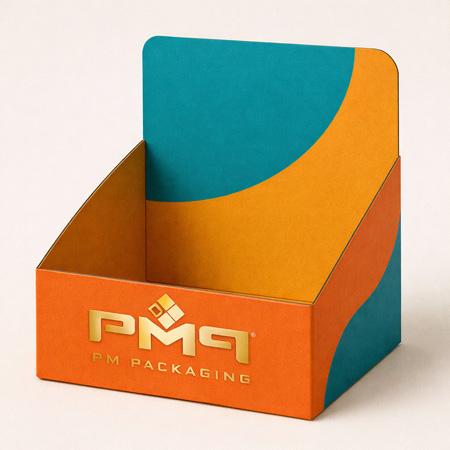
Fulfillment Model Architecture: Choosing between pre-packed, store-filled, and hybrid displays dictates structural corrugate engineering, protective shipping shrouds, and assembly workflows across the retail supply chain.
Assortment Complexity Is One of the Biggest Decision Factors
The number of unique SKUs and their required visual placement is often the single most decisive factor when selecting a fulfillment model.
As product assortments become more complex—featuring multiple shade variants, size progressions, or complementary accessories—the risk of stocking errors escalates exponentially in a store-filled environment. When store associates stock 8 different shades without dedicated pre-kitted trays, high-velocity variants are frequently over-stocked while niche shades are omitted entirely, distorting consumer perception and sales data.
If your retail display program involves highly varied product mixes across store tiers, explore our related guide on large display programs with different product assortments by store.
Store Labor Should Be Treated as a Design Constraint
When opting for store-filled or hybrid displays, retail store labor must be engineered into the structural design as a rigid constraint rather than an afterthought. What a skilled structural packaging designer can assemble in 90 seconds on a clean cutting table can easily confound an overworked retail associate in a crowded store aisle.
Essential design guidelines for store-assembled fixtures include:
- Zero Tools Required: Eliminate any need for packaging tape, hot glue, plastic fasteners, or cutting blades during store setup.
- Limited Step Sequences: Design structures that erect in 4 to 6 obvious folding motions, utilizing self-locking tabs with tactile feedback.
- Pre-Glued Sub-Assemblies: Pre-glue critical stress joints during manufacturing so associates only need to unfold and lock the main frame.
- Permanent Visual Instructions: Print numbered assembly diagrams directly onto non-visible inner flaps rather than relying on loose paper instruction sheets that are easily lost in transit cartons.
Freight Cube vs. Store Labor Is a Real Tradeoff
The economic debate between pre-packed and store-filled displays often stalls in an organizational silo: the logistics team favors flat-shipping to minimize freight spend, while the sales and marketing team demands pre-packed displays to guarantee promotional compliance.
The True Economics of Display Compliance
Saving $25 per display on outbound freight by shipping flat is completely negated if 20% of those displays remain unbuilt in backrooms during a critical 2-week promotional window. Conversely, spending an extra $35 per unit to pre-pack a display with low-margin commodities that associates could easily stock from existing shelf inventory erodes campaign profitability. The total business equation must balance freight cube against sell-through compliance rates.
Transit Protection Requirements Differ Between the Models
How a display moves through freight distribution dictates its protective structural requirements:
- Pre-Packed Displays: Must be engineered to protect heavy, loaded products against vibrational rubbing, pallet lean, and shock during freight transit. Requirements typically include full-height corrugated shipping shrouds (hoods), internal honeycomb or paperboard shelf pads to prevent product ejection, and perimeter edge protectors for strapping.
- Store-Filled Displays: Since displays ship flat inside compact corrugated shipper cartons, individual shelf graphics are protected from product weight during transit. Structural engineering focuses on protecting score lines and display edges from crushing inside the flat master shipper.
Replenishment Can Change the Best Display Strategy
Display programs rarely end on launch day. Initial rollout and ongoing inventory replenishment are distinct operational phases.
Many high-performing retail programs deploy a pre-packed display for the initial launch wave to ensure immediate 100% floor presence on day one. Once the initial inventory sells through, the durable display fixture remains in place and is restocked from local store inventory or modular replenishment packs. Factoring replenishment into your initial structural design prevents discarding expensive display fixtures prematurely.
Illustrative Comparison: A 1,500-Store Promotional Campaign
Illustrative Decision Scenario
Evaluating Fulfillment Options for a National Retail Campaign
Consider a branded personal care manufacturer launching a 4-SKU promotional campaign across 1,500 retail store locations. The brand evaluates three execution models:
- Option A (100% Pre-Packed): 1,500 fully assembled 4-tier floor displays loaded with 48 units each, secured in corrugated shipping shrouds. Delivers guaranteed day-one planogram compliance and eliminates store labor, but requires higher outbound freight volume.
- Option B (100% Store-Filled): 1,500 flat-packed display blanks shipped in cartons to store backrooms, filled from existing store inventory. Minimizes outbound freight expenses, but risks delayed assembly and inconsistent assortment facings across doors.
- Option C (Hybrid Model): 1,500 flat-shipped base towers paired with 4 pre-packed shelf-ready display trays (PDQs) holding 12 units each. Reduces main freight cube while ensuring products arrive pre-organized in factory-aligned trays that slide onto shelves in seconds.
*Note: This scenario is an illustrative operational model comparing fulfillment tradeoffs, not a specific contractual guarantee.
Pre-Packed vs. Store-Filled Decision Checklist
Use this practical decision checklist when determining the right display fulfillment model for your next retail campaign:
- ?How many unique SKUs must be merchandised within the display?
- ?Does product position and facing ratio need to be strictly controlled?
- ?How much in-store assembly labor can participating retailers realistically provide?
- ?Can the loaded display structure survive freight transit without product damage?
- ?How vulnerable are primary product cartons and decorative finishes to transit scuffing?
- ?Do retail stores already maintain sufficient local inventory to fill empty displays?
- ?How frequently will the display be replenished throughout the promotional period?
- ?Is the display tied to a fixed national marketing or promotional reset drop date?
- ?Are product assortments identical across all participating store locations?
- ?Does the retailer enforce specific routing guide mandates for display fulfillment?
When the Challenge Is Coordinating an Entire National Launch
Choosing between pre-packed and store-filled displays is one foundational decision inside a broader commercial rollout. Once the fulfillment model has been selected, the next challenge is coordinating packaging, displays, assortment, assembly, and distribution around the launch date.
See our complete operational guide to packaging and retail display fulfillment for national product launches to master dependency timelines, launch BOMs, and multi-tier distribution logistics.
Planning the Right Retail Display Fulfillment Model
Selecting and executing the optimal retail display fulfillment model requires close alignment between brand marketing, packaging design, converting, and logistics partners.
When preparing to evaluate a retail display fulfillment program, gather the following key parameters:
- Target display format (floor, counter, endcap)
- Total store door count & distribution locations
- SKU assortment matrix & units per display
- Product dimensions, mass & center of gravity
- Store labor expectations & assembly constraints
- Target freight cube & pallet density goals
- Protective packaging & transit cover requirements
- In-store dwell time & replenishment strategy
- Promotional reset date & delivery windows
- Retailer vendor compliance routing guides
PM Packaging engineers high-impact corrugated floor stands, counter PDQ display trays, and protective packaging systems engineered for both flawless presentation and supply chain efficiency. Explore our specialized solutions in in-store displays and fulfillment services.
Select the Right Fulfillment Model for Your Display Program
A retail display program succeeds when the fulfillment model matches the operational realities of the retail channel.
Whether your program calls for factory pre-packed displays with guaranteed planogram compliance, highly efficient flat-shipped store-filled stands, or an agile hybrid format, PM Packaging delivers structural engineering, high-volume converting, and fulfillment expertise to ensure retail success.
Contact PM Packaging to discuss your retail display concepts, store door counts, and distribution requirements. Our structural design team will help engineer a display fulfillment strategy tailored to your timeline, budget, and merchandising goals.