
Managing a multi-store retail program does not require engineering dozens of unique physical display structures.
Retailers frequently demand a unified brand presence across hundreds or thousands of retail stores, even as individual store locations require distinct merchandise assortments based on square footage, historical sales velocity, regional demographics, or planogram allocations. The core manufacturing strategy for successful multi-store merchandising is simple: standardize the outer display structure while introducing product assortment variation during co-packing and fulfillment.
Decouple display structural manufacturing from variable store-level merchandise kitting.
When consumer brands attempt to customize display geometry or outer print plates for every store group, tooling costs skyrocket, converting line efficiency collapses, and inventory management becomes a logistical nightmare. By separating the structural packaging envelope from the internal product pack-out, brands capture high-volume manufacturing economies while delivering tailored SKU mixes to each retail door.
Variable-assortment merchandising succeeds through store tiering, modular dielines, and systematic fulfillment control.
Why Store-Level Assortments Vary Across Large Retail Programs
Major retail chains are rarely homogenous. A national retailer operating 2,500 locations spans high-density urban doors with tight footprints, high-volume suburban superstores, and rural regional outlets.
Assortment variation is driven by specific commercial factors:
- Store Square Footage & Aisle Width: Flagship superstores have the floor space to support comprehensive 12-SKU product line presentations, whereas compact urban stores only have clearance for high-velocity top sellers.
- Historical Category Sales Velocity: Top-tier stores turn inventory rapidly and require deeper unit pack-outs to avoid out-of-stocks between deliveries, while lower-volume doors require smaller unit counts to prevent inventory stagnation.
- Regional Shopper Preferences: Climate, regional lifestyle patterns, or local demographic preferences dictate which product variants (such as fragrance varieties, colorways, or formulation strengths) should be featured.
- Retailer Cluster Planograms: Category managers increasingly deploy clustered assortment profiles rather than a single blanket planogram across their entire chain.
Recognizing these operational drivers allows brands to design retail displays that satisfy buyer assortment requests without fracturing production into unmanageable sub-runs.
Standardize the Display Before Customizing the Product Mix
The most costly mistake a brand can make when facing store assortment variations is creating unique display structures for each store cluster. Producing three separate corrugated dielines triples tooling costs, fragments printing plate runs, complicates co-packing setup, and confuses retail field teams.
Instead, brand teams should standardize every core element of the physical packaging platform:
- Identical exterior base footprint, total height, and shelf depth across all locations
- Standardized master litho-laminated graphics, headers, and sidewall branding
- Uniform corrugated board caliper, flute profile, and structural load ratings
- Consistent shipper carton outer dimensions and pallet tie-high (TI/HI) configurations
- Identical primary display assembly sequence for fulfillment pack-out teams
- Standardized retail store footprint compliance (e.g. 24" × 18" or 48" × 20" floor placements)
By standardizing the physical display structure, you convert corrugated board at high speed and low unit cost, reserving all customization for fulfillment staging.
Using Store Tiers to Manage Assortment Complexity
Fulfilling 2,000 unique store orders individually is impossible without introducing massive packing errors. The proven industry standard is grouping stores into an A/B/C store tier model. Store tiering translates thousands of disparate store requests into 2 to 4 standardized pack-out configurations.
Consider this concrete store-tier merchandising model using a single, standardized floor display structure:
Full product line representation. Four shelves configured with 3 facings each, maximizing product discovery in high-traffic doors.
Core revenue drivers and top seasonal variants. Four shelves configured with 2 facings each using wider modular dividers.
Essential top-sellers only. Lower shelves utilize branded corrugated filler blocks or deeper single facings to maintain full appearance.
In every tier, the customer views an identical, pristine branded display structure. However, the store receives an inventory investment and SKU breadth calibrated precisely to its sales velocity.
Tiering transforms complex store allocations into discrete, repeatable pack-out patterns that co-packing teams can execute with 100% accuracy.
Managing Variable Bills of Material for Pre-Packed Displays
In variable-assortment programs, the bill of materials (BOM) is not a static document. A multi-tier display program requires establishing a parent BOM for the common corrugated structure and individual child BOMs for each store tier configuration.
Effective variable BOM control incorporates:
- Store-to-Tier Allocation Matrices: Maintaining an audited database matching every retailer store number to its designated tier code (Tier A, B, or C) and shipping destination.
- Strict BOM Revision Control: Ensuring that any mid-campaign SKU swaps or artwork revisions update the specific tier BOM without disrupting the rest of the program.
- Visual Planogram Work Instructions: Equipping pack-out assembly lines with color-coded shelf placement diagrams showing line operators the exact physical placement of each SKU for that specific tier.
- Component Stock Balancing: Tracking incoming merchandise inventory against tier build schedules so that shortages of a single niche SKU only pause the affected tier rather than the entire fulfillment operation.
Rigorous BOM management ensures co-packers load the correct product counts into every tier, preventing discrepancies between shipping manifests and retailer invoices.
Designing Displays for Multiple Product Mixes
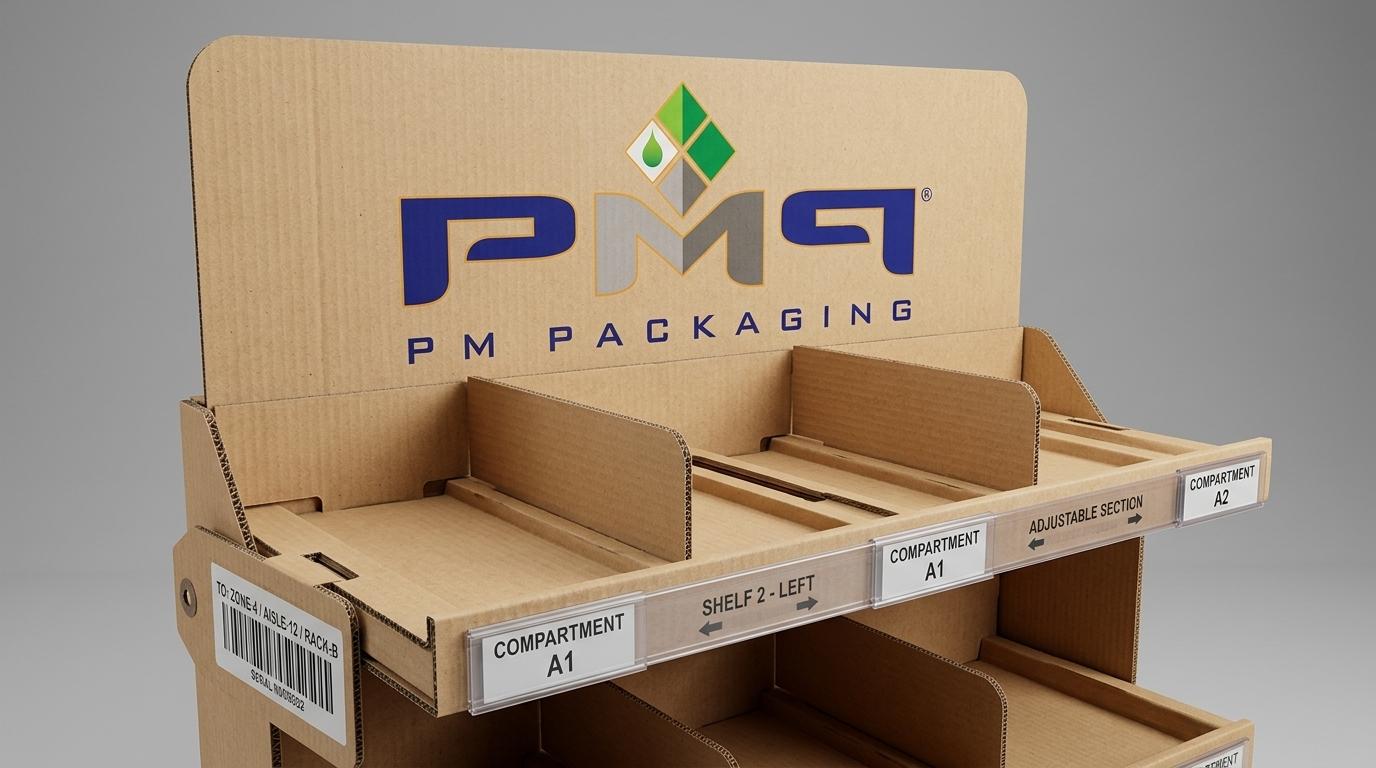
Structural packaging engineers must design display interiors that effortlessly flex between different product sizes, unit depths, and facing counts. If a shelf is rigid and only fits one specific bottle diameter or box width, running different assortments becomes physically impossible.
Engineering strategies for variable product displays include:
- Multi-slot shelf scoring that accepts adjustable corrugated dividers at 1-inch or 2-inch increments
- Modular drop-in product trays that can be configured with different cell counts per shelf tier
- Universal shelf depths engineered to hold either 3 larger product units or 5 compact units
- Branded corrugated riser blocks and void fillers that elevate products and maintain a fully stocked look in Tier C doors
- Interchangeable shelf-talker strips and graphic channel inserts highlighting tier-specific promotional messages
- Reinforced bottom shelves engineered to support heavier product concentrations when assortments vary by weight
Incorporating adjustable dividers and modular trays lets brands reconfigure product facings in seconds without re-cutting corrugated dies.
Late-Stage Customization Can Reduce Manufacturing Complexity
In modern retail supply chain management, postponement—the practice of delaying product differentiation until the latest possible operational step—is a major competitive advantage.
Applying postponement to retail display programs means manufacturing 100% of the corrugated structures as a single, uninterrupted high-volume converting run. The display structures are produced, printed, die-cut, and warehoused as common inventory. Store-specific differences are introduced exclusively during fulfillment line pack-out.
This postponement strategy delivers decisive operational benefits:
- Eliminates short-run plate changes and print setup fees across converting runs
- Allows brands to finalize store-by-store SKU allocations weeks later in the campaign lifecycle
- Protects against obsolete finished packaging inventory if a retailer adjusts tier store counts
- Maximizes converting press speeds by running a single continuous master board dieline
- Simplifies quality control by inspecting one uniform corrugated structural standard
- Permits rapid rebalancing between Tier A, B, and C quantities during active fulfillment
Production note: While managing variable SKU assortments centers on fulfillment logic and modular design, programs with tight launch windows also require massive converting throughput. If your primary challenge is producing thousands of displays against a fixed national launch date, see our guide to high-volume retail display production for fixed-date multi-store launches.
Postponing customization to the fulfillment stage gives retail operations teams unmatched agility when managing retailer demand shifts.
Preventing Store-Level Pack-Out Errors
When displays look identical from the outside but contain different internal SKU counts and dollar values, pack-out error prevention becomes paramount. If a Tier C display containing 20 units is mistakenly labeled as a Tier A display and shipped to a flagship store, the retailer will experience immediate inventory shortages and stock-outs.
Industrial contract fulfillment operations implement multi-point automated verification to guarantee pack-out integrity:
- Barcode Verification at Pick Stations: Operators scan individual product UPC barcodes against the active digital tier BOM before loading units into the display shelves.
- Inline Check-Weighing: Fully packed displays pass over a calibrated inline floor scale. Because Tier A (48 units), Tier B (32 units), and Tier C (20 units) have distinctly different target weights, any missing or excess product triggers an instant line-stop diversion.
- Dynamic Shipper Labeling: Master outer cartons receive automated print-and-apply labels indicating the specific tier code, exact store number, destination distribution center, and serialized UCC-128 barcode.
- Pre-Closure Photographic Audits: High-resolution overhead cameras capture an image of the packed shelves prior to sealing the master shipper, verifying visual planogram compliance for historical records.
Automated scanning and inline check-weighing eliminate human assembly error, ensuring each retailer store receives its intended assortment.
Palletization and Routing for Different Store Assortments
Once displays are packed, labeled, and sealed into master shippers, logistics teams must preserve assortment integrity through pallet staging and retailer distribution center routing.
Key palletization and routing protocols include:
- Tier-segregated pallet builds to simplify receiving audits at retailer cross-dock facilities
- Store-specific routing tags and serialized SSCC pallet labels matched to electronic ASNs
- Mixed-tier pallet configurations utilizing corner boards and clear tier divider cards when door volumes require consolidated pallets
- Strict compliance with retailer-specific DC cross-dock staging rules to prevent misdirected store shipments
- Automated EDI 856 ASN transmissions communicating store-level serial numbers directly to retailer supply chain systems
- Color-coded pallet placards indicating tier designations for rapid warehouse staging
Destination-accurate labeling and clean pallet staging ensure the retailer's logistics network routes each customized display to the correct local storefront.
Questions Brands Should Ask When Planning Variable-Assortment Display Programs
Before launching a multi-tier retail display campaign, brand and operations managers should review their program against a practical execution checklist:
- How many unique store tiers truly provide commercial value? Keep tier models between 2 and 4 groupings. Creating more than 4 tiers adds fulfillment complexity with diminishing merchandising return.
- Can a single structural dieline accommodate all intended product configurations? Ensure shelves feature multi-position divider slots and universal depths that fit all SKU variations.
- At what stage is assortment customization introduced? Verify that physical converting is 100% standardized and customization occurs exclusively on co-packing assembly lines.
- How will BOM revisions be managed during active pack-out? Confirm the fulfillment partner maintains a real-time warehouse management system (WMS) with digital BOM revision control.
- What quality gates prevent mis-packing or wrong-store labeling? Demand barcode scan-verification, inline check-weighing, and automated destination labeling.
Clarifying these operational requirements early prevents costly planogram rework and shipping chargebacks once displays reach retail distribution centers.
Managing Store-Specific Display Programs With PM Packaging
PM Packaging designs, manufactures, and fulfills high-impact retail display programs that solve complex multi-store assortment requirements. From engineering modular structural dielines for in-store floor displays and counter units to managing turnkey co-packing and fulfillment, we help brands maximize retail impact while simplifying supply chain execution.
When planning a variable-assortment display program, our team collaborates with you to define:
- Total store door count and geographical distribution
- Number of store tiers (e.g. Tier A, B, and C classifications)
- Total SKU catalog and dimensions of all product variations
- Target unit counts and facing requirements per tier
- Modular structural dieline engineering with flexible partitions
- Turnkey pre-packing, barcode validation, and inline check-weighing
- Retailer-compliant master shippers, pallet patterns, and EDI ASNs
- Direct-to-DC or cross-dock distribution scheduling
Whether you need modular floor merchandisers or versatile counter-top display trays, PM Packaging delivers structural standardization and fulfillment precision.
Keep the Display Common and Put the Customization Where It Creates Value
High-volume multi-store display programs succeed by decoupling structural display manufacturing from variable store-level product allocation.
Standardize the physical footprint, capture high-volume converting efficiencies, and manage assortment differentiation through store tiers and precision fulfillment.
Deliver store-specific product assortments without scaling structural complexity or ballooning tooling budgets.
Contact PM Packaging with your store count, store tiers, SKU matrix, unit quantities, and fulfillment timeline. Our packaging engineers and fulfillment specialists will design a standardized display structure with turnkey co-packing engineered for flawless store-level execution.