
A national product launch is fundamentally a dependency-management problem.
A brand can have fully approved primary packaging, stunning retail display graphics, and enthusiastic retailer purchase orders, yet still miss the national rollout if components are not manufactured, assembled, packed, and distributed in the correct operational sequence. The central question governing launch execution is: What has to be ready, in what quantity, at which facility, and by what exact date?
Unlike routine replenishment, a national retail product launch operates under an immovable deadline. Television advertising, digital influencer campaigns, and retail planogram resets are synchronized to a single calendar morning. Retailers enforce strict distribution center (DC) receiving appointments; missing a delivery window triggers punitive compliance chargebacks, forfeited promotional floor space, and lost revenue.
Successful national launch fulfillment requires coordinating multiple moving parts across the supply chain:
- A unified launch Bill of Materials (BOM): Tracking every component from folding cartons and display trays to transit hoods and UCC-128 shipping labels.
- Package-to-display dimensional integration: Ensuring primary product cartons and secondary display pockets fit together without binding or falling.
- Controlled kitting & assembly lines: Verifying planogram assortments and SKU placement before cartons are sealed.
- Staged freight logistics: Synchronizing full truckload (FTL) deliveries to regional retail DCs weeks before the consumer marketing drop.
Assuming your brand has already decided whether your displays will ship pre-packed, store-filled, or in a hybrid format, this guide details how to execute the national rollout smoothly from backward scheduling to launch-day retail floor delivery.
Work Backward From the Required Retail Date
Forward scheduling—starting from today and estimating when tasks might finish—is the primary cause of launch delays. National retail execution must be planned backward from the mandatory in-store reset date.
The Backward Critical Path
- 1In-Store Promotional Reset Date: The morning retail floor associates place displays and stock shelves for consumer purchase.
- 2Retailer DC Delivery Appointment: Scheduled delivery window at regional retail distribution centers (typically 14 to 21 days prior to store reset).
- 3Outbound Transit & Pallet Staging: Freight carrier pickup, cross-dock transit, and appointment scheduling with retail logistics teams.
- 4Display Pack-Out & Kitting: Assembly of corrugated floor stands, product loading, insert placement, and protective shipper shrouding.
- 5Component Arrival & Staging: Physical arrival of primary folding cartons, finished goods, display blanks, and graphic headers at the kitting facility.
- 6Manufacturing & Converting: Board procurement, litho printing, die-cutting, folding-gluing, and quality release.
- 7Pre-Press & Retailer Sign-Off: Dieline approval, barcode verification, and retailer packaging compliance sign-off.
Mapping dependencies across this backward timeline reveals the true "point of no return" for artwork approvals and material procurement, protecting the program against late surprises.
Build One Launch Bill of Materials
In a major retail launch, packaging and displays cannot be managed on separate spreadsheets. A complete program requires a single, unified Launch Bill of Materials (BOM) that accounts for every physical item required to complete a retail unit.
An incomplete BOM is a primary cause of assembly line shutdowns. A missing $0.05 barcode label, a delayed graphic header, or a missing corrugated divider halts the entire packaging line just as effectively as a missing primary container.
Essential Elements of a Program Launch BOM
- Primary packaging cartons & sleeves
- Internal carton retention inserts
- Corrugated display base, shelves & dividers
- Promotional graphic headers & side wings
- Protective master shipping covers (shrouds)
- Pallet corner protectors & edge boards
- In-store assembly instructions & hardware
- UCC-128 shipping labels & pallet placards
Coordinate Product Packaging and Display Dimensions Early
Developing primary product packaging in isolation from the retail display frequently leads to expensive dimensional mismatches discovered only during trial pack-outs.
Concurrent engineering between the primary folding carton and the in-store display ensures seamless integration:
- Facing Width & Pocket Clearances: Ensure display tray pockets allow 1/8 to 1/4-inch lateral tolerance so cartons slide in smoothly without binding or scuffing decorative coatings.
- Center of Gravity & Shelf Angle: Heavy primary containers (such as glass jars or liquid bottles) must rest on shelves angled slightly backward to prevent cartons from tipping forward during customer browsing.
- Header Visibility: Verify that products on upper shelves do not obstruct promotional messaging or price point callouts on the display header.
- Master Case Modularity: Ensure individual display trays or cartons nest into standard master shippers without excess void space.
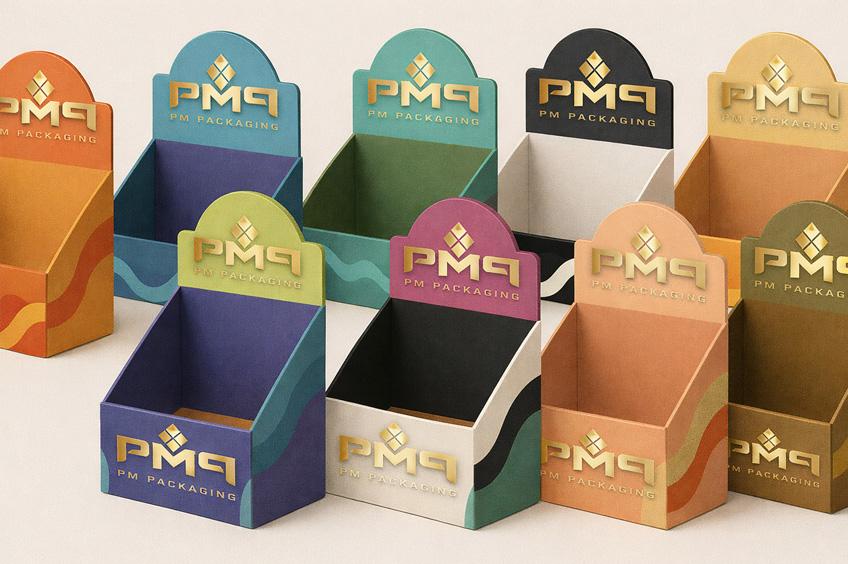
Assembly Line Synchronization: Executing a national retail launch requires staging primary packaging, displays, and products to converge seamlessly on high-speed pack-out lines.
Lock the Display Assortment and Planogram
Last-minute alterations to the retail planogram—such as adding an extra SKU, altering unit counts per shelf, or swapping shade ratios—create massive ripple effects across packaging dielines, insert cutting forms, and assembly work instructions.
The display assortment matrix and visual planogram must be locked prior to authorizing converting plates. If the campaign requires different product assortments for different retailer tiers (e.g., flagship doors receive 48 units while standard doors receive 24 units), document these variations as distinct sub-assemblies. Explore our dedicated guide on large display programs with different product assortments by store for detailed tier-management strategies.
Treat Display Fulfillment as a Controlled Assembly Process
Display fulfillment should never be treated as informal warehouse hand labor. It is a precision assembly line that requires the same engineering rigor as primary product manufacturing.
- Component Staging & Line Clearance: Clear assembly areas between production shifts and stage all BOM components within ergonomic reach before running kitting operations.
- Visual Standard Operating Procedures (SOPs): Provide large, laminated color planograms posted directly over pack-out workstations showing exact product orientation, front-facing graphics, and tier placement.
- In-Line Quality Checks: Implement verification steps such as barcode scans and completed-unit checks to ensure no display leaves the line with missing or misplaced SKUs.
Coordinate Component Availability Before Pack-Out Begins
In multi-vendor launch programs, component arrival dates rarely align automatically. Packaging and display fulfillment cannot begin until 100% of required materials are physically verified inside the assembly warehouse:
DISPLAY CORRUGATE READY + PRODUCT DELAYED = WAREHOUSE CONGESTION & NO SHIPMENT
PRODUCT READY + GRAPHIC HEADER DELAYED = HALTED PACK-OUT LINE
PRIMARY BOXES READY + PROMOTIONAL INSERT DELAYED = MISSED DC APPOINTMENT
Building a 5 to 7-day component staging window before the scheduled start of assembly ensures that unexpected supplier transit delays do not shut down high-cost kitting lines.
Manage Multiple SKU and Retailer Versions
High-profile product launches frequently feature channel-exclusive SKUs or retailer-specific promotional packaging. For example, Retailer A may receive an exclusive gift-with-purchase promotional sleeve, while Retailer B receives standard cartons in a specialized counter tray.
Managing multiple versions requires disciplined configuration control:
- Prominent Version Coding: Print distinct version codes and color-coded bars on non-visible glue flaps and shipper labels.
- Segregated Physical Staging: Physically isolate inventory destined for different retail channels to eliminate cross-contamination.
- Pre-Production Sign-Off: Confirm that dielines pair the exact regulatory text, UPC barcode, and retailer part numbers specified in each retailer purchase order.
Protect Pre-Packed Displays During Distribution When That Model Is Used
When your program utilizes pre-packed displays, the loaded unit becomes a heavy, dynamic structure that must endure severe handling and vibration during freight distribution.
Essential transit protection measures include:
- Full-Height Corrugated Shrouds: Heavy-duty outer shipping hoods that slide over the loaded display, shielding printed surfaces from scuffing and impact.
- Shelf Retention Baffles: Temporary paperboard or foam insert pads that prevent product bottles or cartons from migrating off shelves during truck transit.
- Perimeter Edge Protectors: Rigid corner angle boards applied before stretch-wrapping to prevent strapping from crushing display top edges.
- Pallet Deck Alignment: Sizing display bases to sit flush within standard 48x40-inch pallet decks, avoiding any overhang that invites corner collapse.
Plan Store-Filled Display Components When That Model Is Used
If your launch strategy utilizes store-filled displays, execution focuses on ensuring that every retail store receives complete, undamaged, easy-to-assemble components:
- Compact Master Shippers: Flat corrugated blanks must be packed into heavy-duty cartons that protect crease lines and locking tabs from edge-crushing.
- Attached Instructions: Fasten graphic assembly diagrams securely inside the carton lid so they cannot be discarded with packing dunnage.
- Clear Destination Labeling: Prominently label outer cartons with retailer department codes, promotional event names, and scheduled floor set dates to prevent cartons from getting lost in store backrooms.
Coordinate Master Cases, Pallets and Retailer Distribution Requirements
Delivering finished goods to retail distribution centers requires strict adherence to retailer vendor routing manuals:
- UCC-128 / GS1-128 Barcode Compliance: Serialized shipping container codes formatted to match retailer electronic data interchange (EDI) Advance Shipping Notices (ASNs).
- Pallet Height & Tier Limits: Observing maximum pallet height restrictions (typically 50 to 60 inches including pallet base) to ensure compatibility with retailer automated racking systems.
- Appointment Scheduling: Booking delivery appointments with retail DC receiving desks weeks in advance to secure required dock doors during peak launch windows.
Build Launch-Specific Quality Gates
Quality assurance during a national launch must expand beyond print register and color density to encompass distribution readiness and retailer compliance:
- Pre-Shipment Barcode Verification: Pre-scanning primary cartons, master cases, and display trays using calibrated verifiers to confirm ISO/ANSI scan grades meet retailer minimums.
- Assortment Audit: Verifying that the physical SKU count inside each assembled display matches the approved retail planogram exactly.
- Cosmetic Condition Inspection: Auditing finished shippers to confirm that soft-touch coatings, foil stamping, and display headers are completely free of handling scuffs or adhesive transfer.
Build Contingency Into the Launch Schedule
Even the most rigorously planned national rollouts face unexpected disruptions: late product formulation sign-offs, last-minute retailer door expansions, or freight bottlenecks. Robust launch programs incorporate operational buffers.
Practical contingency strategies include:
- Schedule Cushions: Incorporating a 10 to 14-day operational buffer between finished goods release and the mandatory retailer DC delivery date.
- Unprinted Safety Stock: Holding allocated corrugated and paperboard sheets at the converting plant to rapidly print and convert replacement units if launch forecasts surge.
- Pre-Qualified Expedited Carriers: Retaining dedicated, time-definite freight carriers capable of executing emergency expedited deliveries if primary logistics encounter delays.
Separate Initial Launch Fill From Ongoing Replenishment
A successful product rollout consists of two distinctly different supply chain operations: the Initial Launch Wave and Ongoing Replenishment.
| Operational Phase | Primary Objectives & Focus | Packaging & Fulfillment Format |
|---|---|---|
| Initial Launch Wave | 100% on-time pipeline fill; synchronized floor drop; maximum promotional impact. | Pre-packed floor stands, counter PDQs, and promotional feature shippers. |
| Ongoing Replenishment | Steady-state restock driven by store POS sell-through; lean inventory carrying costs. | Standard modular master shipping cases optimized for under-shelf restock. |
Separating these phases prevents overproducing expensive temporary display packaging and ensures a smooth transition to steady-state inventory management once launch enthusiasm settles into routine sell-through.
Measure the Program as a System, Not as Individual Packaging Components
A national packaging and display program is only as successful as its weakest link. Evaluating carton converting, display printing, co-packing labor, and freight logistics in isolated cost buckets blinds brand teams to total program risk.
A slight increase in primary carton structural caliber that allows tighter nesting inside pre-packed displays can unlock substantial freight cube savings. Similarly, investing in pre-glued display bases that reduce kitting line cycle times by 30 seconds can save thousands of dollars across a national assembly run. Total program success is measured by on-time delivery, zero retailer chargebacks, and flawless in-store execution.
Illustrative Example: A 1,500-Store Multi-Tier Launch
Illustrative Program Execution
Coordinating 4 SKUs and 2 Display Formats for a Fixed-Date Rollout
A national brand prepared to launch 4 premium product SKUs across 1,500 retail store doors on a fixed nationwide marketing drop date. The rollout required:
- Format A (High-Volume Doors): 600 pre-packed 4-tier freestanding floor displays containing 72 units across all 4 SKUs.
- Format B (Standard Doors): 900 pre-packed counter display units (PDQs) containing 24 units of hero SKUs.
- Consolidated Master Logistics: Synchronizing primary carton converting, display manufacturing, assembly kitting, and staged delivery to 5 regional retailer DCs across an 8-day delivery appointment window.
By managing the program under a single launch BOM and building a 10-day operational buffer into DC delivery appointments, the brand achieved 100% on-time, in-full (OTIF) compliance across all regional DCs with zero retailer chargebacks.
*Note: Figures and timelines are illustrative operational models and do not represent contractual performance guarantees.
When the First Decision Is Pre-Packed vs. Store-Filled
Before finalizing fulfillment operations and kitting schedules, the brand must first determine where product loading physically occurs.
If that decision is unresolved, see our companion guide on pre-packed vs. store-filled retail displays to compare store labor, assortment control, freight cube, and execution risk.
Planning Packaging and Display Fulfillment for a National Launch
Orchestrating a national retail product launch requires early, seamless collaboration between brand managers, structural packaging engineers, converting specialists, and fulfillment teams.
When scoping a national packaging and display fulfillment program, assemble the following operational inputs:
- Target retail in-store reset drop date
- Retailer distribution center list & appointment rules
- Store door counts & retail tier allocations
- Complete SKU assortment matrix & unit counts
- Number of display formats (floor, counter, PDQ)
- Primary packaging dimensions & materials
- Component staging & pack-out facility location
- Transit protection & outer shipping shroud specs
- Master shipper & pallet density requirements
- Post-launch replenishment forecast & cadence
PM Packaging partners with national brands to engineer high-impact folding cartons, corrugated in-store displays, and turnkey fulfillment programs designed for seamless retail execution. Explore our capabilities in in-store displays, fulfillment services, and luxury packaging.
Execute Your National Launch With Complete Confidence
A national product rollout demands synchronized execution across packaging converting, display kitting, and retailer logistics.
By engineering primary packaging and displays concurrently, building a comprehensive launch BOM, establishing rigid assembly quality gates, and managing backward distribution timelines, brands can protect promotional margins and deliver flawless in-store execution on launch morning.
Contact PM Packaging to discuss your upcoming national product rollout, store door counts, display requirements, and distribution schedules. Our structural engineering and fulfillment teams will help design an integrated program tailored for on-time retail launch success.