

How to Design Beauty Packaging for Ecommerce and DTC Fulfillment
Protective secondary packaging, product-fit retention inserts, and fulfillment-ready pack-out designed to safeguard fragile cosmetics and deliver an elevated unboxing experience.
Get Options
Request a Quote / Spec Review
Direct Answer
Beauty products sold through ecommerce and direct-to-consumer channels need packaging that protects the primary container during parcel handling while still delivering a strong branded unboxing experience. The packaging system should be built around the actual product—such as a glass serum bottle, skincare jar, fragrance, palette, or multi-piece kit—and may combine a folding carton or rigid presentation box with a fitted insert and an outer corrugated or SFL shipping structure. For brands using fulfillment or subscription programs, the package should also be efficient to kit, pack, identify, and ship across multiple SKUs.
Why Ecommerce Changes Beauty Packaging Requirements
In a traditional brick-and-mortar retail environment, cosmetics packaging is engineered primarily for clean shelf positioning, visual appeal under overhead retail lighting, and protection against casual in-store customer handling. The product travels inside a master carton on a shrink-wrapped pallet directly to the retailer's distribution center and backroom, experiencing minimal individual parcel trauma.
Ecommerce and direct-to-consumer (DTC) distribution completely overturn these assumptions. Once an order is picked and packed, the beauty package travels through automated conveyor sorts, transfer chutes, parcel freight trailers, and local delivery vans. During this journey, it encounters repeated multi-axis vibration, shock drops, pressure changes, and parcel tumbling.
Beauty primary containers—such as fragile glass dropper bottles, heavy glass skincare jars, liquid lotions, pump dispensers, and pressed-powder palettes—are inherently vulnerable to this transit environment:
- Glass dropper and pipette bottles: Lateral impacts can snap glass pipettes inside the bottle or crack the threaded neck, releasing liquid actives and ruining the entire order.
- Pumps and dispensing caps: Vibration and top compression can loosen closures, causing fluid leakage across branded packaging surfaces.
- Heavy skincare jars: Dense cream jars generate high kinetic energy when dropped, blowing out tuck-end carton closures if unsupported by internal retention.
- Pressed powders and eyeshadow palettes: Multi-axial shock waves easily fracture compressed pigment pans, resulting in powdered pigment dusting upon opening.
- Cosmetic surface scuffing: High-end matte soft-touch coatings, metallic foil stamping, and spot gloss varnishes rub against shipping walls, degrading brand equity before the customer touches the product.
Because of these hazards, brands cannot rely on an off-the-shelf retail carton to survive parcel transit. The secondary packaging must be engineered as a coordinated protective system that secures the primary container, isolates impact points, and protects decorative surfaces until unboxing.
Start With the Primary Beauty Container
Effective ecommerce packaging starts with the primary container, not the outer box. A universal shipping carton does not exist because different cosmetic formulas and vessel geometries present fundamentally different failure modes during parcel handling.
| Primary Product | Packaging Risk | Secondary Packaging Response |
|---|---|---|
| Glass serum / dropper bottle | Pipette breakage, bottle cracking, closure loosening, liquid leakage. | Custom paperboard insert with neck collar retention + protective outer folding carton or rigid shipper. |
| Skincare cream jar | High product mass shifting inside carton, lid impact chipping, cosmetic scuffing. | Reinforced platform tray with perimeter side walls or carton with top/bottom dust flaps. |
| Fragrance flacon | Glass impact shattering, atomizing pump leakage, luxury finish abrasion. | Rigid presentation box with engineered cavity insert + snug outer corrugated transit sleeve or mailer. |
| Makeup palette | Pan fracturing, shattered pressed powders, mirror cracking, hinge tearing. | Tight-tolerance tuck carton or sleeve with edge cushioning, protective wrap, and minimal void space. |
| Multi-piece regimen kit | Components colliding in transit, mixed-weight displacement, disheveled unboxing. | Multi-cavity die-cut paperboard divider tray or folding platform organizing order of use. |
Table: Beauty Ecommerce Packaging by Primary Container. Engineered structural responses must be tailored to product mass, fragility, and container geometry.
Use Inserts to Control Product Movement
In ecommerce beauty packaging, internal movement is the primary cause of transit failure. When a glass bottle or heavy jar has room to slide or bounce inside a shipping box, repeated deceleration forces impact the carton walls, breaking seals, denting corners, and shifting components out of position.
Engineered inserts eliminate internal movement by locking each component into a dedicated position:
- Custom paperboard inserts: Precision die-cut and scored paperboard platforms wrap around bottle shoulders, jar bases, and dropper collars. Paperboard inserts provide rigid retention while maintaining full curbside recyclability.
- Internal partitions and cell dividers: For beauty regimens, multi-step skincare sets, or fragrance collections, interlocking paperboard partitions physically isolate glass-to-glass contact points, preventing bottles from striking one another.
- Platform risers and shadow boxes: Elevate primary containers flush with the opening plane of the box, presenting the brand graphics and labels immediately upon lid opening.
- Product orientation control: Inserts ensure dispensing pumps, droppers, and oriented labels remain facing upward and forward throughout shipping, eliminating disheveled arrivals.
By engineering retention directly into the structural paperboard dieline, brands eliminate the need for loose fill, bubble bags, or messy packing peanuts, creating a clean, modern unboxing presentation.
Choose the Primary Presentation Package
Depending on product positioning, unit economics, and fulfillment routing, beauty brands select between three core presentation packaging formats:
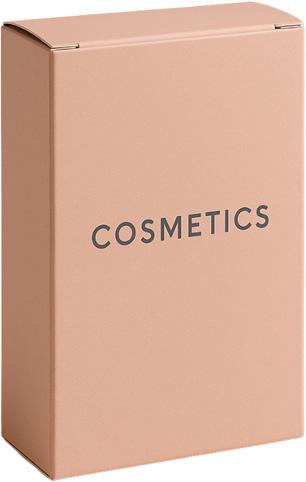
Folding Cartons
Ideal for individual skincare, makeup, and personal-care SKUs. Folding cartons deliver high-resolution offset graphics, precise dielines, and compact footprint. In ecommerce, they function as the branded primary unit inside an outer shipping box or mailer.
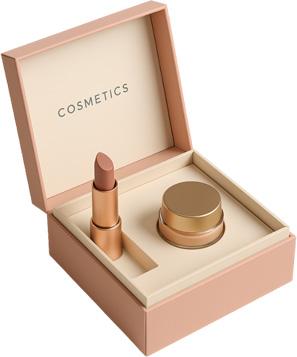
Rigid and Luxury Boxes
Engineered with heavy greyboard cores wrapped in premium litho-printed papers. Essential for luxury fragrances, influencer launch kits, high-end gift sets, and subscription master boxes where an unyielding tactile feel and heirloom unboxing are critical.
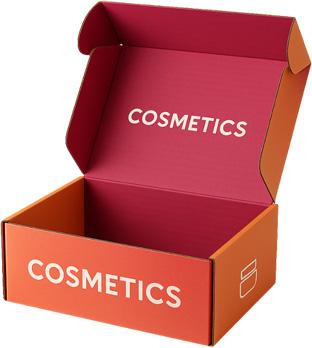
SFL & Corrugated Structures
Single-Face Lamination (SFL) combines micro-flute crush resistance with offset-printed folding-carton paperboard. For larger DTC mailers and heavy product kits, SFL provides the structural rigidity of corrugated with razor-sharp retail brand graphics.
Note: SFL is not required for every beauty item; lightweight cosmetics often pair a standard folding carton with an outer shipping mailer.
Separate the Presentation Package From the Shipping Requirement
A frequent mistake in ecommerce beauty packaging is asking a single box to accomplish two opposing tasks: deliver an ultra-refined tactile presentation and absorb harsh courier transit abuse.
High-end cosmetic finishes—such as soft-touch coatings, embossed gold foil, and high-gloss spot varnishes—are easily marred by shipping labels, courier conveyor belts, and dust. When a brand ships directly in its luxury presentation box without an outer protective layer, the customer receives a package scuffed by road dirt, covered in adhesive bar codes, and dented at the corners.
To avoid this outcome, procurement and packaging teams must answer several practical logistics questions during dieline development:
- Will the package ship directly or inside an overbox? If shipping directly (Ship-in-Own-Container / SIOC), the exterior must use durable kraft or coated linerboard with peel-and-seal adhesive closures, while decorative treatments are focused on the interior unboxing reveals.
- Will customers order multiple SKUs simultaneously? Single-bottle DTC shipments can use tight-tolerance mailers, whereas mixed multi-SKU carts require secondary carton dimensions that nest securely inside standardized master shipping boxes.
- How is void space controlled? Loose space inside an outer shipper allows internal retail cartons to tumble and abrade each other. Secondary mailers should be right-sized to eliminate empty space.
- Are delicate corners protected? Rigid presentation boxes require corner-buffer clearances inside master shippers to prevent crush damage to setup edges.
Design Multi-Product Beauty Kits Around the Pack-Out Process
Multi-product beauty kits—such as holiday gift sets, skincare routine bundles, influencer launch boxes, and sampler collections—require packaging engineered specifically for the fulfillment pack-out line.
If a complex kit requires fulfillment operators to fold multiple intricate origami tabs, apply tape, or force tight containers into stubborn cavities, pack-out throughput plummets, labor costs escalate, and assembly errors increase.
Key Pack-Out Engineering Principles
- Self-locating cavities: Insert cutouts should guide each container smoothly into its seating position without pinching labels or scuffing bottle finishes.
- Intuitive assembly sequence: Design folding inserts so they pop into place with straightforward scores, eliminating ambiguous folding directions on the packing floor.
- Clear component identification: For kits containing multiple shade variants or similar serum vials, print SKU and component indicators directly on hidden insert tabs so fulfillment packers immediately catch picking mismatches.
- Finger-access relief notches: Include subtle thumb cutouts in paperboard trays so the recipient can easily lift bottles and jars out of their compartments without tearing the packaging.
PM Packaging supports commercial beauty programs through comprehensive contract packaging, kitting, assembly, and fulfillment services, helping brands integrate structure, graphics, and manual or semi-automated pack-out workflows into a seamless production run.
Packaging for Subscription and DTC Programs Must Be Easy to Kit
Subscription boxes and recurring DTC replenishment models place extreme demands on fulfillment consistency. In subscription operations, hundreds or thousands of packages must be assembled, filled, verified, and shipped within narrow monthly shipment cycles.
Packaging structures for recurring DTC programs must support fast, repeatable manual packing:
- Auto-lock bottom cartons: Replace standard tuck-bottom boxes with pre-glued auto-bottom cartons that pop open instantly with a single push, cutting assembly seconds per unit.
- Modular partition inserts: Standardize outer mailer dimensions while using interchangeable internal paperboard dividers that adapt to varying monthly product assortments.
- Barcode and SKU verification windows: Ensure primary bottle lot numbers and barcodes remain visible through insert apertures or outer carton cutouts so automated scan-verification can confirm carton contents without opening the sealed pack.
- Integrated tear-strip and return closures: Double adhesive strip closures allow consumers to open the parcel with a clean pull-tab and re-seal the same box if an exchange or return is required.
Protect Premium Finishes Through Parcel Handling
Cosmetics packaging frequently incorporates premium embellishments—such as hot foil stamping, micro-embossing, soft-touch matte lamination, and spot UV varnishes. However, during parcel handling, sustained friction can leave dark scuff marks, flake metallic foils, or create burnish lines across matte backgrounds.
Protecting decorative finishes requires targeted structural and finishing decisions:
- Protective aqueous coatings: Applying a scuff-resistant matte or gloss aqueous coating over printed paperboard seals pigment and prevents ink rub-off when cartons contact one another.
- Recessing delicate foil areas: Combine foil stamping with debossing or position hot-stamped logos within subtle panel recesses so they do not protrude past the contact plane of the carton.
- Protective sleeves and inner wraps: Enclosing luxury rigid boxes in a lightweight paperboard slipcase or tissue wrap absorbs surface friction, ensuring the core branded box emerges pristine.
- Corner-lock dielines: For rigid setup boxes, specify reinforced corner stays and heavy caliper chipboard cores to prevent corner crushing and paper wrap tearing during sudden drops.
Where Does Sustainability Fit Into Ecommerce Beauty Packaging?
In an ecommerce context, sustainability must be evaluated from a complete logistics and material lifecycle perspective rather than treated as a superficial marketing slogan. Unnecessary packaging layers, oversized shipping cartons, and non-recyclable multi-material assemblies alienate environmentally conscious beauty shoppers.
Practical sustainable packaging practices for beauty ecommerce include:
- Right-sizing packaging dimensions: Tightening outer mailer dimensions to the exact volume needed for product retention minimizes dimensional weight freight charges, reduces fuel consumption in transit, and eliminates excess board consumption.
- Eliminating synthetic foam and plastic films: Replacing plastic thermoformed blister trays and poly foam inserts with custom die-cut paperboard platforms provides equal protection while enabling 100% curbside paper recycling.
- Responsible fiber sourcing: Certified-fiber options, such as paperboard sourced from responsibly managed forests, may be specified across folding cartons and corrugated mailers where documented and supported.
- Minimizing composite laminate layers: Selecting aqueous barrier coatings rather than heavy plastic film laminations ensures that paperboard boxes break down cleanly in commercial paper recycling repulping processes.
Note: Specific paperboard fiber grades, recycled-content selections, and detailed folding-carton print substrates are explored in depth on our dedicated paperboard trends resource.
How Should Beauty Packaging Be Evaluated Before Ecommerce Launch?
Beauty packaging should never be released directly into full-scale national ecommerce distribution without rigorous physical pre-launch verification. Evaluation should reflect the actual product format, container fragility, and expected distribution conditions.
A systematic pre-launch packaging evaluation includes:
- Physical container fit check: Test actual production bottles, droppers, and jars—filled with water or representative formula to match actual mass—inside prototype paperboard inserts to confirm secure retention.
- Manual pack-out time trial: Measure the seconds required for an operator to fold the insert, seat the product, close the box, and apply shipping tape. Identify awkward folds that slow assembly.
- Multi-angle drop and vibration simulation: Evaluate packed samples across edge, corner, and face drops from typical conveyor and parcel drop heights to check for seal loosening, pipette fracture, or pan cracking.
- Surface friction inspection: Review decorative foil, matte finishes, and varnishes on trial units after simulated transit shaking to ensure zero visible scuffing or ink migration.
- Customer unboxing walk-through: Open the package from the recipient's perspective. Confirm that the branding is immediately visible, product labels face forward, and containers can be lifted out smoothly.
Example: DTC Skincare Launch With Glass Dropper Bottles
Consider an established clinical skincare brand introducing an advanced facial serum packaged in a 30ml heavy-wall glass bottle with a glass pipette dropper. The brand plans to sell the serum directly via its DTC ecommerce storefront with national parcel shipping.
Step 1: Container & Retention Engineering
Rather than placing the loose bottle in a generic mailer with plastic air pillows, the team designs an individual 18pt SBS folding carton featuring an integrated internal paperboard collar. The collar suspends the glass bottle centrally, isolating the vulnerable glass pipette from direct carton wall impacts.
Step 2: Presentation & Shipper Integration
For individual DTC orders, the primary carton slides into a tailored E-flute single-face laminated (SFL) mailer box. The interior of the mailer is offset-printed with brand messaging and application instructions, while the exterior uses a durable scuff-resistant matte aqueous coating.
Step 3: Fulfillment & Pack-Out Validation
During pack-out trials, the mailer's self-locking dieline allows fulfillment packers to fold and seal each order in under 12 seconds with no external void-fill required. Pre-launch shipping trials confirm zero bottle leakage and pristine presentation upon arrival.
Questions to Resolve Before an Ecommerce Beauty Packaging Program
Before approving packaging tooling or initiating full-scale production runs, procurement and packaging engineering teams should resolve this operational checklist:
When the Main Question Is Paperboard, Printing and Finish Selection
If the distribution system is not the main problem and the buyer instead needs to understand why offset-printed paperboard remains important for beauty cartons—and how sustainability, material, and decorative-finish choices affect the package—that is a different packaging decision. Explore our dedicated analysis of offset-printed paperboard trends in beauty packaging.
Build Beauty Packaging Around the Product and Fulfillment Route
Successful ecommerce cosmetics packaging synchronizes the primary container, protective inserts, branded presentation carton, outer mailer, and fulfillment pack-out into a single cohesive system. When each element is engineered to withstand parcel transit, products arrive undamaged and brand equity is reinforced at unboxing.
Discuss your beauty product format, primary container, packaging structure, SKU count, insert requirements, ecommerce shipping method, and fulfillment needs with PM Packaging.
Contact Our Packaging Specialists