
Why Beauty Brands Use Offset-Printed Paperboard Packaging
How high-resolution offset lithography, structural folding-carton engineering, selective decorative finishes, and fiber specifications define retail beauty presentation.
Direct Answer
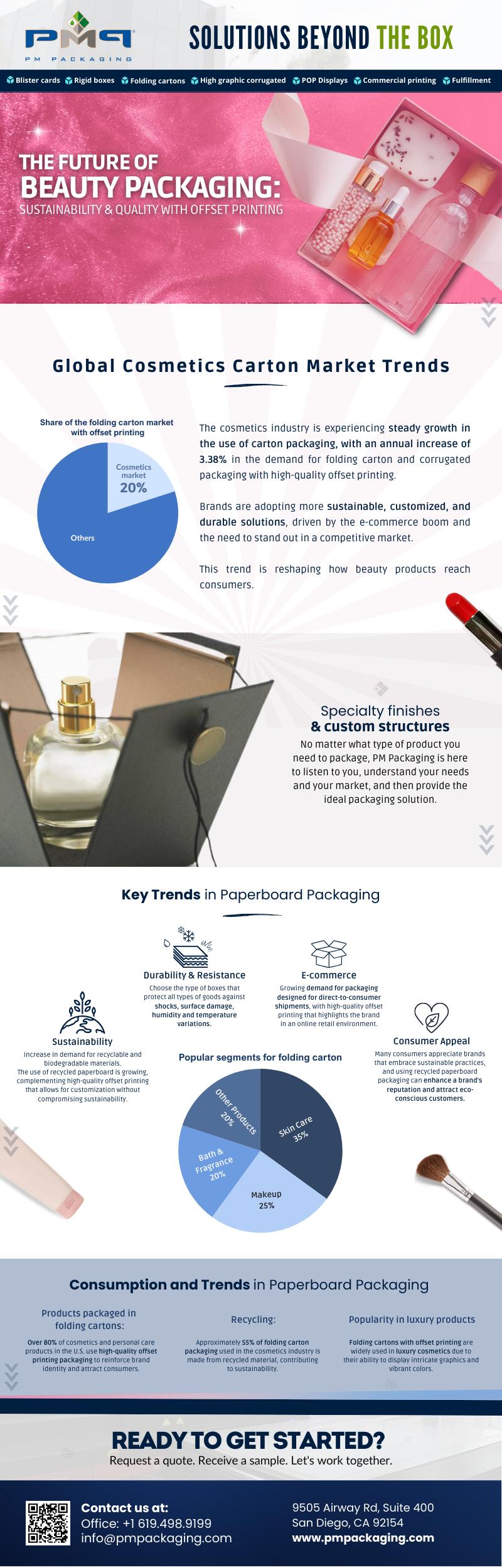
Beauty brands use offset-printed paperboard because it combines high-resolution graphics with a versatile carton structure that can be adapted for skincare, makeup, fragrance, and personal-care products. Offset printing supports detailed imagery, small typography, consistent brand graphics, and decorative treatments such as foil, embossing, debossing, Spot UV, and aqueous coatings where appropriate. Paperboard also gives brands several material and fiber-sourcing options, making it possible to balance presentation, structural requirements, print quality, and sustainability goals within a single folding-carton format.
Why Offset Printing Works Well for Beauty Cartons
In the beauty and personal-care sector, packaging serves as both the consumer's initial sensory touchpoint and the ultimate expression of product quality. Whether on department store shelves, specialty beauty displays, or boutique counters, cosmetic packaging must convey uncompromising precision.
Offset lithography remains the primary print method for high-volume commercial beauty cartons because of its unmatched optical and mechanical advantages:
- Photographic reproduction fidelity: High-line-screen offset printing captures subtle skin-tone transitions, delicate gradients, and hyper-detailed ingredient photography without banding or dot gain distortion.
- Micro-typography legibility: Cosmetics packaging requires substantial mandatory labeling—including multi-language ingredient listings, batch codes, regulatory symbols, and usage directions—often at 4-point type. Offset lithography renders razor-sharp serifs and clean letterforms that remain crisp and legible.
- Solid color saturation: Offset presses lay down rich, uniform ink films across large solid backgrounds without the pinholing, streaking, or mottled coverage often encountered in other processes.
- Inline decorative versatility: Modern sheetfed offset presses integrate inline coating units, allowing precise registration between multi-color process inks, protective aqueous coatings, and downstream embellishments.
When paired with rigorous G7 color calibration standards, offset printing ensures that a brand's signature palette remains visually identical across disparate production cycles and multiple packaging facilities.
Which Beauty Products Commonly Use Paperboard Cartons?
Paperboard folding cartons are the standard secondary packaging format across virtually all commercial cosmetics categories. Because paperboard can be precision cut, scored, embossed, and folded into an infinite array of structural silhouettes, brands deploy it to package a diverse spectrum of primary vessels:
Skincare & Serums
Glass dropper vials, ampoules, treatment serums, day/night moisturizers, and facial oils housed in slender tuck-end cartons.
Color Cosmetics & Makeup
Lipsticks, liquid lip glosses, foundations, mascaras, eyeliner pencils, and compact powder cartons with exact shade indicators.
Fragrance & Cologne
Heavy glass perfume flacons, travel sprays, and eau de parfum collections requiring dense caliper board and internal retention.
Personal Care & Haircare
Premium shampoo pumps, hair oil droppers, body balms, and botanical soaps packaged in coated folding cartons.
For detailed cosmetics packaging formats—including custom dielines, window cartons, and rigid box constructions—explore PM Packaging's dedicated Cosmetics Packaging Solutions.
Choose Paperboard According to Structure and Print Requirements
Selecting the right paperboard substrate is the foundational engineering decision in cosmetics carton production. The paperboard grade dictates sheet brightness, ink absorption, surface smoothness, crease flexibility, and structural corner strength.
Commercial beauty programs primarily utilize these documented paperboard substrates:
- Solid Bleached Sulfate (SBS): The benchmark substrate for prestige cosmetics. Manufactured from 100% bleached chemical virgin wood pulp, SBS features an ultra-smooth clay-coated surface (C1S or C2S) with superior brightness (typically 90+ GE). It delivers flawless ink holdout, maximum dynamic color range, and exceptional score-line integrity that resists cracking during high-speed carton erecting.
- Coated Recycled Board (CRB): Produced from 100% recycled paper stock with a top clay coating. CRB offers an environmentally conscious alternative for mass-market cosmetics, providing a printable white surface over a grey interior ply. It requires careful caliper calibration to maintain adequate panel stiffness.
- Clay Coated News Back (CCNB): A cost-effective recycled substrate manufactured with a newsprint interior layer and a clay-coated top liner. Used primarily for secondary display cartons, large multipacks, or promotional sets where unit economy is prioritized.
- Uncoated Kraft & Solid Unbleached Sulfate (SUS): Selected by clean-beauty and organic brands seeking an authentic earthy aesthetic. While ink absorption is higher than coated SBS, modern offset presses can achieve sophisticated branding using opaque white under-bases and rich spot colors.
Review our comprehensive technical overview of Folding Carton Manufacturing Capabilities to evaluate caliper ranges and dieline options.
How Decorative Finishes Change Beauty-Packaging Presentation
Decorative post-press embellishments transform flat printed paperboard into a multi-dimensional sensory artifact. In retail cosmetics, strategic tactile and optical contrasts draw the consumer's eye and signal product formulation prestige.
Core finishing techniques deployed on commercial beauty packaging include:
Hot Foil Stamping
Applying metallic or pigment foils via heated dies. Used on brand logos, typography, and accent borders in brilliant gold, silver, copper, or rose gold to provide reflective prestige that stands out under retail spot lighting.
Embossing & Debossing
Mechanically raising (embossing) or depressing (debossing) specific areas of the paperboard sheet using matched male/female brass or magnesium dies. Adds tactile depth to brand crests, product titles, or subtle background textures without adding ink.
Spot UV Varnish
A cured high-gloss liquid coating applied to precise graphic zones—such as droplet illustrations or bottle silhouettes—contrasting against a matte background to produce vivid visual and textural drama.
Matte & Gloss Aqueous Coatings
Water-based inline coatings that protect inks from scuffing while establishing an overall satin, velvety matte, or high-gloss sheen across the entire carton surface.
Die-Cut Window Patching
Precision dieline cutouts backed with transparent recyclable film, permitting direct visual inspection of primary bottle colors, mascara wands, or shade swatches on the retail shelf.
For luxury beauty collections requiring custom rigid box silhouettes and specialty finishing, visit our Luxury Packaging Solutions.
Color Consistency Matters Across Beauty Product Families
Color consistency is the linchpin of cosmetics packaging governance. A single beauty brand often encompasses dozens of shade SKUs—from warm ivory to deep espresso foundations, or across entire fragrance and lip lines.
If the core brand color on an eye cream carton displays a slight yellow shift while the matching face cream carton leans cool, consumers perceive a quality defect or suspect counterfeit merchandise.
Key Color Control Standards:
- G7 Master Facility Qualification: Implementing G7 methodology aligns press tone reproduction and neutral gray balance across print runs, ensuring that brand hues match across different press models and sheet runs.
- Dedicated Spot Color Units: Formulating proprietary PMS spot inks directly on dedicated ink stations rather than relying solely on 4-color process simulations ensures rock-solid brand color consistency.
- Controlled Substrate Brightness: Monitoring base paperboard whiteness and shade values across board mill deliveries to prevent natural paper variation from tinting transparent process inks.
- Standardized Viewing Booths: Evaluating color draws under calibrated D50 and retail store lighting to confirm that cosmetic shades read accurately across varied retail environments.
Sustainability Starts With the Actual Material Specification
Commercial beauty brands face mounting regulatory and consumer pressure to improve the sustainability profile of their packaging. However, sustainability cannot be reduced to a generic claim that "paperboard is inherently green."
Real sustainability requires balancing material origin, chemical finishes, and end-of-life repulpability:
- Certified fiber sourcing: Specifying paperboard manufactured from third-party certified working forests guarantees that virgin fiber originates from responsibly managed timberlands that preserve biodiversity.
- Recycled fiber integration: Incorporating post-consumer recycled (PCR) waste into folding carton board reduces demand on virgin forestry resources, provided the board retains necessary bending stiffness.
- Repulpable coating chemistry: Utilizing modern water-based aqueous coatings rather than non-separable plastic film laminations ensures that cartons repulp cleanly in municipal paper recycling streams.
- Selective foil coverage: Confining hot foil stamping to discrete accents rather than total surface lamination preserves the carton's classification as recyclable paperboard under standard recycling guidelines.
- Right-sizing and material reduction: Tightening dieline geometry around primary containers reduces total square inches of paperboard consumed per thousand units, driving down carbon emissions across production and shipping.
Learn more about PM Packaging's sustainable manufacturing framework on our Sustainability Commitments page.
Recycled Board and Premium Print Quality Are Separate Decisions
Procurement teams often assume that choosing a recycled board (CRB or CCNB) will automatically yield the exact same print fidelity and tactile finish as virgin paperboard (SBS). In reality, board structure and print performance are distinct engineering variables.
Recycled paperboard consists of multiple plies of recovered paper fibers. While highly sustainable, recycled fibers are shorter and more porous than virgin chemical wood fibers. This structural reality influences production in several ways:
- Surface smoothness & dot gain: Virgin SBS features an ultra-smooth, uniform calendered surface that yields razor-sharp dot gain control for delicate skincare artwork. Recycled board can exhibit minor micro-texture that requires adjusted ink viscosity and impression pressure.
- Brightness and color saturation: SBS typically achieves 90+ GE brightness, providing an ultra-white backdrop that makes pastel and jewel-tone cosmetics pop. Recycled boards often possess a slightly warmer or grayer base tint that subtly alters transparent ink hues.
- Creasing and folding strength: Virgin fibers flex around scoring rules with exceptional ductility, eliminating corner tear. Recycled fibers are more brittle, requiring wider creasing channels to avoid surface cracking on carton scores.
Rather than treating board selection as an all-or-nothing trade-off, packaging engineers evaluate the exact artwork, embellishment density, and product weight to select the ideal substrate for each SKU.
Offset Printing vs. Decorative Finishes: They Solve Different Problems
To build an effective beauty packaging specification, brand managers must clearly separate the functional role of offset printing from the role of post-press decorative finishes:
Offset Printing Controls:
- High-resolution photographic imagery and gradients
- Fine typography and mandatory regulatory copy
- Multi-color process reproduction (CMYK)
- Brand color consistency and exact PMS spot matches
- Overall visual hierarchy and layout balance
Decorative Finishes Control:
- Metallic and reflective accents (Hot foil stamping)
- Tactile dimensionality (Embossing and debossing)
- Localized gloss/matte contrasts (Spot UV varnishes)
- Surface feel (Velvety soft-touch vs. slick satin)
- Surface protection and scuff resistance
High-end beauty packaging achieves its impact not by overloading every finish onto a single box, but through disciplined synergy—using offset lithography to establish clean, readable information, and selective finishes to create memorable sensory accents.
Where Does Ecommerce Fit Into Paperboard Beauty Packaging?
While offset-printed paperboard cartons are engineered primarily for retail presentation, they also play an essential role in ecommerce and DTC channels.
In an online shopping journey, the offset-printed carton appears prominently in high-resolution product photography, digital marketplace hero images, and social unboxing videos. When the consumer opens the shipping box, the printed folding carton provides the tangible proof of authenticity and luxury.
However, a paperboard folding carton alone cannot absorb the harsh dynamic drops, conveyor vibration, and parcel tumbling of courier transit. Engineering protective inserts, corrugated mailers, and kitting workflows is a distinct packaging discipline.
How Should Brands Evaluate Paperboard Beauty Packaging?
Packaging procurement teams can use this structured decision framework to systematically evaluate paperboard, print, and finish requirements for cosmetics programs:
| Decision | Buyer Question | Packaging Impact |
|---|---|---|
| Board Specification | What surface smoothness, brightness, and bending stiffness are needed? | Determines print contrast, folding score integrity, tactile weight, and corner durability. |
| Offset Printing | How detailed are the product imagery, small type, and graphics? | Delivers visual fidelity, micro-typography legibility, and uniform solid ink fields. |
| Decorative Finishes | Where should tactile and optical contrast be emphasized? | Establishes focal point hierarchy, logo recognition, and premium retail shelf presence. |
| Product Fit & Inserts | Does the primary container require structural stabilization? | Provides internal retention, prevents rattle, and maintains label orientation. |
| Sustainability Target | Is certified fiber, recycled content, or repulpability required? | Dictates substrate selection, coating chemistry, and municipal recycling compliance. |
| Multi-SKU Color Control | How many shades, formulations, or line extensions exist? | Requires G7 color calibration and dedicated spot ink formulation for cross-run consistency. |
Table: Offset-Printed Beauty Carton Decision Framework. Systematically aligns board grade, print process, and finishes with brand positioning.
Example: Offset-Printed Skincare Carton Family
Consider a prestige skincare brand producing a coordinated three-SKU daily facial regimen: a vitamin C serum (30ml glass dropper), a firming eye cream (15ml tube), and a peptide moisturizer (50ml glass jar).
Visual System Architecture
The brand establishes a unified visual architecture across all three SKUs: an 18pt SBS substrate with high brightness, a velvety soft-touch matte aqueous coating, and a hot-stamped gold foil brand emblem positioned at the upper center of the front panel.
SKU Differentiation & Color Calibration
To distinguish formulations without breaking line unity, each product incorporates a distinct spot-color band along the lower carton panel—sunburst gold for the serum, pale blush for the eye cream, and rich sage for the moisturizer. G7 master color calibration ensures that these pastel hues remain perfectly repeatable across re-orders.
Selective Embellishment
The product name is blind-debossed directly beneath the gold foil logo, creating an understated tactile accent. Mandatory multi-language ingredients and batch codes are printed in razor-sharp 4.5pt dark charcoal type on the rear panel, remaining 100% legible.
Questions to Ask Before Specifying Offset-Printed Beauty Cartons
Before finalizing dielines and placing production tooling orders, packaging developers should verify these critical parameters:
When the Main Problem Is Ecommerce Protection and Fulfillment
If the print and paperboard specification are established but the greater challenge is protecting glass containers, building multi-product kits, or managing DTC pack-out and parcel shipping, that is a separate ecommerce packaging problem. Read our complete guide to designing beauty packaging for ecommerce and DTC fulfillment.
Balance Print, Structure and Material Goals
Exceptional beauty packaging is achieved when paperboard substrate, carton engineering, offset lithography, brand color discipline, and decorative embellishments operate in complete harmony. When executed with precision, the folding carton elevates consumer perception and anchors long-term brand equity.
Discuss your beauty product, carton structure, board requirements, SKU count, artwork, color standards, and decorative finishes with PM Packaging.
Contact Our Packaging Specialists