
A product family can expand faster than its packaging architecture.
A successful consumer or hardware brand may have 20, 50, or 100 distinct SKUs sharing a common visual brand identity. Yet physically, those products vary substantially in dimensions, total weight, center of gravity, accessory counts, and transit vulnerability. Treating every SKU as an isolated custom packaging project creates an uncontrolled proliferation of cutting dies, board specifications, inserts, and warehouse inventory.
The opposite mistake is just as damaging: attempting to force every product into a single universal box size. Oversized products crush under-engineered cartons, while compact, lightweight items rattle inside cavernous boxes filled with expensive, wasteful dunnage.
The strategic objective of portfolio packaging engineering is straightforward: Standardize the platform. Vary the structure only where product physical requirements justify it.
Single Face Lamination (SFL) provides the ideal manufacturing foundation for this balance. By uniting offset-printed paperboard liners with engineered fluted mediums, brands can standardize outer dielines and material grades while utilizing modular inserts to adapt to unique product requirements.
Start by Classifying Products by Structural Requirement
When standardizing packaging across an expanding product family, do not organize your packaging solely around marketing categories or product line names. Marketing groupings rarely correspond to physical packaging physics.
Instead, audit and classify your entire portfolio by engineering characteristics:
- Product Weight & Density: Does the product weigh 0.5 lb or 12 lb? Is that mass evenly distributed, or concentrated in a dense motor or battery?
- Outer Dimensional Envelope: What are the maximum length, width, and height profiles across the SKU lineup?
- Component & Accessory Count: Does the SKU ship as a standalone unit, or include cords, chargers, nozzles, or replacement parts?
- Vulnerability & Surface Sensitivity: Does the item feature polished cosmetic surfaces, glass lenses, or sharp metal corners that could puncture paperboard?
- Distribution Channel: Will the package merchandise on retail shelves, hang on peg hooks, or ship direct-to-consumer?
Grouping your SKUs by physical behavior reveals natural clustering, proving that dozens of commercial products can often be served by just three or four structural packaging tiers.
Build Structural Tiers Instead of One Package Per SKU
Rather than designing a custom box for every individual item, establish a tiered structural packaging hierarchy across your portfolio.
An illustrative portfolio tiering model typically includes:
- Tier 1:Compact & Lightweight Products: Items under 1.5 lb with low shock vulnerability. Requires minimal flute caliper (e.g., F-flute microflute) and basic perimeter retention.
- Tier 2:Medium-Duty Products: Items between 2 and 6 lb requiring moderate panel stiffness (e.g., E-flute SFL), reinforced fold-over flaps, and custom-cut interior platforms.
- Tier 3:Heavy or Dense Products: Items exceeding 7 lb or featuring sharp, concentrated weight centers. Requires robust flute profiles (e.g., B-flute or heavy E-flute SFL), crash-lock reinforced bottoms, and load-bearing corner supports.
- Tier 4:Special-Case Products: Irregular shapes, oversized dimensions, or fragile sub-assemblies requiring dedicated custom tooling and multi-part protective cushioning.
This tiering architecture establishes operational clarity: 100 SKUs do not require 100 unique packaging structures. They require four well-engineered structural platforms.
Standardize the Outer Package Where Product Geometry Allows
Standardizing the exterior dimensions and footprint of cartons within each tier generates massive operational dividends across the manufacturing and distribution lifecycle:
- Tooling Consolidation: A single cutting die can convert cartons for 8 different product SKUs, slashing upfront tooling expenditures and setup charges.
- Unified Master Shippers: Standardized outer cartons pack into common corrugated master shippers and achieve identical pallet cube utilization across variants.
- Harmonized Retail Presence: Matching carton heights and depths align perfectly on retail shelves, creating a cohesive, professional brand billboard in retail aisles.
- Rapid SKU Introductions: New product formulations or colorways can launch immediately using existing structural dielines, requiring only new printing plates rather than 6 weeks of structural CAD sampling.
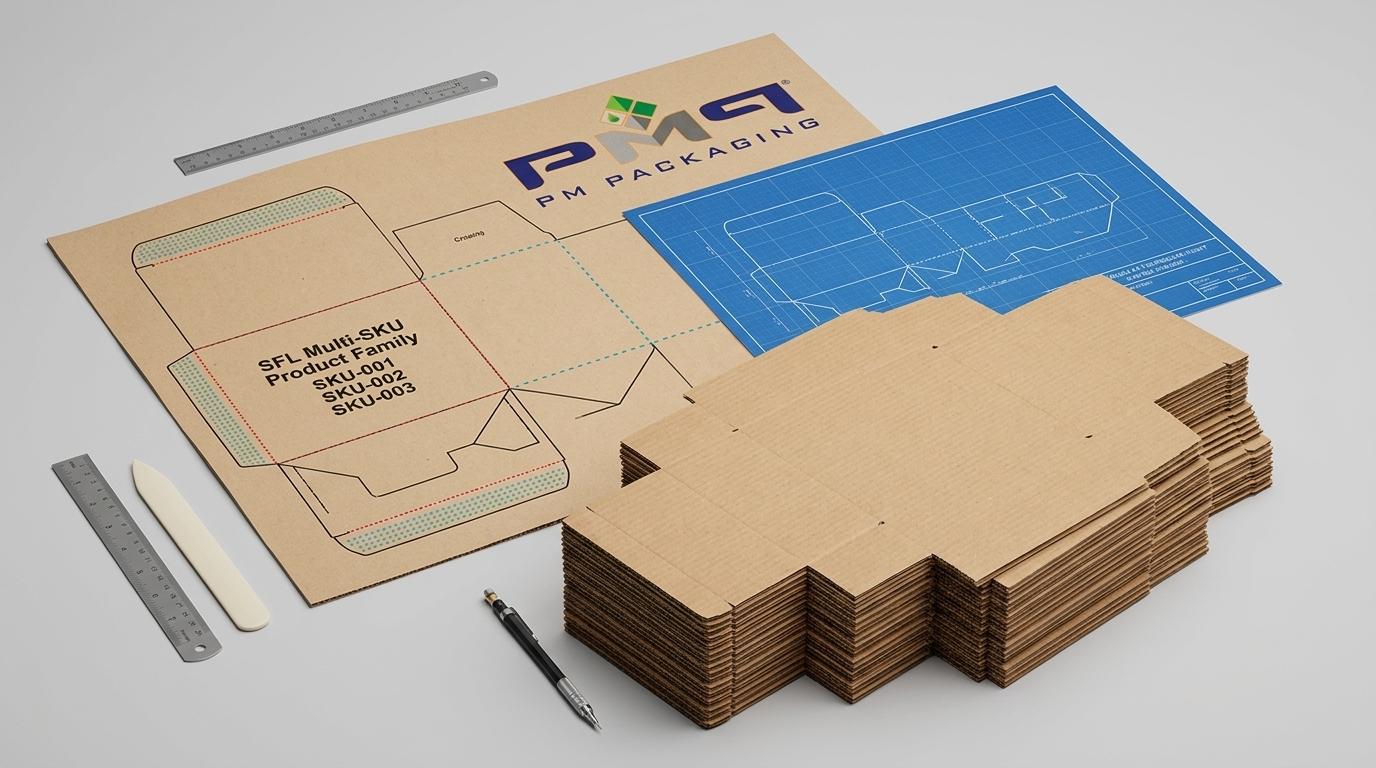
Platform Standardization: Managing multi-SKU retail lines efficiently requires standardizing outer SFL carton dielines while letting internal modular inserts adapt to specific product geometries.
Let Inserts Handle Product-Specific Variation Where Practical
The cornerstone of scalable product-family packaging is: KEEP THE OUTER STRUCTURE COMMON WHEN POSSIBLE. LET THE INTERNAL INSERT ADAPT TO THE PRODUCT.
Instead of reshaping the exterior box whenever an accessory changes or a product handle shifts, use modular interior inserts to bridge the gap:
- Standardized Outer Insert Footprint: The exterior perimeter of the folded insert matches the interior walls of the common outer box exactly.
- Customized Interior Cavity Routing: Only the internal die-cut apertures change, cradling the specific tool, bottle, or accessory set snugly.
- Economical Insert Tooling: Insert cutting dies are smaller, less complex, and significantly less expensive to modify or replace than primary full-box converting dies.
This modular strategy allows a brand to maintain one universal outer carton shell while effortlessly accommodating five distinct tool models or three accessory bundle variations.
Do Not Standardize Across Meaningfully Different Weight Classes
Platform standardization is powerful, but pushing it too far leads to severe failure. Standardizing across fundamentally incompatible weight classes is one of the most common mistakes in portfolio management.
If a 2 lb handheld cordless driver and an 11 lb rotary hammer drill are forced into the same carton dieline to save tooling fees:
- The 2 lb tool will be burdened with excessive, expensive board caliper and wasted internal void volume.
- The 11 lb hammer drill will blow out bottom tuck flaps, split corner seams, and dish side panels during freight vibration.
The Boundary Rule: Standardize within defined structural weight and size classes. When product mass, center of gravity, or transit shock hazards jump to a higher threshold, transition to the next structural tier rather than stretching an under-engineered package beyond its physical limits.
Create a Structural Specification Matrix
A practical structural specification matrix documents portfolio rules clearly, ensuring marketing, product design, and packaging engineering remain aligned:
| Product Group | Relative Structural Need | Outer Packaging Platform | Insert Strategy | Primary Variant Driver |
|---|---|---|---|---|
| Small / Light Items | Lower (Under 2 lb) | Common Platform A (F-Flute Microflute SFL) | Simple folded paperboard friction nest | Printed artwork & product diameter |
| Medium Core Items | Moderate (2 to 6 lb) | Common Platform B (E-Flute SFL Auto-Bottom) | Product-specific routed cavity insert | Accessory count & product contour |
| Heavy Duty Items | Higher (7+ lb) | Reinforced Platform C (Heavy E/B-Flute SFL) | Load-bearing folded platform with end-caps | Concentrated mass & shock protection |
| Specialty Products | Unique / Irregular | Custom Engineered SFL Structure | Bespoke multi-piece protective cradle | Asymmetric geometry & fragility |
Standardize Flute and Material Specifications Where Appropriate
Managing 30 SKUs with 15 different paperboard calipers and corrugated fluting combinations creates logistical chaos at the converting facility. Paperboard mills require minimum production orders, and frequent board grade changes drive up machine setup charges and scrap rates.
Where possible, standardize raw material combinations across your structural tiers:
- Common Top Liner Substrate: Specifying an identical high-performance coated top sheet (such as 10pt or 12pt SBS) across all cartons allows multiple SKUs to run consecutively on high-speed litho offset presses without recalibrating ink and coating chemistry.
- Standardized Fluted Mediums: Consolidating your portfolio onto proven flute profiles—such as E-flute or F-flute Single Face Lamination—enables bulk board procurement and guarantees continuous material availability.
Separate Structural Variation From Graphic Variation
One of the most effective principles in portfolio packaging management is separating physical engineering from visual design:
STRUCTURE Changes When:
- Physical product dimensions change significantly
- Product mass crosses a structural weight threshold
- Internal center of gravity shifts drastically
- Transit impact vulnerabilities demand more cushioning
GRAPHICS Change When:
- SKU name, shade, or model number changes
- Marketing claims or certifications differ
- Barcode, UPC, or regulatory text updates
- Retailer channel requires specific branding
Never allow a simple marketing variation—such as a new flavor, scent, or promotional partner—to trigger the creation of a new structural dieline. Keep the CAD form identical and handle the differentiation entirely on the print plates.
Use Common Dielines Across SKUs Only When the Physical Requirements Match
Sharing a dieline across multiple SKUs is highly advantageous, but only when physical product requirements genuinely align:
- When Common Dielines Succeed: Products with identical footprints, similar weights (within ±15%), matching closure preferences, and compatible loading ergonomics.
- When Common Dielines Fail: Forcing a product with large unsupported panel spans into a dieline designed for a compact, rigid item, resulting in sidewall bowing and retail shelf deformation.
Plan the Product Family Around Future SKU Growth
A well-engineered packaging architecture is built for portfolio expansion. When R&D develops next-generation models, limited-edition bundles, or seasonal variants, the packaging system should accommodate them effortlessly.
By establishing pre-engineered platform tiers and modular insert guidelines, product managers can launch new SKUs in weeks rather than months, using proven structural dielines and predictable supply chain footprints.
Manage Packaging Part Numbers Without Creating Unnecessary Complexity
In large product families, bill-of-materials (BOM) management can quickly become unmanageable if part numbers are unstructured.
Decouple your component numbering logic:
- Structural Dieline Number: Identifies the physical blank geometry, flute profile, and scoring layout (e.g., SFL-PLATFORM-B).
- Modular Insert Number: Identifies the internal folded tray configuration (e.g., INSERT-B-MOD04).
- Graphic Artwork Identifier: Tracks the specific printed graphics and regulatory revision (e.g., ART-SKU102-REV03).
This separation makes it instantly clear that an artwork revision does not require structural re-tooling, keeping procurement and inventory teams perfectly synchronized.
Standardization Can Also Improve Repeat Production
Reducing the number of unique structural dielines across your portfolio directly improves high-volume converting economics:
- Fewer Die Setup Changes: Converting machinery can run continuously across multiple SKU sheet runs without swapping heavy cutting dies.
- Standardized Quality References: Quality control inspectors use the same boundary gauges and squareness criteria across multiple product variants.
- Consolidated Reordering: Purchasing teams can combine seasonal reorders into larger, more economical board runs, reducing unit packaging costs.
When a Product Needs a Completely Different Structural Package
While standardization is a vital operational discipline, knowing when to create a completely bespoke structural package is equally critical.
A dedicated, non-standard structural package is justified when:
- The product mass or density is so extreme that standard platform flutes fail compression or drop thresholds.
- The product geometry is radically asymmetric, requiring specialized internal braces that cannot fit inside standard box footprints.
- The retail merchandising format shifts—such as moving from a standard shelf-stacking carton to a peg-hanging blister card or oversized floor display tray.
Illustrative Portfolio Example: A 24-SKU Line
Illustrative Portfolio Architecture
Consolidating 24 SKUs Into 3 Standard Outer Platforms
A commercial power-tool accessory brand with 24 distinct product SKUs was historically purchasing 24 independent custom carton sizes. Warehouse shelves were congested with 24 separate carton inventories, and reorders required constant machine setup downtime.
PM Packaging collaborated with the brand to restructure the portfolio:
- 3 Standardized Outer SFL Platforms: Grouped all 24 SKUs into 3 exterior footprint sizes (Small, Medium, Deep) sharing identical E-flute SFL specifications.
- Modular Die-Cut Inserts: Developed 6 standardized folded paperboard insert blanks with customized interior routing tabs to cradle specific tools and attachments.
- Universal Master Case Footprint: Designed 2 master case sizes that modularly pack the 3 carton platforms onto standard 48x40 pallets.
The outcome: Active packaging part numbers dropped by over 60%, die-cutting changeover downtime was cut in half, and the brand established a unified, high-impact retail presence across national hardware shelves.
*Note: Figures are illustrative of portfolio engineering principles and do not represent contractual performance guarantees.
When Strength + Retail Branding Is the Primary Problem
Some packaging programs are not primarily struggling with multi-SKU platform complexity. Instead, the central challenge is giving an individual retail package additional structural rigidity while delivering high-resolution lithographic graphics and premium shelf presentation.
See our companion guide to balancing SFL structural strength and retail branding to learn how to harmonize litho liners with fluted corrugated structures.
Planning SFL Packaging Across a Large Product Family
Establishing a standardized SFL packaging platform across a multi-SKU portfolio requires a systematic review of your product lineup, structural demands, and distribution goals.
When preparing a portfolio packaging consolidation program, gather the following key data:
- Total active SKU count & projected new additions
- Complete dimensional range (min / max length, width, depth)
- Weight distribution spectrum across all items
- Current packaging formats & dieline counts
- Specific structural failure points in current boxes
- Insert retention & accessory organization requirements
- Retail shelf facing constraints & planogram depths
- Master shipping carton & pallet cube targets
- Annual unit volumes across SKU variants
- Target board substrates & flute profiles
PM Packaging works directly with commercial manufacturers to audit SKU portfolios, establish structural tier matrices, and engineer scalable SFL packaging platforms. Learn more about our custom solutions on our Single Face Lamination solution page.
Standardize Your Packaging Portfolio With Confidence
A multi-SKU packaging family succeeds when structural engineering simplifies manufacturing without compromising product protection.
By classifying products into structural tiers, standardizing outer carton footprints, letting modular inserts adapt to specific product geometries, and decoupling structural blanks from printed artwork, brands can scale their portfolios smoothly while controlling costs and inventory.
Contact PM Packaging to discuss your multi-SKU portfolio, structural requirements, and consolidation objectives. Our packaging engineering team can help analyze your dielines and build a standardized SFL packaging architecture tailored for scale.