
For an established consumer brand, folding-carton capacity should be evaluated across the entire manufacturing route rather than by looking only at printing speed.
A large carton program may pass through paperboard procurement, printing, coatings or decorative finishes, die-cutting, window patching where required, folding and gluing, quality checks, packing, and delivery. The practical manufacturing question is whether those steps can support the program's required volume, carton structure, production cadence, pack-out method, and seasonal demand without one stage becoming the limiting operation.
The central buyer question is: "Can a folding-carton manufacturer support the production volume, manufacturing route, pack-out requirements, and production cadence of our established program?" In commercial shorthand: we need to manufacture a high volume of packaging reliably.
This guide examines how enterprise procurement and packaging engineering teams evaluate end-to-end carton manufacturing routes, identify potential machinery bottlenecks, align structural designs with pack-out requirements, and structure production cadences to support established consumer brands.
Why Folding-Carton Capacity Is More Than Printing Speed
High-speed sheet-fed offset lithography can print tens of thousands of sheets per shift. However, an efficient press run does not guarantee that the complete carton manufacturing system can support a brand's commercial delivery timeline. Printing is only one stage in an interconnected converting workflow.
When sourcing custom folding carton manufacturing for an established consumer brand, the program passes through sequential operations:
- Paperboard Procurement: Sourcing and conditioning approved paperboard grades (SBS, CRB, CCNB, C1S/C2S) in sheet sizes optimized for press imposition.
- Prepress & Plate Generation: Calibrating approved artwork to press curves and mechanical dielines.
- Lithographic Printing: Printing primary brand process colors and spot inks with inline coatings.
- Finishing & Coatings: Applying protective aqueous or UV coatings, foil stamping, or embossing/debossing where specified.
- Die-Cutting: Cutting, scoring, creasing, and stripping individual cartons from printed sheets.
- Window Patching: Applying clear poly film across die-cut apertures when product visibility is required.
- Folding & Gluing: Pre-breaking scores, folding flaps, applying adhesives, and forming flat knocked-down cartons.
- In-Line Inspection & Quality Checks: Verifying score stiffness, glue adhesion, barcode scanability, and visual fidelity against approved specifications.
- Packing & Palletizing: Packing knocked-down flat (KDF) cartons into corrugated shippers or bulk bins on pallets.
- Outbound Delivery: Moving finished cartons into the brand's plant, contract packager, or regional fulfillment hub.
If a plant possesses extensive printing capacity but limited die-cutting throughput or narrow folder-gluer configurations, cartons stack up as printed work-in-process sheets. True capacity is the sustainable throughput of the slowest step along this route.
Map the Complete Carton Manufacturing Route Before Awarding a Large Program
To prevent production surprises, procurement teams should map their carton specifications against each converting station. The following matrix illustrates what buyers should define at each stage and the potential operational constraints to audit:
| Production Stage | What the Buyer Should Define | Potential Constraint |
|---|---|---|
| Paperboard Specification | Substrate grade (SBS, CRB, CCNB), caliper/thickness, surface coating (C1S/C2S), sheet dimensions. | Mill order minimums, inbound freight lead time, sheet conditioning requirements. |
| Printing | Ink sequence, process colors, spot colors, G7 color standard expectations, sheet imposition layout. | Press sheet size limitations, ink fountain setup time, color matching approvals. |
| Finishing & Coatings | Protective aqueous gloss/matte, Spot UV, hot-stamp foil, multi-level embossing/debossing. | Off-line vs. in-line processing passes, cure/dry times, tooling registration tolerances. |
| Die-Cutting | Approved CAD dieline, steel-rule die specifications, creasing matrix profile, stripping requirements. | Die makeready complexity, platen tonnage limits, intricate interior cutout stripping. |
| Window Patching | Film material (PET, PVC, acetate), film gauge/thickness, adhesive type, patch margin overlap. | Window applicator speeds, film feed tension, static accumulation on plastic film. |
| Folding / Gluing | Carton style (straight tuck, auto-bottom, 4-corner tray), hot-melt or cold-glue requirements. | Belt speeds, complex multi-point folding hook setup, glue tab compression time. |
| Packing & Palletizing | KDF count per case, case orientation, pallet pattern, stretch wrap, labeling standards. | Case-packing labor or speed, pallet staging space, corrugated shipper supply. |
| Delivery Cadence | Scheduled release quantities, drop locations, recurring shipping dates, dock receiving constraints. | Carrier transit times, warehouse dock scheduling, regional freight congestion. |
Annual Volume Is Not the Same as Required Production Throughput
When requesting quotes or evaluating suppliers, procurement teams often lead with a single number: "We need 5 million folding cartons annually." While annual volume establishes commercial scale, it provides insufficient information to plan manufacturing throughput.
Sourcing teams must translate annual demand into operational production cadence:
- Release Size vs. Run Size: Will the supplier produce 400,000 cartons every month, or produce a large scheduled run and release smaller quantities weekly to co-packers?
- Order Frequency: High-frequency releases require reliable inventory visibility and clear dispatch protocols between the packaging plant and the filling line.
- Peak Concentration: An annual volume of 5 million cartons distributed evenly across twelve months requires ~416,000 cartons per month. If 60% of that volume is consumed during a four-month retail holiday build, the required production rate surges to 750,000 cartons per month.
- Filling Plant Dock Capacity: Automated packing facilities cannot absorb three months of carton volume at once due to floor space constraints. Cadence must match plant consumption.
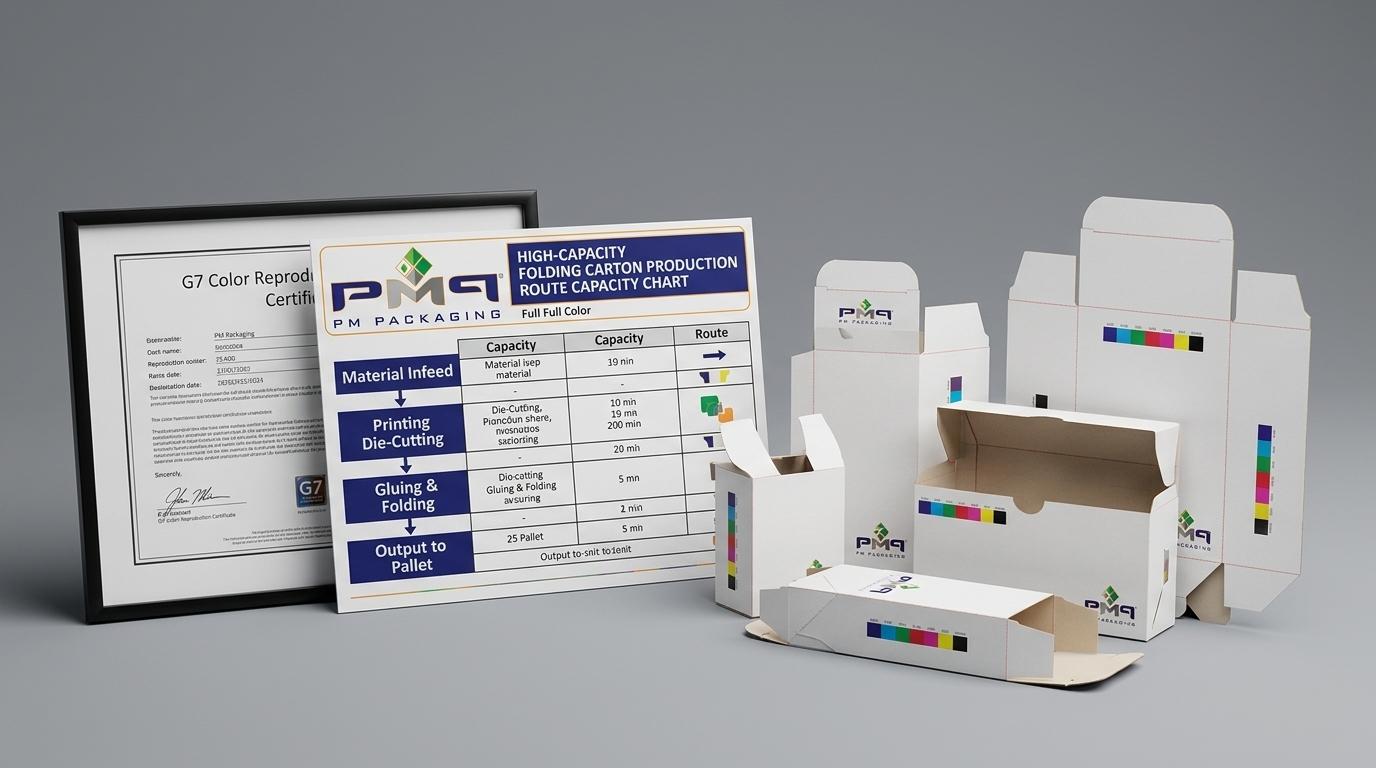
Which Folding-Carton Operations Can Become Bottlenecks?
In folding carton production, converting bottlenecks shift depending on the physical specifications of the box. Identifying potential choke points helps procurement evaluate a manufacturer's equipment mix:
Printing and Finishing
Programs requiring multiple specialty spot colors, protective aqueous coatings, Spot UV accents, or hot-foil stamping add machine passes or complex makereadies. If finishes are applied off-line, sheets must be restacked, moved, and acclimated between passes, extending total cycle time.
Die-Cutting
Platen die-cutters score, cut, and strip internal waste. Complex dielines with intricate internal cutouts, perforations, or heavy paperboard calipers require precise tonnage calibration and slower cycle speeds. Steel-rule dies must be maintained and inspected for blade sharpness to prevent ragged edges or flaking.
Folding and Gluing
Folder-gluers transform flat blanks into functional cartons. A straight tuck carton runs at high linear belt speeds. Conversely, an auto-bottom lock or a 6-corner collapsible tray requires motorized folding hooks, overhead timed belts, and multiple adhesive application guns, requiring longer setup times and measured operating speeds.
Window Patching or Specialty Operations
When a retail carton features a transparent window, window patching machines cut clear film from roll stock and adhere it across the opening. Window application operates as a dedicated converting stage that must be synchronized with die-cutting and final gluing schedules.
Carton Structure Affects Manufacturing Efficiency
Structural choices directly govern both converting throughput at the packaging plant and assembly speed on the packing floor. Brands can explore structural variations across PM Packaging's folding carton catalog:
Straight Tuck End (STE)
Top and bottom closure flaps tuck from the same face. Maximizes sheet nesting efficiency and allows rapid straight-line gluing. Excellent for automated horizontal cartoning equipment.
Reverse Tuck End (RTE)
Top and bottom flaps fold toward opposite sides. Offers optimal sheet layout on certain press sheet sizes, reducing board waste. Frequently chosen for manual and semi-automated packing lines.
Auto-Bottom Lock (Crash Lock)
Bottom flaps are glued together during converting. On the packing line, the carton erects instantly when squeezed open. Reduces manual labor by up to 50% during hand packing, though it requires more complex folder-gluer setup.
Snap-Lock Bottom (1-2-3 Bottom)
Four interlocking base flaps fold manually without glue. Converts through simpler straight-line machines while supporting heavier products than standard tuck closures.
Manual and Automated Pack-Out Create Different Carton Requirements
A high-capacity folding carton program must be engineered to perform in its specific packing environment. Cartons designed for manual pack-out prioritize easy opening and ergonomic folding, whereas automated cartoning lines demand tight physical tolerances:
- Opening Force & Score Stiffness: Automated cartoning machines pick flat cartons with vacuum cups and erect them in milliseconds. If scores are too stiff, suction cups fail to open the carton, tripping line jams. If scores are too loose, cartons bow or lose squareness.
- Squareness Tolerances: Erected cartons must maintain crisp 90-degree corners so high-speed product pushers can insert bottles, tubes, or jars without striking carton walls.
- Flap Alignment & Glue Seams: Glue tabs must be consistently compressed without skew or adhesive bleed. Excess glue inside the carton will seal interior flaps shut, causing automated insertion failures.
- Grain Direction: Paperboard grain must run parallel to primary crease scores or carton height depending on the mechanical cartoner's feeder mechanism to prevent panel buckling.
How Should Paperboard Requirements Be Planned for a Large Program?
Paperboard represents the largest raw material cost in high-capacity carton manufacturing. Established brands must lock in an approved paperboard specification rather than leaving substrate selection open:
Solid Bleached Sulfate (SBS)
Virgin bleached wood pulp throughout. Clean white interior and superior clay-coated exterior surface. Standard choice for cosmetics, pharmaceuticals, food, and high-end consumer goods.
Clay Coated Newsback (CCNB)
Recycled paperboard with a gray newsprint back and clay-coated white top sheet. Highly cost-effective for large-volume dry foods, hardware, and household packaged goods.
Coated Recycled Board (CRB)
100% recycled fiber content offering sustainable credentials. Balances stiffness and print fidelity for secondary retail packaging and consumer staples.
Brands should also establish caliper ranges (e.g., 16pt, 18pt, 24pt) based on product weight and distribution stacking requirements. Substrate substitutions should never occur without formal pre-production qualification, as changes in caliper or board stiffness alter score memory and packing-line performance.
How Should Quality Be Defined for Repeat High-Volume Carton Production?
For large ongoing programs, quality is defined as repeatable adherence to an approved master specification sheet across successive manufacturing runs. Key quality parameters include:
- G7 Color Standards: Printing according to G7 methodology ensures consistent gray balance and color density across lithographic press runs, maintaining brand equity on retail shelves.
- Dimensional Stability: Verifying cutting and scoring tolerances on coordinate measuring tables to ensure dieline geometry does not drift as tooling wears.
- Fiber-Tear Adhesive Validation: Testing glue joints to confirm destructive fiber tear, verifying that carton manufacturer joints will not pop open during distribution or retail handling.
- Barcode Verification: In-line optical scanners verifying ANSI/ISO grade readability for UPCs and GS1 barcodes to prevent retail distribution fines.
Seasonal Demand Can Change the Manufacturing Plan
Established consumer brands often experience pronounced volume swings driven by holiday merchandising, back-to-school resets, spring promotional campaigns, or seasonal gift sets. Sourcing teams cannot assume packaging capacity can simply be doubled on three weeks' notice during peak converting months.
To protect delivery schedules, buyers and manufacturers should plan seasonal demand months ahead:
- Early Paperboard Advance Orders: Mills experience extended lead times heading into Q3 and Q4. Substrate orders must be placed early to secure required tonnage.
- Pre-Building Core Cartons: If the physical carton and branding are stable, producing cartons ahead of peak season and staging inventory reduces pressure on converting lines during surge periods.
- Locking Release Schedules: Establishing firm release dates with filling plants ensures transportation and warehouse staging are coordinated without dock congestion.
What Information Should a Brand Provide When Sourcing High-Capacity Folding Cartons?
To receive an accurate capacity evaluation and production route plan, procurement teams should supply the following technical inputs:
- ✓Finished Carton Dimensions: Length × Width × Depth (internal dimensions) and CAD dieline files.
- ✓Product Weight & Internal Load: Net product mass and whether the product supports top-load compression.
- ✓Carton Style: Straight tuck, reverse tuck, auto-bottom lock, snap-lock, or custom sleeve configuration.
- ✓Paperboard Grade & Caliper: Substrate specification (e.g., 18pt SBS C1S) and approved commercial equivalents.
- ✓Annual Demand & Release Cadence: Total annual quantity, typical shipment size, and order frequency.
- ✓Seasonal Peak Distribution: Percentage of annual volume required during promotional or holiday build windows.
- ✓Finishes & Coatings: Spot UV, hot stamping, embossing, matte/gloss aqueous coatings, or windowing.
- ✓Pack-Out Method: Manual packing, semi-automated fixture, or high-speed automated cartoning machinery.
- ✓Production & Pack-Out Locations: Manufacturing facilities, contract packagers, and receiving delivery docks.
Example: An Established Personal-Care Brand With a High-Volume Core Carton
Consider a hypothetical commercial scenario: an established personal-care brand manufactures a high-volume flagship body lotion packed in an 18pt SBS reverse tuck carton. The product uses a single, uniform graphic design year-round across retail drug and grocery channels.
The brand requires 3.6 million cartons annually. Rather than treating this as a generic print job, the procurement team audits the converting route:
- Standardized Substrate: 18pt SBS C1S is pre-scheduled with the paperboard mill in master roll sizes optimized for press sheet imposition.
- Dedicated Die Tooling: High-precision steel-rule cutting dies and counterplates are maintained with scheduled re-knifing protocols to prevent fiber flaking.
- Automated Cartoning Compatibility: Crease stiffness is monitored continuously so the cartons feed smoothly into the brand's 180-carton-per-minute cartoning machine without vacuum misfeeds.
- Scheduled Monthly Cadence: Cartons are manufactured in consistent monthly runs of 300,000 units, with scheduled truckload deliveries directly to the brand's contract filler.
Because the program features zero graphic version complexity, the entire operational focus centers on physical throughput, mechanical repeatability, and delivery timing.
When Multiple Print Versions Become the Bigger Manufacturing Problem
High physical production volume is one problem. Dividing that volume across many SKU, language, retailer, flavor, or promotional graphics creates a different prepress and production-management problem.
If the physical manufacturing route is established but the program includes dozens of distinct SKUs sharing common or unique dielines, the primary challenge shifts from total throughput to version control. Read our operational guide to managing large-scale folding carton production across multiple print versions.
Planning a High-Capacity Folding Carton Program
High-capacity folding carton production succeeds when procurement teams, structural engineers, and converting operators align on the full manufacturing route before the first production run begins.
To evaluate manufacturing capacity for an established brand, contact PM Packaging to discuss your annual carton volume, required production cadence, carton structure, paperboard grade, pack-out method, seasonal surge windows, and delivery schedule.
Evaluate Your Folding Carton Production Route
Connect with PM Packaging's packaging engineering team to review structural dielines, paperboard options, converting throughput, and scheduled delivery programs.