
A national retail product launch creates an entirely different manufacturing challenge than ongoing inventory replenishment.
When thousands of retail doors must set a promotional campaign on the exact same date, the production window narrows dramatically. Rather than spreading corrugated manufacturing across months, operations teams must coordinate massive raw board conversion, high-speed litho printing, precision die-cutting, assembly, pack-out, palletization, and freight routing so that every distribution center receives completed displays within strict appointment windows.
Executing a multi-store rollout requires synchronizing manufacturing capacity with distribution deadlines.
For brands scaling into national big-box, grocery, specialty, or club channels, display production is governed by an unforgiving critical path. Retailers do not postpone seasonal merchandising campaigns or circular print dates because a packaging converter encountered downtime. Missing a delivery window means empty floor footprints, severe retailer chargebacks, and lost launch momentum.
Successful high-volume retail display rollouts depend on production velocity, structural rigor, and end-to-end launch planning.
Why Fixed-Date Retail Launches Create a Different Production Challenge
Standard packaging procurement operates on rolling forecasts and reorder points. If inventory dips, replenishment orders absorb minor lead-time variations. In stark contrast, a coordinated multi-store retail launch has an immovable target: the national store-set date.
In fixed-date programs, every downstream activity compresses back from that single date:
- Immovable retail store-set dates tied to national ad circulars and omnichannel campaigns
- Distribution center delivery windows restricted to 3- to 5-day inbound receiving slots
- High freight volume requiring advance carrier scheduling and multi-stop consolidation
- Staged co-packing lines requiring finished corrugated components on strict schedules
- Simultaneous multi-region delivery schedules spanning dozens of retailer DC destinations
- Zero tolerance for late deliveries, which result in OTIF fines and canceled shelf space
Manufacturing high-volume retail displays for fixed launch dates requires building an execution schedule backwards from the retail distribution center dock appointment.
Translating Store Count Into Display Production Requirements
Launch planning begins by translating headline store counts into an exact manufacturing bill of materials. Brands often underestimate total production requirements by counting only primary store placements and neglecting essential operational buffers.
Consider a practical national launch model:
Target retail doors across regional and national divisions
2 floor displays per store (endcap + front lobby)
Includes 10% safety stock, DC buffer, and replacement units
If an operations team orders exactly 4,000 units, any warehouse handling damage, transit attrition, or retailer door additions will leave stores with empty footprints on launch morning. Accounting for overruns, DC safety stock, and rapid-response replacement units ensures the campaign launches at 100% store compliance.
Factoring replacement units and distribution safety stock into initial converting runs protects gross margins against expensive rush re-runs.
Manufacturing Capacity and Throughput Matter Before Production Starts
In high-volume launch execution, total production capacity is meaningless without high converting throughput. A packaging facility may claim the ability to produce 10,000 displays, but if their equipment footprint can only convert 500 units per week, the program will miss a compressed 6-week launch window.
Brands must evaluate true operational throughput across every phase of the manufacturing workflow:
- Large-Format Printing Throughput: High-speed flexographic or high-graphic litho-laminated sheet capacity capable of producing thousands of vibrant, full-coverage display sheets daily without color drift.
- High-Tonnage Die-Cutting Capacity: Precision flatbed and rotary die-cutters that convert heavy fluted corrugated board with clean creases, sharp cut edges, and zero fiber fraying.
- Automated Folder-Gluing & Lamination: High-speed multi-point gluers and laminators that ensure structural bonds cure properly at high line velocities.
- Machine Redundancy: Operating parallel press and converting lines so that mechanical maintenance on one machine does not halt an entire national launch run.
Machine redundancy and validated daily throughput ensure production schedules absorb real-world manufacturing variables without compromising delivery dates.
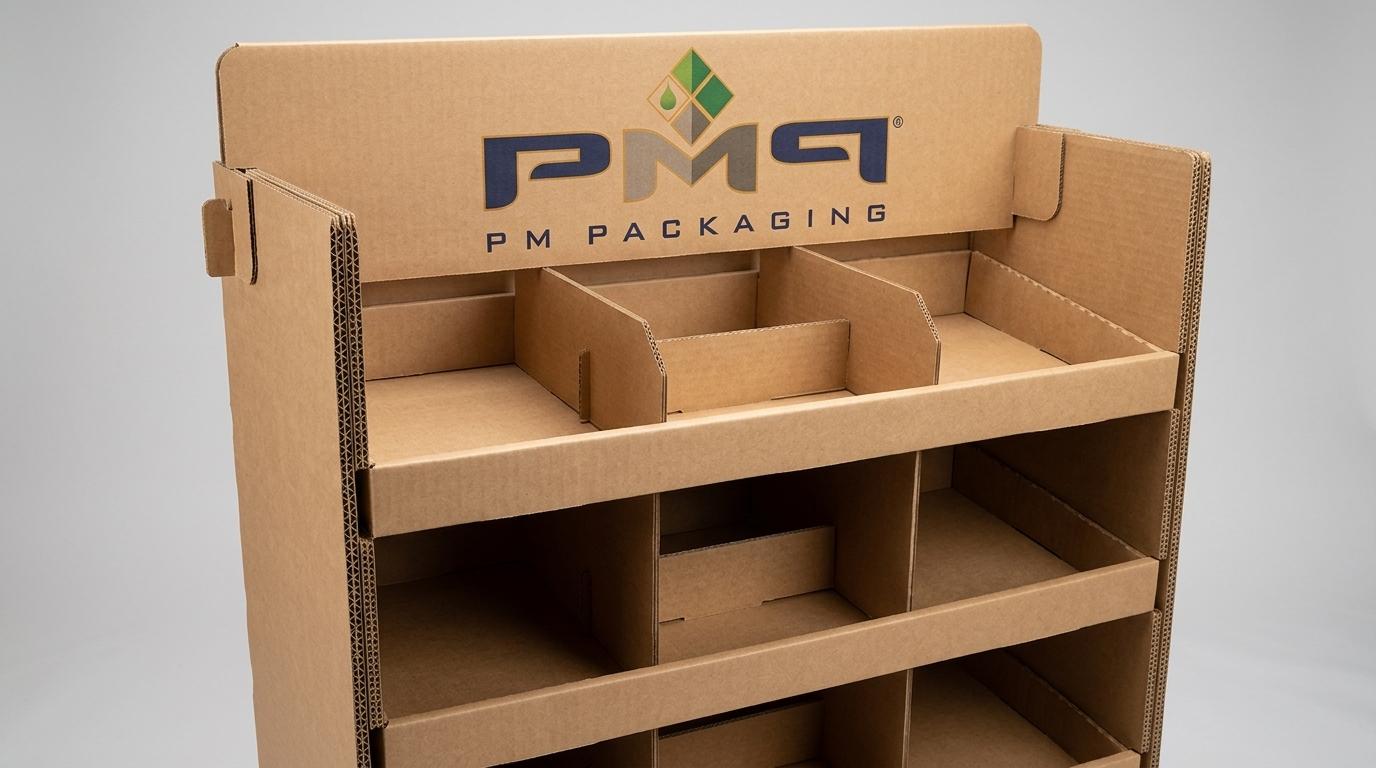
Maintaining Structural and Print Consistency Across Thousands of Displays
When a display program scales across 4,000 units, maintaining quality control across the first and last unit converted is critical. Inconsistent scoring or dimensional variance causes structural failure under full merchandise load or assembly line jams during co-packing.
Industrial manufacturing consistency requires rigorous process checkpoints:
- Calibrated board caliper and ECT (Edge Crush Test) verification across all raw corrugated paper rolls
- G7 master color calibration ensuring consistent brand equity reproduction from sheet 1 to sheet 4,400
- Precision die-cut registration to prevent shelf tab skewing and guarantee rapid interlock fitment
- Automated glue bead inspection systems to ensure joint integrity under heavy product loading
- Pre-flight structural proofing and load-deflection testing under dynamic transit conditions
- Inline optical QA stations monitoring print registration, barcode scannability, and dieline accuracy
Displays produced for national retailers must stand straight, hold their rated weight without shelf deflection, and reflect consistent brand color on the sales floor.
Coordinating Display Assembly and Pack-Out With the Launch Schedule
Converting corrugated board into die-cut sheets is only half the battle. High-volume retail programs often require pre-packed displays—units fully assembled, stocked with product, and shrouded in protective master shippers before arriving at retail DCs.
Coordinating pack-out requires seamless staging between packaging manufacturing and fulfillment labor. If 4,000 displays arrive at fulfillment lines before the consumer product is ready, warehouse floors congest rapidly. Conversely, if packaging converting runs behind, co-packing teams sit idle while labor costs mount.
Staging production in matched batches—converting 1,000 displays, immediately routing them to pack-out, loading product, palletizing, and shipping—creates a steady operational rhythm that mitigates warehouse gridlock and allows for early freight dispatch.
Planning note: While fixed-date rollouts focus on production throughput and launch timing, some programs require different product mixes across store types. If the same display structure needs to carry different SKU mixes by store or region, see our guide to managing store-specific SKU assortments in pre-packed retail displays.
Synchronizing corrugated converting with co-packing labor ensures displays move continuously from the press to the shipping dock without bottlenecks.
Palletization and Distribution Center Requirements
A high-volume retail display program is not complete until units pass retailer distribution center receiving docks without friction. National retailers maintain strict distribution compliance manuals detailing pallet footprints, maximum load heights, corner protection, and electronic advance shipping notices (ASNs).
Key logistics and palletization parameters include:
- Strict Overhang Limits: Shippers must fit squarely on 48" × 40" GMA Grade-A pallets with zero edge overhang. Even half an inch of overhang invites transit crush damage and immediate DC refusal.
- TI/HI and Cube Optimization: Pallet tie and high configurations engineered to maximize full truckload (FTL) cubic efficiency, reducing freight costs across national distribution networks.
- UCC-128 & ASN Compliance: Serialized logistics barcode labels placed on designated pallet quadrants to allow automated DC scan-tunnel induction.
- Delivery Appointment Windows: Booking dock delivery slots weeks in advance to align freight carrier transit times with strict retailer receiving calendars.
Adhering strictly to retailer pallet guidelines prevents expensive compliance chargebacks, receiving delays, and freight re-delivery fees.
Building Contingency Into a National Retail Display Launch
In large-scale manufacturing, unforeseen disruptions happen. Raw board deliveries can experience regional weather delays, carrier trucks can encounter transit accidents, or a retailer may abruptly add 150 doors to the launch program two weeks before the set date.
Robust multi-store launch programs build systematic contingency into the production schedule:
- Dedicated safety buffer stock held at central distribution hubs for rapid replacement of transit damage
- Pre-cut replacement component kits (headers, shelves, base wraps) ready for overnight dispatch
- Scheduled open capacity windows on converting lines to accommodate late retailer door increases
- Multi-carrier transportation routing options to bypass regional freight terminal bottlenecks
- Real-time tracking of DC deliveries against mandatory retailer In-Full On-Time (OTIF) metrics
- Clear operational escalation protocols connecting packaging engineers, production planners, and brand managers
A dependable packaging partner builds buffer capacity into the timeline so unexpected challenges never jeopardize launch day.
Questions Brands Should Ask Before Awarding a Large Display Launch
Before committing to a packaging manufacturing contract for a critical multi-store rollout, procurement and marketing leaders should audit prospective suppliers on operational reality rather than sales promises:
- What is your verified weekly converting and printing throughput? Ensure their equipment velocity can produce your required volume with time to spare before assembly and fulfillment begin.
- Which operations are performed directly in-house versus brokered out? Facilities with integrated printing, die-cutting, assembly, and fulfillment eliminate the hand-off delays and finger-pointing common to broker networks.
- What equipment redundancy and disaster recovery plans are in place? Verify that if a key press or die-cutter requires emergency maintenance, parallel machines can absorb production without stopping your rollout.
- How does your fulfillment and assembly capacity scale with converting? Packaging manufacturing and co-packing must scale in harmony to prevent warehouse bottlenecks and inventory staging gridlock.
- How are retailer DC receiving deadlines incorporated into production planning? Confirm that the manufacturer plans backwards from the earliest delivery appointment date, rather than aiming for a generic ship date.
Asking these questions upfront separates true industrial display manufacturers from transactional brokers who lack production control.
Planning a High-Volume Retail Display Launch With PM Packaging
PM Packaging engineers, manufactures, and fulfills high-volume retail display programs designed for flawless multi-store execution. Whether deploying national endcaps, floor merchandisers, or shelf-ready display trays, we manage the complete manufacturing lifecycle from structural dielines to final DC delivery.
Integrated launch capabilities include:
- High-volume corrugated floor displays, pallet displays, and side wings
- High-graphic litho-laminated and flexographic printing with G7 master color control
- Heavy-duty single-face laminated (SFL) fluted structures for high-weight capacity
- Dedicated co-packing and pre-packed display fulfillment operations
- Rigorous retailer compliance engineering for major national wholesale, grocery, and mass merchants
- End-to-end logistics coordination, ASN labeling, and scheduled DC freight management
Explore our complete line of in-store displays and contract fulfillment services to scale your next national retail campaign.
Scale the Retail Launch, Not Just the Display Order
Executing a high-volume multi-store launch requires delivering structurally pristine, pre-packed displays to retailer distribution centers on precise delivery dates.
Lock in your manufacturing capacity early, align converting throughput with fulfillment labor, and establish buffer stock to protect your brand's retail footprint.
Ensure 100% store compliance on launch day with an industrial manufacturing partner built for scale.
Contact PM Packaging with your store count, target launch date, display format, total unit requirements, and distribution center schedule. Our packaging engineers and production specialists will build a comprehensive manufacturing and rollout plan tailored to your retail launch deadlines.