
In luxury packaging, a ribbon pull is not an ornamental flourish—it is an engineered mechanical interface.
When a recipient pulls a ribbon tab, unboxing becomes a tactile brand interaction. If that ribbon detaches, frays, twists, or binds, perceived quality collapses. Scaling ribbon-pull gift boxes across commercial runs requires treating the ribbon as an engineered sub-assembly governed by material selection, loop dimensioning, anchor shear strength, and drawer slide mechanics.
What Does the Ribbon Actually Do? Drawer Pull vs. Product Lift
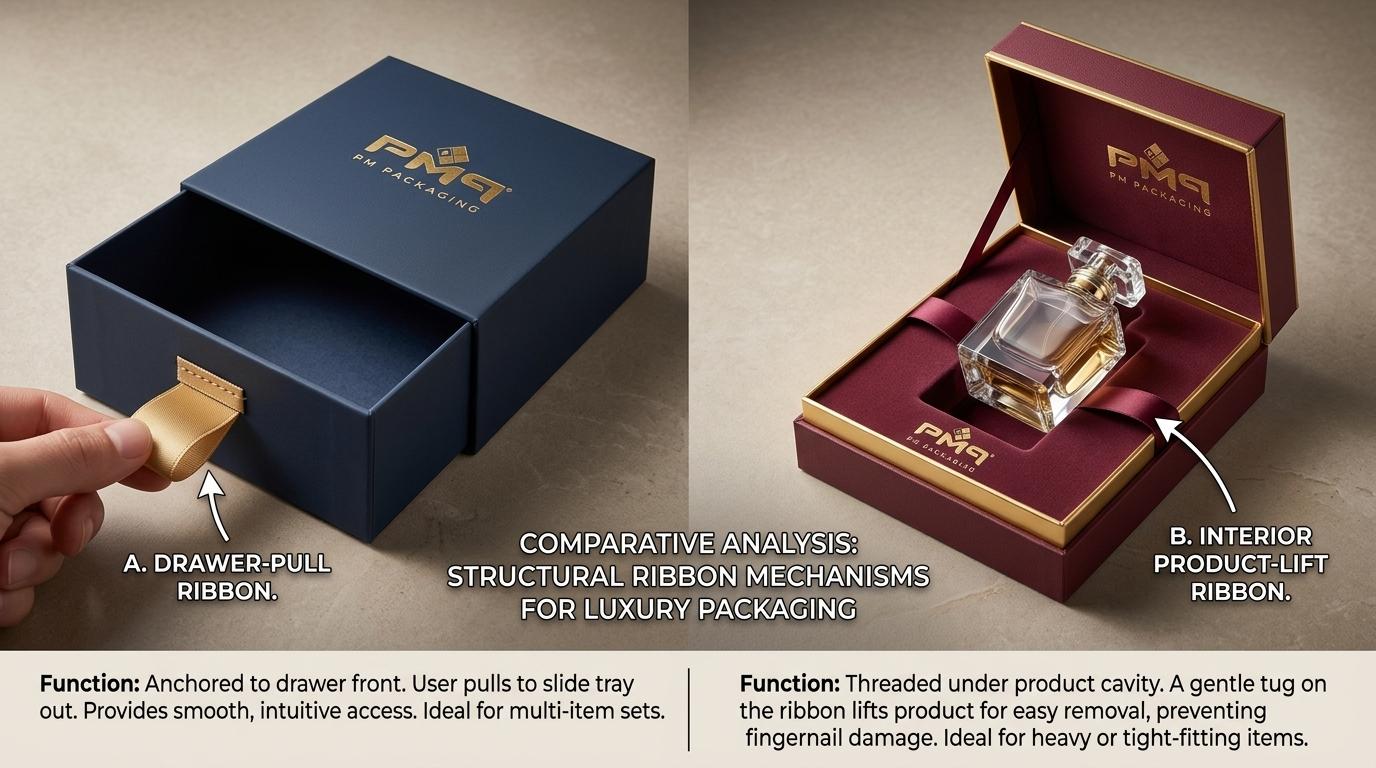
Commercial gift packaging deploys ribbon mechanisms in two distinct structural configurations:
- Drawer-Pull Ribbon: Anchored horizontally to the front wall of a sliding tray to overcome sleeve friction. It requires high anchor shear strength, comfortable grip ergonomics, and centered alignment.
- Interior Product-Lift Ribbon: Threaded beneath a component nestled inside a fitted insert cavity (fragrance flacons, glass droppers, compacts) to gently lift it upward, eliminating awkward fingernail prying.
Ribbon Pull vs. Thumb Notch: When Is the Added Component Worth It?
Brands evaluating slide-open architecture must weigh the ceremony of a ribbon against simpler alternatives:
| Opening Mechanism | Tactile Experience | Assembly Complexity | Best-Fit Commercial Application |
|---|---|---|---|
| Ribbon Pull Tab | Ceremonious, premium unboxing ritual. | Higher (requires slotting & anchor gluing). | Luxury beauty gift sets, fine jewelry, fragrance. |
| Precision Thumb Notch | Direct, functional, minimalist access. | Lowest (rotary die-cut; zero added parts). | High-volume retail cosmetics, consumer electronics. |
| Woven Cord / Rope Pull | Substantial, artisanal, architectural feel. | Higher (grommet or knot anchor cavity). | Spirits presentation boxes, leather accessories. |
| Exposed Tray Edge | Modern reveal with contrasting tray color. | Low (requires calibrated sleeve setback). | Stationery gift sets, confectionery, apparel. |
| Stop-Tab Drawer | Engineered slide with positive stop catch. | Moderate (internal interlocking score flaps). | Multi-tier vanity chests, advent calendars. |
Specify a ribbon pull when the unboxing ritual enhances perceived gift value. For everyday retail goods or automated packing lines, a precision thumb notch on a slide-open box provides superior commercial efficiency.
Choose Ribbon Material Around Look & Mechanical Function
Ribbon selection balances appearance against mechanical performance:
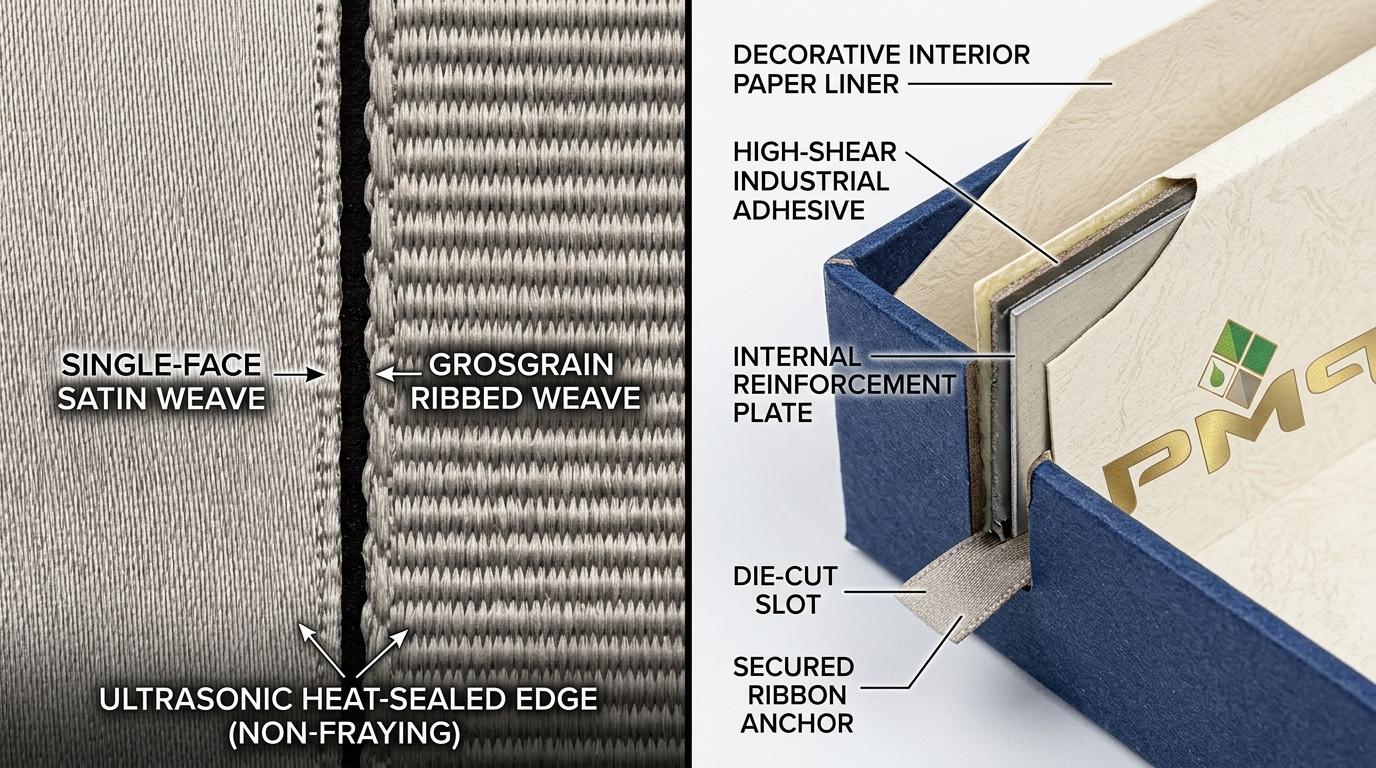
- Satin Ribbon: Smooth, reflective luster with soft drape. Best for beauty and fragrance. Requires ultrasonic slitting or heat-knives to fuse polyester fibers and prevent edge fraying.
- Grosgrain Ribbon: Pronounced transverse ribs provide superior fingertip grip, hold adhesive tenaciously, and resist twisting on heavy trays.
- Paper & Woven Fiber Pulls: Engineered from FSC-certified paper yarns, enabling curbside recyclability without separating textiles from paperboard.
Engineer Ribbon Width, Length & Exposed-Loop Grip
The ergonomics of the grasp govern unboxing satisfaction:
- Too Short (<15mm): Difficult to pinch, forcing awkward fingernail prying.
- Too Long (>30mm): Flops untidily, twists, and catches on shipper walls.
- Too Narrow (<10mm): Cuts into fingers under load and concentrates stress on the anchor.
- Too Wide (>25mm): Overwhelms box scale and risks catching along sleeve score lines.
Engineers proportion ribbon width (typically 12mm to 19mm) and exposed loop extension (18mm to 25mm) around tray scale and loaded slide resistance.
Design a Repeatable Commercial Ribbon Attachment
Commercial ribbon assembly requires a four-step repeatable structural attachment:
- Die-Cut Slot: Sized within 0.5mm of ribbon thickness to prevent play.
- High-Shear Adhesive: Structural adhesive bonds the ribbon tail across a broad footprint.
- Reinforcement Plate: A rigid plate traps the ribbon tail against the tray board.
- Liner Concealment: The decorative interior liner covers all mechanics seamlessly.
The Ribbon Cannot Compensate for Excessive Drawer Friction
When a tray binds inside its sleeve, users naturally pull harder, transferring excessive tensile stress into the ribbon anchor. A ribbon pull cannot fix poor drawer clearance.
Structural designers engineer clear tolerances (typically 1.0mm to 1.5mm overall), accounting for board caliper, turned-edge wrap paper, and humidity expansion. For dieline and clearance engineering, see our guide on high-volume drawer box production.
Account for Loaded Gift-Set Weight & Friction Dynamics
Testing pull force on an empty box produces misleading data. In gift sets with heavy glass perfume bottles or ceramic jars, product weight presses the tray floor firmly against the sleeve, increasing sliding friction.
Testing protocols must evaluate pull force on production-representative loaded packaging to verify anchor durability under real handling weights.
Coordinate the Ribbon with Custom Inserts & Pack-Out
Custom interior inserts must accommodate the ribbon mechanism:
- Cavity Clearances: Inserts must not block anchor plates or pinch the ribbon against the sleeve.
- Product-Lift Wells: Lift ribbons require dedicated finger notches for grasping beneath products.
- Pack-Out Staging: Assembly SOPs stage ribbons flat against the tray to prevent creasing.
For internal cavity structures, explore our guide on paperboard inserts and product retention.
Repeat-Use Keepsake Boxes vs. One-Time Reveal
Gift sets range from single-opening seasonal boxes to keepsake vanity chests used for years.
Reusable packaging requires cycle-tested grosgrain or heavy satin weaves, dual-plate anchors, and scuff-resistant wrap coatings that withstand repeated sliding.
Protect Premium Wraps & Specialty Finishes
Soft-touch laminations and dark matte papers can burnish from sliding friction.
Designers position metallic foils away from high-contact edges and specify scuff-resistant coatings along the slide path. For embellishment strategies, see our guide on foil, embossing, and luxury coatings.
Common Ribbon-Pull Failure Modes & Troubleshooting
Quality teams should monitor and prevent eight primary failure modes:
1. Pull-Through Detachment
Ribbon pulls free under load; solved by larger anchor plates and high-shear adhesive.
2. Board Tear-Out
Ribbon holds but tears chipboard; solved by heavier calipers and radiused slots.
3. Off-Center Binding
Off-center placement wedges the tray; solved by center-line fixtures.
4. Edge Fraying
Raw woven edges unravel; solved by ultrasonic or thermal sealing.
5. Variable Exposed Length
Irregular loops look untidy; solved by standardized tension jigs.
6. Loop Inversion & Twisting
Ribbon flips dull side outward; solved by double-face satin or grosgrain.
7. Ribbon Trapping
Ribbon tucked inside sleeves during assembly; solved by clear SOPs.
8. Transit Burnishing
Vibration rubs tabs against wraps; solved by protective tissue interleaving.

When a Ribbon Pull Adds More Complexity Than Value
Evaluate simpler thumb notches when packaging lines require automated tray insertion, budgets eliminate manual handwork, mono-material paper recyclability is mandated, or box depth allows easy finger access.
High-Volume Ribbon-Pull Quality Control Checklist
Enforce these ten quality inspection benchmarks across commercial production runs:
| Quality Inspection Point | Target Specification | Inspection Method |
|---|---|---|
| Center-Line Alignment | ±1.0mm of center. | Precision gauge check. |
| Exposed Loop Extension | ±1.5mm of spec. | Calibrated depth caliper. |
| Anchor Shear Strength | 3x loaded tray weight. | Tensiometer pull test. |
| Edge Fray Resistance | Zero loose threads. | 10x magnification audit. |
| Ribbon Orientation | Flat; no twists. | 100% visual assembly check. |
| Loaded Glide Smoothness | Smooth glide; no sticking. | Loaded tactile stroke test. |
| Sleeve Squaring | Square 90-degree corners. | 90-degree corner square gauge. |
| Insert Clearance | Anchor plate cleared. | Internal fit verification. |
| Finish Scuff Resistance | No burnishing. | Sutherland rub cycle test. |
| Master Shipper Pack Fit | Folds flat; no creasing. | Pack-out trial audit. |
When Another Luxury Structure Makes Better Sense
When freight cube or unit costs dictate alternatives, evaluate premium folding cartons or Single Face Lamination (SFL) slide boxes that ship flat before pack-out.
Frequently Asked Questions
What is the difference between a drawer-pull ribbon and a product-lift ribbon?
Drawer-pull ribbons anchor horizontally to a sliding tray to overcome sleeve friction. Product-lift ribbons sit beneath items inside fitted cavity inserts to gently elevate them for easy removal.
Which ribbon material is best for commercial luxury packaging?
Satin provides a smooth, reflective hand-feel for beauty and fragrance. Ribbed grosgrain offers firmer tactile grip, superior adhesive bonding, and higher resistance to twisting on heavier trays.
How is a ribbon pull anchored to a rigid drawer box?
The ribbon passes through a die-cut slot in the chipboard wall, bonded with high-shear adhesive behind a reinforcement plate, and concealed beneath the decorative paper liner.
How long should an exposed ribbon pull tab be?
Exposed loops should extend 18mm to 25mm beyond the tray wall. Loops under 15mm are hard to pinch, while loops over 30mm look untidy and risk transit damage.
How do you prevent ribbon pull tabs from fraying?
Ribbon edges must be sealed using ultrasonic slitting or thermal heat-knife trimming during converting, fusing synthetic polyester fibers to eliminate loose threads.
Can a ribbon pull fix a rigid drawer box that binds?
No. When a tray binds, pulling harder strains the anchor. Sleeve-to-tray clearances (1.0mm to 1.5mm) must be engineered properly before adding the ribbon.
When is a thumb notch preferable to a ribbon pull?
Thumb notches are preferable when assembly speed, automated packing lines, minimalist brand aesthetics, or unit cost efficiency take priority over unboxing ceremony.
Can ribbon-pull boxes be engineered for repeat use?
Yes. Reusable keepsake boxes require cycle-tested grosgrain or heavy satin ribbons, double-anchored backing plates, and scuff-resistant wrap coatings.
Scale Your Luxury Gift Packaging Program
Whether developing a limited-edition holiday beauty set or launching an ongoing luxury vanity line, PM Packaging delivers high-performance rigid drawer box manufacturing, precision ribbon attachment, custom insert converting, and luxury finishing.
Coordinate ribbon specifications, drawer tolerances, and insert engineering with PM Packaging's luxury packaging specialists.