
A package does not always need to show the product inside.
High-resolution graphics, deliberate typography, and bold carton geometry frequently communicate product benefits with complete clarity. A die-cut window should only be added when physically seeing the merchandise resolves an essential buyer question that printed graphics cannot answer alone. Cutting fiber out of a panel alters structural stiffness, reduces printable surface, and introduces converting operations that must justify their commercial investment.
When Does a Window Actually Help the Shopper?
A successful packaging window performs a specific communication job, answering one of five core customer questions at the point of purchase:
"What color am I actually getting?"
For cosmetics, hair care, apparel, and coatings, printed inks rarely match real-world luster, sheen, or pigment depth.
"What does the material really look like?"
Artisan goods, natural wood grain, embossed leather, and woven textiles carry organic textures that flat photography cannot duplicate.
"How much is actually included?"
Multi-piece gift sets, confectionery assortments, and tool kits benefit from visual verification of component count and arrangement.
"What is this product?"
Novel accessories and ergonomic devices with non-standard contours become immediately understandable when viewed in physical reality.
"Does the product match the quality I expect?"
Visible machining, tailored stitching, or polished metal accents validate premium pricing and build consumer confidence.
Window vs. No Window at a Glance
Evaluate your product against this ten-point decision matrix before deciding whether to incorporate an aperture:
| Buyer / Design Question | Window More Likely to Help | Fully Printed Carton May Be Better |
|---|---|---|
| Does actual color drive purchase? | Yes (cosmetics, apparel, finishes). | No (standardized commodity hues). |
| Is texture or material finish critical? | Yes (wood, fabric, brushed metal). | No (uniform molded plastics). |
| Is product shape difficult to explain? | Yes (ergonomic tools, novel devices). | No (standard bottles or rectangular units). |
| Does bundle count need visual proof? | Yes (gift sets, multi-packs). | No (single items with count callouts). |
| Is the product inherently attractive? | Yes (clean craftsmanship, sleek finish). | Not particularly (raw cables, internal parts). |
| Must front-panel branding dominate? | Less critical (product acts as hero). | Very critical (billboard brand blocking). |
| Is product positioning predictable? | Yes (firmly locked behind aperture). | No (loose items that rotate or settle). |
| Does the panel carry stack loads? | Lower concern (reinforced insert). | Higher concern (heavy top-loading cases). |
| Is mono-material recycling primary? | Less critical (or open window used). | More critical (100% paperboard stream). |
| Will product stay clean without film? | Open window viable (pre-contained). | Film patch or solid carton required. |
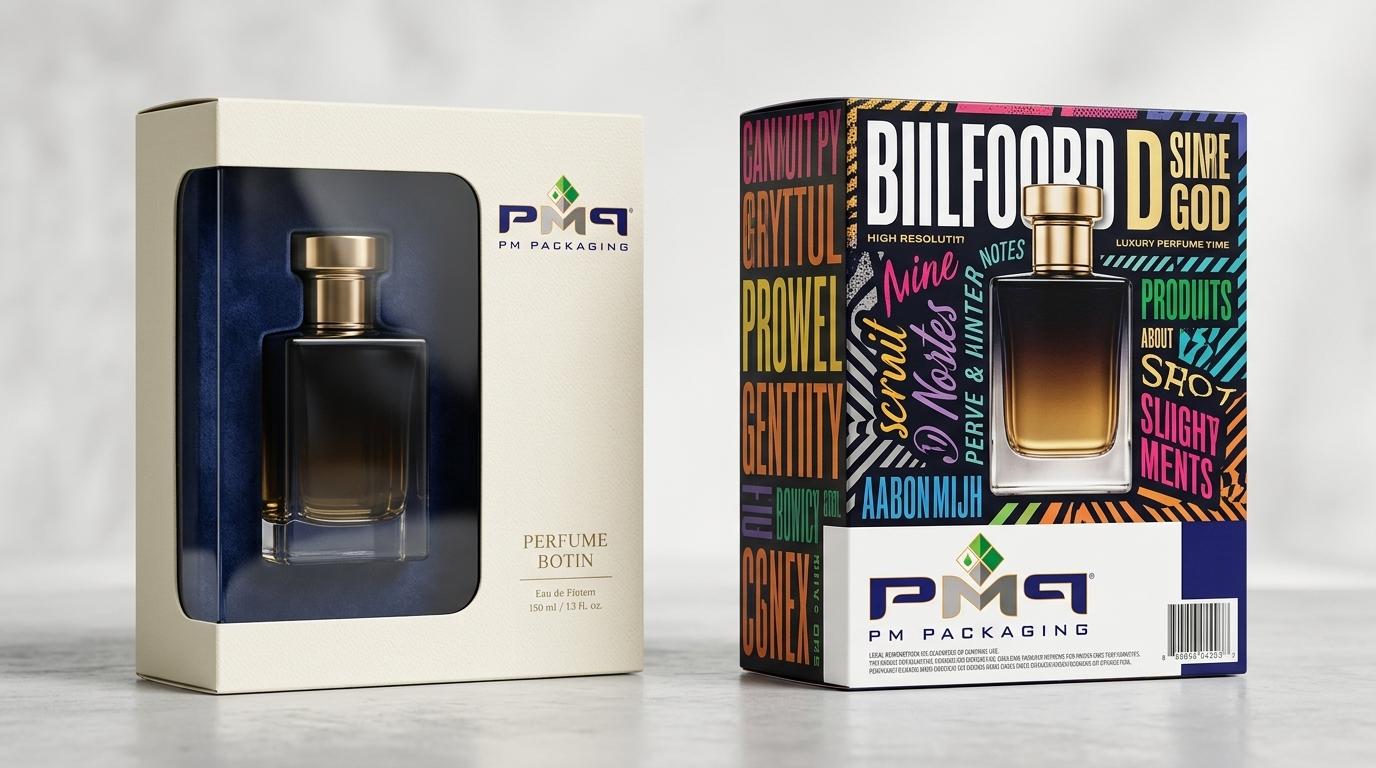
Open Window vs. Film-Covered Window
When a window is warranted, packaging engineers choose between an open cutout and a transparent film-patched aperture:
| Design Factor | Open Die-Cut Window | Film-Covered Window Patch |
|---|---|---|
| Visibility & Touch | Direct sightline with tactile touch. | Protected view through clear film. |
| Dust & Contamination | None at the aperture. | Full barrier against dust and handling. |
| Product Retention | Must be fully self-contained. | Film assists in restraining light items. |
| Added Material | None (100% paperboard). | Transparent film patch (PET, RPET, PLA). |
| Converting Operations | Standard die-cutting pass. | Requires dedicated window patching. |
| Reflections & Glare | Zero surface reflection. | Produces glare under directional lights. |
| Best-Fit Applications | Bottles, jars, wrapped soaps, textiles. | Cosmetics, food, multi-piece sets. |
In technical specifications, transparent patches should be designated as window film or window patches rather than generic "barrier films," unless certified for defined moisture, grease, or oxygen resistance.
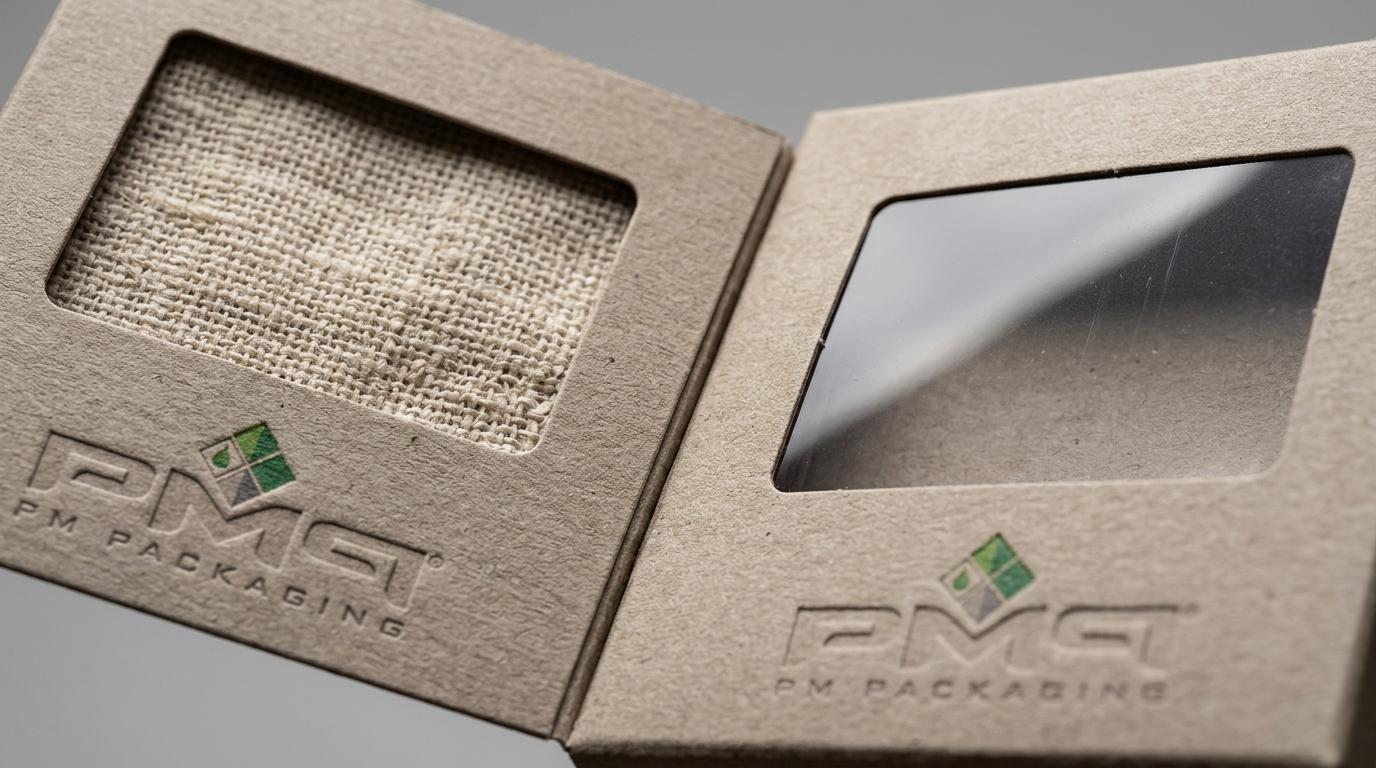
How Large Should a Packaging Window Be?
A key rule of carton engineering is that bigger windows are not automatically better. An oversized opening removes substantial board fiber, reducing beam stiffness and causing panel bulging under vertical warehouse loads.
The governing design question is: What is the smallest opening that reveals the product feature the shopper needs to see? Keeping apertures focused preserves printable brand space, lowers film material costs, and minimizes exposure of internal retention structures.
Structural Placement and Shape Complexity
Windows must be integrated directly into the structural dieline rather than treated as late artwork. Aperture performance depends on distance from score lines, corner radii, board caliper, and bottom closure style:
- Simple Geometric Windows: Rectangles with radiused corners and ovals balance carton stresses, patch reliably at high converting speeds, and resist panel buckling.
- Custom Silhouette Windows: Brand-shaped silhouettes create strong shelf identity, but sharp internal corners concentrate stress and narrow paperboard bridges risk tearing during high-speed folding.
A Window Only Works if the Product Stays Behind It
During transit, loose items can rotate, settle, or shift away from the cutout—revealing blank board or misaligned barcodes. A windowed carton requires an engineered retention system.
Paperboard platforms, neck locks, folded cradles, and thermoformed trays secure items across all shock axes. For comprehensive structural insert techniques, consult our guide on packaging inserts, dividers, and product retention.
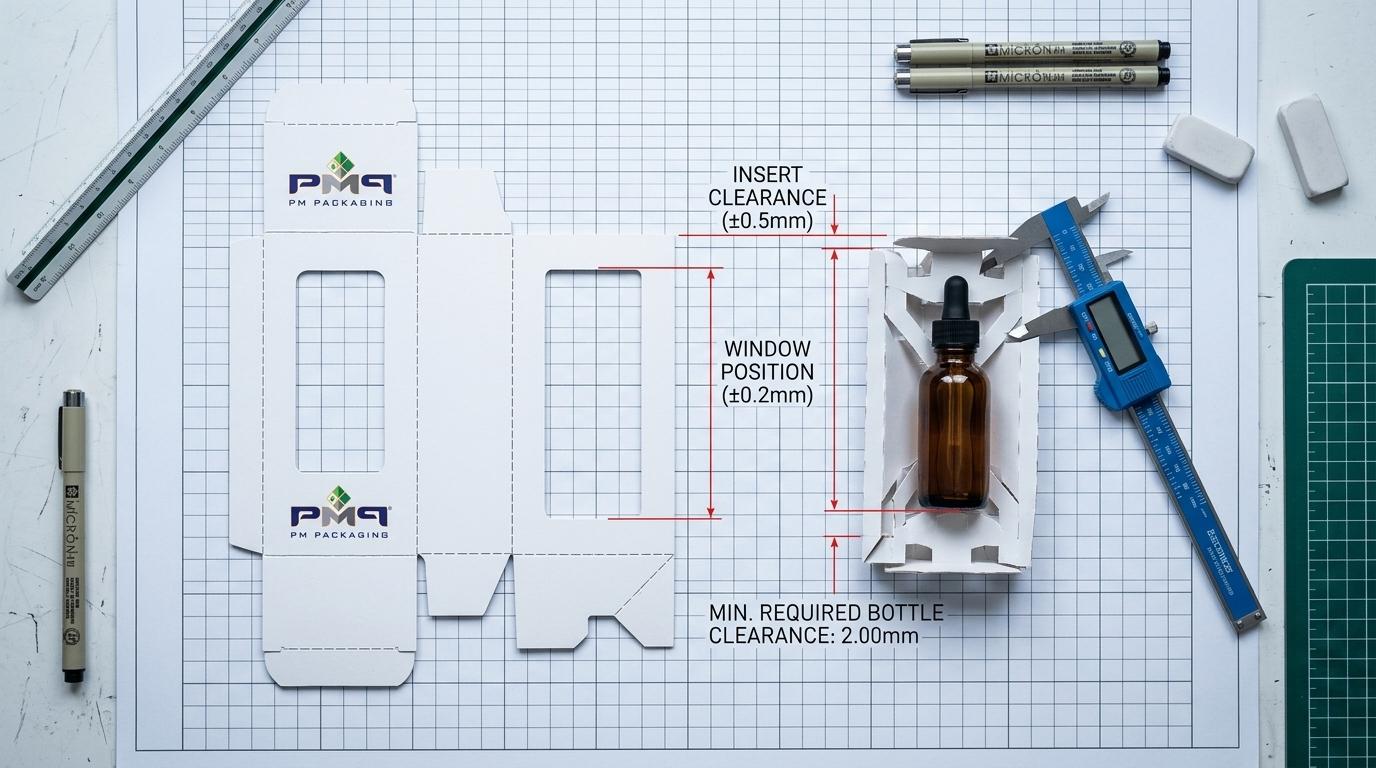
Account for the Complete Tolerance Stack
Alignment behind a window is the cumulative stackup of multiple manufacturing tolerances:
- Die-cut window aperture placement: Steel-rule die registration ($pm 0.5$ mm).
- Carton folding & gluing: Belt tension and squaring variance.
- Insert folding variance: Score fold angles and cavity dimensions.
- Product dimensional tolerance: Mold shrinkage or glass bottle variation.
- Pack-out positioning: Manual or automated pick-and-place accuracy.
Designing an aperture with a rigid 2 mm margin around a product without accounting for this cumulative stackup risks off-center displays. Incorporating self-centering insert geometry ensures consistent retail presentation.
When a Window May Be the Wrong Choice
A solid, fully printed folding carton is often the superior choice under these operational conditions:
- The product is visually ordinary: Utilitarian items gain little emotional traction through a cutout.
- Manufacturing variations are visible: Parting lines, sprue marks, or fill-level differences degrade brand value.
- Maximum billboard area is essential: Crowded retail shelves require complete front panels for brand blocking. Learn more in our guide on creating strong shelf presence without overdesigning.
- Light and environmental sensitivity: UV-sensitive formulas require opaque light barriers.
- High compression strength is required: Heavy pallet stack loads require continuous paperboard panel integrity.
- Mono-material circularity is mandated: Unlined paperboard eliminates multi-material sorting during repulping.
Food-Contact Regulations and Package Recyclability
If window films or adhesives contact food products, materials must comply with FDA 21 CFR standards for the intended food type, temperature conditions, and fat content. Verify regulatory documentation with your packaging partner before production.
Sustainability claims require similar rigor. Adding a plastic window creates a multi-material configuration. Evaluate the complete carton using circular frameworks (such as The Recycling Partnership or How2Recycle) to verify recycling sortation characteristics.
Evaluate Prototypes Under Retail and Studio Lighting
Transparent film patches can produce unwanted glare under retail spotlights and studio cameras. Evaluate physical production prototypes—combining printed board, window film, insert, and merchandise—under directional lighting to ensure reflections do not obscure visibility.
High-Volume Converting & Sourcing Support
At commercial scale, windowed cartons require precise film tension and adhesive registration. To explore high-speed folder-gluer operations, read our guide on scaling windowed folding cartons at high volume.
PM Packaging coordinates window aperture geometry, dielines, film patching, and retention inserts under one synchronized engineering standard. Discover our converting capabilities on our dedicated Windowed Cartons catalog page.
Frequently Asked Questions
What is a die-cut window in product packaging?
A die-cut window is an aperture cut into a paperboard folding carton to reveal the enclosed product, either left open for tactile touch or sealed with transparent film for protection.
Does a packaging window always require a clear plastic film patch?
No. Pre-contained products like bottles, jars, or wrapped items can use open die-cut windows to invite shopper touch without added plastic film.
Does cutting a die-cut window weaken a folding carton?
Yes. Removing paperboard reduces beam stiffness and top-to-bottom compression. Engineers compensate by setting clearances from score lines and adding internal inserts.
How large should a carton window be?
It should be the smallest aperture necessary to reveal the essential product attribute, preserving carton strength and front-panel branding space.
How do you keep a product centered behind a window?
Products are secured using custom paperboard inserts, cradles, or cavity trays that restrain movement across all axes during distribution.
Are windowed folding cartons recyclable?
Adding a film patch creates a multi-material format that must be evaluated as a complete package using circular packaging assessment protocols.
Prototype Before Commercial Production
Before cutting production dies, evaluate a physical prototype combining your carton board, aperture, window film, and retention insert with actual product samples. Testing fit and presentation under real lighting guarantees shelf success.
Coordinate structural dieline development, window film patching, and custom retention inserts with PM Packaging’s technical team.