
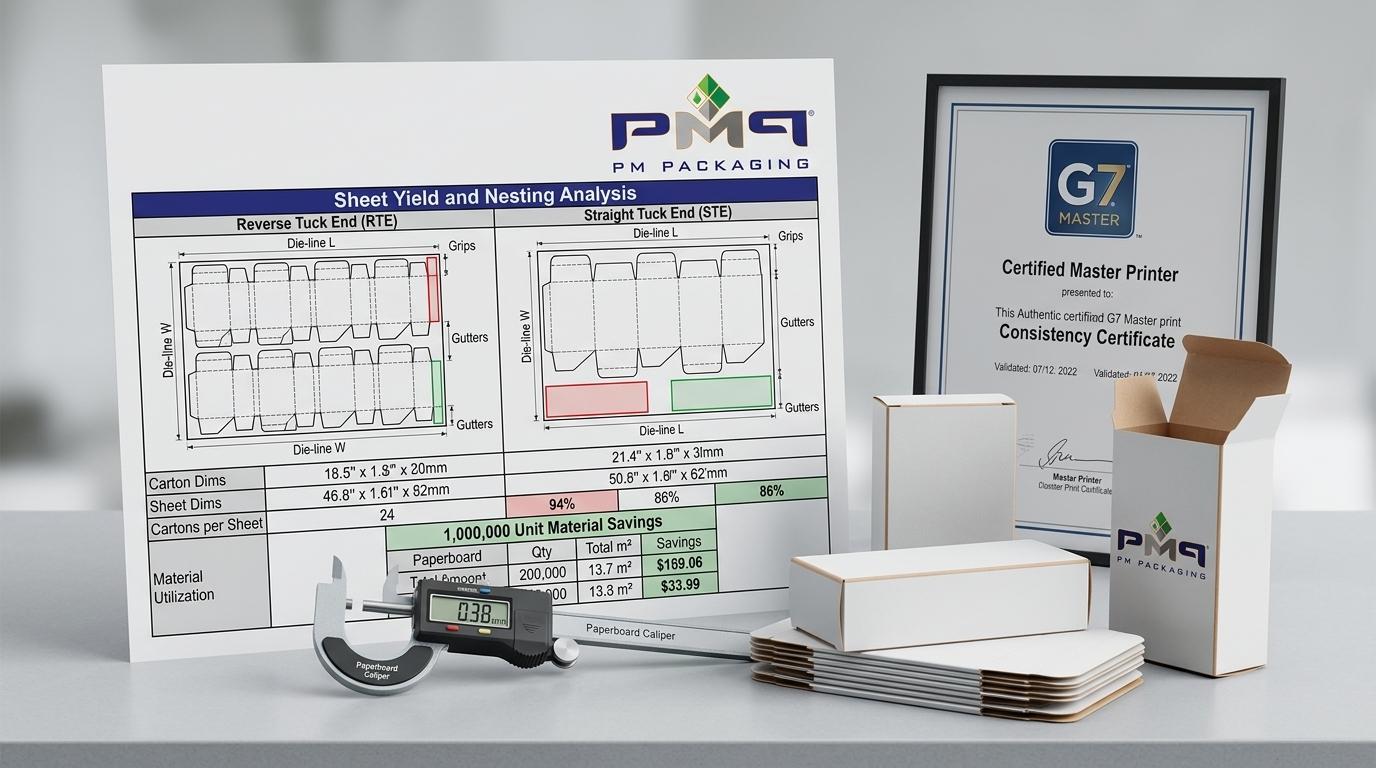
At 10,000 cartons, a small difference in paperboard nesting is an interesting technical detail. At 1,000,000 cartons, gaining even one extra carton per press sheet translates into tens of thousands of fewer master sheets, reduced trim waste, and major material savings.
Because Reverse Tuck End (RTE) cartons feature top and bottom flaps that tuck in opposite directions, flat blanks can interlock tightly on the print sheet—delivering workhorse manufacturing efficiency for lightweight cosmetics, pharmaceuticals, supplements, and food products with PM Packaging.
Evaluate press-sheet imposition, grain direction, and caliper optimization before locking your structural dieline.
Rather than finalizing carton dimensions and graphics in isolation, large consumer brands consult with PM Packaging early in structural development. Small dimensional adjustments of just a few millimeters can shift an imposition from 12-up to 13-up on the press, compounding into immense cost advantages across annual replenishment runs.
Optimize high-volume folding carton dielines with PM Packaging.
The Economics of One Extra Carton Per Sheet
High-volume packaging procurement is defined by cumulative efficiency. Consider how nesting differences compound across a 1,000,000-unit program:
| Sheet Imposition | Total Press Sheets (1M Units) | Board Utilization Impact |
|---|---|---|
| 10-Up Layout (STE) | 100,000 Sheets | Baseline board consumption with wider interlock gutters |
| 11-Up Layout (Interim) | 90,909 Sheets | 9,091 fewer sheets processed through press and die-cutter |
| 12-Up Layout (Optimized RTE) | 83,333 Sheets | 16,667 fewer sheets purchased and converted |
| 13-Up Layout (Tight Right-Sizing) | 76,923 Sheets | 23,077 fewer sheets required (over 23% material reduction) |
When Reverse Tuck End Delivers Maximum ROI
Reverse Tuck End is most commercially compelling when product attributes match its flat blank geometry:
- Lightweight Consumer Goods: Cosmetics, skincare, supplements, OTC drugs, dry foods
- Millions in Annual Demand: Large scale where sheet yield differences yield substantial dollar savings
- Flat Blank Interlocking: Opposing flaps nest together with minimal trim waste between blanks
- Ergonomic Hand Packing: Natural opposing motion allows operators to close cartons rapidly
- Multi-SKU Platforms: Common carton dieline shared across dozens of distinct graphic versions
- Right-Sized Headspace: Calibrated dimensions that tighten blank footprints without product jamming
PM Packaging manufactures SBS, CUK, CRB, and kraft paperboard cartons with precision score lines, high-speed folder-gluer setups, and G7 Master certified color reproduction.
Develop High-Volume RTE Cartons With PM Packaging
PM Packaging designs, optimizes, and converts millions of custom folding cartons annually for national retail, pharmacy, and consumer goods brands.
PM Packaging high-volume converting capabilities:
- Custom RTE, STE, auto-bottom, and snap-lock structural dieline development
- Sheet imposition modeling to achieve maximum number-up yield on master press sheets
- Solid Bleached Sulfate (SBS), Coated Unbleached Kraft (CUK), and recycled CRB boards
- Friction-lock and slit-lock closures for tamper-resistant retail integrity
- Die-cut display windows, hang tabs, tear strips, and internal partitions
- Continuous replenishment programs with forecasted board staging and G7 color consistency
PM Packaging evaluates your product dimensions, board caliper, grain direction, automated cartoning speeds, and pallet configurations to engineer the lowest total cost of ownership.
Planning a High-Volume Folding-Carton Program?
Unlock substantial material savings by optimizing flat blank geometry and press sheet yield before finalizing your carton dielines.
Compare Reverse Tuck End against Straight Tuck End, auto-bottom, and snap-lock structures across converting, assembly, and pallet economics.
Achieve maximum board efficiency and repeatable G7 print quality across millions of cartons.
Planning a high-volume folding-carton program? Contact PM Packaging to compare Reverse Tuck End, Straight Tuck End, auto-bottom, and other carton structures based on sheet yield, board usage, packing requirements, and total program economics.