
For growing and established consumer brands, packaging architecture evolves through distinct commercial stages.
In early-stage and regional distribution, shipping standalone primary folding cartons bulk-packed into standard Regular Slotted Shippers (RSC) is standard practice. Store associates open the shipper with a box cutter, extract individual cartons one by one, and manually front-face them on retail shelves.
However, as retail volume scales into national mass merchants, club stores, grocery chains, and big-box specialty retailers—such as Walmart, Target, Kroger, CVS, Home Depot, Sephora, and Ulta—this legacy distribution method breaks down. Loose cartons suffer from slow shelf replenishment, high in-store labor overhead, messy shelf-facing disarray, carton crushing during stocking, and the pervasive problem of “phantom inventory,” where products languish un-stocked in retail backrooms.
The Evolution From Standalone Cartons to Integrated PDQ Trays
Standalone Primary Cartons in RSC Shippers
- Manual, carton-by-carton shelf stocking (45–90 seconds per master case)
- High risk of box-cutter blade damage to primary package faces
- Frequent carton slouching, tipping, and competitor shelf encroachment
- High out-of-stock (OOS) rates caused by backroom stocking delays
Integrated PDQs & Retail-Ready Packaging (RRP)
- One-touch / two-touch shelf replenishment (3–5 seconds per tray)
- Guaranteed planogram facing and permanent shelf-edge billboard
- Zero box cutter contact with primary folding cartons
- 15% to 35% measurable retail sales velocity lift
For Directors of Procurement, VP/Directors of Supply Chain, Brand Directors, and Principal Packaging Engineers, transitioning from standalone primary cartons to Integrated Point-of-Display (PDQ) Trays / Retail-Ready Packaging (RRP) / Shelf-Ready Packaging (SRP) is one of the most critical structural and financial decisions in a brand’s lifecycle.
1. The Core Catalysts Driving the Transition
Moving from loose cartons to integrated PDQ display trays is rarely driven by packaging aesthetics alone. It is an operational necessity catalyzed by four converging commercial pressures:
Mass Retailer RRP Mandates
Retail store associates represent the single highest operating cost for brick-and-mortar merchants. Vendors are evaluated on labor touches and stocking cycle time.
Eliminating Phantom Inventory
When store staff delay hand-sorting complex master shippers, shelves sit empty while ERP systems show “in stock.” PDQs ensure instant shelf replenishment.
Planogram & Facing Discipline
Standalone cartons tip over, rotate backwards, or lose linear shelf width to aggressive neighboring SKUs. PDQ trays lock in permanent primary display panel (PDP) positioning.
Volume & Velocity Thresholds
Crossing 2–3 case turns per week per store or scaling runs beyond 25,000–50,000+ units achieves the economic scale where automated litho-lamination offsets tooling.
Walmart’s “5 Easy Rules” for Shelf-Ready Packaging
- 1. Easy to Identify:Clear brand, SKU, and barcode labeling on all four exterior faces of the secondary transit packaging.
- 2. Easy to Open:Tool-free, blade-free opening within 2 seconds using engineered perforations or tear tape.
- 3. Easy to Replenish:Single-motion (“one-touch”) insertion directly onto the retail shelf fixture.
- 4. Easy to Shop:Unobstructed customer view and clean finger-access notches for effortless carton extraction.
- 5. Easy to Recycle:Single-material 100% repulpable paperboard/corrugate that collapses flat without manual sorting.
2. Structural PDQ Architectures & Dieline Engineering
Selecting the proper PDQ structural architecture depends on product weight, primary carton dimensions, supply chain handling severity, and whether the tray will be packed manually or automatically at contract packagers (co-packers).
Archetype 1: 1-Piece Convertible Shipper-to-Display
Perforated HoodThe transit shipper and the display tray are manufactured from a single continuous blank of Single Face Laminate (SFL) microflute. The upper hood shears away cleanly along calibrated knife-to-tie perforation lines at the shelf edge.
Archetype 2: 2-Piece Display Tray + Protective Transit Hood
Tray & ShroudSeparates the pristine, high-finish retail PDQ tray (E/F-flute or heavy SBS) from a heavy-duty outer corrugated protective hood. The outer shroud absorbs all transit scuffing, forklift contact, and top-load compression during interstate trucking.
Archetype 3: Tiered & Gravity-Feed Counter PDQs
Stepped RisersUtilizes internal stepped paperboard risers or an angled gravity-feed false bottom (5° to 12° incline) to ensure rear cartons remain elevated or slide forward as front units are purchased.
Archetype 4: Auto-Bottom (Crash-Lock) vs. Roll-Over Wall Bases
Base DynamicsAuto-bottom pre-glued bases snap into rigid rectangular trays in 1.5–2.5 seconds for high-speed co-packing lines. Roll-over wall bases require manual tab insertion but provide double-wall structural rigidity for heavy items.
3. Technical Comparison: Standalone Cartons vs. Integrated PDQ Formats
The following matrix compares operational, logistical, and commercial performance metrics across primary and secondary packaging architectures:
| Metric | Standalone Cartons (RSC) | 1-Piece Perforated PDQ | 2-Piece Tray + Hood | Tiered Counter PDQ |
|---|---|---|---|---|
| Shelf Stocking Time | 45–90s / case | 3–5s / tray | 3–5s / tray | 2–4s / unit |
| Replenishment Motion | Multi-touch manual | One-touch slide & tear | One-touch lift shroud | One-touch counter drop |
| Planogram Control | Poor (Slouch & drift) | High (Locked tray width) | Superior (Rigid chassis) | Superior (Multi-tier) |
| Box Cutter Loss Risk | High (Direct face contact) | Low (Tear-tape guide) | Zero (Outer shroud buffer) | Zero (Pre-kitted unit) |
| Billboard Area | Primary PDP only | Tray lip + side panels | High-impact lip + tall header | Multi-tier lips + header |
| Sales Velocity Lift | Baseline (0%) | +12% to +18% | +18% to +30% | +25% to +45% |
4. Substrate Engineering & Structural Physics
An integrated PDQ program requires precise physical harmony between the primary folding carton and the secondary display tray. If the secondary tray is under-engineered, sidewalls buckle under pallet stacking, crushing the primary cartons inside. If over-engineered, excess board caliper inflates material and freight costs unnecessarily.
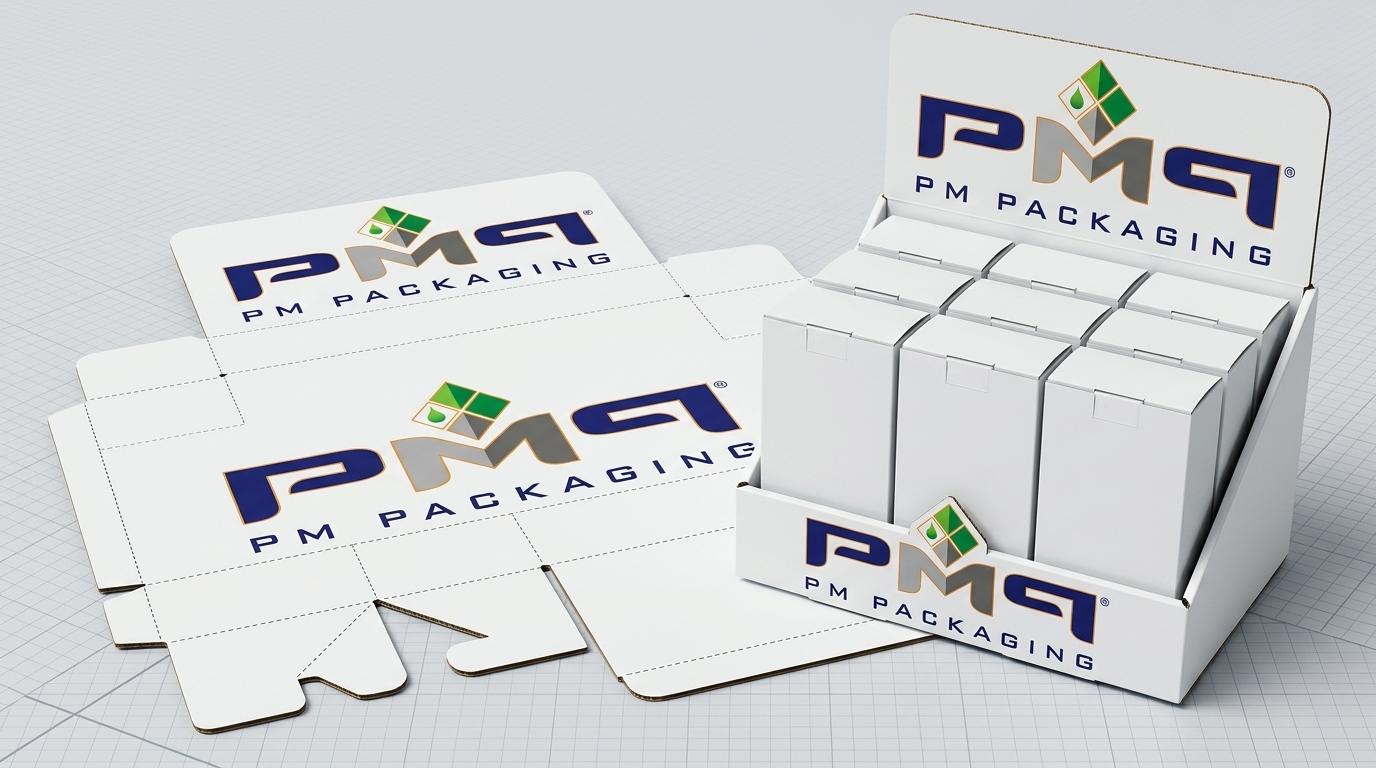
SFL Microflute Specifications for PDQ Displays
Box Compression Test (BCT) Engineering
To calculate required top-load stacking strength, packaging engineers apply the McKee Formula with an environmental Safety Factor of 4.5 to 5.5:
Where ECT = Edge Crush Test (lbs/in), T = Caliper thickness (in), and P = Perimeter (in). The safety factor compensates for 80%+ relative humidity softening, transit vibration resonance, and pallet creep over 30–90 days.
5. Total Cost of Ownership (TCO) & Financial Economics
A common procurement hurdle when transitioning to integrated PDQ displays is the perceived increase in primary-plus-secondary packaging unit cost. An SFL litho-laminated PDQ tray and transit hood costs more in raw material than an unprinted brown kraft RSC box.
However, an enterprise Total Cost of Ownership (TCO) model reveals that integrated PDQs dramatically lower net operational costs while unlocking substantial top-line revenue expansion:
| Cost / Revenue Component | Standalone Cartons in RSC | Integrated 2-Piece PDQ Tray |
|---|---|---|
| Primary Carton Material Cost | $0.22 per unit ($22,000) | $0.22 per unit ($22,000) |
| Secondary Packaging (RSC vs. PDQ+Hood) | $0.85 per box ($7,083) | $1.65 per tray ($13,750) |
| Co-Packer Packing & Kitting Labor | $0.35 per box ($2,917) | $0.55 per tray ($4,583) |
| In-Store Damage & Box Cutter Loss (3%) | $1.20/carton ($3,600) | $0.00 (Zero cutter damage) |
| Out-of-Stock (OOS) Lost Sales Rate | 8.5% Lost Gross Margin | 2.1% Lost Gross Margin |
| Net Sales Velocity Lift (Conservative) | Baseline ($0) | +18% Net Lift (+$72,000 GM) |
| Net Commercial Program Impact | Baseline Benchmark | +$54,583 Net Profit Expansion |
6. Retail Channel Specifications & Compliance Blueprint
Every major retail chain enforces strict packaging compliance manuals. Failing a retail compliance audit can result in vendor chargebacks, mandatory packaging re-works, or cancelled distribution agreements.
Walmart RRP Standards
Front lip height must expose 70% to 80% of the primary carton face (max 1.25" to 2.00" lip). Ergonomic finger access apertures and tool-free perforations (<10 lbs pull force) are strictly enforced.
Target Corporation Guidelines
Strict window aperture requirements under LED shelf canopy lighting. 100% repulpable paperboard with zero non-recyclable plastic film windows on secondary display trays.
Club Stores (Costco & Sam’s Club)
Full-pallet modular grids (48" x 40" GMA footprint) with zero pallet overhang. Trays must support 2,000 to 3,000 lbs top load for 3-high warehouse stacking.
Drug & Grocery (CVS, Kroger, Walgreens)
Shallow 10" to 14" shelf depths require narrow, high-density footprints. Multi-tier stepped risers maximize vertical spacing for multi-shade cosmetics and OTC lines.
7. Print, Embellishment & Visual Merchandising at the Shelf Edge
An integrated PDQ tray is not merely secondary shipping containment—it is a permanent, high-impact billboard at the point of sale. While primary cartons communicate detailed product claims to shoppers holding the package, the PDQ tray captures foot traffic from 15 to 20 feet down the aisle.
4-Zone Merchandising Communication Architecture
8. Procurement & Supply Chain Strategy: Single-Source Sourcing
A major operational pitfall for enterprise brand procurement is fragmented multi-vendor sourcing—purchasing primary cartons from Vendor A, SFL microflute display trays from Vendor B, and master shippers from Vendor C. This leads to tolerance mismatches, spectral color drift, split shipments, and co-packer line downtime.
The PM Packaging Nearshore US-Mexico Advantage
1–3 Day Ground Transit
Rapid ground shipping from Baja California facilities directly to California, Texas, Nevada, and North American co-packers eliminates 8–12 week Asian ocean freight delays.
100% Tariff-Free USMCA
Manufactured under strict North American Rules of Origin, completely exempt from Section 301 tariffs and volatile container demurrage charges.
C-TPAT & OEA Border Clearance
Dedicated FAST-lane logistics ensure continuous cross-border flow with zero border inspection delays.
VMI & Safety Stock Programs
Managed floor stock and just-in-time releases buffer your supply chain against sudden national retail replenishment surges.
9. The Enterprise Implementation Playbook: Step-by-Step Transition
Commercial & Retail Planogram Audit
Audit SKU velocity, retail shelf dimensions, and retailer RRP compliance manuals. Define pack-count configuration (e.g. 1x6 single facing, 2x4 dual facing, 3x4 tiered).
Dieline Prototyping & Tolerance Matching
CAD dieline development establishing 1/32" clearance tolerances between primary and tray. Production of 100% physical white CAD prototypes and 3D digital mockups.
ISTA Transit Simulation & Perforation Calibration
ISTA 3A / 1A transit vibration, rotational drop, and static compression testing. Precise calibration of perforation knife-to-tie ratios (burst resistance vs. 2-second in-store tear).
Co-Packer Line Trial & Time-Motion Study
Pre-production run of 250–500 sample units shipped to contract packaging facility. Time-motion study measuring flat-to-assembled setup speed and carton insertion cycle times.
G7 Color Proofing, Production Run & Mass Retail Rollout
G7 press-match drawdowns across SBS folding carton stock and SFL microflute top-sheet. Full-scale production (50k to 500k+ units) with integrated JIT / VMI logistics release.
Summary & Next Steps: Partnering With PM Packaging
The transition from standalone folding cartons to integrated PDQ display trays marks the evolution of a consumer brand from regional player to national retail category leader. By eliminating stocking friction, securing shelf discipline, preventing phantom inventory stockouts, and turning secondary packaging into an active billboard, brands unlock double-digit revenue growth while streamlining supply chain velocity.
To evaluate your current packaging portfolio, audit retail planogram compliance, or request custom CAD dieline prototypes and physical samples, contact the PM Packaging engineering team at pmpackaging.com.