
For decades, high-visibility thermoformed plastic clamshells were the default packaging format for consumer hardware, electronics, personal care, automotive aftermarket parts, and retail accessories.
Clamshells offered 360-degree product visibility, robust moisture barriers, and deterrence against in-store pilferage. However, shifting retailer mandates, aggressive state-level Extended Producer Responsibility (EPR) legislation, escalating raw material volatility, and consumer backlash against non-recyclable plastics have forced enterprise packaging teams to re-evaluate this legacy format.
For Directors of Procurement, VP/Directors of Supply Chain, and Principal Packaging Engineers managing multi-SKU retail portfolios, transitioning from rigid plastic clamshells to engineered paperboard blister cards is no longer merely a corporate sustainability gesture.
It is a critical operational and financial optimization strategy that slashes packaging cubic volume, lowers per-unit shipping weight, eliminates high-frequency RF tooling overhead, and significantly improves retail shelf density across mass merchants like Walmart, Target, Home Depot, and AutoZone.
Strategic Conversion Drivers
The Commercial & Regulatory Catalysts Driving Conversion
The transition away from thermoformed plastic clamshells is driven by four converging macro-pressures across the retail and manufacturing landscape:
1. Mass Retail Scorecards & Sustainability Mandates
Tier-1 retailers have transitioned from voluntary packaging sustainability goals to strict vendor compliance scorecards. Walmart’s Project Gigaton, Target’s Forward Initiative, and Home Depot’s Circular Packaging Mandates explicitly target the reduction of single-use virgin plastic packaging, virgin Polyvinyl Chloride (PVC), and non-recyclable thermoforms. Brands that fail to present actionable plastic-reduction roadmaps risk losing preferred endcap placements, receiving shelf-placement demotions, or incurring vendor compliance chargebacks.
2. State-Level Extended Producer Responsibility (EPR) Legislation
Legislative frameworks such as California's SB 54 (Plastic Pollution Prevention and Packaging Producer Responsibility Act), alongside emerging EPR laws in Oregon, Colorado, Maine, and Washington, impose escalating fees on consumer packaged goods (CPG) based on the net weight and resin type of plastic packaging introduced into the waste stream. Rigid PVC and complex multi-layer thermoforms carry the highest penalty tiers due to low municipal recycling facility (MRF) sortability. Transitioning to FSC® and SFI® certified paperboard substrates with minimal thermoformed cavities drastically lowers annual EPR liability.
3. Freight Inefficiency, Nesting Lockup, and Warehouse Cube Utilization
Rigid clamshells consume extraordinary secondary and tertiary freight cube. Even nested clamshells introduce significant dead space within master shippers. Furthermore, static electricity and mechanical interlocking frequently cause "nesting lockups" on automated de-nesting equipment at co-packing facilities, triggering line jams and manual operator intervention. Flat-packed paperboard blister cards increase pallet packing density by 300% to 500%, drastically reducing inbound freight costs and warehouse footprint.
4. Consumer "Wrap Rage" and Brand Perception
Sealed full-plastic clamshells—particularly those joined by continuous Radio Frequency (RF) or ultrasonic welding—require heavy shears or utility knives to open, presenting severe cut risks and frustrating consumers. In an era where unboxing experience directly correlates with customer review scores and repeat purchase intent, paperboard blister cards and tear-strip trapped blisters provide intuitive, frustration-free access while maintaining structural integrity on retail peg hooks.
Structural Packaging Formats: Evaluating the Alternatives
When replacing a full thermoformed clamshell, packaging engineers have several proven structural formats. Selecting the correct architecture depends on product mass, center of gravity, retail anti-theft requirements, and existing pack-out machinery:
Traditional Face-Seal Blister Cards
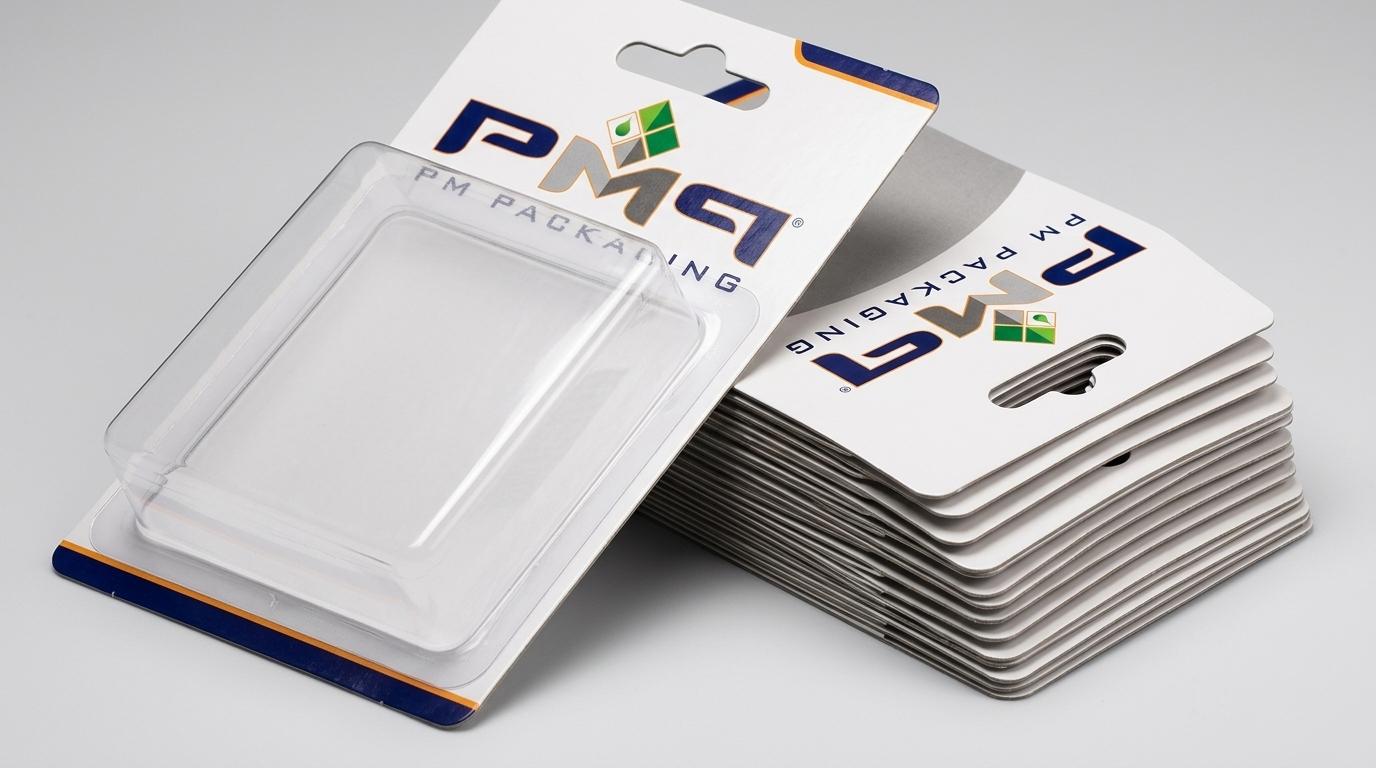
A thermoformed plastic blister (PET, RPET, or GAG) containing the product is heat-sealed directly onto the coated face of a single paperboard card (typically 18pt to 28pt SBS).
Fold-Over (Book-Style) Blister Cards
Features two connected panels separated by a precision-scored hinge crease. The blister flange is placed between the panels, which are folded and heat-sealed face-to-face.
Trapped Blister Packaging (Two-Piece Lamination)
Utilizes two separate paperboard cards (a front card with a custom die-cut aperture and a solid back card). The thermoformed blister is inserted through the die-cut window from the inside, trapping its perimeter flange securely between the two paperboard plies.
100% All-Paperboard & Molded Fiber Structural Blisters
Replaces the thermoformed bubble with engineered paperboard collars, die-cut lock tabs, or thermoformed wet-press molded pulp inserts integrated into a folding carton backing.
Technical Comparison Matrix: Clamshell vs. Alternative Formats
The following matrix outlines the operational, structural, and commercial trade-offs across each packaging format:
| Criteria | Thermoformed Clamshell | Face-Seal Blister | Trapped Blister | Fold-Over Card | All-Paperboard |
|---|---|---|---|---|---|
| Plastic Content (Wt) | 85% – 100% | 15% – 35% | 10% – 25% | 10% – 25% | 0% |
| EPR Fee & Tariff Impact | High Penalty Tier | Low Penalty Tier | Ultra-Low Tier | Low Penalty Tier | Zero EPR Fee |
| Pegboard Strength | High (Plastic) | Moderate (24pt+ SBS) | Exceptional (Double Ply) | Exceptional (Double Ply) | High (Reinforced) |
| Theft Resistance | Very High (RF Welded) | Moderate | High (Internal Trap) | High (Enclosed) | Moderate to High |
| Curbside Recyclability | Poor (Low MRF recovery) | Moderate (Coating wash) | Excellent (Clean Separation) | Excellent (Clean Separation) | 100% Repulpable |
| Sealing Tooling (NRE) | $15k – $40k (RF Dies) | $2.5k – $6k | $3.5k – $8k | $3k – $7k | $1.5k – $4k (Die) |
| Pack-Out Cycle Time | 4 – 8 sec (RF weld) | 1.5 – 3.0 sec (Rotary) | 2.0 – 4.0 sec (Auto) | 2.5 – 4.5 sec | Variable (Cartoner) |
| Freight Cube Efficiency | Low (Bulky nested) | High (Flat sheets) | High (Flat sheets) | High (Flat sheets) | Very High (Knocked down) |
Substrate Engineering & Board Selection
Replacing the structural rigidity of a 15mil to 30mil thermoformed plastic clamshell requires careful selection of paperboard calipers, grain direction alignment, and fiber furnish:
Solid Bleached Sulfate (SBS)
14pt – 28pt Caliper
100% virgin chemical pulp offering superior brightness (90+ GE), maximum internal bond strength, and pristine print fidelity.
Coated Unbleached Kraft (CUK)
18pt – 28pt Caliper
High-strength unbleached virgin pine fibers with exceptional Mullen burst strength and tear resistance.
Recycled Board (CCNB / CRB)
18pt – 26pt Caliper
100% recycled fiber furnish (pre- and post-consumer waste) with a white clay-coated top liner for circularity mandates.
Board Grain Direction & Pegboard Deflection Dynamics
A common failure mode during clamshell-to-blister conversions is card sagging or bowing under product weight when hung on retail pegboard fixtures. Packaging engineers must specify vertical grain direction (parallel to the vertical card axis) to maximize beam stiffness against gravitational bending moments. Furthermore, Euro-slot or delta hang holes should be engineered with a minimum clearance of 0.75 inches from the top card edge to prevent hang-tab tear-out under dynamic store restocking handling.
Heat-Seal Chemistry, Coatings, and Sealing Mechanics
The structural integrity of a face-seal or fold-over blister package depends on the molecular bond formed between the thermoformed plastic flange and the aqueous coating applied to the paperboard.
Heat-Seal Bonding Mechanism & Quality Standard
Aqueous Coating Chemistry: PM Packaging applies advanced inline water-based heat-seal coatings immediately following offset litho print towers. This eliminates VOC emissions, ensures FDA direct/indirect food contact compliance, and prevents yellowing over prolonged retail shelf life.
The 100% Fiber-Tear Standard: In industrial qualification, a heat-seal bond is acceptable only if destructive pull testing yields 100% fiber-tear failure—proving the adhesive bond between coating and plastic is stronger than the internal bond strength of the board itself.
| Blister Resin | Sealing Temp Window | Coating Chemistry | Bond Failure Mode |
|---|---|---|---|
| RPET / APET | 280°F – 340°F | High-solids modified acrylic emulsion | 100% Fiber-Tear Pull |
| GAG (PETG/APET/PETG) | 260°F – 315°F | Universal aqueous heat-seal | Rapid low-temp activation |
| Recycled PVC | 250°F – 300°F | Vinyl-acrylic aqueous varnish | High initial tack |
Pack-Out Line Economics, Automation & Co-Packing Conversion
A primary concern for procurement directors during a clamshell-to-blister conversion is the operational impact on packing line speeds and capital expenditure:
Legacy Clamshell RF Welding
- Tooling Cost: $15,000 – $40,000 per RF die set.
- Line Speed: 8 – 18 units/minute per operator station.
- Scrap & Tuning: Frequent arcing, burnt plastic, high setup waste.
- Ergonomics: Sharp flash edges require manual de-nesting and safety gloves.
Modern Rotary Blister Heat Sealing
- Tooling Cost: $2,500 – $6,000 per aluminum platen set.
- Line Speed: 30 – 75 units/minute (automated pick-and-place >120 ppm).
- Scrap & Tuning: Consistent thermocouple heating, <0.5% scrap rate.
- Changeovers: Tool-less changeovers in under 30 minutes.
Multi-SKU Programs & PM Packaging's qikCombo™ Solution
For consumer brands managing extensive SKU catalogs (such as hardware lines with 50+ part numbers, multi-shade cosmetics, or multi-size electronic accessories), transitioning to blister packaging historically presented inventory and minimum order quantity (MOQ) hurdles.
PM Packaging’s proprietary qikCombo™ program eliminates this obstacle by grouping 5 to 20 distinct part numbers onto standardized large-format lithographic print sheets and combo die-cut layouts:
The qikCombo™ Strategic Advantage
Accommodates run sizes from 5,000 to 100,000 pieces per SKU without penalizing low-velocity items.
Amortizes plate setups and make-readies across all SKUs, lowering unit costs by 35% to 55%.
Dedicated production windows allow finished heat-seal blister cards to ship in as few as 10 business days.
Eliminates the requirement to carry 6+ months of obsolete safety stock to satisfy mill-run minimums.
Loss Prevention & Retail Shelf Merchandising
A legacy argument in favor of rigid plastic clamshells was loss prevention. Modern structural paperboard engineering delivers equal or superior deterrence while dramatically improving retail presentation:
Concealed EAS & RFID Anti-Theft Integration
In trapped blister packaging, Electronic Article Surveillance (EAS) and RFID tags are laminated directly between the front and back board plies during converting. The tag is completely invisible, tamper-proof, and cannot be peeled off by shoplifters without destroying the package.
25% – 40% Increase in Pegboard Density
Rigid clamshells have wide thermoformed flanges and bulbous contours that force store clerks to space products apart on peg hooks. Flat-backed blister cards occupy significantly less depth, allowing more units per peg wire, preventing out-of-stocks, and maximizing revenue per square foot.
Supply Chain Resiliency & The Nearshore Advantage
Sourcing bulky plastic clamshells from transpacific suppliers in East Asia introduces severe supply chain volatility, long cash-to-cash cycles, and carbon-heavy ocean transit.
- 1 to 3 Day Ground Freight: PM Packaging’s bi-national manufacturing centers in San Diego, CA and Baja California (Tijuana & Mexicali) deliver finished blister cards to West Coast and Southwest distribution centers in 1 to 3 days (3 to 5 days nationwide).
- 100% USMCA / T-MEC Tariff-Free: Fully compliant with North American Rules of Origin and IMMEX certification, eliminating Section 301 tariffs, import duties, and port demurrage charges.
- World-Class Quality & Security Certifications: ISO 9001:2015 certified, SQF certified for consumer packaging safety, GMI certified for Walmart/Target print fidelity, G7 Master Printer certified, and C-TPAT / OEA certified for FAST-lane border clearance.
- Vendor Managed Inventory (VMI): Dedicated warehouse staging and automated replenishment buffers eliminate stockouts during major retail promotions.
5-Phase Transition Roadmap for Packaging & Procurement Teams
Total Cost of Ownership (TCO) Comparison: A Case Study
To understand the macro-financial impact of transitioning from clamshells to blister cards, consider an annual program producing 1,000,000 units across 10 SKUs for national retail distribution:
Annual Program Financial Breakdown
Basis: 1,000,000 units across 10 SKUs in national retail distribution
- Material ($0.42/unit): $420,000
- RF Tooling (10 SKUs): $65,000
- Inbound Ocean Freight: $95,000
- Pack-Out Labor (RF Weld): $180,000
- State EPR Plastic Fees: $55,000
- Material (Card + Blister): $240,000
- Heat-Seal Tooling: $12,000
- Nearshore Ground Freight: $28,000
- Rotary Pack-Out Labor: $75,000
- State EPR Fees: $8,000
- qikCombo™ Setup Savings: -$18,000
Scale Your Transition with PM Packaging
Moving an established consumer brand from plastic clamshells to engineered paperboard blister cards is a transformative operational upgrade. When executed with the right structural engineering partner, the transition protects your margins, reduces your carbon footprint, satisfies strict mass retail mandates, and accelerates packing line velocity.
With 45+ years of packaging manufacturing excellence, PM Packaging provides the structural engineering expertise, G7 Master certified print quality, high-capacity bi-national manufacturing scale, and innovative programs like qikCombo™ to make your retail conversion seamless, compliant, and cost-effective.
Contact PM Packaging today to discuss your blister-card dimensions, product assortment, annual quantities, retailer requirements, sealing process, and replenishment plans. The PM Packaging engineering team will help you evaluate dedicated runs, qikCombo™, or hybrid production strategies tailored to your retail footprint.