
In commercial product packaging, digital short-run printing is the undisputed king of agility during brand infancy.
When launching an initial Direct-to-Consumer (DTC) product, running regional consumer tests, or fulfilling boutique influencer seeding kits, digital printing provides a low upfront barrier to entry: zero tooling costs, no physical print plates, rapid 72-hour turnaround times, and variable data flexibility for orders between 500 and 3,000 units.
However, when an emerging brand achieves commercial escape velocity—securing national retail distribution in Walmart, Target, Costco, Sam’s Club, Sephora, Ulta Beauty, The Home Depot, or regional grocery chains—the operational dynamics of digital printing invert.
What was once an agile advantage becomes a severe operational and financial bottleneck.
The Strategic Convergence: Digital Agility vs. Offset Scale
Agile Pilot Phase (500 – 5,000 Units)
- Economic Model: Zero plate costs, but flat “click charges” yielding static, high unit costs ($0.75–$1.50+)
- Mechanical Limits: Small sheet size (B2 max ~20"x29"), light calipers (<18pt), offline embellishments
- Operational Reality: Manual unboxing, slow CAD scoring, unsuited for high-speed cartoning
Enterprise Scaling (10,000 – 500,000+ Units)
- Economic Model: Upfront CTP tooling amortized over large sheets; unit costs drop to $0.12–$0.25
- Mechanical Prowess: Large format (40" to 64" VLF), 12pt–32pt SBS/CCNB and microflute SFL
- Operational Reality: G7/GMI Delta-E < 1.5 color lock, inline coatings/foil, 400+ CPM run speed
For Procurement Directors, VP/Directors of Supply Chain, Brand Managers, and Packaging Engineers, recognizing the exact tipping point where digital short-run packaging ceases to be cost-effective—and transitioning smoothly to large-format sheetfed offset lithography—is one of the most critical supply chain decisions in a brand’s lifecycle.
Staying in digital too long erodes gross margins, causes retail audit rejections due to color drifting across store shelves, throttles automated packaging line speeds, and caps brand growth. Conversely, transitioning to large-format offset unlocks massive economies of scale, structural rigidity, photographic print fidelity, and automated pack-out efficiency.
1. Print Physics & Press Mechanics: Digital Limitations vs. Large-Format Offset Prowess
To understand the operational tipping point, packaging engineers and procurement teams must evaluate the underlying mechanical differences between how digital presses and large-format offset lithographic presses apply ink to paperboard.
Direct Jetting / Toner Fusion
│ │ │
▼ ▼ ▼
┌──────────────────────────────────┐
│ Droplet Jetting / Toner Fusion │
└──────────────────────────────────┘
════════════════════════════════════ Top Sheet
- Micro-banding at solid ink laydown & process builds
- Vulnerable to scuffing and cracking at score lines
- Constrained to sheet sizes up to 20.8" x 29.5" (B2)
Chemical Water/Ink Repulsion via Blanket
│
▼
[Rubber Blanket Cylinder] (Transfers Ink Film)
│
════════════════════════════════════════ Top Sheet
- Sub-micron, perfectly uniform ink film leveling
- Inline chemical cross-linking with UV/Aqueous cure
- Large-format sheet sizes up to 40", 56", and 64" VLF
Digital Printing Mechanics and Physical Bottlenecks
Digital packaging production relies predominantly on liquid electrophotography (HP Indigo ElectroInk) or high-speed piezo inkjet arrays:
- Ink-to-Substrate Fusion: Digital inks and toners sit on the surface of the paperboard, bound by thermal fusion, polymeric primers, or UV pinning. Because the ink film is a surface layer rather than an emulsified lithographic ink absorbed and bonded into the coating matrix, digital inks are highly prone to flaking and cracking along score lines when paperboard is creased and folded on high-speed packaging lines.
- Sheet Size & Gang Limits: Most commercial digital folding carton presses are constrained to B2 sheet formats (approximately 20.8" x 29.5" / 530mm x 750mm) or continuous narrow webs (13" to 30"). A typical consumer folding carton (e.g., a 4" x 2" x 7" retail box) can only be imposed 4 to 8 units per sheet on a B2 digital press.
- Throughput Speed Limits: High-end digital sheetfed presses operate at linear speeds of 3,000 to 4,500 sheets per hour in standard multi-pass color modes. When running heavy folding carton board (>14pt), throughput speeds drop significantly to allow adequate thermal fusing or UV drying.
Large-Format Offset Lithography Mechanics and Structural Dominance
Sheetfed offset lithography operates on the chemical principle of mutual repulsion between oil and water, utilizing high-precision aluminum Computer-to-Plate (CTP) plates, dampening systems, and high-resilience rubber blanket cylinders:
- Sub-Micron Ink Transfer & Surface Leveling: Paste inks with high pigment load are transferred from the plate cylinder to the rubber blanket cylinder, and then offset onto the paperboard under hydraulic cylinder impression. The ink film is sub-micron in thickness, leveling perfectly across the microscopic valleys of coated paperboard without surface buildup. This eliminates cracking at carton creases and delivers photographic halftone resolution at 175 to 200+ Lines Per Inch (LPI) or high-definition stochastic screening.
- Very Large Format (VLF) Imposition Efficiency: Large-format offset litho presses—ranging from 40-inch (28" x 40") up to 56-inch (41" x 56") and 64-inch (47" x 64") formats—can impose 18, 24, 36, or 48+ folding cartons per single press sheet.
- Industrial Throughput Velocity: Modern 6-to-8 color large-format offset presses run continuously at 15,000 to 18,000 sheets per hour. When combined with 24-up to 48-up imposition, a single offset press produces between 360,000 and 864,000 carton blanks per hour—more than 20 to 50 times the hourly output of a digital press room.
| Mechanical Criteria | Digital Sheetfed / Web (Short-Run) | Mid-Format Offset Litho (28" x 40") | Large-Format Offset Litho (41" x 56" / 47" x 64") |
|---|---|---|---|
| Max Sheet Size | 20.8" x 29.5" (B2) | 28.5" x 41.0" (Format 3B) | 41.0" x 56.0" (Format 6) to 47.2" x 64.0" (Format 7) |
| Impressions Per Hour | 3,000 – 4,500 sph | 15,000 – 18,000 sph | 15,000 – 16,500 sph |
| Carton Units/Hr (4x2x7" Box) | 12,000 – 24,000 units/hr (4–6 up) | 180,000 – 288,000 units/hr (12–16 up) | 360,000 – 792,000 units/hr (24–48 up) |
| Maximum Board Caliper | 18pt – 24pt (Speed penalties) | 32pt SBS / CCNB | 32pt SBS / CCNB & SFL Microflute (E/F/B) |
| Halftone Resolution | 133 – 150 LPI equivalent | 175 – 250 LPI (AM & Stochastic) | 175 – 250+ LPI (G7 Master Certified) |
| Dedicated Spot Color Units | CMYK Simulated (or 7-color) | 6 to 8 dedicated ink towers | 6 to 8 dedicated ink towers + dual coating towers |
| Inline Embellishment | None (Secondary offline) | Inline Aqueous, UV, Cold Foil | Inline Cold Foil, UV, Soft-Touch, Strike-Through |
| Score Line Durability | Moderate (Toner cracking risk) | Flawless (Zero ink flaking) | Flawless (Optimal crease recovery & flexibility) |
2. Unit Economics and Total Landed Cost (TCO) Crossover Dynamics
The most common reason enterprise packaging buyers initiate the migration from digital to large-format offset is the Click-Charge Trap.
The Economic Crossover Inflection Window
The Click-Charge Economic Model of Digital
Digital printing equipment operates on a metered consumables model known in the graphic arts industry as the “click charge.”
Every time a sheet passes through a digital engine, the equipment manufacturer charges the converter a fixed fee that covers toner, imaging oil, developer, photo imaging plates, and maintenance service contracts.
- Marginal Cost is Flat: There is no marginal economies-of-scale benefit on raw printing passes.
- Single-Up / Low-Up Imposition Penalty: Because digital sheets are small, each carton bears a large fraction of the click charge.
- Unit Cost Floor: The cost per folding carton levels off between $0.65 and $1.20 per unit and cannot drop further, creating an unsustainable margin drag when retail price points demand secondary packaging costs below 3% to 5% of COGS.
The Large-Format Offset Economies-of-Scale Model
Large-format offset lithography operates on a classic industrial manufacturing cost structure: High Fixed Setup Cost, Near-Zero Marginal Run Cost.
1. Fixed Upfront Tooling Costs
- High-resolution CTP aluminum plates ($35–$65 per color plate)
- Steel-rule flatbed cutting dies ($800–$2,500 depending on cavity count)
- Stripping and blanking tooling ($600–$1,500)
- Make-ready waste (350–700 sheets for exact G7 color register)
2. Marginal Run Costs
- Bulk paperboard purchased in truckload master rolls and sheeted inline
- Bulk vegetable or UV paste inks purchased in 50-lb kits or 500-lb drums
- 24 to 48 cartons produced with every single press revolution
- Exponential unit cost decay as run volume expands
Detailed Crossover Financial Modeling
Consider a standard retail folding carton (Dimensions: 4.5" x 2.25" x 7.5", printed on 18pt SBS with 4-color process + 1 Pantone Spot Color + Aqueous Soft-Touch Coating):
| Production Run Volume | Digital Total Cost | Digital Unit Cost | Offset Total Cost | Offset Unit Cost | Offset Savings (%) | Gross Dollar Savings |
|---|---|---|---|---|---|---|
| 1,000 units | $1,250 | $1.25 | $3,850 | $3.85 | -208% (Digital Wins) | ($2,600) |
| 3,000 units | $3,150 | $1.05 | $4,450 | $1.48 | -41% (Digital Wins) | ($1,300) |
| 7,500 units | $6,975 | $0.93 | $5,625 | $0.75 | +19.4% (Offset Crossover) | $1,350 |
| 15,000 units | $12,750 | $0.85 | $6,750 | $0.45 | +47.1% | $6,000 |
| 50,000 units | $38,500 | $0.77 | $12,500 | $0.25 | +67.5% | $26,000 |
| 100,000 units | $74,000 | $0.74 | $18,000 | $0.18 | +75.7% | $56,000 |
| 250,000 units | $180,000 | $0.72 | $35,000 | $0.14 | +80.6% | $145,000 |
| 500,000 units | $355,000 | $0.71 | $62,500 | $0.125 | +82.4% | $292,500 |
For standard folding cartons, the commercial crossover point occurs between 6,500 and 10,000 units. Beyond 15,000 units, continuing in digital results in an immediate 40% to 80% cost penalty, directly draining brand EBITDA during national retail scaling.
3. Substrate Caliper Thresholds & Structural Rigidity: Folding Paperboard & SFL Microflutes
As retail velocity expands into high-density retail environments—mass merchants, warehouse club stores, and home improvement chains—the packaging must perform structural work. It is no longer just a graphic wrapper; it is an engineered protective vessel supporting top-load stacking compression, resisting warehouse humidity, and surviving parcel sorting drops.
Paperboard Caliper Limitations in Digital Presses
Digital sheetfed presses utilize complex roller paths, static-generating transfer blankets, and tight internal paper transports:
- Board Stiffness Rejection: Most digital engines cannot reliably feed paperboard exceeding 18pt to 22pt caliper (0.018" to 0.022"). Heavier caliper boards cause feed jams, head strikes on inkjet nozzles, and uneven toner transfer across the sheet surface.
- Coated Board Restrictions: Digital presses require specialized pre-treated or digitally-primed substrates to allow ink adhesion. Sourcing heavyweight 24pt–32pt Solid Bleached Sulfate (SBS), Coated Unbleached Kraft (CUK/SUS), or Clay Coated Newsback (CCNB) with proprietary digital primers is expensive, has long mill lead times, and severely restricts supply chain flexibility.
Heavy-Caliper Offset Litho & Single Face Laminate (SFL) Microflutes
Large-format offset litho presses are built with heavy-duty feeder heads, straight-line sheet travel, and high-clearance impression cylinders designed to process:
- Solid Bleached Sulfate (SBS) from 12pt up to 32pt.
- Coated Unbleached Kraft (CUK/SUS) for maximum tear strength and wet-strength beverage packaging.
- Clay Coated Newsback (CCNB) & Coated Recycled Board (CRB) for sustainable, cost-optimized retail packaging.
- Folding Boxboard (FBB) offering superior bulk-to-weight ratios.
Furthermore, when consumer brands outgrow folding paperboard altogether—such as when packaging heavy culinary electronics, power tools, automotive hardware, or multi-can beverage packs—large-format offset seamlessly transitions to Litho-Laminated Single Face Laminate (SFL) microflute packaging.
──────────────────────────────────────────
/\ /\ /\ /\ /\ /\ /\ ──► Fluted Corrugating Medium (F-Flute 1/32" or E-Flute 1/16")
/ \ / \ / \ / \ / \ / \ / \
────────────────────────────────────────── ──► Inside Kraft Linerboard
4. Color Consistency, Brand Equity & Retail Compliance (G7 Master & GMI)
In high-volume retail, color is intellectual property. A consumer standing in the aisle at Target or Sephora looks across a shelf facing of 12 to 24 units. If the brand’s signature teal, crimson, or pastel background varies by even a slight shade from one box to the next, the consumer perceives the product as old, counterfeit, or defective.
Shelf-Facing Variation
- Micro-fluctuations in ambient humidity or printhead heat cause perceptible color shifts
- Metamerism failure under fluorescent vs warm LED store lighting
- High risk of retail audit rejection under Walmart/Target GMI scoring
Locked Shelf Harmony
- Dedicated ink fountains mix exact physical Pantone Matching System (PMS) pigments
- Closed-loop inline spectrophotometers scan color bars at 18,000 sheets/hr
- Certified G7 Master Printer & GMI / SQF compliance across all production lots
Offset Lithography: G7 Master Certification & Dedicated Spot Colors
Large-format offset presses utilize dedicated ink fountains for precise physical ink formulation:
- Physical Pantone Matching System (PMS) Formulations: Instead of approximating a brand color using tiny CMYK dots, offset presses mix exact wet chemical pigments (e.g., Pantone 186 C Red or custom brand formulations) and lay down a solid, homogeneous ink film through a dedicated press tower.
- G7 Master Idealliance Calibration: G7 methodology aligns the press curve to neutral grayscale tonal reproduction rather than relying merely on TVI (Tone Value Increase / Dot Gain). By locking neutral density values across CMYK and running closed-loop inline spectrophotometers that scan color bars at 18,000 sheets per hour, offset presses hold Delta-E (ΔE) < 1.2 tolerances across millions of impressions.
- Multi-Plant & Re-Order Consistency: Whether a brand re-orders 50,000 cartons in March or 250,000 cartons in November, spectrophotometric CTP curves ensure exact visual and spectral identity across every production lot.
5. Inline Embellishments & High-Speed Surface Converting
Brand packaging on competitive retail shelves must capture shopper attention in less than three seconds. Premium visual and tactile embellishments—such as metallic foil accents, spot high-gloss contrasts, matte textures, and multi-level embossing—are proven catalysts for retail conversion.
Finishing Workflow: Offline Digital vs. Inline Offset
[Digital Print Pass] ──► [Manual Pallet Move] ──► [Offline Foil/Varnish Machine] ──► [Manual Move] ──► [Slow Flatbed CAD Table Die-Cut] (5–10 Days Total Cycle Time, +$0.30–$0.85/unit surcharge)
[6–8 Color Offset + Inline Cold Foil + Inline Dual Aqueous/UV Towers at 15k sph] ──► [High-Speed Platen Die-Cutter & Blanker] ──► [Automated Folder-Gluer] (1–3 Days Total Throughput)
Large-Format Offset Inline Embellishment Architecture
1. Inline Cold Foil Stamping
Applied on the first two press towers before process colors. CMYK inks print directly over the foil inline, allowing unlimited gradient metallic colors, hyper-intricate vector details, and mirror finishes without expensive brass dies.
2. Dual-Tower Strike-Through Coatings
Spot matte varnish is applied on the final print tower, followed by high-gloss aqueous or UV flood coat in the coating tower, creating tactile contrasts (gritty matte against glass-like high-gloss) in a single high-speed pass.
3. Soft-Touch Aqueous Finishes
Water-based inline soft-touch aqueous coatings provide a velvet luxury tactile feel that dries instantly without the delamination risks associated with soft-touch plastic film lamination.
4. Anti-Scuff Matte Protection
Formulated specifically for high-velocity distribution chains to withstand ASTM D5264 Sutherland Rub Test standards, preventing ink burnishing and transit scuffs during pallet freight.
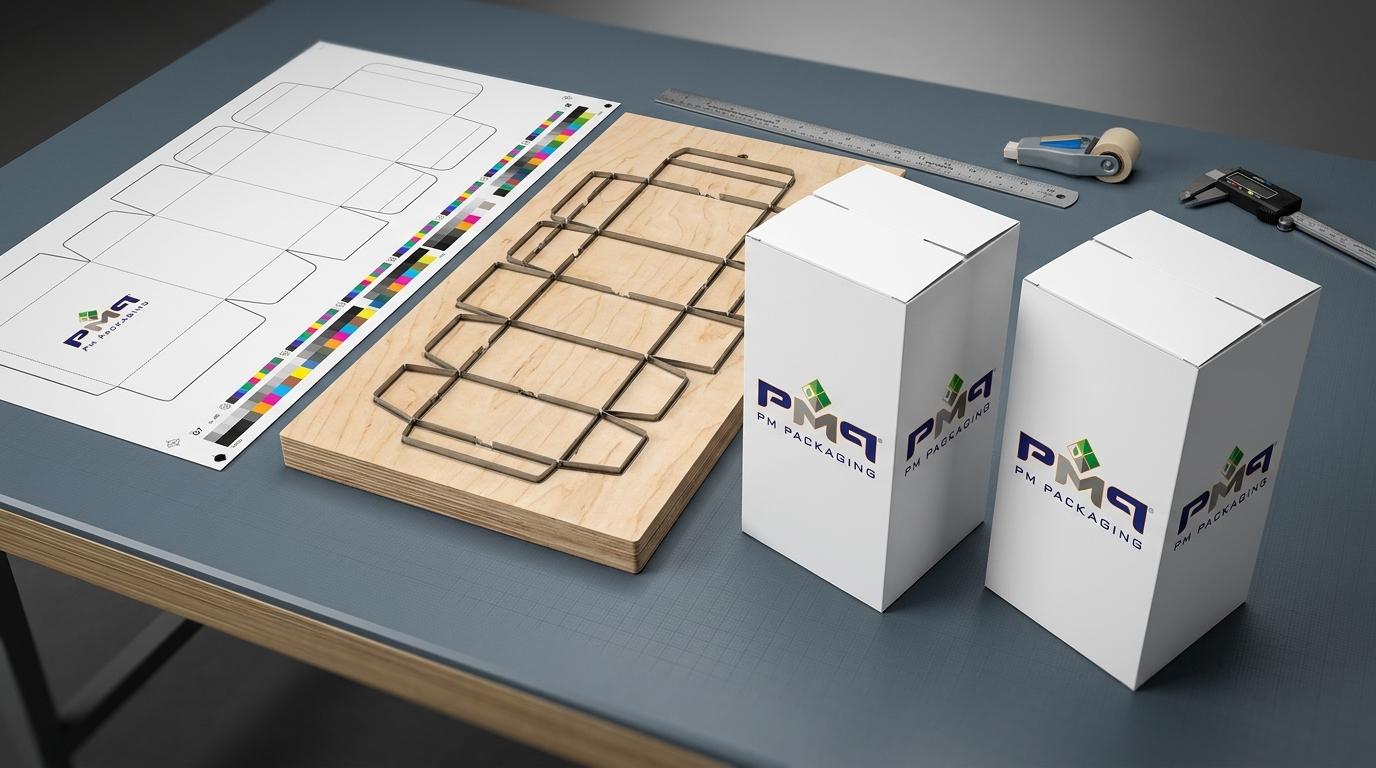
6. Pack-Out Velocity: Automated Cartoning Machine Performance & Score-Bend Rigidity
When enterprise brands scale into national distribution, manual hand-packing of cartons at the co-packer or manufacturing facility becomes financially impossible. High-volume contract packaging facilities deploy high-speed automated cartoning machines (such as R.A Jones, Bosch/Syntegon, Kliklok, or Marchesini) that erect, insert product, glue, and close cartons at speeds of 200 to 600 cartons per minute (CPM).
│ │ │
Requires Exact Requires Precise Requires Uniform
Die-Cut Caliper Crease-Bend Score Taber Stiffness
(± 0.005" Flatbed) Recovery (1.5 - 2.5:1) (Zero Bowing/Warp)
Why Digital / CAD-Cut Cartons Jam Automated Lines
- Inconsistent Crease Memory: Digital CAD creasing wheels compress paperboard fibers unevenly. The crease lacks a defined hinge matrix, resulting in high and unpredictable Score-Bend Resistance (opening force).
- Vacuum Cup Failure & Feeder Jams: When vacuum cups on an automated cartoning machine grab a flat carton blank from the magazine, the carton must erect square instantaneously. If score lines are stiff or improperly formed, the carton fails to open, causing the machine to misfeed, jam the feed hopper, and halt the entire packaging line.
- Dimensional Variation: Digital cutting tables exhibit slight X-Y dimensional drift (± 0.020" to 0.035"). On automated lines running at 400 CPM, a tolerance deviation of 0.020" causes tuck flaps to miss guide tracks, triggering repeated line stoppages and expensive co-packer downtime surcharges.
Offset Steel-Rule Tooling & Score Optimization
- Engineered Crease-to-Board Caliper Ratios: Steel-rule creasing knives and phenolite counter-matrices are micro-engineered for the specific caliper and fiber direction of the board. The score-bend opening force is calibrated to an optimal 1.5:1 to 2.5:1 ratio between uncreased board stiffness and creased score resistance (measured via TAPPI T829 score-bend testing).
- Extreme Dimensional Precision: Flatbed steel-rule platen die-cutting delivers micro-tolerances of ± 0.005" across all 24 to 48 cavities on the sheet, guaranteeing 100% carton-to-carton uniformity.
- High-Speed Automated Gluer Converting: Blanks are processed through multi-stage high-speed folder-gluers running at 1,500 feet per minute. Pre-breaking score lines 1 and 3 to 180 degrees ensures cartons break open effortlessly on automated packing lines, eliminating co-packer line stoppages and maximizing pack-out throughput.
7. Nearshore Manufacturing Architecture: Baja California Footprint & USMCA Strategy
For enterprise packaging procurement teams, choosing how to manufacture is only half the equation; where to manufacture dictates lead time agility, working capital efficiency, and supply chain resilience.
8–12 Week Lead Time Bottlenecks
- High inventory carrying costs & working capital tied up in ocean transit
- Vulnerability to port congestion, demurrage fees, and shipping delays
- Inability to respond quickly to sudden retail replenishment surges
- Section 301 tariffs and fluctuating cross-border customs regulations
San Diego HQ + Baja California Facilities
- 100% USMCA tariff-free trade compliance (IMMEX integrated)
- C-TPAT & OEA green-lane fast-track border crossing
- 1–3 day ground freight to West Coast distribution centers (3–5 days nationwide)
- Vendor Managed Inventory (VMI) hubs for agile JIT releases
8. The Transition Playbook: Step-by-Step Enterprise Migration Roadmap
Migrating an entire product catalog from digital short-run printing to large-format offset lithography requires a disciplined engineering roadmap:
Phase 1: Tooling & Dieline Harmonization (Days 1–14)
Audit multi-SKU dielines; standardize dimensions across product lines to eliminate micro-variations. Gang 4 to 8 compatible SKUs with shared CMYK and common spot colors on 40", 56", or 64" master sheets to maximize imposition and minimize make-ready waste.
Phase 2: Color Fingerprinting & G7 Proofing (Days 10–20)
Convert digital CMYK simulations into dedicated PMS spot colors. Generate ISO 12647-7 certified contract G7 proofs on actual production paperboard (SBS, CUK, CCNB, or SFL top liner) to establish baseline spectrophotometric Delta-E standards.
Phase 3: High-Tonnage Tooling Fabrication & Press Run (Days 18–28)
Fabricate precision laser steel-rule dies, phenolite counter-matrices, and blanking units. Image 2,400 DPI thermal aluminum CTP plates and execute production on large-format 6-to-8 color presses running inline aqueous, UV, soft-touch, or cold foil.
Phase 4: Co-Packer Qualification & JIT Rollout (Days 25–35)
Validate carton score-bend memory and opening forces on automated packing lines (200–600 CPM). Establish VMI min/max stock safety levels in PM Packaging's San Diego / Baja logistics hubs for seamless JIT replenishment.
9. Comprehensive Decision Matrix: When to Stay Digital vs. When to Go Large-Format Offset
| Decision Factor | Keep Digital Short-Run | Transition to Large-Format Offset Litho |
|---|---|---|
| Run Volume Per Order | < 5,000 units total | 10,000 to 500,000+ units |
| SKU Lifecycle Stage | Regional test, clinical trial, influencer kit | National mass retail rollout (Walmart, Target, Costco) |
| Target Packaging Unit Cost | $0.80 – $1.50+ is acceptable | Must achieve $0.10 – $0.35 to protect retail margin |
| Substrate Requirements | 12pt to 18pt standard paperboard | 12pt–32pt SBS/CCNB or SFL Microflutes (E/F/B) |
| Color Criticality | Standard CMYK pictorials; slight drift okay | Strict brand spot colors; GMI/G7 certified (ΔE < 1.5) |
| Embellishment Needs | Plain print or low-volume offline digital foil | Inline cold foil, strike-through varnish, soft-touch |
| Pack-Out Method | Manual hand-erecting and hand-loading | High-speed automated cartoning lines (200–600 CPM) |
| Supply Chain Strategy | Local quick-turn on-demand | Nearshore USMCA tariff-free JIT / VMI replenishment |
Partner with PM Packaging for Enterprise-Scale Packaging Excellence
For over 45 years, PM Packaging has engineered, printed, and converted high-performance packaging programs for the world’s leading consumer brands, industrial manufacturers, and retail suppliers.
Request a Strategic Packaging Audit
Ready to eliminate click charges, reduce unit packaging costs by 40% to 80%, and lock in G7 color consistency for your national retail rollouts? Contact the PM Packaging Engineering Team today to review your dielines, evaluate unit economics, and receive a comprehensive Total Landed Cost (TCO) analysis.