
In the scaling lifecycle of consumer packaged goods (CPG), few packaging milestones exert as profound an impact on gross margins, fulfillment throughput, and supply chain agility as the structural dieline chosen for primary folding cartons.
When emerging brands launch high-value products—spanning health and beauty, nutraceuticals, specialty food, consumer hardware, and over-the-counter wellness—procurement and packaging teams almost universally select Auto-Bottom Cartons (also referred to as Crash-Lock, Auto-Lock, or 1-2-3 Bottoms). The commercial rationale at lower volumes is indisputable: auto-bottom cartons arrive flat with pre-glued base flaps that snap into a rigid, closed base with a single manual hand squeeze. This enables pack-out operators or contract packagers (co-packers) to erect and pack boxes in 2 seconds per unit without requiring capital equipment or complex bottom-tucking labor.
However, as a brand crosses the threshold into national retail distribution (e.g., Target, Walmart, Sephora, Ulta, CVS, Whole Foods) and annual production volumes climb from tens of thousands to hundreds of thousands or millions of units, the structural and financial dynamics invert entirely.
The Packaging Dieline Evolution: Volume vs. Unit Economics
Auto-Bottom / Crash-Lock Dieline
Pack-Out Method: 100% Manual Assembly & Hand-Packing Lines.
Primary Benefit: Slashes manual assembly labor from 10s to 2s per unit.
Economic Trade-Off: Pays 15% to 35% converter unit premium; economically acceptable at low volume.
Transition Evaluation: Auto-Bottom vs. Straight Tuck End (STE)
Pack-Out Method: Semi-Automated vs. Automated Intermittent Motion Cartoning (40–80 CPM).
Primary Benefit: Converter price premium begins to drastically exceed manual labor savings.
Economic Trade-Off: CapEx / Co-Packer automation investment vs. runaway manual pack-out payroll.
Straight Tuck End (STE) / RTE / Glued End-Flap Cartons
Pack-Out Method: High-Speed Continuous Motion Automated Cartoners (120–400+ CPM).
Primary Benefit: Maximum sheet nesting yield, 50% higher pallet density, $0 manual erecting labor.
Economic Trade-Off: Requires ultra-strict board tolerances, crease stiffness & COF friction control.
At enterprise scale, auto-bottom cartons become an expensive operational liability. Brands pay significant converters’ specialty gluing upcharges ($20 to $45+ per thousand cartons), suffer 10% to 18% higher paperboard trim waste during die-cutting, lose 40% to 60% of their pallet freight density due to uneven “caliper shingling” (the stacked base flaps make flat bundles wedge-shaped), and encounter mechanical jamming when attempting to run pre-glued bases on continuous-motion cartoning machinery.
For Directors of Procurement, VP/Directors of Supply Chain, Operations Leaders, and Senior Packaging Engineers, determining the precise operational inflection point to transition from pre-glued auto-bottoms to High-Speed Straight Tuck End (STE) lines is critical to protecting margins and meeting retail fill rates.
1. Dieline Anatomy & Structural Physics: Auto-Bottom vs. Straight Tuck
To establish an objective transition roadmap, packaging engineers and procurement leaders must evaluate the mechanical, geometric, and manufacturing differences between these two primary folding carton styles.
Auto-Bottom / Crash-Lock Carton
- 3-Point Gluing: Side seam plus two opposing diagonal base flaps folded at 45° angles.
- Kinematic Pop-Open: Inward diagonal squeeze locks the overlapping base in 1.5–2.0 seconds.
- Stepped Interior Floor: Overlapping glued flap seams create an uneven base, causing slender bottles or dropper jars to tilt.
- Caliper Shingling: Base has 4–6 plies vs. 2 plies on tube, causing flat stacks to become wedge-shaped and cutting pallet freight density in half.
Straight Tuck End (STE) Carton
- Single-Point Gluing: Continuous PVA/hot-melt bead along side tab running at 1,500 ft/min.
- Symmetrical Flaps: Both top and bottom tuck flaps hinge from front panel and tuck toward rear.
- Flawless Shelf Edge: Raw cut edge is concealed on the rear panel, presenting smooth folded radiuses on retail shelves.
- Dead-Flat Stacking: Uniform 2-ply thickness across the entire carton length allows 40%–60% more units per pallet cube.
Structural & Manufacturing Comparison Matrix
The following engineering matrix contrasts converting parameters, line throughput, nesting efficiency, and unit economics across carton formats:
| Engineering & Procurement Metric | Auto-Bottom Carton (Crash-Lock) | Straight Tuck End (STE) | Reverse Tuck End (RTE) | Glued End-Flap Machine Carton |
|---|---|---|---|---|
| Primary Pack-Out Method | Manual / Semi-Automated Hand Pack | High-Speed Automated Cartoner | Automated Cartoner or Manual | Continuous High-Speed Line |
| Converting Glue Points | 3 Points (Side seam + 2 diagonal base) | 1 Point (Side seam tab only) | 1 Point (Side seam tab only) | 1 Point (End flaps glued on-line) |
| Folder-Gluer Press Speed | 20,000 – 45,000 cartons/hr | 60,000 – 120,000+ cartons/hr | 60,000 – 120,000+ cartons/hr | 80,000 – 150,000+ cartons/hr |
| Die Nesting Paperboard Yield | Baseline (82%–88% sheet yield) | +8% to +14% vs. Auto-Bottom | +12% to +18% vs. Auto-Bottom | +15% to +22% vs. Auto-Bottom |
| KDF Bundle Thickness Profile | Tapered / Shingled (3x thicker at base) | Dead Flat (Uniform 2-ply) | Dead Flat (Uniform 2-ply) | Dead Flat (Uniform 2-ply) |
| Pallet Cube Density (KDF) | 25,000 – 35,000 units/pallet | 50,000 – 75,000 units/pallet | 50,000 – 75,000 units/pallet | 60,000 – 85,000 units/pallet |
| Manual Pack-Out Speed | 1.5 – 2.5s / unit (Pop & Pack) | 8.0 – 12.0s / unit (Fold & Tuck) | 8.0 – 12.0s / unit (Fold & Tuck) | Not feasible manually |
| Automated Machine Line Speed | 15 – 35 CPM (Specialized feeder) | 60 – 250+ CPM (Standard) | 60 – 300+ CPM (Standard) | 120 – 450+ CPM (Hot-melt line) |
| Interior Base Planarity | Stepped / Glued seams (Tilt risk) | 100% Flat & Level | 100% Flat & Level | 100% Flat & Level |
| Converter Unit Price Index | 120% – 140% (Upcharge) | 100% (Baseline Benchmark) | 95% – 98% (Optimized nesting) | 90% – 95% (Lowest cost) |
2. The Financial & Operational Inflection Point: Economic TCO Modeling
The core dilemma facing procurement directors and VP/Directors of Supply Chain is balancing converter packaging purchase price against pack-out labor and equipment capital expenditure.
The Mathematics of Manual Assembly Labor
Pop open base (1.5s) + insert product (2.5s) + close top tuck (1.5s) + tamper seal & pack (2.5s) = 450 units/hr.
At $24.00/hr loaded wage = $0.0533 per unit ($53.33 / 1,000 units).
Fold bottom flaps (4.5s) + insert product (2.5s) + fold top flaps (3.5s) + seal & pack (2.5s) = 277 units/hr.
At $24.00/hr loaded wage = $0.0866 per unit ($86.63 / 1,000 units).
Converter Surcharge Delta by Annual Volume
For a typical 18pt SBS folding carton (e.g., 3.50" × 2.00" × 6.00"), the converter unit pricing across volume tiers demonstrates how rapidly the auto-bottom premium accumulates:
| Annual Production Volume | Auto-Bottom Unit Price | Straight Tuck (STE) Unit Price | Converter Savings per Unit | Total Converter Annual Savings |
|---|---|---|---|---|
| 25,000 units | $0.385 | $0.320 | $0.065 (16.9%) | $1,625 |
| 75,000 units | $0.265 | $0.215 | $0.050 (18.8%) | $3,750 |
| 150,000 units | $0.195 | $0.152 | $0.043 (22.0%) | $6,450 |
| 300,000 units | $0.145 | $0.108 | $0.037 (25.5%) | $11,100 |
| 500,000 units | $0.118 | $0.084 | $0.034 (28.8%) | $17,000 |
| 1,000,000 units | $0.096 | $0.066 | $0.030 (31.2%) | $30,000 |
Annualized Total Cost of Ownership (TCO) Model
When automated machine cartoning is introduced, line throughput jumps from 450 units/hr (manual) to 3,600–9,000+ units/hr (60 to 150 CPM). The following model compares Total Cost of Ownership (Packaging Material Cost + Pack-Out Labor + Pallet Freight + Machine Amortization) across volume tiers:
| Volume Tier (Units/Yr) | Auto-Bottom Manual (Material + Labor + Freight) | Automated Straight Tuck (Material + Labor + Amort. + Freight) | Net TCO Advantage |
|---|---|---|---|
| 25,000 | $9,625 + $1,333 + $450 = $11,408 | $8,000 + $200 + $6,000* + $250 = $14,450 | Auto-Bottom (+$3,042) |
| 75,000 | $19,875 + $4,000 + $1,350 = $25,225 | $16,125 + $600 + $6,000* + $750 = $23,475 | Straight Tuck (+$1,750) |
| 150,000 (Inflection Point) | $29,250 + $8,000 + $2,700 = $39,950 | $22,800 + $1,200 + $6,000* + $1,500 = $31,500 | Straight Tuck (+$8,450) |
| 300,000 | $43,500 + $16,000 + $5,400 = $64,900 | $32,400 + $2,400 + $6,000* + $3,000 = $43,800 | Straight Tuck (+$21,100) |
| 500,000 | $59,000 + $26,665 + $9,000 = $94,665 | $42,000 + $4,000 + $6,000* + $5,000 = $57,000 | Straight Tuck (+$37,665) |
| 1,000,000 | $96,000 + $53,330 + $18,000 = $167,330 | $66,000 + $8,000 + $6,000* + $10,000 = $90,000 | Straight Tuck (+$77,330) |
*Note: Automated cartoner CapEx ($180,000) amortized over a 5-year schedule ($36,000/yr), allocated across multi-SKU portfolios (modeled at $6,000 per 250k unit increment), or equivalent co-packer automated machine fee.
3. Cartoner Machine Mechanics & Substrate Engineering Specifications
When transitioning to high-speed automated straight tuck packaging lines, packaging engineers must recognize that a carton blank ceases to be merely a decorative box—it becomes a high-speed mechanical component.
A manual pack-out operator can compensate for stiff score lines, board warping, or high friction by using tactile hand pressure. An automated cartoning machine running at 120 to 250 cartons per minute has zero tactile tolerance: an out-of-spec crease or high-friction coating will cause feeding mispicks, vacuum erection failures, or line jams, causing downstream production stoppages that cost $1,500 to $5,000 per hour in downtime.
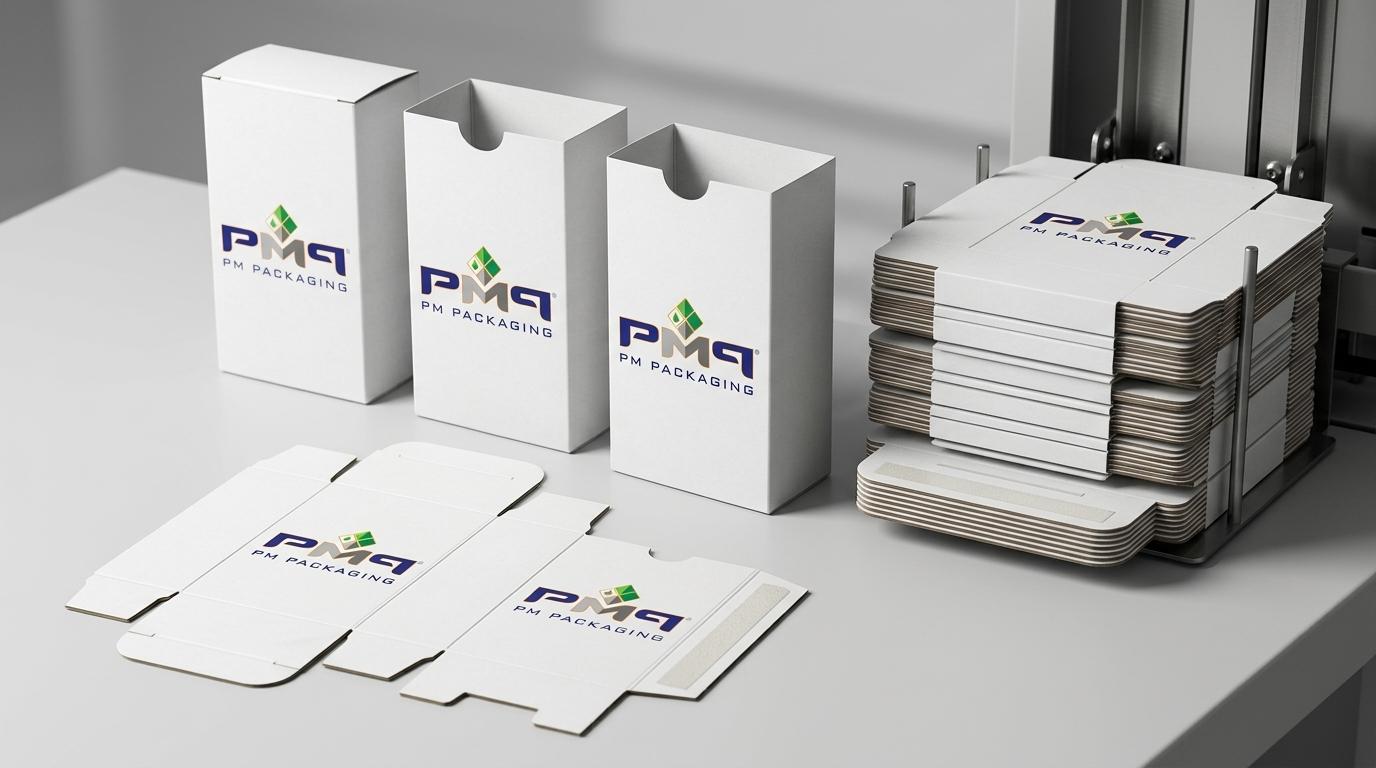
Substrate Quality Matrix for High-Speed Cartoning
To ensure flawless high-speed cartoning performance, PM Packaging engineers folding carton blanks to strict mechanical specifications:
| Engineering Parameter | Target Specification Range | Test Standard | Failure Mode if Out of Spec |
|---|---|---|---|
| Paperboard Caliper | 14pt to 24pt (±0.0005" / ±0.5pt) | ASTM D645 / TAPPI T411 | Magazine feed jams or double-blank pulls. |
| Fiber Grain Direction | Parallel to major score lines | TAPPI T409 | Panel bowing, carton racking, and machine jams. |
| Crease Bending Stiffness | 30% to 45% of uncreased board stiffness | TAPPI T543 / T556 | >50% causes vacuum pop failure; <25% causes panel collapse. |
| Carton Opening Force | 35 to 65 gram-force (gf) | ASTM D5621 / Iggesund | >80 gf causes vacuum suction cups to tear away from hopper. |
| Static Friction (COF) | 0.42 to 0.48 (Coated to Coated) | ASTM D1894 | >0.55 causes multi-blank feed jams; <0.35 causes magazine slippage. |
| Kinetic Friction (COF) | 0.32 to 0.38 | ASTM D1894 | Friction spikes cause transit lug instability. |
| Score Line Pre-Breaking | 1st Score: 180° / 3rd Score: 90° | Converter Pre-Breaker | Unbroken scores retain memory, resisting square erection. |
| Die-Cut Edge Quality | 100% clean shear; zero angel hairs | 50x Optical Inspection | Fiber dust fouls vacuum lines and optical eye sensors. |
| Varnish Knockout on Glue Tabs | 100% bare fiber knockout (0% coating) | Dyne Pen / Vision System | Coating bleed on glue tabs causes seam delamination. |
4. Retail Channel, Product Weight & Aesthetic Considerations
Beyond unit economics and line speeds, procurement and brand managers must evaluate how the structural dieline impacts retail presentation, heavy product support, and consumer unboxing.
1. Shelf Aesthetics: Straight Tuck vs. Reverse Tuck
Front Panel IntegrityIn an STE carton, both top and bottom tuck flaps hinge from the front panel and fold toward the rear. As a result, the front face exhibits smooth, folded radius edges at both the top and bottom borders. The raw die-cut edges of the tuck flaps are positioned on the rear panel, completely hidden from the consumer browsing the shelf.
In contrast, Reverse Tuck (RTE) leaves an exposed raw paperboard cut line across the lower front edge. Prestige beauty and health brands universally mandate STE to preserve a pristine front-facing billboard.
2. Base Planarity & Slender Product Stability
Zero Bottle TiltThe internal base of an auto-bottom carton contains overlapping triangular flaps joined by adhesive beads, creating an uneven, stepped interior floor. Slender dropper bottles, cosmetic pumps, or perfume vials placed inside auto-bottom cartons frequently rest on an angled seam, causing the bottle to sit crooked inside the box.
Straight Tuck cartons provide a 100% planar, seamless floor that guarantees vertical alignment and flawless unboxing presentation.
3. Product Weight & Bottom-Load Retention
Load Rating PhysicsStandard friction-lock tuck flaps support lightweight items up to 1.5 lbs. For heavier products (2.0 to 6.0+ lbs)—such as dense jars, hardware, or multi-packs—automated packaging lines utilize End-Load Glued-Flap Cartons or apply a localized dot of hot-melt adhesive to the straight tuck flap.
This creates a tamper-proof, fiber-tearing mechanical bond that easily outperforms auto-bottom structural load ratings while preserving high machine line speeds (150+ CPM).
5. The Step-by-Step Transition Roadmap for Supply Chain & Procurement
Transitioning an active brand portfolio from manual auto-bottom cartons to high-speed straight tuck lines requires a synchronized, cross-functional implementation strategy across packaging engineering, procurement, and contract manufacturing.
SKU Rationalization & Footprint Harmonization
Audit carton dimensions across your portfolio and group SKUs into standardized Length x Width cross-sections. Varying only vertical carton height minimizes cartoner changeover parts and downtime.
Dieline Re-Engineering & CAD Prototyping
Convert CAD dielines to precision Straight Tuck End (STE) geometry with chamfered dust flaps (15°–30° relief angles), friction-lock tuck shoulders, and bare vacuum cup land areas on major panels.
Line Trials & Factory Acceptance Testing (FAT)
Run 10,000 to 25,000 production-die trial blanks on target cartoning machines at 100%, 110%, and 125% rated speeds (150–200 CPM). Validate Taber stiffness, crease recovery, and <0.05% stoppage rate.
Safety Stock Cutover & Nearshore Rollout
Establish a 60-day safety stock buffer of legacy auto-bottoms while scaling automated STE lines. Transition purchase orders with agile nearshore replenishment (1–3 day ground freight) from Baja California.
6. How PM Packaging De-Risks High-Volume Cartoning Programs
Successfully executing a high-volume transition from auto-bottom to automated straight tuck packaging requires a manufacturing partner with world-class structural engineering, precision converting assets, and agile supply chain logistics.
The PM Packaging Manufacturing Advantage
45+ Years Structural Engineering
Dedicated CAD packaging lab collaborating directly with packaging machinery OEMs and contract packagers to optimize dielines for your exact cartoner models.
Bobst Converting & Pre-Breaking
High-speed Bobst folder-gluers with inline 180° pre-breaking stations and optical vision glue detection, delivering <50 gf opening force at 300+ CPM.
G7 Master & GMI Certified
Spectrophotometric color consistency (Delta E < 1.5) across SKU families, backed by ISO 9001:2015, SQF food safety, and FDA compliance certifications.
Nearshore US-Mexico Dual-Hub
San Diego HQ + Baja California plants provide 1–3 day ground freight across California and the Southwest, 100% USMCA tariff-free compliance, and VMI floor stock.
Strategic Action Plan for Packaging Leaders
Transitioning from pre-glued auto-bottom cartons to high-speed straight tuck lines is the defining operational milestone separating emerging startups from high-efficiency enterprise brands. When production volumes cross the 100,000 to 150,000 unit threshold, continuing manual auto-bottom pack-out imposes severe EBITDA penalties.
Ready to evaluate your brand’s folding carton portfolio, model your TCO crossover threshold, and transition to high-speed automated packaging lines? Contact the PM Packaging Engineering & Commercial Team today to request a comprehensive packaging audit, obtain precision CAD prototypes, or schedule a technical consultation.