
In the commercial packaging hierarchy, few formats communicate prestige, product value, and brand equity as decisively as the Rigid Set-Up Box.
For decades, enterprise brands across luxury cosmetics, prestige spirits, high-end consumer audio, luxury apparel, premium health and wellness, and high-Average Order Value (AOV) direct-to-consumer (DTC) electronics have relied on rigid chipboard setup boxes—such as two-piece lift-off lid boxes, shoulder/neck boxes, and hinged cigar-style book boxes—to deliver an unmistakable sensory unboxing experience.
However, as emerging brands scale into enterprise volumes (scaling from 10,000 units to 50,000, 250,000, or 1,000,000+ units annually) and distribute across national mass retail, luxury department stores, and global 3PL fulfillment networks, traditional rigid set-up boxes introduce severe supply chain bottlenecks.
The core operational liability of a traditional rigid setup box is structural: it is manufactured, shipped, and stored as 90% empty air.
The Logistical Dilemma: Freight & Warehousing of Void Space
Fully Erected / Fixed 3D Assembly
- Inbound Freight: Ships 85% – 92% empty air volume
- 40ft HC Container: Holds only 10,000 – 14,000 units
- Pallet Density: 200 – 350 units per pallet ($22/pallet/mo)
- Pack-Out Staging: Crowds assembly floors with bulky erected boxes
- Transit Risk: Corner crushing and scuffing during bulk transport
Knocked-Down Flat (KDF Blank)
- Inbound Freight: Ships 100% dense, solid flat-pack sheets
- 40ft HC Container: Holds 50,000 – 65,000 units (400%+ lift)
- Pallet Density: 1,200 – 1,800 units per pallet (80% footprint cut)
- Pack-Out Staging: Compact flat stacks erected in 4–6 seconds
- Transit Protection: Zero crushed corners inside dense master shippers
When an enterprise brand scales, paying ocean freight container rates, cross-border ground transport, and monthly 3PL warehouse pallet racking fees for tens of thousands of cubic feet of empty air severely erodes gross product margins. Furthermore, transpacific ocean freight volatility and port demurrage exacerbate these costs when sourcing bulky rigid boxes overseas.
The engineering solution engineered for high-scale luxury CPG is Collapsible Magnetic Packaging (also known as Foldable Rigid Magnetic Boxes or Flat-Pack Luxury Boxes). By combining precision CNC V-grooved high-density greyboard, concealed rare-earth neodymium magnetic closures, and structural high-shear adhesive corners, collapsible magnetic packaging delivers identical luxury heft, wall thickness, and unboxing tactile snap as a non-collapsible setup box—while shipping and storing 100% Knocked-Down Flat (KDF).
1. Structural Anatomy & Manufacturing Physics: Set-Up vs. Collapsible Magnetic
To make an informed procurement and engineering transition, packaging leaders must understand the structural architecture, converting steps, and mechanical behaviors that differentiate traditional rigid setup boxes from collapsible magnetic boxes.
2. Die-cut 4 corner notches & knock out blanks
3. Quad-stay tape 4 vertical corners into 3D tray
4. Glue & tight-wrap litho paper on automatic box line
5. Result: Permanently fixed in 3D (90% air)
2. Precision CNC 90° V-grooving through 95% board caliper
3. Pocket-route cavities & embed flush N42 NdFeB magnets
4. Apply 3M high-shear acrylic transfer tape to corner gussets
5. Result: Ships 100% flat; erects in 4–6 seconds
Traditional Rigid Set-Up Box Architecture (Lift-Off Lid / Shoulder Box)
A traditional rigid set-up box is a non-collapsible three-dimensional structure engineered through a multi-stage forming and wrapping process:
- Board Scoring and Corner Notching: Heavy chipboard or greyboard (typically 40pt to 120pt / 1.0mm to 3.0mm thickness) is rotary scored to define the box perimeter. The four corners are die-cut and knocked out as square blanks.
- Corner Quad-Staying: The flat scored board is fed into a quad-stayer machine. Mechanical forming shoes fold the four sidewalls upward at 90-degree angles. Heat-activated paper or plastic stay tape is applied to the four vertical corner seams under pressure, locking the flat board into a permanent, rigid three-dimensional tray.
- Tight-Wrap Gluing: A printed, embellished outer wrap paper (128gsm to 157gsm coated art paper or specialty dyed paper) is coated with hot animal protein glue or PVA adhesive. The erected greyboard tray is placed onto the glued wrap. Automatic wrapping arms roll the paper around the four sidewalls, turn the edges around the bottom, and fold the top lips inward (the “turn-in”) across the interior top rim.
- Permanent 3D State: Once the glue cures, the base and lid trays are permanently rigid. They cannot be compressed, folded, or flattened without catastrophic structural destruction. From the moment of manufacture through ocean transit, warehouse storage, pack-out, and final distribution, the packaging consumes its full cubic exterior volume.
Collapsible Magnetic Packaging Architecture (Foldable Rigid Box)
Collapsible magnetic packaging eliminates the permanence of rigid 3D quad-staying by replacing fixed taped corners with precision geometric hinges, CNC V-grooves, and dynamic locking corners:
- Multi-Segment Greyboard Core Alignment: Instead of forming a continuous notched tray, the box structure is engineered as a segmented matrix of high-density greyboard panels (Base, Rear Spine, Lid, Front Closure Flap, Left Sidewall, Right Sidewall, and four triangular corner folding gussets).
- Precision CNC 90-Degree V-Grooving: The critical engineering feature of collapsible packaging is V-grooving. High-speed carbide or diamond-tipped V-cutters carve 90-degree (or 45-degree opposing) V-shaped channels through 90% to 95% of the greyboard caliper. The bottom 0.1mm of greyboard fiber and the laminated backing wrap paper remain completely uncut. This creates a razor-sharp, zero-radius 90-degree folding hinge with no exterior board rounding, blistering, or paper tearing.
- Concealed Rare-Earth Magnetic Locking System: Before the inner liner wrap is laminated, robotic pick-and-place stations pocket-route recessed cavities into the greyboard panels. High-grade Neodymium-Iron-Boron (NdFeB) disc magnets (typically N38, N42, or N52 grade) and matching galvanized steel attraction plates (or opposing polarity magnets) are pressed flush into the routed pockets. When wrapped with the interior liner, the magnets are completely invisible, silent during folding, and deliver a crisp, audible 2.0 to 3.5 lb (9N to 15N) pull-force snap closure.
- High-Shear Corner Fastening Mechanics: The four corner gussets are engineered with two primary fastening mechanisms:
- Pre-Applied High-Tack Acrylic Adhesive: Four triangular corner flaps feature pre-applied, cross-linked high-shear acrylic transfer tape (e.g., 3M 9485EK or equivalent) backed by silicone release pull-tabs. At pack-out, fulfillment operators peel the four release liners, pull the sidewalls upright, and press the corner joints firmly. The adhesive creates an immediate, permanent fiber-tearing bond, locking the box into a rigid setup structure in 4 to 6 seconds.
- Four-Corner Magnetic Hinge Gussets (Reusable / Re-Collapsible): For ultra-luxury applications where the consumer is intended to collapse and re-erect the box repeatedly (such as luxury apparel storage or keepsake presentation), the corners incorporate secondary embedded magnet pairs or mechanical folding diagonal flaps that snap into place without adhesive.
| Engineering & Logistical Metric | Traditional 2-Piece Rigid Set-Up Box | Hinged Book-Style Non-Collapsible Box | Collapsible Magnetic Box (Adhesive Corners) | Collapsible Magnetic Box (4-Corner Magnetic) |
|---|---|---|---|---|
| Shipped / Stored State | 100% 3D Erected (Void Air) | 100% 3D Erected (Void Air) | 100% Knocked-Down Flat (KDF) | 100% Knocked-Down Flat (KDF) |
| Flat-to-Erected Volume Ratio | 1:1 (No volume reduction) | 1:1 (No volume reduction) | 1:4 to 1:6 (75%–83% reduction) | 1:4 to 1:6 (75%–83% reduction) |
| Greyboard Caliper Range | 40pt to 100pt (1.0mm – 2.5mm) | 50pt to 120pt (1.2mm – 3.0mm) | 60pt to 110pt (1.5mm – 2.8mm) | 60pt to 110pt (1.5mm – 2.8mm) |
| Corner Forming Technology | Quad-stay taped corners | Quad-stay base + glued lid | CNC 90° V-Groove + High-Shear Tape | CNC 90° V-Groove + Corner Magnets |
| Closure Mechanism | Friction-fit lid overlap | Magnetic flap or ribbon tie | Concealed Neodymium Disc Magnets | Concealed Neodymium Disc Magnets |
| Liner Wrap Tension & Edge | Rolled edge on tray | Rolled edge on tray & lid | Razor-sharp 90° V-cut flush edge | Razor-sharp 90° V-cut flush edge |
| Pack-Out Assembly Time | 0.0 sec (Pre-erected) | 0.0 sec (Pre-erected) | 4.0 – 6.0 sec (Peel & press) | 2.0 – 3.5 sec (Snap upright) |
| 40ft HC Container Capacity | 10,000 – 14,000 units | 8,000 – 12,000 units | 50,000 – 65,000 units | 50,000 – 65,000 units |
| Warehouse Pallet Density | 200 – 350 units / pallet | 150 – 300 units / pallet | 1,200 – 1,800 units / pallet | 1,200 – 1,800 units / pallet |
| Transit Damage Rate | 3.5% – 7.0% (Crushed corners) | 4.0% – 8.5% (Hinges snap/scuff) | <0.2% (Flat master pack) | <0.2% (Flat master pack) |
2. Supply Chain & Total Cost of Ownership (TCO) Financial Modeling
The decision to transition an enterprise packaging program from traditional rigid set-up boxes to collapsible magnetic packaging is fundamentally governed by Total Landed Cost of Ownership (TCO).
While a collapsible magnetic box requires more intricate converting steps (CNC V-grooving, robotic magnet embedding, and adhesive application) that result in a slightly higher baseline manufacturing unit cost at low volumes, the astronomical freight, warehousing, and logistics penalties of shipping non-collapsible boxes invert the financial equation as annual volume grows.
Total Landed Cost of Ownership (TCO) Equation
The Mathematics of Inbound Freight & Container Density
To quantify the freight volume disparity, consider an enterprise packaging specification for a premium luxury cosmetic gift set or consumer audio product:
- Traditional 2-Piece Rigid Set-Up Box (Erected State):
- Master shipping carton holds 12 erected boxes plus protective corrugated dividers (21.5" × 17.0" × 13.5" = 2.85 ft³).
- A standard 40-foot High Cube (40' HC) shipping container has an internal usable volume of approximately 2,380 ft³ (accounting for 88% practical palletized packing efficiency).
- Maximum container capacity: 9,800 to 10,500 erected rigid boxes.
- At a transpacific ocean freight rate of $6,500 per 40' HC container, the inbound shipping cost is: $6,500 / 10,000 units = $0.650 per unit.
- Collapsible Magnetic Rigid Box (Knocked-Down Flat State):
- When flattened, the same 10.0" × 8.0" × 4.0" box unfolds into a flat blank measuring 18.5" × 10.5" × 0.35" thick (including protective interleaving tissue).
- Master shipping carton holds 40 flat-packed collapsible boxes (19.2" × 11.2" × 15.0" = 1.86 ft³).
- Maximum container capacity: 51,000 to 54,000 collapsible flat-pack boxes.
- At the identical $6,500 container freight rate, the inbound shipping cost is: $6,500 / 52,500 units = $0.124 per unit.
- Net Inbound Freight Savings: $0.650 − $0.124 = $0.526 per unit (81.0% Freight Cost Reduction).
The Mathematics of 3PL Pallet Storage Overhead
In modern multi-channel fulfillment and e-commerce distribution, third-party logistics (3PL) providers charge monthly pallet storage fees ranging from $18.00 to $28.00 per pallet position per month. For a 100,000-unit annual brand program with a 90-day average safety stock holding period (25,000 units on hand):
| Warehousing Storage Metric | Traditional Rigid Set-Up Box (Erected) | Collapsible Magnetic Box (KDF Flat) | Variance / Net Savings |
|---|---|---|---|
| Units per Pallet Position | 240 units (40" × 48" × 54") | 1,440 units (40" × 48" × 48") | +500% units per pallet |
| Pallet Positions Required (25k Safety Stock) | 104 Pallet Positions | 17 Pallet Positions | -87 Pallets (83.6% footprint cut) |
| Monthly Storage Cost (@ $22/pallet) | $2,288.00 / month | $374.00 / month | $1,914.00 / month savings |
| Annualized Warehouse Holding Cost | $27,456.00 / year | $4,488.00 / year | $22,968.00 / yr Net Storage Savings |
Comprehensive Annualized TCO Financial Model Across Volume Tiers
| Volume Tier (Units/Yr) | Traditional Rigid Set-Up Box (Unit + Freight + Storage + Scrap = Total) | Collapsible Magnetic Box (Unit + Freight + Storage + Labor + Scrap = Total) | Net Annual TCO Advantage |
|---|---|---|---|
| 15,000 units | $2.85 + $0.65 + $0.27 + $0.15 = $3.920 | $3.25 + $0.12 + $0.04 + $0.033 + $0.01 = $3.453 | +$7,005 / yr |
| 50,000 units | $2.35 + $0.65 + $0.27 + $0.12 = $3.390 | $2.55 + $0.12 + $0.04 + $0.033 + $0.01 = $2.753 | +$31,850 / yr |
| 150,000 units | $1.95 + $0.65 + $0.27 + $0.10 = $2.970 | $2.05 + $0.12 + $0.04 + $0.033 + $0.01 = $2.253 | +$107,550 / yr |
| 500,000 units | $1.65 + $0.65 + $0.27 + $0.08 = $2.650 | $1.70 + $0.12 + $0.04 + $0.033 + $0.01 = $1.903 | +$373,500 / yr |
3. Substrate Physics, CNC V-Grooving & Magnetics Engineering
A common misconception among brand managers is that collapsible packaging represents a compromise in luxury quality. When engineered to high technical specifications, a collapsible magnetic box is structurally indistinguishable from a luxury setup box once assembled.
Achieving this level of rigidity and sensory perfection requires uncompromising control over board density, CNC grooving kinematics, magnetic flux density, and adhesive chemistry.
| Engineering Parameter | Target Specification Range | Test Method / Standard | Operational Failure if Out of Spec |
|---|---|---|---|
| Greyboard Density / Caliper | 1,200 – 1,800 gsm (60pt–110pt / 1.5mm–2.8mm) | TAPPI T411 / ISO 534 | Low density (<1,000 gsm) causes panel bowing and stacking flex. |
| Greyboard Moisture Content | 7.0% – 9.0% RH (Equilibrium @ 50% RH) | TAPPI T412 / ASTM D644 | Moisture >10% causes warping; <6% causes brittle grooving cracking. |
| V-Groove Angle Precision | 90.0° (±0.5°) or 45.0° dual-mitre | Optical Toolmaker Microscope | Grooves <89° prevent 90° upright fold; >91° cause loose sidewalls. |
| Residual Hinge Thickness | 0.08mm – 0.12mm (Base paper + fiber) | Micrometer Depth Gauge | Cutting too deep severs paper hinge; too shallow cracks outer wrap. |
| Magnet Grade & Material | Sintered NdFeB N38 – N45 Discs | ASTM A977 / IEC 60404-5 | Low-grade ceramic/ferrite magnets lack pull force, popping open. |
| Magnetic Pull Force | 1.8 lbs to 3.2 lbs (8.0N – 14.5N) per disc | ASTM D3574 Pull Test Jig | <1.5 lbs pops open easily; >4.5 lbs tears wrap paper during opening. |
| Magnet Surface Step (Coplanarity) | 0.0mm (+0.05mm / -0.00mm flush fit) | Laser Surface Profilometry | Protruding magnets create visible bumps under outer wrap paper. |
| Corner Adhesive Shear Strength | >150 hours @ 2.2 psi / 50°C (High Shear) | PSTC-107 / ASTM D3654 | Low-shear tape delaminates in hot transit trucks (45°C+). |
| Outer Wrap Paper & Lamination | 157gsm C2S Art Paper + 1.2mil Matte BOPP | TAPPI T410 / ASTM D2176 | Brittle wrap paper exhibits white-line cracking along V-grooves. |
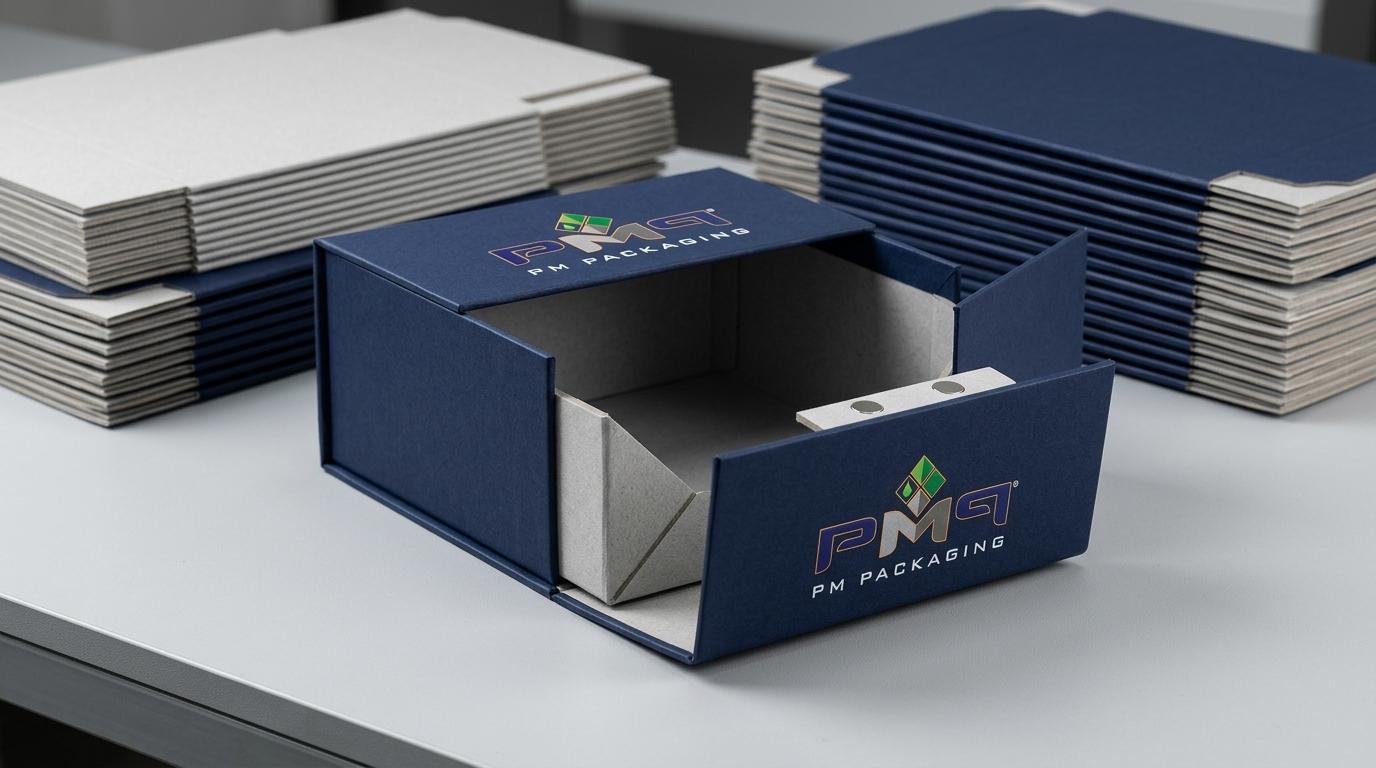
4. Channel-Specific Applications & Transition Triggers
Determining whether your brand should transition to collapsible magnetic packaging depends on retail sales channels, fulfillment operations, and product weight:
High-Velocity DTC & E-Commerce
Scaling past 25,000 orders/yr creates severe pack-bench congestion. Flat blanks store directly under packing tables; operators assemble boxes in 4–6 seconds without leaving their stations.
Mass Retail Holiday & Gift Kits
Holiday builds for Sephora, Ulta, Target, and department stores require staging hundreds of thousands of units. Flat-pack storage eliminates off-site warehouse leasing surcharges.
Payload Weight & Structural Limits
Lightweight-to-medium payloads (0.5 to 6.0 lbs) perform flawlessly. Ultra-heavy payloads (>8.0 lbs, e.g. heavy spirits bottles) benefit from reinforced wood-core or Litho-Laminated SFL microflute.
5. The 5-Phase Operational Transition Playbook for Procurement & Supply Chain
Transitioning an enterprise brand from legacy rigid set-up boxes to collapsible magnetic packaging requires a structured, cross-functional execution plan to avoid supply chain disruptions, obsolete inventory write-offs, or fulfillment delays:
Phase 1: Portfolio & Cube Audit (Weeks 1 – 2)
Audit existing rigid box SKUs, internal dimensions, payload weights, and annual unit volumes. Quantify current inbound freight expenditures and 3PL monthly pallet racking fees. Model prospective TCO savings across volume tiers to identify highest-ROI SKUs.
Phase 2: Structural Dieline & Magnetics Engineering (Weeks 3 – 5)
Translate 3D rigid CAD dielines into 2D flat-pack collapsible V-groove layouts. Calibrate greyboard caliper (60pt–110pt), magnet size/grade (N42 NdFeB), polarity alignment, and high-shear corner adhesive tape geometry. Produce CNC plot-cut white samples for fit checks and custom insert integration.
Phase 3: Transit Testing & ISTA 3A Laboratory Qualification (Weeks 6 – 8)
Subject fully assembled and packed samples to certified ISTA 3A / ASTM D4169 test sequences: 10-point drop testing, random vibration transit simulation, and environmental chamber cycling (-18°C to +55°C at 90% RH) to validate magnetic closure retention and adhesive shear stability.
Phase 4: Co-Packer & Fulfillment Ergonomics Line Training (Weeks 9 – 10)
Deliver Standard Operating Procedure (SOP) visual cards, video training, and simple corner-squaring assembly jigs to contract packagers and 3PL fulfillment centers. Benchmark manual assembly cycle times to ensure <6.0 second pack-out speeds per operator.
Phase 5: Inventory Depletion & Nearshore Rollout (Weeks 11 – 14)
Phase out legacy rigid box inventory to target safety buffers while ramping nearshore manufacturing. Establish Just-In-Time (JIT) replenishment cycles with 1–3 day direct ground freight from Baja California to West Coast distribution hubs.
6. How PM Packaging De-Risks Enterprise Collapsible Packaging Programs
Executing a flawless transition to collapsible magnetic packaging requires a manufacturing partner with deep structural engineering expertise, advanced converting technology, and resilient nearshore supply chain infrastructure.
10–14 Week Lead Times & Freight Risk
- Paying ocean container rates for 90% empty air if shipping assembled boxes
- 30–45 days maritime humidity exposure risks board warping and adhesive degradation
- Inability to respond to sudden retail demand spikes or holiday restocks
- Vulnerability to port demurrage, customs bottlenecks, and Section 301 tariffs
Agile Nearshore Production & JIT Ground Transit
- Dual-hub footprint: San Diego engineering HQ paired with Baja California converting plants
- 100% USMCA / T-MEC tariff-free North American Rules of Origin compliance
- C-TPAT & OEA certified for rapid green-lane border crossing
- 1–3 day direct ground freight to California/Southwest DCs (3–5 days nationwide)
Executive Transition Decision Checklist
If you checked YES to these criteria, transitioning to Collapsible Magnetic Packaging is an immediate, high-ROI commercial and operational imperative for your organization.