
In commercial retail distribution, packaging systems undergo a fundamental operational transformation when brands transition from standard retail shelving to high-velocity palletized merchandising.
Scaling commercial automotive packaging requires targeted engineering: Automotive replacement parts require rigorous corrosion protection, high structural crush resistance for dense cast iron components, and strict barcode readability for automated distribution centers. PM Packaging partners with high-volume brands to ensure G7 color consistency, structural durability, and predictable replenishment.
Rather than treating automotive packaging as generic paperboard, engineering teams must account for product geometry, hanging shelf wear, moisture barriers, and high-speed automated cartoning line tolerances.
The Evolution From Industrial Shippers to Self-Merchandising Pallets
Direct-Print Flexo Corrugated (RSC Boxes)
- Designed solely for DC transit protection; drab brown/white aesthetics
- Severe flute washboarding, low line-screen print (65–85 LPI), ink scuffing
- Requires retail associates to manually unbox and hand-stack units
- High risk of carton slicing damage and retail OTIF chargebacks
Litho-Laminated Single Face Laminate (SFL)
- Master shipper IS the retail sales vehicle (full, half, and quarter trays)
- G7 Master photorealistic offset litho (175–200+ LPI) on smooth top liners
- Engineered BCT & ECT ratings supporting 3,000+ lb warehouse stacks
- Zero-knife “one-touch” retail stocking, 360° shoppability, and 20%–45% lift
PM Packaging manufactures engineered automotive parts packaging, line-side kits, and retail aftermarket cartons with certified Delta-E color consistency and high-speed box converting. High-speed gang printing and shared dielines reduce per-unit tooling costs while clear technical graphics guide buyers directly to the correct model.
When brand owners deploy standard direct-print corrugated boxes on retail club pallets, they face severe commercial penalties: visible flute washboarding, muddy graphics that destroy brand equity, structural carton sagging under humidity, crushed pallet corners, and On-Time In-Full (OTIF) compliance chargebacks from major retailers.
1. Substrate Physics: Direct-Print Corrugated Deficit vs. Litho-Laminated SFL
To understand why enterprise brands must upgrade to Litho-Laminated SFL for palletized retail, procurement and packaging teams must examine the micro-level mechanical and visual differences between direct flexographic printing on combined board and sheetfed offset litho-lamination.
Impression on Combined Board
│ │ │
═════▼═════▼═════▼═════ Outside Liner
/\ /\ /\ /\ /\ Fluted Medium
─────────────────────── Inside Liner
- Caliper crushing at flute peaks degrades ECT by 10%–25%
- Severe flute washboarding & zebra-striping effect
- High dot gain (30%–45%) plugs fine details & typography
Pre-Printed Sheet Laminated to Flute Tips
│ (10pt-16pt Smooth Coated Liner)
═══════════════════════ Coated Top Sheet
/\ /\ /\ /\ /\ Uncrushed Flutes
─────────────────────── Single-Face Liner
- Zero flute impression crush; 100% ECT retention
- Completely flat, unbroken plane with zero washboarding
- Razor-sharp G7 Master photographic fidelity & embellishments
The Physics of the Direct-Print Flexo Deficit
In conventional corrugated box manufacturing, the board is combined into a three-ply sandwich (outside liner, fluted medium, inside liner) using starch adhesive on a corrugator. The combined board is then fed through a flexographic printer-slotter or rotary die-cutter:
- Flute Washboarding & Caliper Compression: When the flexible photopolymer printing plate presses ink onto the combined board, the underlying flutes act as rigid structural ribs, while the open spans between flute tips deflect downward. This creates the “washboarding” or “zebra-stripe” effect—uneven ink laydown with dark bands over flute tips and light, mottled bands over flute valleys. To force ink into the valleys, press operators increase impression pressure, which permanently crushes the structural flute arches and degrades the box’s Edge Crush Test (ECT) and stacking strength by 10% to 25%.
- Resolution & Dot Gain Limitations: Direct flexo on corrugated liners is typically constrained to coarse screen rulings of 65 to 100 Lines Per Inch (LPI). Because corrugated linerboards are porous and absorbent, dot gain can reach 30% to 45%, causing highlight dots to bridge, midtones to darken, and shadow areas to plug into muddy solids. Fine serif typography, intricate vector branding, and photorealistic human skin tones or food imagery cannot be reproduced accurately.
- Ink & Coating Limitations: Direct flexo utilizes water-based inks that dry through absorption into the paper fibers. The resulting finish is matte, flat, and vulnerable to moisture, smudging, and surface burnishing during transit vibration. High-gloss UV, soft-touch coatings, or metallic foil stamping cannot be applied inline on standard direct-print corrugated converting equipment.
The Physics of Litho-Laminated Single Face Laminate (SFL)
Single Face Laminate (SFL) bypasses the physics of combined board printing by decoupling the printing process from the corrugating process:
- Flat-Sheet Offset Lithography: The exterior top liner—typically a 10pt to 16pt Solid Bleached Sulfate (SBS), Coated Recycled Board (CRB), or Clay Coated Newsback (CCNB) sheet—is printed flat on a high-precision, large-format 6-to-8 color sheetfed offset lithographic press running at 175 to 200+ LPI (or advanced stochastic screening).
- Single-Facer Lamination: The single-face component (consisting of the interior kraft liner glued to the fluted corrugate medium—E-flute, F-flute, B-flute, or N-flute) is manufactured with its upper flute tips exposed. The printed top liner is precisely laminated to the exposed flute tips using cold PVA or moisture-resistant adhesive in a high-speed laminator.
- Pristine Structural Integrity: Because the high-graphic top liner is printed while completely flat before joining the fluted medium, the flutes experience zero printing impression crush. The outer surface is an unbroken, glass-smooth plane with zero washboarding. The full geometric height and compression resistance of the corrugate arch are preserved, delivering maximum Edge Crush Test (ECT) rigidity and Box Compression Test (BCT) performance.
| Engineering Criteria | Direct-Print Flexo Corrugated | Direct-Print High-Graphic Flexo | Preprint Linerboard (Web Flexo) | Litho-Laminated SFL |
|---|---|---|---|---|
| Print Technology | Rotary Flexographic (Water-based) | Central Impression (CI) Flexo | High-Speed Web Flexo (Roll) | Large-Format Sheetfed Offset Litho |
| Halftone Screen Ruling | 65 – 85 LPI | 100 – 133 LPI | 120 – 150 LPI | 175 – 200+ LPI (G7 Master) |
| Flute Washboarding | Severe zebra striping | Moderate to High | Low to None | Completely Invisible |
| Dot Gain & Registration | 30%–45% dot gain, loose | Moderate dot gain, tighter | Controlled, web stretch risk | <12% dot gain, micro-registration |
| Top Face Substrates | 26#–42# Kraft / Bleached | 33#–42# Coated White Top | 33#–48# Coated Bleached | 10pt–16pt SBS, CRB, CCNB, Kraft |
| Flute Profiles Available | B-Flute (1/8"), C-Flute | B-Flute, C-Flute, E-Flute | B-Flute, C-Flute, E-Flute | F-Flute (1/32"), E-Flute, B-Flute |
| Embellishment Options | None (Basic aqueous) | Basic flood aqueous/varnish | Flood aqueous/varnish | Cold Foil, Spot UV, Soft-Touch |
| Minimum Order Quantity | 1,000 – 3,000 units | 10,000 – 25,000 units | 50,000 – 100,000+ units | 2,500 – 50,000+ units |
| Structural ECT Retention | 75% – 85% (Plate crush) | 80% – 90% (Impression crush) | 95% – 100% | 100% (Zero impression crush) |
2. Core Commercial & Retail Catalysts Driving the SFL Pallet Transition
Transitioning an enterprise brand’s secondary packaging from standard corrugated shippers to Litho-Laminated SFL shelf pallets is not merely an aesthetic choice. It is a commercial, operational, and structural pivot driven by four converging catalysts:
Club Store Compliance Mandates
Costco, Sam’s Club, and BJ’s enforce strict 48x40 GMA pallet footprints, zero overhang, 360° shoppability, zero-knife opening rules, and 2,500–3,500 lb static top-load compression ratings.
Brand Positioning & Conversion ROI
A pallet display occupies 13.3 sq ft of floor space and up to 48" of vertical billboard. 200 LPI G7 litho packaging drives a 20% to 45% sell-through lift compared to industrial kraft boxes.
Structural Density & Weight
When multipacks or primary units exceed 5 to 8 lbs (beverage cans, power tools, chemical jugs), solid paperboard folding cartons burst. SFL microflutes deliver 200#–350# Mullen burst strength.
Co-Packer Labor Minimization
Integrated SFL auto-lock modular trays collapse a 7-step legacy pack-out (erecting RSCs, taping, inserting pads, strapping) into a 3-step drop-in process, reducing labor by 65%–75%.
Costco & Sam’s Club Full Pallet Specification Requirements
3. Structural Pallet Dieline Architectures & Engineering
Selecting the proper structural dieline architecture for an SFL pallet program depends on product weight, primary container geometry, retailer unboxing rules, and transit stress profiles:
Architecture 1: Modular Tier Trays with Protective Transit Shroud
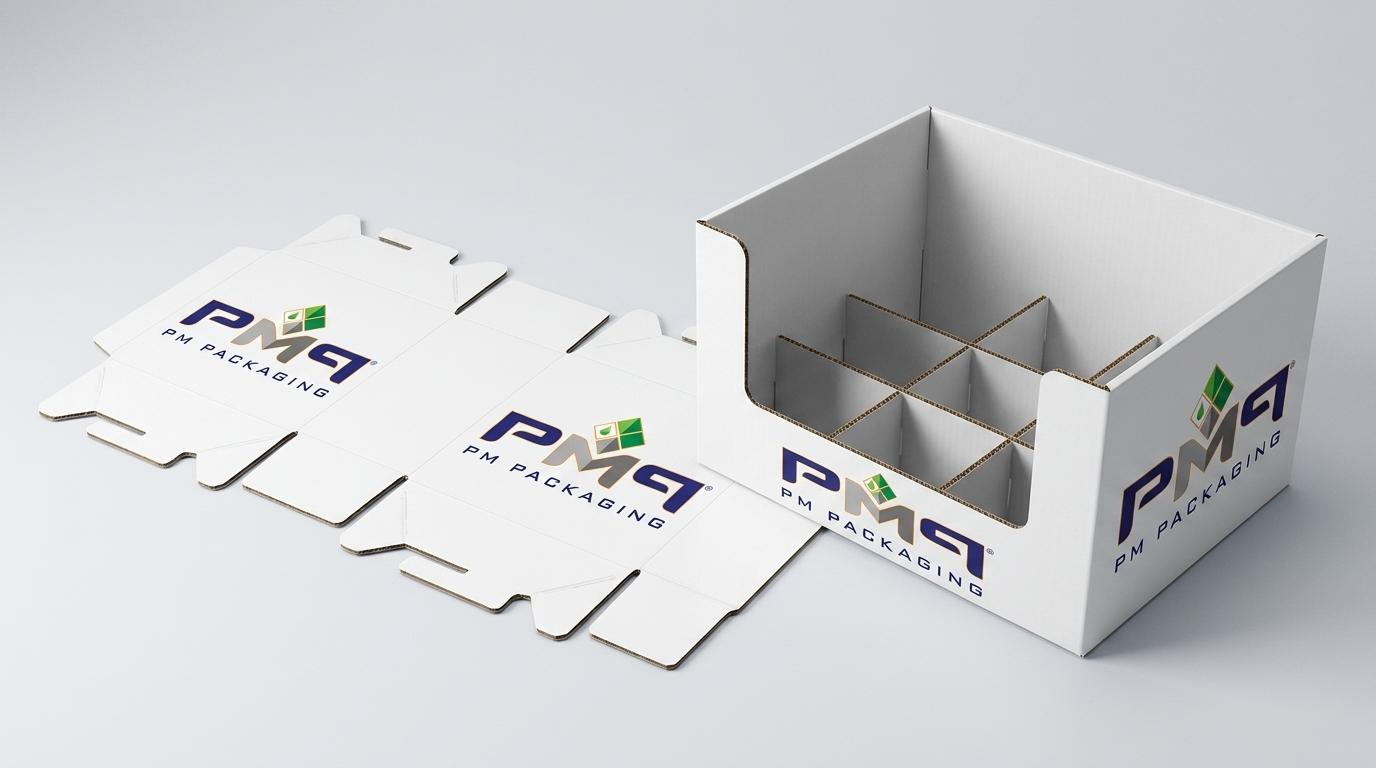
Club Store Gold StandardConstructed from 3 to 6 vertical tiers of modular SFL trays (full-pallet 48x40, half-pallet 48x20 / 24x40, or quarter-pallet 24x20). Trays feature double-wall roll-over side panels, self-locking corner posts, and top alignment tabs that lock into upper tiers. Enclosed by a heavy-duty kraft outer transit shroud and top cap.
Architecture 2: 1-Piece Convertible Shipper-to-Display Pallet Packs
Convertible ShippersManufactured from a single continuous blank of Litho-Laminated E-flute or B-flute. Precision-engineered knife-to-tie perforation lines or integrated plastic tear tapes separate the upper shipping hood from the lower display tray.
Architecture 3: High-Strength SFL Multipacks with Integrated Handles
Heavy Carrier MultipacksReplaces folding cartons for heavy multipacks sold as single consumer units. Features pre-glued crash-lock auto-bottoms holding up to 35 lbs, reinforced double-ply die-cut handles with rolled edges, and internal anti-rattle dividers.
4. Compressive Physics: ECT, BCT & The McKee Formula for Pallet Stacking
In palletized retail, structural failure is catastrophic. A crushed bottom carton causes the entire pallet column to tilt, leading to load collapse, forklift dumping, retailer chargebacks, and total inventory write-offs.
Box Compression Test (BCT) Engineering
The McKee formula estimates the ultimate top-to-bottom compressive strength of an erected rectangular SFL container:
Representative SFL Substrate Physical Properties Matrix
| Substrate & Flute Spec | Caliper (t) | Flutes / Linear Ft | Typical ECT Rating | Burst Strength |
|---|---|---|---|---|
| 12pt SBS + F-Flute (30# / 30#) | 0.045 in | 128 flutes/ft | 32 – 38 ECT | 175 – 225 psi |
| 14pt SBS + E-Flute (33# / 33#) | 0.070 in | 90 flutes/ft | 44 – 55 ECT | 250 – 300 psi |
| 16pt SBS + B-Flute (36# / 36#) | 0.135 in | 47 flutes/ft | 48 – 65 ECT | 275 – 350 psi |
| Double-Wall (EE-Flute SFL) | 0.140 in | 180 flutes/ft | 65 – 85+ ECT | 350 – 450 psi |
Real-World Environmental Safety Factors & Stacking Physics
Laboratory BCT values measured at 73°F and 50% relative humidity do not reflect real-world supply chains. Packaging engineers apply cumulative derating factors to calculate the required Design Safety Factor (SF):
5. Print Fidelity, Surface Coatings & Transit Scuff Mitigation
A club store pallet pack must not only survive compressive stacking; it must arrive on the retail floor in pristine cosmetic condition after 1,500+ miles of interstate truck transit:
G7 Master Color Consistency
PM Packaging utilizes Idealliance G7 Master calibration across all large-format presses, ensuring exact color matching (Delta E < 1.5) between 14pt SBS folding cartons and 16pt SFL master pallet trays.
Anti-Scuff Aqueous Formulations
Cross-linked anti-scuff aqueous coatings lower the surface coefficient of friction (COF), preventing harmonic transit vibration (2–20 Hz) from burnishing dark inks during cross-country freight.
Moisture & Condensation Barriers
For refrigerated beverage multipacks, wax-free water-resistant functional barrier coatings on interior liners prevent moisture migration into flute mediums, preserving 100% of ECT rigidity.
High-Impact Visual Embellishments
Inline cold foil stamping, spot gloss UV, soft-touch matte lamination, and embossed metallic accents create high-contrast shelf dominance visible from 30 feet down retail aisles.
6. Total Cost of Ownership (TCO) & Financial ROI Modeling
Procurement directors evaluating the transition from direct-print corrugated shippers to Litho-Laminated SFL pallet trays must look beyond the raw purchase price of the box. A pure unit-cost comparison is fundamentally flawed because it ignores co-packing labor, freight cube efficiency, retail chargebacks, and sell-through conversion velocity.
| Cost & Financial Component (100k Program) | Standard Direct-Print RSC | Integrated Litho-Laminated SFL |
|---|---|---|
| Primary Packaging Unit Cost | $0.45 per unit | $0.42 per unit (Integrated SFL) |
| Secondary Master Shipper Cost | $1.15 per RSC box (4-pk) | Included in SFL Tray System |
| Pallet Skirt & Corner Post Wrap | $18.50 per pallet ($0.15/unit) | $0.00 (Self-merchandising tray) |
| Co-Packer Assembly & Kitting Labor | $0.55 per unit (7 steps) | $0.22 per unit (3 steps auto) |
| Retail Club OTIF Chargeback Risk | $0.08 per unit (Crush/scuff) | $0.00 (Engineered BCT compliant) |
| Transit Damage & Returns | $0.12 per unit (1.8% rate) | $0.01 per unit (<0.1% rate) |
| TOTAL DELIVERED PACKAGING COST | $1.64 per unit | $1.18 per unit (-28.0% Net Savings) |
| Average Retail Sell-Through Rate | Baseline (68% velocity) | +28.5% Lift (87.4% velocity) |
| Gross Revenue Generated ($25 MSRP) | $1,700,000 | $2,185,000 |
| NET COMMERCIAL GAIN | Baseline Benchmark | +$485,000 Gross Margin Expansion |
7. Supply Chain Strategy: The Nearshore US-Mexico Manufacturing Advantage
For enterprise brands operating in North America, where and how SFL pallet packaging is manufactured is just as critical as its structural design. Sourcing fluted corrugate and large-format SFL packaging from overseas suppliers introduces severe freight and lead-time risks:
8–12 Week Inflexible Lead Times
- High freight-to-value ratio: Paying to ship air inside empty corrugate flutes
- 30–45 days of humid maritime shipping degrades starch bonds & board ECT
- Cannot respond to sudden club store replenishment surges, leading to empty shelves
- Vulnerability to Section 301 tariffs and port demurrage bottlenecks
Agile 2–3 Week Production & JIT Ground Transit
- San Diego engineering hub paired with advanced Baja California converting plants
- 100% USMCA / T-MEC tariff-free trade compliance (IMMEX certified)
- C-TPAT & OEA green-lane fast-track border crossing for expedited ground transit
- 1–3 day ground freight to California/Southwest DCs (3–5 days nationwide)
8. Enterprise SFL Implementation Roadmap & PM Packaging Partnership
Transitioning a product line from standard shippers to Litho-Laminated SFL shelf pallets requires a disciplined, multi-phase engineering protocol:
Summary & Next Steps: Partnering With PM Packaging
Transitioning from utilitarian corrugated shippers to Litho-Laminated SFL retail shelf pallets is one of the most powerful levers an enterprise brand can pull to expand market share, secure premium club store placement, and eliminate retail chargebacks.
To evaluate your current packaging portfolio, calculate pallet compressive load requirements using the McKee formula, or request custom CAD dieline prototypes, contact the PM Packaging engineering team at pmpackaging.com.