
Transitioning an enterprise consumer brand from regional retail distribution to a national warehouse club store program represents one of the most profitable—and operationally unforgiving—inflection points in a company’s growth lifecycle.
Scaling commercial automotive packaging requires targeted engineering: Automotive replacement parts require rigorous corrosion protection, high structural crush resistance for dense cast iron components, and strict barcode readability for automated distribution centers. PM Packaging partners with high-volume brands to ensure G7 color consistency, structural durability, and predictable replenishment.
The Channel Shift: Regional Grocery vs. National Club Stores
Traditional Grocery & Specialty Retail
- Primary Packaging: Single-unit folding cartons (16pt–20pt SBS/CCNB) on 12"–18" deep shelves
- Secondary Packaging: Brown kraft Regular Slotted Cartons (RSC) unboxed in backroom
- Merchandising: Clerks hand-stock individual cartons onto gondolas; shelf-talkers drive AOV
- Compressive Load: Low top-load requirements (400–800 lbs BCT); short regional transit
Costco, Sam’s Club & BJ’s Wholesale
- Primary Packaging: High-count multipacks, bundles, or heavy-gauge litho-laminated cartons
- Secondary Packaging: Master pallet display trays (PDQs) ARE the sales floor merchandising
- Merchandising: 48" x 40" full pallets dropped directly on concrete; 360° shoppability
- Compressive Load: Extreme multi-tier stacking (2,500–3,500+ lbs BCT); zero-overhang mandate
Rather than treating automotive packaging as generic paperboard, engineering teams must account for product geometry, hanging shelf wear, moisture barriers, and high-speed automated cartoning line tolerances.
PM Packaging manufactures engineered automotive parts packaging, line-side kits, and retail aftermarket cartons with certified Delta-E color consistency and high-speed box converting. High-speed gang printing and shared dielines reduce per-unit tooling costs while clear technical graphics guide buyers directly to the correct model.
When brands attempt to scale regional packaging into national club programs without re-engineering their substrate physics, dielines, and supply chain logistics, the commercial consequences are severe:
Structural Pallet Collapse
16pt–24pt paperboard cartons buckle under dynamic transit vibration and 85%–90% relative humidity, resulting in leaning pallets, crushed product, and DC safety lockouts.
Punitive Retail Chargebacks
Non-compliance with strict 48" x 40" footprint tolerances, pallet overhang rules, or barcode scannability triggers On-Time In-Full (OTIF) penalties, mandatory rework fees ($15–$35 per pallet), or outright load rejection at the DC gate.
Severe In-Store Aesthetic Degradation
Direct-print flexographic corrugated displays suffer from flute washboarding, scuffed inks, and torn perfs, projecting a low-tier commodity image that depresses sell-through velocity.
Contract Packager Bottlenecks
Complex multi-piece manual display trays cripple co-packer line speeds, driving labor costs through the roof and causing missed delivery windows during critical promotional rotations.
1. Structural Physics & Substrate Transformation: From Folding Cartons to Litho-Laminated SFL
The fundamental physical difference between regional distribution and club store merchandising lies in the mechanical demands placed on the primary container and secondary tier trays.
16pt–24pt SBS / CCNB Folding Carton
│ Solid Bleached Paperboard Core │
│ (High print fidelity, low vertical │
│ compression resistance) │
└────────────────────────────────────────┘
- Compressive Strength: 50–120 lbs BCT
- Vulnerable to side-wall bulging in multipacks
- Loses 50%–70% stiffness in high humidity
12pt–14pt Litho Liner + Microflute Corrugate
/\ /\ /\ /\ /\ /\ /\ Fluted Medium (E/F)
──────────────────────────────── Kraft Linerboard
- Compressive Strength: 450–1,200+ lbs BCT per tray
- Extreme vertical beam strength; zero flute washboarding
- 200+ LPI G7 Master photorealistic lithography
The Substrate Failure Point in Regional Packaging
Regional primary packaging is optimized for visual appeal on protected, planar retail shelves. Typical specifications utilize 16pt to 24pt Solid Bleached Sulfate (SBS), Clay Coated Newsback (CCNB), or Folding Boxboard (FBB). While these substrates offer pristine print surfaces and clean crease lines for automated cartoning lines, their structural contribution to vertical compression is minimal.
When individual consumer units are consolidated into club store multipacks (e.g., 2-packs, 4-packs, or 12-count bundles weighing 4 to 15 lbs), traditional folding cartons suffer from:
- Side-Panel Bulging & Hydrostatic Pressure: Granular, liquid, or pouch-based primary goods push outward against paperboard sidewalls, creating package distortion that breaks pallet interlocking geometries.
- Creep & Hygroscopic Softening: Virgin and recycled paperboard fibers absorb atmospheric moisture in unconditioned cross-dock facilities (70%–90% RH), causing paperboard to lose up to 50%–70% of its initial bending stiffness within 72 hours.
- Corner-Post Buckling: Without fluted corrugation, primary paperboard cartons cannot bear the static load of 4 to 6 tiers of heavy club product stacked above them.
Upgrading to Litho-Laminated Single Face Laminate (SFL)
To achieve the vertical load-bearing capacity mandated by club retailers while maintaining G7 photorealistic retail branding, enterprise brands transition their secondary trays and large primary multipacks to Litho-Laminated Single Face Laminate (SFL) microflutes.
| Flute Profile | Caliper Thickness | Flutes / Linear Foot | Primary Club Packaging Applications |
|---|---|---|---|
| F-Flute | ~ 1/32" (0.8 mm) | 120–130 FPF | High-end cosmetics, OTC multipacks, electronics bundles, premium retail cartons |
| E-Flute | ~ 1/16" (1.6 mm) | 90–100 FPF | Universal club standard: PDQ trays, tier display trays, 6–12 lb multipacks |
| B-Flute | ~ 1/8" (3.2 mm) | 45–50 FPF | Heavy club multipacks (>15 lbs), master tier base trays, power tools & hardware |
Single Face Laminate (SFL) decouples the printing and corrugating processes:
- Top Sheet Lithography: A 10pt to 16pt SBS, CRB, or virgin kraft top liner is printed flat on high-speed 6-to-8 color sheetfed offset litho presses at 175 to 200+ Lines Per Inch (LPI).
- Inline Single-Face Lamination: The printed top sheet is laminated directly to an exposed single-face corrugated web (kraft inner liner + fluted medium).
- Flute Integrity & Zero Washboarding: Because the printed sheet is laminated after the flutes are formed, there is zero printing plate impression crush. The flutes retain 100% of their structural geometric height, delivering superior Edge Crush Test (ECT) performance with an unbroken, glass-smooth exterior finish.
2. Compressive Load Engineering: The McKee Formula & Multi-Tier Stacking Physics
Club store logistics operate on extreme density. Distribution centers require pallets to be stacked two-to-three high in static storage and endure intense dynamic vibration during cross-country transport.
Costco & Sam’s Club Multi-Tier Pallet Stacking Model
The McKee Formula for Structural Box Compression Test (BCT)
Packaging engineers calculate the required box compression strength (BCT) of club store trays using the simplified McKee equation:
The McKee Compressive Formula
Environmental Derating & Dynamic Safety Factors
In a controlled laboratory environment (ASTM D642), a pallet tray might withstand 1,500 lbs of direct vertical force. However, in commercial supply chains, packaging engineers must apply environmental and logistical derating multipliers to determine the Required Laboratory BCT:
| Operational Variable | Typical Operating Condition | Strength Retention Multiplier |
|---|---|---|
| Relative Humidity (RH) | 85%–90% RH (Summer Cross-Dock DC) | 0.45 – 0.55 (50% strength loss) |
| Long-Term Storage Dwell | 30 to 90 Days Warehouse Storage | 0.55 – 0.65 (40% loss) |
| Stacking Pattern Misalignment | Interlocked / Column Overhang (1") | 0.60 – 0.75 (30% loss) |
| Pallet Deck Gaps | GMA Wooden Pallet Slats (>2" gaps) | 0.85 – 0.90 (15% loss) |
| Dynamic Transit Vibration | Intermodal Rail / Air-Ride Truckload | 0.70 – 0.80 (25% loss) |
| Compound Safety Factor (SF) Mandated | 4.0x (Rigid) to 5.5x (Non-rigid/pouches) | |
Engineering Comparison: Regional Shipper vs. National Club Store Tray
| Engineering Metric | Regional Grocery Master Shipper (RSC) | National Club Store Tier Display Tray (SFL) |
|---|---|---|
| Primary Structural Substrate | 32 ECT Single Wall C-Flute Kraft | 44 to 55+ ECT Litho-Laminated E/B Flute SFL |
| Print Caliper & Linerboard | 26#–33# Mottled White Kraft Liner | 12pt–16pt G7 Coated SBS Top Sheet |
| Target Perimeter Compression (BCT) | 600 – 900 lbs | 2,500 – 4,200+ lbs (Total Layer Array) |
| Pallet Stacking Hierarchy | 1-High Rack Stacking (No Top Load) | 3-High Static Warehouse Bulk Stacking |
| Safety Factor Standard | 2.5x – 3.0x | 4.5x – 5.5x (Rigorous Club Compliance) |
| Retail Stocking Access | 100% Manual Unboxing / Knife Cut | Zero-Knife Quick-Release / Shrouded Tray |
| Moisture Resistance Chemistry | None (Standard Starch Adhesive) | Water-Resistant Adhesives & Barrier Coatings |
3. Merchandising Geometry & Dieline Architecture for the 48" x 40" GMA Footprint
Regional packaging design focuses on single-lane shelf facings (e.g., 3.5" wide carton front). National club store packaging design is an exercise in cube utilization and pallet footprint geometry.
40" x 24" Half-Pallet Trays
│ TRAY A (40"x24") │ TRAY B (40"x24") │
│ • Front Lip: 2.5" │ • Front Lip: 2.5" │
│ • High-Back: 10.0" │ • High-Back: 10.0" │
│ • 180° Shoppable Face │ • 180° Shoppable Face │
└─────────────────────────┴─────────────────────────┘
- Zero Pallet Overhang (0.0" tolerance)
- Pallet Footprint Utilization: 100.0%
- Optimal for large multipack bottles & jugs
24" x 20" Quarter-Pallet Trays
│ TRAY 1 (24"x20") │ TRAY 2 (24"x20") │
├─────────────────────────┼─────────────────────────┤
│ TRAY 3 (24"x20") │ TRAY 4 (24"x20") │
└─────────────────────────┴─────────────────────────┘
- 4-Way 360° Pallet Shoppability
- Pallet Footprint Utilization: 100.0%
- Ideal for center-aisle quad-orientation
The Strict Zero-Overhang Mandate
Costco, Sam’s Club, and BJ’s enforce an absolute zero-overhang rule (0.0 inches) across all four edges of a 48" x 40" GMA wood or plastic pallet:
- Load Path Dynamics: If a packaging tray hangs over the wood pallet edge by even 0.25 inches, the edge of the lower tray absorbs 100% of dynamic transit shock instead of the wood pallet stringer. This causes instant corner blowout, tier shifting, and pallet tipping.
- Automated Receiving Scanners: Retail DCs utilize automated laser scanning dimensioners at inbound receiving. Overhanging pallets are automatically rejected or assessed penalty fees.
- Engineering Best Practice: Design master tray footprints with a 0.25" to 0.375" total underhang margin (e.g., 47.5" x 39.5" total layer footprint) to account for board bulge, corner radius flare, and stretch-wrap tensioning.
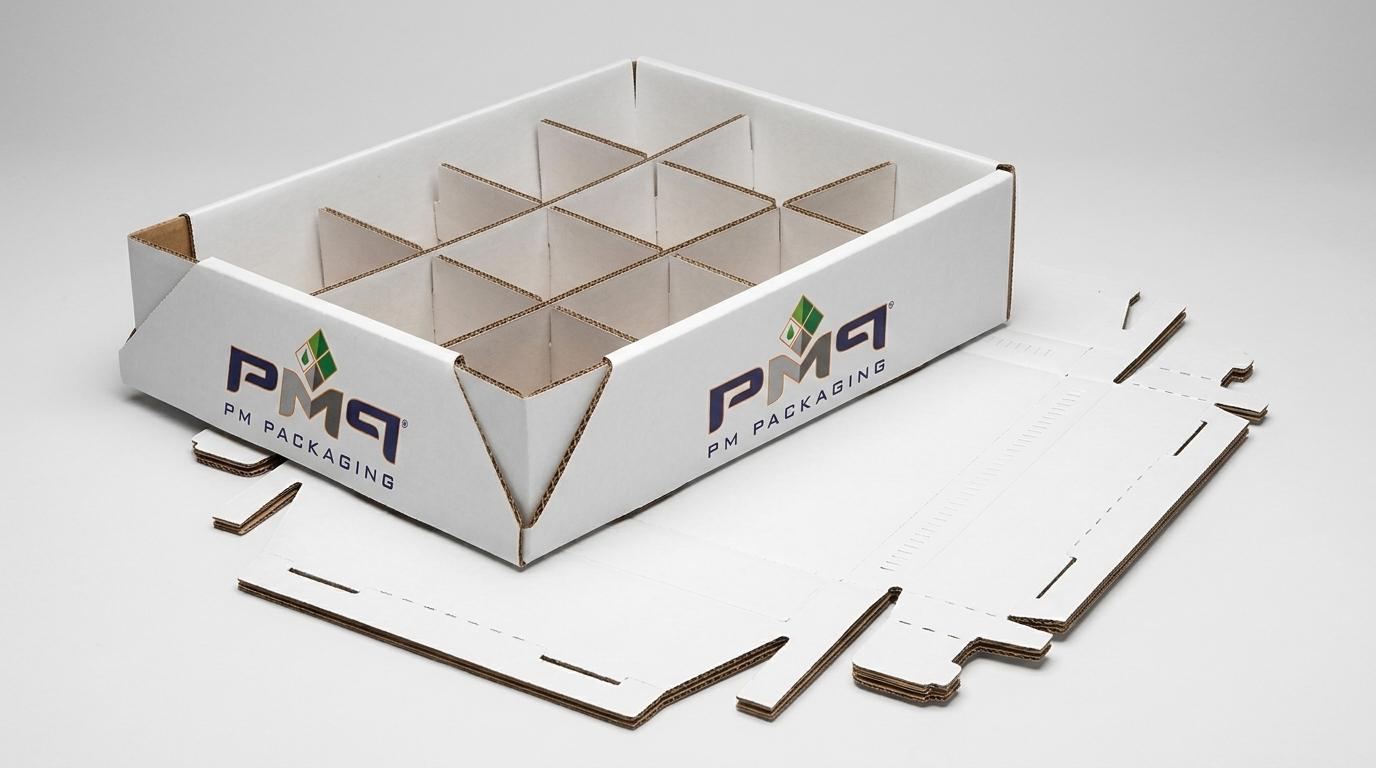
Core Dieline Structures for Club Store Merchandising
| Dieline Style | Mechanical Characteristics | Best Channel Application |
|---|---|---|
| Roll-Over Side Wall (Walker) Display Tray | Double-wall sides and back; fold-over locking tabs. Extreme vertical ECT. | Heavy bottles, canned goods, sauces, high-AOV hardware |
| Auto-Bottom Crash Lock Club PDQ Tray | Pre-glued base folds flat, erects in under 3 seconds. Front drop-down lip. | Fast manual co-packing; OTC health, cosmetics, bars |
| Two-Piece Convertible Shipper (Tray + Transit Hood) | Lower display tray with perforated tear-away hood. Zero knives needed. | High-velocity dry grocery; confection, household goods |
| Full-Tier Club Display Slip Tray with Corner Posts | 48" x 40" single-sheet perimeter tray with reinforced laminated posts. | Bulk snack multipacks, pet food bags, beverage packs |
4. In-Store Merchandising Physics: The 15-Foot Rule & Visual Competition
In a regional grocery or specialty environment, the consumer stands 24 to 36 inches from the shelf in an 8-foot-wide aisle illuminated by directed shelf lighting. Shoppers read small 8pt feature copy, ingredient callouts, and regulatory claims.
In a 150,000-square-foot warehouse club, the shopping psychology and visual physics change entirely:
The 15-Foot / 3-Second Rule
Club members push oversized 55-gallon shopping carts down 12-to-15-foot-wide concrete center aisles (“Action Alley”) at walking speeds of 3 to 4 mph under harsh 4000K–5000K industrial metal-halide or high-bay LED lighting. Packaging must communicate four essential data points in under 3 seconds:
Premium Coatings & Transit Vibration Scuff Mitigation
During a 2,000-mile transit across regional distribution networks, corrugated surfaces experience continuous microscopic rubbing caused by diesel engine vibration and highway harmonic oscillations. Standard direct-print inks rub off onto adjacent primary cartons, creating “black tracking” and ink burnishing that renders retail units unsaleable.
To eliminate transit scuffing while elevating retail aesthetics, enterprise club packaging utilizes specialized inline surface chemistry:
- Anti-Scuff Matte Aqueous Coating: Provides a soft, glare-free aesthetic under harsh overhead warehouse lighting while creating a hard, cross-linked protective barrier that resists vibration burnishing (tested via Sutherland Rub Tester, 450+ strokes with 4 lb weight).
- Strike-Through Gloss / Matte Contrast: Employs an inline coating tower to apply high-gloss UV over hero graphics while surrounding panels receive a matte varnish, making the package pop off the pallet face.
- Inline Cold Foil Stamping: Applies brilliant metallic micro-accents to club store cartons without the costly tooling, offline stamping bottlenecks, or recycling penalties of traditional hot-stamped foils.
5. Pack-Out Velocity & Co-Packer Line Economics
A frequent point of failure when scaling from regional distribution to national club programs occurs at the contract packager (co-packer) or internal packing facility.
In regional distribution, a brand producing 15,000 units per month can absorb manual tray folding and hand packing. When a national club purchase order drops for 250,000 to 1,000,000 units, manual packaging line speeds become an catastrophic bottleneck.
| Dieline Architecture | Assembly Mechanism | Setup Time / Tray | Hourly Line Rate |
|---|---|---|---|
| Manual Fold-and-Tuck Tray | Hand-folded 4-corner tray | 18–25 seconds | 140–200 trays/hr |
| Pre-Glued Auto-Bottom Tray | Pop-open crash lock | 3–5 seconds | 700–900 trays/hr |
| Automated Tray-Former Blank | Machine-erected (Wexxar/SWF) | 0.8–1.2 seconds | 2,400–3,600 trays/hr |
Co-Packer Labor Cost Per 100,000 Display Trays ($32/hr Burdened Labor Rate)
6. Total Cost of Ownership (TCO) & Financial Risk Modeling
Procurement teams evaluating the transition to national club programs often fall into the “Unit Cost Trap.” They compare the raw material cost of a basic direct-print flexo corrugated box against a precision-engineered Litho-Laminated SFL display tray and hesitate at the initial $0.35 to $0.65 unit premium for SFL.
This short-sighted analysis ignores the catastrophic downstream financial liabilities of retail chargebacks, damaged goods deductions, and lost rotation slots.
| Violation / Defect Category | Commercial Penalty / Chargeback Impact |
|---|---|
| Pallet Overhang (>0.0" out of spec) | $25.00 – $50.00 per pallet rework fee OR load reject |
| Crushed / Leaning Pallet Tiers | 100% load rejection + inbound/return freight costs |
| Non-Compliant Barcode (GS1-128 Grade C) | $5.00 – $15.00 per master carton penalty |
| Carton Slicing Damage (Box cutter used) | Full credit deduction for all damaged primary units |
| Missed Delivery Slot (OTIF failure) | 3.0% of total invoice value deducted (Costco / Walmart) |
| Failed Club Rotation (Poor Sell-Through) | Cancellation of program; loss of multi-million $ rotation slot |
Comprehensive Total Cost of Ownership (TCO) Model
Baseline: National Club Store Rollout of 500,000 Units (50,000 10-Pack Master Display Trays / 1,000 Pallets).
| Cost / Operational Factor | Direct-Print Flexo System | Litho-Laminated SFL Program |
|---|---|---|
| Secondary Packaging Unit Cost ($/tray) | $1.10 ($55,000 total) | $1.65 ($82,500 total) |
| Inbound Co-Packer Freight | $6,500 (Bulkier C-flute) | $4,200 (Dense E-flute flat) |
| Co-Packer Assembly & Pack-Out Labor | $18,285 (Manual fold-tuck) | $3,555 (Pre-glued auto) |
| Transit Damage & Crushed Tiers (1.8%) | $45,000 (Product write-off) | $0.00 (Zero structural fail) |
| Club Chargebacks & Pallet Rework Fees | $12,500 (Overhang/labels) | $0.00 (100% spec compliant) |
| In-Store Sell-Through Velocity Lift | Baseline ($2,500,000 rev) | +18% Lift (+$450,000 rev) |
| TOTAL DELIVERED PACKAGING COST | $137,285 | $90,255 (34.2% Savings) |
| NET COMMERCIAL IMPACT | Baseline | +$497,030 NET VALUE DELIVERED |
7. Supply Chain Architecture & Nearshore Scaling: The PM Packaging Advantage
A national club store rotation introduces severe supply chain volatility. When a product achieves high sell-through during an initial 4-week club trial, Costco or Sam’s Club buyers issue immediate “Run-It-Again” re-orders with 2-to-3 week lead time expectations.
Brands relying on transpacific Asian packaging suppliers face total operational failure in this scenario:
- Transpacific Ocean Transit Bottlenecks: 8 to 12 weeks of ocean freight, container port congestion, customs clearance holds, and transpacific demurrage fees prevent rapid re-orders.
- Extreme Working Capital Lockup: Sourcing packaging from overseas requires purchasing 3 to 6 months of excess buffer inventory, tying up millions in cash and risking catastrophic packaging obsolescence if the retailer requests dieline or graphic modifications between rotations.
Supply Chain Velocity: Transpacific vs. PM Packaging Nearshore
The PM Packaging Nearshore Advantage
For over 45 years, PM Packaging has served as the premier commercial packaging partner for high-growth consumer brands and Fortune 500 enterprises navigating mass retail and warehouse club expansions.
8. Strategic Club Store Transition Checklist for Brand Executives
Before approving packaging production for a national warehouse club rollout, procurement and engineering leaders should execute this 10-point commercial audit:
Conclusion: Engineering National Club Store Success
Transitioning from regional distribution to a national club store program is a transformative milestone that validates a brand’s market appeal and unlocks unprecedented enterprise value. However, the physical and operational realities of warehouse club retail demand an equally sophisticated packaging architecture.
By moving away from fragile paperboard cartons and drab direct-print corrugated boxes—and embracing Litho-Laminated Single Face Laminate (SFL), pre-glued high-velocity dielines, and agile nearshore manufacturing—brand owners protect their margins, eliminate chargebacks, and dominate the club store sales floor.
To evaluate your current packaging portfolio, calculate pallet compressive load requirements using the McKee formula, or request custom CAD dieline prototypes, contact the PM Packaging technical engineering team.