
For Vice Presidents of Supply Chain, Directors of Procurement, and Senior Packaging Engineers managing mobile device accessories, charging cables, power delivery (USB-PD) hardware, and high-velocity consumer electronics, packaging selection represents a high-stakes balance between retail loss prevention, automated pack-out throughput, multi-SKU inventory agility, and sustainable material compliance.
Scaling commercial medical packaging requires targeted engineering: Medical device packaging requires strict contamination controls, uncompromised tamper evidence, and absolute regulatory print legibility across multi-lingual distribution channels. PM Packaging partners with high-volume brands to ensure G7 color consistency, structural durability, and predictable replenishment.
+-----------------------------------------------------------------------------------------------------------------------+
|                       THE MOBILE DEVICE ACCESSORY PACKAGING EVOLUTION & SPECTRUM                                      |
+-----------------------------------------------------------------------------------------------------------------------+
|  LEGACY CLAMSHELL (100% Plastic):                                                                                     |
|  [ Heavy PVC/PET Clamshell ] ──> High Plastic Mass ──> RF Sonic Welding ──> Severe "Wrap Rage" ──> Retail Penalties   |
|                                                                                                                       |
|  FACE-SEAL BLISTER (Hybrid Card):                                                                                     |
|  [ Single SBS Card (18-24pt) ] + [ RPET Blister Flange ] ──> Fast Rotary Heat Seal ──> Low Unit Cost ──> Moderate Shrink|
|                                                                                                                       |
|  TRAP BLISTER PROGRAM (Sandwich / Fold-Over):                                                                         |
|  [ Two SBS Plies (16-20pt) ] + [ Trapped Blister Flange ] ──> Concealed Flange ──> Integrated EAS ──> 360° Graphics    |
|                                └──> 75-90% Plastic Reduction ──> High Tear Resistance ──> 100% Recyclable Board       |
+-----------------------------------------------------------------------------------------------------------------------+
Historically, consumer electronics brands relied heavily on clamshell packaging—thick, thermoformed PVC or APET shells radio-frequency (RF) welded along the perimeter. While tamper-resistant, full clamshells suffer from severe consumer “wrap rage,” elevated resin costs, escalating Extended Producer Responsibility (EPR) eco-tax penalties, and outright retailer bans across sustainability-focused chains.
Modern enterprise brands are standardizing on carded blister packaging programs, strategically deploying Face-Seal Blister Cards for cost-sensitive, high-velocity entry items and Trap Blister (Sandwich / Fold-Over) Cards for premium, high-shrink, and heavier power electronics.
This comprehensive technical guide details the structural engineering, heat-seal coating chemistry, loss-prevention mechanics, high-speed pack-out dynamics, and nearshore supply chain strategies required to execute multi-SKU carded blister programs at scale.
1. Structural Comparison: Trap Blister vs. Face-Seal Card Engineering
Selecting between a face-seal blister card and a trap blister system dictates everything from structural load capacity and anti-theft security to sealing line speeds and tooling capital expenditure.
                  CROSS-SECTIONAL STRUCTURAL ARCHITECTURE

       FACE-SEAL BLISTER CARD                       TRAP BLISTER CARD (SANDWICH)

       ┌─────────────────────────┐                  ┌─────────────────────────┐ ◄── Front Card (Aperture)
       │  Paperboard Backer      │                  │  Top SBS Ply (18pt)     │
       │  (18pt - 24pt SBS)      │                  ├─────────────────────────┤
       ├─────────────────────────┤                  │  Heat-Seal Lacquer Film │
       │  Heat-Seal Coating Film │                  ├──────────┐   ┌──────────┤
       └───┬─────────────────┬───┘                  │ Flange   │   │ Flange   │ ◄── Trapped RPET Flange
           │ Blister Flange  │                      ├──────────┴───┴──────────┤
           │ (Sealed to Face)│                      │  Heat-Seal Lacquer Film │
       ┌───┴─────────────────┴───┐                  ├─────────────────────────┤
       │                         │                  │  Back SBS Ply (18pt)    │ ◄── Solid Back Card
       │   Thermoformed Cavity   │                  └─────────────────────────┘
       │   (Cables / Adapters)   │                  ┌─────────────────────────┐
       │                         │                  │                         │
       └─────────────────────────┘                  │   Thermoformed Cavity   │
                                                    │   (Protruding Front)    │
                                                    │                         │
                                                    └─────────────────────────┘
Face-Seal Blister Cards
A face-seal blister card consists of a single sheet of paperboard—typically 18pt to 24pt Solid Bleached Sulfate (SBS)—coated on the printed primary face with a heat-activated solvent or water-based heat-seal lacquer. A thermoformed plastic blister (RPET, APET, or GAG) containing the accessory is positioned against the card, and heated sealing dies apply pressure directly to the plastic flange, fusing the blister flange to the card’s coated surface.
Primary Advantages
- Lowest Unit Material Cost: Requires only a single paperboard card blank, reducing raw paperboard consumption by 40% to 50% compared to two-piece trap systems.
- Ultra-Fast Sealing Cycles: Direct heat transfer through the thin plastic flange activates the heat-seal adhesive in 1.2 to 1.8 seconds on rotary or carousel heat-sealers.
- Compact Footprint: Minimal flange width requirements (typically 1/4" to 3/8" / 6.35mm to 9.5mm) allow tighter card dimensions, maximizing pegboard SKU density on retail gondolas.
Structural Vulnerabilities
- Flange Peeling & Tamper Vulnerability: Because the thermoformed flange is exposed on the front face, a shoplifter can wedge a fingernail or blade under the edge and peel the blister away, causing fiber tear that exposes the cable or charger.
- Weight Limitations: For heavier accessories (multi-port 100W–140W GaN desktop chargers or 3-meter heavy-gauge braided cables weighing over 150g), shear forces on surface fibers can cause card face delamination during transit or drops.
- Single-Sided High-Gloss Finish: Back sides are typically raw uncoated board or lightly coated back-side print with lower aesthetic pop.
Trap Blister (Sandwich & Fold-Over) Packaging
In a trap blister program, the thermoformed blister flange is physically captured (“trapped”) between two layers of paperboard. This can be achieved via two distinct structural configurations:
- Two-Piece Sandwich Construction: A separate die-cut front card (featuring a precision window/aperture matching the blister profile) and a solid back card.
- One-Piece Fold-Over Construction: A single scored paperboard blank that folds over itself along a center or side hinge, with an aperture on one panel and a solid back on the opposing panel.
The blister is dropped through the aperture from the back of the front panel, positioning the flange flat against the reverse side of the board. The rear panel is then heat-sealed or cold-glued against the front panel, completely encasing the plastic flange within the internal paperboard sandwich.
Primary Advantages
- Extreme Loss Prevention: The plastic flange is completely inaccessible from the exterior. Tearing the blister out requires rupturing through two plies of virgin SBS board (combined caliper of 32pt to 40pt), virtually eliminating in-store theft.
- 360-Degree Premium Canvas: Both front and back present fully coated, premium-printed surfaces. Allows complex specs, regulatory markings (FCC, CE, UL, RoHS, WEEE), and compatibility charts (iPhone, Galaxy, iPad, MacBook) with crisp offset lithography.
- Integrated EAS Cavities: Anti-theft tags (AM 58 kHz or RF 8.2 MHz labels) drop inside the sandwich during sealing, completely concealing the tag so it cannot be scratched off or shielded.
- Maximum Hang-Hole Durability: The pegboard hang hole punches through both bonded plies, resisting 15-lb (6.8 kg) retail pull tests without plastic hang-tab reinforcement.
Structural Trade-Offs
- Higher Tooling & Material Investment: Requires dual-ply board consumption and precision multi-cavity aperture cutting dies.
- Thermal Transfer Through Board: Heat must penetrate through the board ply to reach internal heat-seal coating, requiring slightly longer dwell times (2.0 to 3.0 seconds) or radio-frequency (RF) / ultrasonic sealing equipment.
| Engineering Parameter | Face-Seal Blister Program | Trap Blister Program (Fold-Over / Sandwich) |
|---|---|---|
| Typical Board Caliper | 18pt – 24pt SBS | Dual 16pt – 20pt SBS (Combined 32pt–40pt) |
| Board Chemistry | C1S SBS with Face Heat-Seal Coating | C2S SBS with Internal Heat-Seal Lacquer |
| Blister Polymer Compatibility | RPET, APET, GAG (0.012" - 0.025") | RPET, APET, GAG, PLA (0.010" - 0.020") |
| Sealing Method | Thermal Direct Platen / Rotary | Thermal Platen, RF, or Heat-Seal Cold Press |
| Sealing Dwell Time | 1.2 – 1.8 seconds | 2.0 – 2.8 seconds |
| Sealing Temperature | 285°F – 330°F (140°C – 165°C) | 320°F – 365°F (160°C – 185°C) |
| Sealing Pressure | 40 – 60 PSI (2.8 – 4.1 bar) | 60 – 85 PSI (4.1 – 5.9 bar) |
| Flange Exposure | Exposed on front face | 100% Encapsulated / Trapped |
| Hang Hole Burst Strength | Moderate (Single-ply tear risk) | High (Double-ply 36pt+ tear resistance) |
| EAS Tag Integration | Surface-applied (Vulnerable) | Internally trapped / 100% Concealed |
| Retail Shrink Rating | Moderate (Susceptible to edge peel) | Maximum / Tamper-Evident Fiber Tear |
| Maximum Product Weight | Up to 100g (3.5 oz) | Up to 350g+ (12.3 oz) |
| Unit Packaging Cost Index | 1.00 (Baseline) | 1.25 – 1.45 (Offset by lower shrink) |
| Primary Accessory Applications | 1m USB Cables, Dongles, Earbuds | GaN Chargers, 2m-3m Cables, MagSafe Pucks |
2. Substrate Science, Coating Chemistry & Thermoforming Dynamics
The structural integrity of a blister card packaging program relies on the molecular bond formed between the paperboard fibers, the heat-seal coating, and the thermoformed plastic flange. A failure at any interface results in packaging popping open in transit, warped cards on retail pegboards, or failed retail visual audits.
                           THE HEAT-SEAL BONDING INTERFACE

     [ APET / RPET Blister Polymer Matrix ]
     ═══════════════════════════════════════════════════════════  ◄── Blister Flange (0.015" Caliper)
     ░░░░░░░░░░░░░░░░░░░░░░░░░░░░░░░░░░░░░░░░░░░░░░░░░░░░░░░░░░░  ◄── Heat-Seal Adhesive Layer (4-6 gsm Dry Coat Weight)
     ───────────────────────────────────────────────────────────  ◄── Blade Clay Coating / Calendered Surface
     ▓▓▓▓▓▓▓▓▓▓▓▓▓▓▓▓▓▓▓▓▓▓▓▓▓▓▓▓▓▓▓▓▓▓▓▓▓▓▓▓▓▓▓▓▓▓▓▓▓▓▓▓▓▓▓▓▓▓▓  ◄── SBS Virgin Hardwood/Softwood Fiber Matrix
     ▓▓▓▓▓▓▓▓▓▓▓▓▓▓▓▓▓▓▓▓▓▓▓▓▓▓▓▓▓▓▓▓▓▓▓▓▓▓▓▓▓▓▓▓▓▓▓▓▓▓▓▓▓▓▓▓▓▓▓      (Controlled Internal Bond Strength: 120-160 J/m²)
Paperboard Substrate Selection: SBS vs. Recycled Alternatives
For consumer electronics accessories, Solid Bleached Sulfate (SBS) is the undisputed global benchmark. Sourced from bleached virgin wood pulp, SBS delivers specific mechanical properties vital for blister converting:
1. High Z-Direction Tensile Strength (Internal Bond)
The internal fiber cohesion of SBS prevents premature ply separation under heavy structural loads. While recycled boards like Clay Coated Newsback (CCNB) or Coated Recycled Board (CRB) contain shorter, recycled secondary fibers prone to internal splitting, virgin SBS ensures that failure occurs only under deliberate, high-force fiber tear.
2. Moisture Equilibrium and Dimensional Flatness
Mobile device accessory cards must maintain absolute flatness under varying relative humidity (RH) levels across global retail distribution chains (from humid coastal Florida to arid Arizona distribution centers). SBS features uniform fiber orientation and controlled moisture content (typically 5.5% to 6.5%), preventing concave or convex card curling that causes blister cards to jam automated sealing tracks or fall off retail peg hooks.
3. Smoothness and Ink Holdout
SBS provides a triple-coated blade-calendered top surface (Parker Print-Surf smoothness < 1.2 µm), allowing ultra-high-definition offset lithography, vibrant PMS brand colors (e.g., Apple MFi white, Anker blue, Belkin green), and flawless inline foil stamping without surface mottling.
Heat-Seal Coating Chemistry
The heat-seal lacquer applied over the printed card is a precision-engineered formulation balancing heat activation, chemical compatibility, and anti-blocking properties:
- Water-Based Heat-Seal Emulsions: Composed of ethylene-vinyl acetate (EVA) copolymers, acrylics, or polyurethane dispersions. Water-based systems provide clean environmental footprints, low VOC emissions, and exceptional bond strength to polyester-based blisters.
- Solvent-Based Formulations: Vinyl-acrylic resin solutions offering ultra-wide sealing temperature windows and fast tack times, widely used on ultra-high-speed legacy packaging lines.
- The Anti-Blocking Requirement: Because blister cards are printed, coated, die-cut, and stacked in tight corrugated master cartons (under static loads of hundreds of pounds during warehouse storage), the coating must possess high blocking resistance (anti-stick). The coating must remain entirely non-tacky at ambient storage temperatures up to 120°F (49°C) and activate only when subjected to sealing die heat (>275°F / 135°C) and pressure.
| Critical Parameter | Under-Sealed (Failure Zone) | Optimal Process Window | Over-Sealed (Degradation) |
|---|---|---|---|
| Sealing Temperature (Interface Pyrometer) | < 260°F (127°C) [Incomplete resin melting] | 290°F – 335°F (143°C – 168°C) [Full molecular diffusion] | > 380°F (193°C) [Board scorching/blistering] |
| Dwell Time | < 0.9 seconds [Thermal transfer deficit] | 1.4 – 2.2 seconds [Complete thermal soak] | > 4.0 seconds [Cycle bottleneck/shrinkage] |
| Platen Pressure | < 30 PSI (2.0 bar) [Insufficient contact area] | 50 – 70 PSI (3.4 – 4.8 bar) [Uniform adhesive wet-out] | > 100 PSI (6.9 bar) [Board fiber crushing] |
| Quality Failure Mode | Clean peel (Zero fiber tear); Blister pops open in transit | 100% Fiber Tear (Destructive); Optimal tamper evidence | Blister flange distortion, board delamination/burn |
Thermoformed Blister Resins: RPET vs. APET vs. GAG
With global environmental mandates restricting polyvinyl chloride (PVC), consumer electronics packaging is standardized on polyester-based thermoforming films:
- RPET (Recycled Polyethylene Terephthalate): Containing 30% to 100% post-consumer recycled (PCR) content, RPET is the preferred substrate for retail sustainability scorecards. Modern extrusion technologies deliver optical clarity matching virgin resin without yellowing or haze.
- APET (Amorphous Polyethylene Terephthalate): Virgin PET film offering superior clarity, deep-draw vacuum forming performance, and high impact strength at cold temperatures.
- GAG (PETG / APET / PETG Co-Extrusion): A three-layer structure featuring a core of standard APET sandwiched between outer layers of glycol-modified PET (PETG). GAG delivers unmatched heat-sealing speed, lower sealing initiation temperatures, and extreme resistance to brittle cracking when cold-folded.
3. Loss Prevention & Anti-Theft Engineering for High-Shrink Retail
Mobile device accessories represent one of the single highest retail shrink categories in the consumer electronics sector. Their small physical volume, high resale liquidity, and universal consumer compatibility make them prime targets for organized retail crime (ORC) and casual shoplifting.
Packaging engineers and supply chain leaders must design packaging that complies with strict loss-prevention standards mandated by national retail security councils.
+-----------------------------------------------------------------------------------------------------------------------+
|                       MULTI-LAYER LOSS PREVENTION ARCHITECTURE (TRAP BLISTER)                                         |
+-----------------------------------------------------------------------------------------------------------------------+
|                                                                                                                       |
|  [ Reinforced Euro-Slot Hang Hole ] ──> Dual-ply SBS (36pt combined) resists peg hook tear-away (15+ lbf)            |
|                                                                                                                       |
|  [ Concealed EAS Resonant Cavity ] ──> Internal AM (58 kHz) or RF (8.2 MHz) tag hidden between plies (Zero Tamper)   |
|                                                                                                                       |
|  [ Fully Encapsulated Blister Flange ] ──> 360° perimeter capture inside paperboard sandwich (No edge peel)          |
|                                                                                                                       |
|  [ Tamper-Evident Fiber Tear Matrix ] ──> Destructive fiber separation upon unauthorized opening                      |
|                                                                                                                       |
|  [ Reverse-Side Perforated Tear Strip ] ──> Consumer-friendly unboxing post-purchase without scissors                 |
|                                                                                                                       |
+-----------------------------------------------------------------------------------------------------------------------+
1. Concealed EAS (Electronic Article Surveillance) Tag Integration
Traditional surface-applied security labels are easily peeled off or shielded with aluminum foil in retail aisles. In a trap blister program, EAS tags—either Acousto-Magnetic (AM) 58 kHz Sensormatic-compatible tags or Radio-Frequency (RF) 8.2 MHz Checkpoint-compatible thin labels—are automatically inserted into an internal die-cut cavity between the front and back board plies during high-speed folding and gluing.
- Concealment: The tag is 100% invisible from the exterior, eliminating consumer awareness and preventing physical deactivation before passing checkout detection gates.
- Signal Integrity: Sourcing virgin SBS board with zero metallic inclusions or conductive carbon particles ensures 100% RF/AM signal transmission without false alarms or attenuated detection fields.
2. Dual-Ply Hang-Hole Burst Mechanics
A common shoplifting technique involves yanking carded merchandise directly off pegboard hooks, tearing through the single-ply hang hole.
- Standard single-ply 20pt face-seal cards fail at approximately 5 to 8 lbf (22 to 35 N) of vertical pull force.
- Dual-ply trap blister cards (two 18pt SBS plies bonded with heat-seal adhesive) withstand over 18 to 25 lbf (80 to 111 N) of pull force.
- Geometry Optimization: Replacing sharp-cornered slot geometries with radiused Euro-slot or Delta-hole designs eliminates stress-concentration notches, distributing hook contact loads evenly across the board grain.
3. Perimeter Aperture Geometry and Flange Clamping
To prevent “popping” the blister through the front window under impact or thumb pressure:
- The front die-cut aperture must maintain a precision clearance gap of 0.015" to 0.030" (0.38mm to 0.76mm) around the thermoformed blister sidewall.
- The trapped flange must extend a minimum of 0.375" (9.5mm) beyond the aperture edge on all four sides, maximizing the surface area of the adhesive sandwich clamping the plastic.
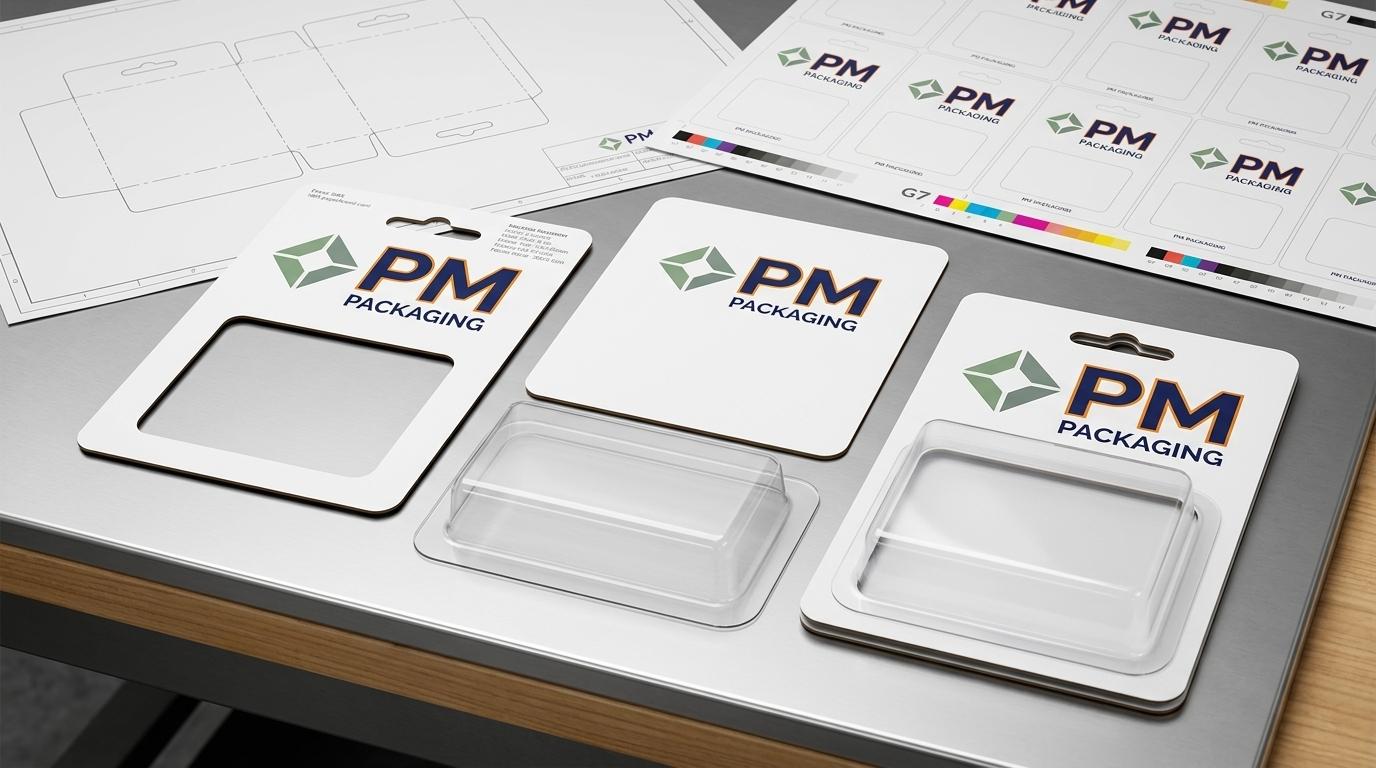
4. Multi-SKU Portfolio Optimization: The qikCombo™ Program
Consumer tech hardware brands face an acute SKU proliferation challenge. A single charging cable line might encompass dozens of distinct SKUs varying by connector, power rating, length, and colorway:
                            THE MOBILE ACCESSORY SKU MATRIX

  CONNECTORS            LENGTHS            POWER RATINGS         COLORWAYS
  ┌──────────────┐      ┌────────────┐     ┌──────────────┐      ┌──────────────┐
  │ USB-C / C    │      │ 1m (3.3ft) │     │ 60W (3A)     │      │ Matte Black  │
  │ USB-C / Lgt  │ ───► │ 2m (6.6ft) │ ──► │ 100W (5A)    │ ───► │ Arctic White │
  │ USB-A / C    │      │ 3m (10ft)  │     │ 240W (E-Mrk) │      │ Midnight Navy│
  │ Audio 3.5mm  │      │ 0.5m Short │     │ Standard 15W │      │ Braided Gray │
  └──────────────┘      └────────────┘     └──────────────┘      └──────────────┘

  TOTAL VARIATIONS: 4 Connectors x 4 Lengths x 4 Power Tiers x 4 Colors = 256 Active SKUs!
The Sourcing Bottleneck: Dedicated Press Runs vs. Dead Stock Risk
Under traditional dedicated printing procurement models:
- Sourcing 256 SKUs requires 256 individual press setups.
- Commercial packaging converters enforce minimum order quantities (MOQs) of 25,000 to 50,000 cards per SKU to justify offset litho makeready, plate imaging, and die-cutting setup.
- Ordering 25,000 cards across 256 SKUs requires purchasing 6.4 million units of packaging, tying up over $1.2 million in working capital.
- When fast-charging protocols change (such as the EU USB-C standard mandate or Qi2 15W wireless updates), hundreds of thousands of slow-moving “C” and “D” SKU cards become obsolete, resulting in massive inventory write-offs.
| Supply Chain Metric | Traditional Dedicated Press Runs | PM Packaging qikCombo™ Gang-Run Program |
|---|---|---|
| Minimum Order Quantity (per SKU) | 25,000 – 50,000 units | 5,000 – 10,000 units |
| Press Makeready Allocation | 100% absorbed by single SKU | Amortized across 10–24 ganged SKUs |
| Tooling & Die Setup Fees | Dedicated tooling per part number | Standardized shared master die grid |
| Order-to-Delivery Lead Time | 6 – 8 weeks (Domestic) / 12 wks Asia | 10 – 14 business days |
| Working Capital Requirement | High ($500k - $1.5M per catalog) | Lean ($75k - $200k dynamic replenishment) |
| Obsolescence Scrap Exposure | Severe (Excess safety stock) | Near Zero (On-demand agile batch runs) |
| Color Consistency Control | Variable run-to-run drift | Strict G7 Master standardized press sheets |
The qikCombo™ Manufacturing Solution
PM Packaging’s proprietary qikCombo™ program transforms multi-SKU carded blister procurement:
- Standardized Sheet Layouts: Standardizing master card footprints (e.g., 3.5" x 6.5" for standard cables; 4.5" x 8.0" for chargers and multipacks) allows 10 to 24 distinct part numbers to be imposed onto large-format 40" to 56" offset press forms.
- Shared Makeready Economics: Aluminum Computer-to-Plate (CTP) costs, press washup, color calibration, and die-cutting makeready are distributed across the entire gang, enabling cost-effective production runs as small as 5,000 cards per SKU.
- 10-Day Turnaround Cycles: Standardized SBS calipers (18pt / 20pt) and certified heat-seal chemistries run continuously through PM Packaging’s converting facilities, allowing brands to submit revised artwork files and receive finished blister cards at North American packaging lines in just 10 to 14 days.
5. Sealing Machinery Dynamics & Automated Pack-Out Efficiency
For high-volume consumer electronics brands producing millions of units annually, secondary packaging labor and line speed dictate total conversion costs. Packaging engineers must design blister cards and thermoforms that integrate seamlessly with high-speed automated sealing equipment.
                           ROTARY AUTOMATED PACK-OUT WORKCELL

                             [ Station 1: Card De-Nesting ]
                                         │
                                         ▼
      [ Station 6: Auto Eject ] ──►  ┌───────┐  ◄── [ Station 2: Blister Drop ]
      (Vision Inspection Pass)       │   ○   │      (Vacuum Pick & Place)
                                     │ ┌───┐ │
      [ Station 5: Cooling Platen ] ─┤ │ R │ ├─► [ Station 3: Cable / Accessory Insert ]
      (Bond Solidification)          │ └───┘ │      (Robotic or Manual Kitting)
                                     │   ○   │
                                     └───────┘
                                         ▲
                                         │
                         [ Station 4: Heated Sealing Platen ]
                         (Thermal Activation: 310°F, 2.0s, 60 PSI)
Machinery Configurations: Rotary vs. Linear Carousel vs. Shuttle
- Shuttle Heat Sealers: Two-station manual slide tables used for low-volume production, pilot validation, or niche SKU pack-out (5 to 15 packages per minute).
- Rotary Turret Systems (4 to 8 Stations): The industry standard for medium-to-high velocity accessory lines (30 to 60 packages per minute). Operators or SCARA robots place blisters, insert cables, lay down cards, and rotate into the thermal sealing chamber.
- Continuous Inline Linear Indexing Machines: High-speed fully automated lines running up to 120 to 200 packages per minute. Automated de-nesters feed cards from hoppers, pick-and-place robots drop coiled charging cables, automated vision systems verify barcode and serial accuracy, and high-tonnage heated platens seal entire multi-cavity jigs in single cycles.
| Packaging Design Variable | Impact on Throughput | Engineering Best Practice / Solution |
|---|---|---|
| Card De-Nesting Reliability | Card feed jams cause line stoppages on automated lines | Precision die-cut edges with zero burrs/angel hair; embossed de-nesting anti-suction corner dimples. |
| Blister Cavity Clearance | Tight cavity slows robotic cable coil insertion | 5° to 7° draft angle on thermoform sidewalls; generous lead-in chamfers on connector ports. |
| Heat-Seal Dwell Optimization | Long dwell slows total index cycle time | High-thermal-conductivity aluminum tooling plates; integrated silicone heat-equalization diaphragms. |
| Cooling / Settling Station | Hot bonds tear during rapid robotic pack-out discharge | Active refrigerated water-jacket cooling platens to solidify adhesive matrix before carton pack-out. |
6. Retail Channel Compliance & Merchandising Optimization
Packaging engineered for consumer tech must satisfy the distinct logistical, structural, and visual compliance standards of varying retail channels:
                  RETAIL CHANNEL MERCHANDISING REQUIREMENTS

   MASS RETAIL (Walmart / Target)        CARRIER STORES (Verizon / T-Mobile)
   ┌───────────────────────────────┐     ┌───────────────────────────────┐
   │ * GMI Certified Color Control │     │ * High-End Luxury Aesthetic   │
   │ * High-Density Peg Alignment  │     │ * Ultra-Compact Card Footprint│
   │ * Drop-Tested Tear Resistance │     │ * Soft-Touch / Metallic Foils │
   │ * PDQ Display Tray Ready      │     │ * Premium Device Matching Pcs │
   └───────────────────────────────┘     └───────────────────────────────┘

   CLUB STORES (Costco / Sam's)          AIRPORT / CONVENIENCE (Hudson)
   ┌───────────────────────────────┐     ┌───────────────────────────────┐
   │ * Oversized Cards (8" x 10")  │     │ * Heavy-Duty Gravity Feeders  │
   │ * Multi-Pack Blister Cavities │     │ * Instant Value Proposition   │
   │ * 100% Perimeter Clamping     │     │ * Universal Compatibility Bold│
   │ * Full Pallet Tray Structural │     │ * High Contrast Shelf Impact  │
   └───────────────────────────────┘     └───────────────────────────────┘
1. Mass Retail (Target, Walmart, Best Buy)
Print Consistency (GMI & G7 Certification): Mass retailers enforce strict brand consistency across lighting conditions. PM Packaging operates as a certified G7 Master Printer, maintaining spectral ΔE tolerances below 1.5 across large-format offset runs.
PDQ Counter & Power Wing Trays: Blister cards must fit perfectly into corrugated shelf-ready PDQ display trays with front retaining lips, preventing forward-tip during high-velocity shopping.
2. Carrier & Specialty Retail (Verizon, AT&T, Apple Authorized Retailers)
Tactile Embellishments: Premium tier cards leverage inline cold foil stamping, tactile soft-touch coatings, spot raised UV gloss over embossed cable textures, and precision holographic authentication badges (e.g., Apple MFi certification logos).
Ultra-Slim Profiles: Space is constrained in carrier display cases. Slim trap blister profiles minimize shelf depth while showcasing sleek anodized aluminum connector housings through high-clarity RPET windows.
3. National Club Store Programs (Costco, Sam’s Club)
Club-Sized Multi-Pack Architecture: Club stores require multi-unit bundles (e.g., a 3-pack assortment of 3ft, 6ft, and 10ft braided cables, or a GaN charger paired with a heavy-duty cable).
Oversized Structural Cards: Cards expand to 8.5" x 11" or 10" x 12", requiring heavy-duty 24pt to 28pt SBS backer cards to prevent sagging and warping when suspended from extended club-store display pegs.
7. Nearshore Manufacturing & Total Landed Cost (TCO) Strategy
In the fast-moving mobile device accessory sector, supply chain agility is directly tied to market share. Consumer tech hardware experiences predictable annual demand spikes driven by flagship smartphone launches every September and February, as well as the critical Q4 holiday retail surge.
Relying on transpacific Asian packaging converters introduces severe supply chain vulnerabilities that erode gross margins.
+-----------------------------------------------------------------------------------------------------------------------+
|                       SUPPLY CHAIN LEAD-TIME VELOCITY: ASIA VS. NEARSHORE MEXICO                                      |
+-----------------------------------------------------------------------------------------------------------------------+
|                                                                                                                       |
|  TRANSPACIFIC SOURCING (Shenzhen / Vietnam):                                                                          |
|  [ PO Issued ] ──► [ Production: 4 Wks ] ──► [ Ocean Freight: 4-6 Wks ] ──► [ Port/Customs: 2 Wks ] ──► [ Total: 10-12 Wks]|
|                    (High MOQs)               (Container Volatility)         (Demurrage Risk)         (Stockouts)      |
|                                                                                                                       |
|  PM PACKAGING NEARSHORE (San Diego / Baja California):                                                                |
|  [ PO Issued ] ──► [ Production: 10 Days ] ──► [ C-TPAT Border: Fast Track ] ──► [ DC Delivery: 1-3 Days ] ──► [ Total: 2 Wks ]|
|                    (qikCombo™ Agile)          (100% USMCA Tariff-Free)         (Direct Ground Freight)  (Zero Dead Stock)|
|                                                                                                                       |
+-----------------------------------------------------------------------------------------------------------------------+
The Transpacific Freight & Tariff Burden
- Extended Lead Times (10 to 14 Weeks): Ocean freight lead times force brands to forecast consumer tech demand months in advance. When an unexpected product launch shift occurs or a specific cable color surges in popularity, brands cannot replenish stock in time, missing high-margin retail sales windows.
- Section 301 Tariffs: Printed packaging imported from China remains subject to punitive tariffs (7.5% to 25%), inflating landed unit costs.
- Container Demurrage and Port Congestion: West Coast port bottlenecks and ocean freight rate volatility introduce unbudgeted supply chain costs.
The Nearshore US-Mexico Advantage
PM Packaging operates a synchronized North American manufacturing footprint:
- Headquarters & Structural Design Engineering: San Diego, CA.
- Advanced High-Volume Converting Facilities: Baja California (Tijuana and Mexicali).
| Cost / Operational Factor | Overseas Sourcing (Asia) | PM Packaging Nearshore (US-Mexico) |
|---|---|---|
| Unit Piece Price (FOB Factory) | Moderately Lower (-10% to -15%) | Highly Competitive |
| Transpacific Ocean Freight | High ($0.03 – $0.07 per card) | $0.00 (Eliminated) |
| Import Tariffs (USMCA vs 301) | 7.5% – 25% Section 301 Tariffs | 0.00% (100% USMCA Tariff-Free Origin) |
| In-Transit Working Capital | 60 – 90 Days Trapped on Water | 2 – 4 Days Ground Freight Transit |
| Pipeline Safety Stock Inventory | 12 – 16 Weeks Buffer Stock | 2 – 4 Weeks Lean Kanban Replenishment |
| Obsolescence Scrap Rate | 8% – 14% (Excess batch overages) | < 1.5% (Agile qikCombo™ batch sizing) |
| Quality Dispute Resolution | 8,000 miles away / 6-week redraw | Same-day San Diego engineering response |
| Total Landed Cost (TCO) | Higher Net Cost + Severe Risk | Lowest Net Cost + Maximum Agility |
- 100% USMCA Tariff-Free Compliance: All raw SBS paperboards and converting operations meet North American Rules of Origin criteria, entering the United States duty-free under USMCA / T-MEC with IMMEX certification.
- 1 to 3-Day Ground Freight: Finished blister cards, fold-over trap cards, and thermoformed blisters ship via dedicated air-ride ground freight from Tijuana to distribution centers across California, the Southwest, and nationwide within 3 to 5 days.
- C-TPAT & OEA Fast-Track Clearance: PM Packaging maintains C-TPAT (Customs-Trade Partnership Against Terrorism) and OEA certifications, ensuring dedicated border lanes and rapid, frictionless customs clearance.
8. Implementation & Quality Assurance Playbook
Transitioning a high-volume mobile accessory portfolio to a standardized blister card program follows a structured 5-phase engineering protocol:
┌───────────────────────────────────────────────────────────────────────────────────────────────────┐
│                        TRAP BLISTER PROGRAM ONBOARDING ROADMAP                                    │
└───────────────────────────────────────────────────────────────────────────────────────────────────┘
  PHASE 1: Dieline & Cavity Optimization (Days 1–5)
  ├─ 3D CAD modeling of cable coils, GaN bricks, and wireless pucks.
  ├─ Flange clamping & aperture clearance tolerance analysis (0.020" gap).
  └─ Rapid 3D printing of thermoform tooling mockups & vacuum form sampling.

  PHASE 2: Material & Coating Specification (Days 6–10)
  ├─ Virgin SBS board caliper selection (18pt - 24pt based on drop-test modeling).
  ├─ Water-based heat-seal coating chemistry matching to RPET blister resin.
  └─ ASTM F88 seal peel-strength bench validation (> 5.0 lbf/in threshold).

  PHASE 3: qikCombo™ Gang-Run Imposition (Days 11–15)
  ├─ SKU catalog grouping by shared footprint and board caliper.
  ├─ Digital CTP plate imaging under certified G7 Master color management.
  └─ Master die layout optimization to maximize sheet yield (> 88%).

  PHASE 4: Sealing Line IQ/OQ/PQ Qualification (Days 16–20)
  ├─ Sealing machine parameter mapping: Heat (310°F), Dwell (2.0s), Pressure (60 PSI).
  ├─ Visual and destructive testing: 100% fiber tear verification.
  └─ Accelerated environmental chamber testing (104°F / 85% RH for 72 hours).

  PHASE 5: Full-Scale Production & VMI Replenishment (Day 21+)
  ├─ High-speed offset litho printing and inline heat-seal coating.
  ├─ Cross-border dispatch to co-packers and contract manufacturing facilities.
  └─ Activation of Vendor Managed Inventory (VMI) min-max safety stock triggers.
Critical Quality Assurance Protocols
1. ASTM F88 / F88M Standard Test Method for Seal Strength of Flexible Barrier Materials
Sealed test specimens are cut into 1-inch (25.4mm) strips and pulled on an Instron tensile tester at a rate of 10 to 12 inches/min. A passing result requires a minimum seal strength of 5.0 lbf/inch (875 N/m) with 100% destructive paperboard fiber tear.
2. ASTM D5276 Standard Test Method for Drop Test of Loaded Containers
Fully packaged accessories are subjected to 10 free-fall drops from a height of 36 inches (914mm) onto flat concrete surfaces to confirm that blister flanges do not delaminate and heavy GaN chargers do not rupture the paperboard aperture.
3. ASTM D4332 Conditioning for Environmental Stress
Sealed packages are conditioned at extreme temperature and humidity cycles (-20°F to 140°F / -29°C to 60°C; 90% RH) for 72 hours to verify zero adhesive breakdown, board warping, or blister embrittlement.
9. Strategic Summary & Partnering with PM Packaging
For consumer electronics brands scaling mobile device accessory catalogs, packaging is a powerful lever for supply chain velocity, brand equity, and bottom-line profitability.
Transitioning from costly, environmentally hazardous plastic clamshells to engineered Face-Seal and Trap Blister Programs delivers immediate business value:
75% to 90% Plastic Reduction
Achieve full compliance with global retail sustainability mandates and eliminate punitive EPR eco-taxes.
Eliminate Retail Theft & Shrinkage
Utilize dual-ply tear-resistant SBS paperboard and internally concealed EAS security tags.
Slash Packaging Inventory by 70%
Leverage the qikCombo™ gang-run program to procure 5,000-unit batches across dozens of cable SKUs with 10-day press turnarounds.
Nearshore Supply Chain Agility
Eliminate transpacific lead times and Section 301 tariffs through tariff-free manufacturing in Baja California backed by San Diego design engineering.
Initiate Your Packaging Audit
PM Packaging brings over 45 years of commercial packaging expertise, large-format offset press capacity, certified G7 Master color consistency, and dedicated nearshore manufacturing to tier-1 consumer electronics brands.
Contact PM Packaging’s structural engineering and procurement advisory team to request a comprehensive packaging portfolio audit, custom dieline prototypes, and a total landed cost analysis for your mobile accessory catalog:
PM Packaging
45+ Years of Structural Packaging Excellence & Nearshore Manufacturing Leadership
Headquarters: San Diego, California
Manufacturing Centers: Tijuana & Mexicali, Baja California
Core Specializations: Face-Seal & Trap Blister Cards, Litho-Laminated Single Face Corrugate (SFL), Folding Cartons, Counter PDQ Displays, and Luxury Rigid Setup Boxes.
Website: pmpackaging.com