
In high-velocity mass retail environments, impulse merchandising at the perimeter of the aisle represents one of the most profitable footprints on the sales floor.
Sidekick displays—also known in the commercial retail sector as power-wings, hanging side-wings, or endcap hanging units—are self-contained, pre-packed merchandising structures suspended from metal gondola uprights, wire grid endcap side panels, or cash-wrap perimeter fixtures.
For brand owners in consumer packaged goods (CPG), consumer electronics, personal care, over-the-counter (OTC) wellness, hardware, automotive accessories, and pet care, securing sidekick placement in retail giants like Walmart, Target, The Home Depot, Lowe’s, CVS, Walgreens, and Dollar General yields an immediate 20% to 45% lift in product velocity. Because sidekicks occupy previously unmonetized vertical air space at eye level directly adjacent to high-traffic primary endcaps, they capture high-margin impulse sales without cannibalizing baseline shelf inventory.
The High-Stakes Architecture of Mass Retail Sidekick Merchandising
Solid Paperboard & Direct Flexo
- Solid Fiber Paperboard (SBS/CCNB): Structural buckling, shelf sagging under >10 lbs, hanger slot tear-out
- Direct-Print Flexo Corrugated: Severe flute washboarding, muddy graphics (65–85 LPI), low brand equity
- Knock-Down Flat (KDF) Kits: 30%–45% store execution failure due to complex store associate setup
Litho-Laminated SFL Pre-Packs
- G7 Master Lithography: 175–200+ LPI photorealistic offset print on premium top-liner sheets
- E/F Microflute Core: Uncrushed beam stiffness supporting 15 to 45+ lb load capacities
- Turnkey Co-Packer Kitted Shippers: 100% retail compliance with zero-tool store hanging under 60 seconds
However, executing a national sidekick program across 1,500 to 5,000 retail doors presents severe structural and logistical engineering challenges. A sidekick is subject to harsh mechanical loads: it is suspended from two narrow wire clips or S-hooks, holds 15 to 45 pounds of dense product, and must withstand weeks of aggressive consumer pulling, shelf impact, and store cart collisions. Furthermore, modern sidekicks are almost universally specified as pre-pack kitted displays—packed with live inventory at the manufacturing facility or co-packer, dropped into a heavy-duty master shipper, transported through distribution centers via Less-Than-Truckload (LTL) freight, and hung by store associates in under 60 seconds without tools or loose parts.
When brand procurement teams attempt to build sidekicks using standard folding carton paperboard (Solid Bleached Sulfate - SBS or Clay Coated Newsback - CCNB), the structural shelves bow, dividers collapse under vibration, and the top hanger slots rip under shear stress. Conversely, when brands turn to conventional direct-print flexographic corrugated board, the coarse printing (65–85 LPI), pronounced flute washboarding, and mottled ink destroy the brand’s visual equity next to premium endcaps.
The definitive commercial packaging solution for enterprise brands is Litho-Laminated Single Face Laminate (SFL). By marrying a high-resolution, offset-printed paperboard top sheet with a precision-engineered microflute corrugate base (E-flute or F-flute), SFL delivers the photorealistic visual fidelity of a luxury folding carton combined with the load-bearing beam strength, puncture resistance, and torsional stiffness of structural corrugate.
1. Retail Channel Specifications: Engineering for Compliance
Mass retailers treat retail floor space with exacting discipline. Every major retail chain publishes rigorous point-of-purchase (POP) display style guides that dictate maximum dimensions, total display weight, mounting hardware, drop-testing standards, and sustainability compliance. A display that exceeds dimensional tolerances by half an inch or sags into an aisle walkway will be rejected at the distribution center or discarded in the store backroom, resulting in devastating retail compliance chargebacks and lost promotional revenue.
| Retailer / Channel | Typical Dimensions (W x D x H) | Max Total Weight | Approved Mounting Hardware | Graphic / Print Mandates | Critical Compliance Pitfalls |
|---|---|---|---|---|---|
| Walmart | 14.0" x 5.0" x 48.0" 12.0" x 4.5" x 24.0" | 30.0 lbs (Standard) 40.0 lbs (Heavy Duty) | Heavy-gauge wire S-hooks, universal grid clips, zip-ties | GMI Certified, G7 Master, Grade A Barcodes (ISO/IEC 15416) | Aisle projection >5.5"; displays requiring tools; missing ISTA 3A transit certification. |
| Target | 14.0" x 4.5" x 48.0" 14.0" x 4.5" x 24.0" | 25.0 lbs | Target-approved metal wire brackets, white zip-ties | High-end litho print, FSC certified fiber, G7 color calibration | Dark/uncoated interior kraft walls; displays sagging below shelf plane; non-recyclable clips. |
| The Home Depot / Lowe’s | 14.0" x 6.0" x 48.0" 16.0" x 6.5" x 54.0" | 45.0 lbs to 60.0 lbs | Heavy-duty steel upright brackets, slotted pegboard brackets | High-impact industrial graphics, scuff-resistant UV varnishes | Shelf tear-out under dense metal/liquid loads; failure to withstand high-humidity garden zones. |
| CVS / Walgreens | 10.0" x 4.0" x 24.0" 12.0" x 4.5" x 36.0" | 15.0 lbs to 20.0 lbs | Universal wire grid hooks, adhesive hang strips | High-gloss cosmetic/skincare litho, soft-touch tactile finishes | Interference with ADA-compliant aisle clearance; poor blister card fitment on peg hooks. |
| Dollar General / Family Dollar | 12.0" x 4.0" x 24.0" 14.0" x 5.0" x 48.0" | 20.0 lbs | Integrated fiber hang tabs, S-hooks, plastic cable ties | High-contrast promotional pricing callouts, scuff-resistant litho | Display collapse during store unpack; non-convertible bases for stores lacking grid space. |
The “Convertible Sidekick-to-Countertop” Dual Mandate
A major source of wasted marketing spend in retail rollouts occurs when store associates encounter an endcap that is already fully utilized with vendor fixtures or sidekicks from competing brands. In 15% to 25% of retail doors, the store associate cannot hang the sidekick.
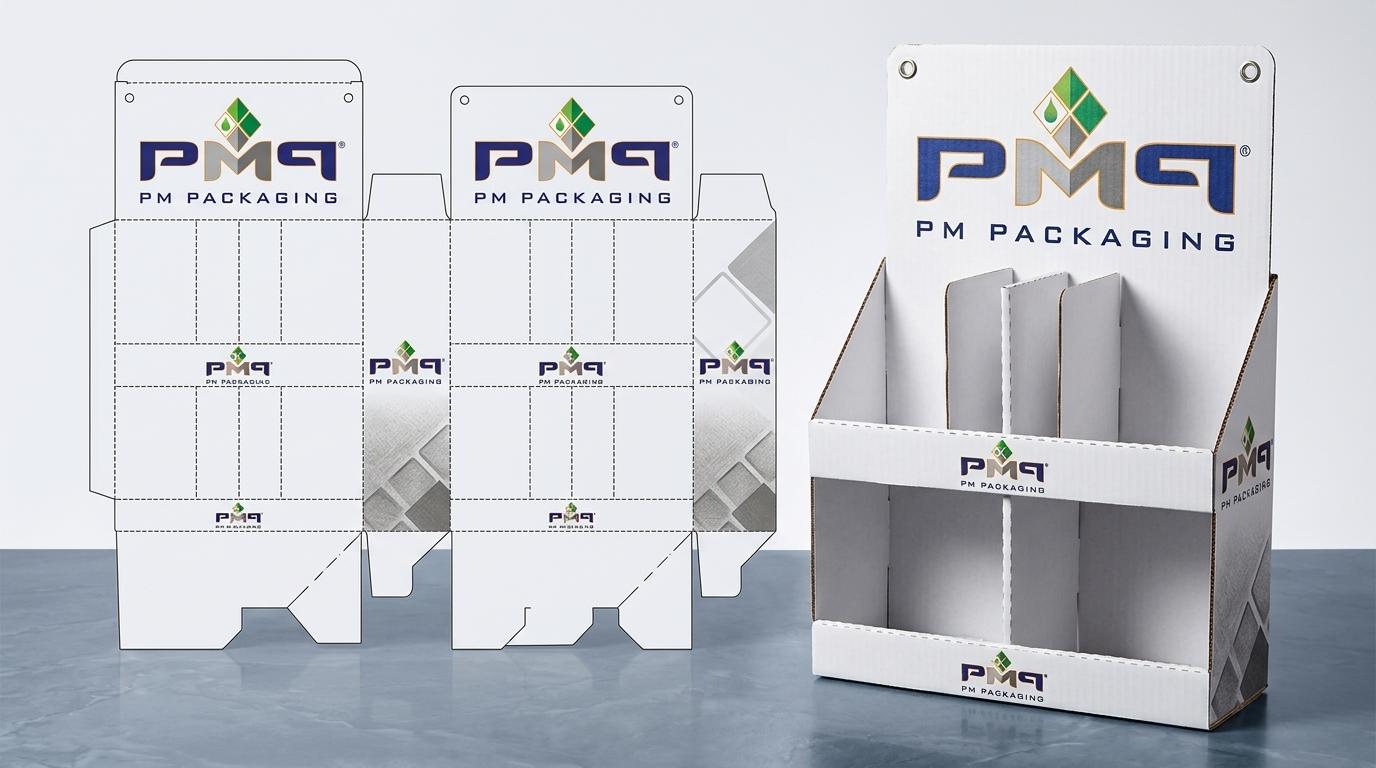
To safeguard sell-through across 100% of store allocations, PM Packaging engineers specify a Convertible Sidekick Dieline:
Pre-Scored Stabilizer Feet
The sidekick backwall and sidewalls incorporate pre-scored, snap-out stabilizing feet at the base.
Instant Tool-Free Fold
If hanging grid space is full, the associate folds down the bottom flaps, turning the sidekick into a freestanding Countertop PDQ Tray.
100% Placement Retention
The display is placed immediately on checkout counters, pharmacy desks, or service bars without backroom waste.
2. Substrate Physics: Why SFL Microflute Outperforms Paperboard & Direct Flexo
To understand why Single-Face Lamination is the engineered standard for mass retail sidekicks, procurement and engineering teams must analyze the structural mechanics and graphic capabilities of competing substrate classes.
24pt – 30pt Solid Fiberboard
│ Solid Homogeneous Fiber │
└────────────────────────────┘
- Weak area moment of inertia ($I$)
- Severe shelf sagging >10 lbs load
- Hanger holes tear under shear stress
B-Flute / C-Flute Combined Board
═════▼═════▼═════▼═════ Outside
/\ /\ /\ /\ /\ Fluted
─────────────────────── Inside
- Coarse graphics (65–85 LPI)
- Severe flute washboarding (zebra striping)
- Caliper crushed on press, losing 15%–30% ECT
E-Flute / F-Flute + 12pt SBS
═══════════════════════ 12pt SBS
/\ /\ /\ /\ /\ Uncrushed
─────────────────────── Base Liner
- Photorealistic G7 litho (175–200+ LPI)
- Maximum beam stiffness & 38–48 ECT
- Completely flat, zero washboarding
The Inherent Failure Modes of Solid Fiber Paperboard
Solid Bleached Sulfate (SBS) and Clay Coated Newsback (CCNB) folding carton paperboards are exceptional substrates for individual primary cartons up to 28pt or 32pt. However, when used as the primary structural shell for a multi-tiered sidekick carrying 20 to 40 pounds of merchandise, paperboard fails under basic structural physics:
- Low Area Moment of Inertia (I): The mechanical resistance to bending (flexural rigidity, D) of a flat sheet is directly proportional to the cube of its caliper thickness (t):
D = (E · t³) / [12(1 - ν²)], where E is Young’s modulus and ν is Poisson’s ratio. Because solid paperboard has a thin caliper (t ≈ 0.024 to 0.030 inches), its resistance to bending is minuscule compared to a corrugated sandwich. Under a sustained 25-pound product load, solid paperboard shelves suffer catastrophic creep deflection, causing products to slide forward and spill onto the retail aisle. - Stress Concentration & Hanger Tear-Out: A loaded sidekick is suspended from two points with contact diameters of approximately 0.25 inches. The resulting shear stress ($\tau$) on the fiberboard easily exceeds the internal fiber bond strength (Z-directional tensile strength) of solid paperboard, causing the hanger holes to elongate, tear, and drop the display to the floor during retail restocking.
The Physics of Litho-Laminated Single Face Laminate (SFL)
Single-Face Lamination resolves both failure modes by decoupling high-resolution lithographic printing from corrugated structural lamination:
- High-Precision Sheetfed Lithography: The top liner (typically a 10pt to 16pt Solid Bleached Sulfate or Clay Coated Newsback sheet) is printed flat on high-speed, large-format 6-to-8 color offset lithographic presses at 175 to 200+ LPI (or stochastic screening). Full visual fidelity, tight registration (± 0.002 inches), inline cold foil stamping, and spot UV coatings are applied while the sheet is completely flat.
- Precision Single-Facer Lamination: The single-face corrugate component (an exposed fluted medium adhered to a bottom kraft or white liner) is manufactured separately. The printed top-liner sheet is precision-mounted to the exposed flute tips using a high-speed laminator with cold polyvinyl acetate (PVA) or starch-based adhesive.
- Zero Impression Crush & Absolute Flatness: Because the top sheet is printed prior to lamination, the structural fluting experiences zero printing impression pressure. The finished sheet boasts a glass-smooth outer surface with zero washboarding and 100% structural retention of the fluting’s compressive strength.
| Criteria | SBS Paperboard 28pt | CCNB Paperboard 30pt | Direct Flexo (B-Flute) | SFL (F-Flute + 12pt SBS) | SFL (E-Flute + 12pt SBS) |
|---|---|---|---|---|---|
| Caliper Thickness | 0.028" (0.71 mm) | 0.030" (0.76 mm) | 0.125" (3.18 mm) | 0.045" (1.14 mm) | 0.075" (1.90 mm) |
| Flute Profile | None (Solid) | None (Solid) | 1/8" (~47 flutes/ft) | 1/32" (~125 flutes/ft) | 1/16" (~90 flutes/ft) |
| Edge Crush Test (ECT) | N/A (<15 lbs/in) | N/A (<12 lbs/in) | 32 – 40 ECT | 29 – 34 ECT | 38 – 48 ECT |
| Max Sidekick Weight | 8 – 12 lbs | 6 – 10 lbs | 30 – 50 lbs | 15 – 25 lbs | 30 – 45+ lbs |
| Print Screen / Resolution | 175 – 200 LPI | 150 – 175 LPI | 65 – 85 LPI | 175 – 200+ LPI | 175 – 200+ LPI |
| Flute Washboarding | None | None | Severe | Completely Invisible | Completely Invisible |
| Die-Cut & Fold Sharpness | Sharp (Score crease) | Sharp | Soft / Rounded | Crisp 90° Fold Radii | Clean Structural Folds |
3. Structural Dieline Architecture & Mechanical Load Engineering
Engineering a high-volume sidekick display requires balancing three competing variables: structural load-bearing capacity, ease of assembly at the co-packer, and material yield on large-format litho press sheets.
1. Main Shell & Vertical Flute Grain Physics
Vertical Grain MandateIn corrugate physics, 95% of vertical compression strength is carried along the direction of the flutes. Flutes and paperboard grain direction must run vertically from top hanger to base. Side panels incorporate 180-degree roll-over flaps that mechanically lock into the backwall, creating double-ply vertical beams and increasing torsional stiffness by >300%.
2. Shelf Deflection & Cantilever Mechanics
Beam Deflection ControlWhen product loads a shelf, the shelf acts as a cantilevered horizontal beam. Maximum downward deflection is calculated by δmax = (5 · w · L⁴) / (384 · E · I). PM Packaging eliminates shelf bowing by folding a 1.5" to 2.0" vertical retention lip at the front and engineering stepped double-ply shelf trays that anchor directly into die-cut receiver slots in the backwall.
Hanger Slot Reinforcement: Three Engineering Tiers
4-Ply Fiber Rollover
Top header incorporates a 3-inch reverse fold-down flap, doubling SFL thickness around the hanger slot to 4 combined plies (>0.150" caliper).
Polymer Reinforcement
A 2-mil cross-filament Mylar or high-density polypropylene tape is laminated inline between top liner and fluted medium over hanger holes.
Swaged Steel Eyelets
Industrial zinc-plated steel grommets (0.375" ID) are mechanically swaged through the multi-ply board, distributing load across 360° to eliminate fiber tear.
4. Master Shipper Engineering, Co-Packing & Transit Simulation (ISTA 3A)
A retail sidekick display program is only as successful as its transit survival rate. Over 90% of national sidekick programs are executed as Pre-Pack Displays (packed with merchandise at the manufacturing plant or contract packager, sealed inside a protective corrugated master shipper, and transported through retail distribution networks).
Certified ISTA Project 3A Testing Sequence
Before Walmart, Target, or Home Depot accept a pre-packed sidekick program, the complete packaged assembly (display + live merchandise + master shipper) must undergo certified laboratory transit testing:
5. Print Quality, Embellishments & Retail Compliance Certifications
In competitive retail aisles, a sidekick display functions as a high-impact promotional billboard. While individual product packages communicate item features, the sidekick shell and oversized header billboard must command shopper attention from 20 to 30 feet down the main aisle.
G7 Master Lithography & GMI Control
Printed on large-format 6-to-8 color sheetfed offset presses with inline closed-loop spectrophotometry. Tight color tolerances (ΔE00 < 1.5) maintain PMS brand colors across millions of units, certified under Walmart GMI and Target Print Standards.
Anti-Scuff Coatings & Cold Foil
Cross-linking scuff-resistant aqueous coatings protect printed face sheets against transit burnishing. Inline cold foil stamping and contrasting spot UV over soft-touch matte deliver premium luxury aesthetics directly on retail corrugate.
6. Procurement Economics & Total Cost of Ownership (TCO)
When evaluating sidekick programs, procurement teams often make the mistake of evaluating unit packaging costs in isolation—comparing the raw unit price of a folding carton blank against an SFL microflute assembly. However, senior procurement directors and supply chain executives evaluate the Total Cost of Ownership (TCO) across raw materials, co-packer labor, transit survival, chargeback risk, and sell-through velocity.
| Production Volume Tier | Tooling Amortization | SFL Shell & Header | 3x Shelf Trays | Master Shipper | Co-Packer Labor | Effective Total Cost |
|---|---|---|---|---|---|---|
| 5,000 Units (Pilot) | $0.85 | $3.80 | $1.95 | $1.65 | $1.85 | $10.10 |
| 15,000 Units (Regional) | $0.28 | $2.95 | $1.45 | $1.30 | $1.40 | $7.38 |
| 30,000 Units (National) | $0.14 | $2.40 | $1.15 | $1.05 | $1.15 | $5.89 |
| 50,000 Units (Multi-Chain) | $0.08 | $2.10 | $0.98 | $0.92 | $0.95 | $5.03 |
| 100,000+ Units (Enterprise) | $0.04 | $1.82 | $0.82 | $0.80 | $0.80 | $4.28 |
7. Nearshore Manufacturing Strategy: The San Diego – Baja California Advantage
For brand owners managing high-velocity promotional calendars, packaging lead time is a decisive competitive advantage. Retail sidekick programs are driven by strict promotional reset dates (e.g., Back-to-School, Black Friday, Spring Resets). Missing a retail distribution center “Must-Arrive-By-Date” (MABD) results in immediate inventory rejection, vendor chargebacks of 3% to 5% of invoice value, and permanent loss of promotional allocations.
10 to 14-Week Total Lead Time
- High ocean freight penalty for shipping empty corrugated air
- Inability to replenish successful promotional runs within 6-week windows
- Section 301 tariffs and unpredictable customs clearance dwell times
2 to 3-Week Total Lead Time
- 100% USMCA / T-MEC tariff-free fiberboard and converting
- C-TPAT & FAST Lane certified border crossings with zero dwell time
- 1 to 3 days ground freight to West Coast / Southwest retail DCs
8. Summary & Strategic Implementation Roadmap
Deploying a high-volume sidekick or power-wing display program across mass retail channels requires meticulous packaging engineering, rigorous ISTA 3A transit validation, flawless G7 Master print execution, and an agile, nearshore supply chain.
Retail Spec & Structural CAD (Weeks 1–2)
Audit retailer style guides (Walmart, Target, Home Depot, CVS) for dimensional/weight limits. Engineer SFL microflute dieline (E-flute/F-flute) with auto-locking shelves and universal hangers. Generate 3D digital renderings and CAD prototypes.
Pre-Press, G7 Proofing & Tooling (Weeks 2–3)
Pre-press color separation, GMI / G7 Master ink profiling, and ISO barcode verification. Manufacture precision flatbed steel rule cutting dies, stripping dies, and CTP aluminum plates.
High-Speed Nearshore Manufacturing (Weeks 3–5)
6-to-8 color sheetfed offset printing on 12pt–14pt SBS top liner with UV/anti-scuff coatings. High-speed single-face lamination to E-flute / F-flute corrugate core. Flatbed die-cutting, stripping, and specialty folding-gluing.
Co-Packing, ISTA 3A Validation & DC Rollout (Weeks 5–6)
Deliver flat-packed display shells and 44 ECT master shippers to regional co-packers. Pack live merchandise, install transit shrouds, conduct certified ISTA 3A testing, and ship via 1–3 day ground freight.
Partner with PM Packaging for Mass Retail Packaging Programs
With more than 45 years of specialized experience in commercial packaging engineering, high-graphic folding cartons, single-face laminate corrugate, and mass retail POP displays, PM Packaging provides enterprise brands with the manufacturing scale, technical rigor, and nearshore agility required to dominate the retail sales floor.
To discuss an upcoming mass retail sidekick rollout, request structural dieline prototypes, or evaluate your packaging Total Cost of Ownership, contact PM Packaging’s commercial engineering team at pmpackaging.com.