
The residential electric vehicle supply equipment (EVSE) market is undergoing a seismic commercial transition. What began as a niche, direct-to-installer industrial component has evolved into a high-volume consumer technology appliance sold across national retail home centers, consumer electronics retailers, direct-to-consumer (DTC) digital storefronts, and national electrical wholesale supply chains.
As automotive original equipment manufacturers (OEMs) standardize on the North American Charging Standard (NACS / SAE J3400) alongside existing SAE J1772 connectors, residential Level 2 charging stations (32A to 48A plug-in and 80A hardwired wallboxes) have become flagship consumer electronics hardware. For Directors of Procurement, VP/Directors of Supply Chain, Brand Directors, and Senior Packaging Engineers managing EVSE portfolios, concentrating 15 to 28+ pounds of dense, off-center mechanical and electrical mass into a compact footprint demands enterprise structural physics and immaculate retail aesthetics.
The Triple Mandate for Residential EV Wallbox Packaging
- • Absorb dynamic shock of 15–28+ lb concentrated mass under ISTA 3A / ISTA 6-Amazon drop tests
- • Isolate 20–25 ft coiled copper cable to prevent impact damage against delicate fascia optics
- • Restrain heavy steel mounting hardware and terminal connectors without internal puncture
- • G7 Master photorealistic lithographic reproduction (175–200 LPI) for mass retail aisles
- • Razor-sharp technical spec legibility (amperage, kW rating, NACS/J1772, Energy Star, UL)
- • Anti-scuff, tactile soft-touch, and spot gloss finishes conveying high-tech engineering
- • 100% curbside-recyclable, all-paperboard suspension architecture eliminating EPS/EPE foam
- • Compliance with corporate ESG, retail clean-packaging mandates, and NEVI federal standards
- • Precision die-cut geometries optimized for sub-10-second pack-out assembly lines
Traditional secondary packaging substrates cannot satisfy this triple mandate:
- Standard Solid-Fiber Paperboard (SBS / CCNB / CUK): While delivering high-definition print reproduction, standard paperboard (18pt to 28pt) lacks the structural section modulus, puncture resistance, and Box Compression Test (BCT) top-load capacity required to support a 20+ lb appliance. Under pallet stacking loads or dynamic drop impacts, solid paperboard tears along crease lines, buckles at corner joints, and allows the heavy internal cable to burst through sidewalls.
- Direct-Print Flexographic Corrugated: While providing basic structural cushioning, direct-print flexography suffers from pronounced flute washboarding, coarse screen rulings (50–85 LPI), ink bleeding on fine typography, and high color variance (Delta E > 4.0). Furthermore, raw corrugated fibers shed abrasive cellulose dust inside the package, micro-scratching high-gloss acrylic displays and optical bezels during freight transit.
The definitive, enterprise-grade packaging solution for Tier-1 EVSE hardware manufacturers is Litho-Laminated Single Face Laminate (SFL). By fusing a high-definition, sheetfed offset lithographic top sheet directly to the exposed flutes of a single-face corrugated substrate (E-flute, F-flute, B-flute, or heavy-duty EB double-wall), SFL delivers the photographic clarity, brilliant color saturation, and fine-type technical legibility of a luxury folding carton combined with the crush resistance, beam strength, and impact absorption of industrial corrugate.
1. Multi-Channel Distribution Landscape: Retail, Wholesale, Utility & DTC
Rather than treating hardware packaging as generic paperboard, engineering teams must account for product geometry, hanging shelf wear, moisture barriers, and high-speed automated cartoning line tolerances.
In mass retail environments, the EVSE package serves as an unassisted silent salesperson competing in the smart home and electrical aisles. Buyers must instantly identify critical technical specifications: charging speed (e.g., "Up to 48A / 11.5 kW — 44 miles of range per hour"), connector architecture (NACS vs J1772), input requirements (NEMA 14-50 plug-in vs hardwire), and UL/Energy Star certifications. G7 Master offset lithography ensures complex wiring schematics remain razor-sharp. Packaging must integrate heavy-duty handles and embedded EAS anti-theft tags.
Licensed electrical contractors and certified EV installers purchase equipment through wholesale branches. Cartons are subjected to repeated sliding across abrasive steel and wire shelving, requiring tough, anti-scuff barrier coatings. High-contrast GS1-128, DataMatrix, and 2D QR inventory barcodes on multiple panels enable rapid picking and contractor warranty registration.
Club store rollouts represent massive unit volumes merchandised on full 48" x 40" wood pallets stacked 3 to 4 tiers high. Master cartons and primary packaging must withstand 2,500 to 3,200+ lbs of vertical static compressive load without sidewall bowing or corner crushing. Dieline dimensions must achieve 100% pallet surface utilization with zero perimeter overhang.
A major percentage of EV wallboxes ship directly to consumers via e-commerce or utility portals. Packaging must qualify as Ships-in-Own-Container (SIOC / SIPP), surviving a 17-step freefall drop test from 36 inches onto concrete without requiring a secondary corrugated overbox, while optimizing dimensional weight (DIM weight) to prevent costly parcel surcharges.
2. Mechanical Vulnerabilities and Kinetic Mass Physics of EV Wallboxes
PM Packaging specializes in heavy-duty blister cards, trapped blister packaging, and fluted tool cartons for national hardware and industrial tool brands. High-speed gang printing and shared dielines reduce per-unit tooling costs while clear technical graphics guide buyers directly to the correct model.
| Component / Assembly | Physical & Mechanical Profile | Primary Transit Failure Modes | SFL Structural Solution |
|---|---|---|---|
| Coiled Charging Cable (20–25 ft, 6–8 AWG) | High kinetic mass (8–14 lbs), spring-like elasticity, off-center dynamic load | Cable shifting under drop; impact against main unit; sidewall blowout on parcel drop | Split-level interior tray with die-cut cable retention collar isolating cable in lower deck |
| High-Gloss Front Fascia & LED Light Bar | Scratch-sensitive acrylic, glass, or polycarbonate bezel; capacitive touch sensors | Micro-abrasions from cellulose fibers, rubbing against cables, crack formation under flexure | Non-abrasive soft interior barrier; floating suspension maintaining 1" front air gap |
| Charging Connector Head (NACS / J1772) | Heavy terminal pins, glass-filled nylon housing, release latch button, rubber cap | Pin damage, latch spring shear, connector head breaking free and impacting enclosure | Integrated connector holster cradle locking plug rigidly in dedicated die-cut cavity |
| Die-Cast Aluminum Enclosure & Electronics | Dense mass (6–12 lbs), sharp mounting lugs, internal transformers and high-voltage relays | Corner drop impact punching through carton corners; PCB shock-induced solder fracture | 3-ply roll-over end walls on outer SFL carton; bottom fold-over suspension riser bridge |
| Steel Mounting Bracket & Hardware Fasteners | Dense, sharp-edged cold-rolled steel plate (2–4 lbs), lag bolts, conduit torque hub | Puncture through carton liner; scratching painted chassis; loose hardware rattling | Dedicated captive hardware box or recessed corrugated cavity nested beneath wallbox |
3. Substrate Engineering & Microflute Selection Matrix
Selecting the optimal substrate architecture for EV wallbox packaging requires balancing high-resolution offset print quality against heavy-duty structural compression strength and puncture resistance:
16pt SBS / E-Flute SFL
Maximum flat crush resistance, sharp 90° fold lines, and an exceptionally smooth print surface with zero flute telegraphing. Engineered for compact residential wallboxes weighing 12 to 20 lbs.
18pt SBS / B-Flute SFL
Elevated beam stiffness, higher cushioning absorption, and superior Box Compression Test (BCT) top-load strength. Ideal for heavy 48A wallboxes with 25-ft heavy-gauge copper cables weighing 20 to 30 lbs.
Double-Wall EB-Flute SFL
Combines an outer E-flute print surface with an inner B-flute heavy cushioning structure. Engineered for commercial dual-port Level 2 chargers and full-pallet club store displays exceeding 35 lbs.
| Engineering Parameter | 16pt SBS / E-Flute | 18pt SBS / B-Flute | Double-Wall EB-Flute SFL | 28pt Solid SBS Paperboard |
|---|---|---|---|---|
| Total Caliper (approx.) | 0.078" (1.98 mm) | 0.142" (3.60 mm) | 0.205" (5.20 mm) | 0.028" (0.71 mm) |
| Edge Crush Test (ECT) | 32–40 lbs/in | 44–55 lbs/in | 65–80 lbs/in | N/A (Solid Fiber) |
| Box Compression (BCT)* | 850–1,200 lbs | 1,400–1,850 lbs | 2,200–3,100 lbs | 220–350 lbs (Fails) |
| Print Screen Ruling | 175–200 LPI (G7 Litho) | 175–200 LPI (G7 Litho) | 175–200 LPI (G7 Litho) | 175–200 LPI (G7 Litho) |
| Flute Telegraphing Risk | Zero (Imperceptible) | Very Low | Zero (E-Flute Top Layer) | None |
| Puncture Resistance | High | Very High | Extreme | Very Low (Prone to Tear) |
| Max Recommended Weight | Up to 20 lbs | Up to 30 lbs | Up to 55 lbs | < 5 lbs (Unsuitable) |
| Typical EVSE Application | Compact Resi Wallbox | 48A Heavy Cable Resi | Commercial Dual-Port / 80A | Small Accessory Cables |
*Estimated BCT for a 20" x 14" x 10" carton under standard TAPPI test conditions (73°F, 50% RH).
4. Dieline Architectures & Premium Unboxing Geometries
The physical dieline architecture must balance rapid assembly line efficiency with an unforgettable, ergonomic unboxing experience for homeowners and certified electrical contractors:
Roll-Over End Tuck Top (RETT / "Cherry Box")
As the side panels roll over and lock into the bottom tray, they form 3 plies of vertical corrugate on both lateral sides, dramatically boosting side-impact crush resistance. When opened, the full interior is presented cinematically without tipping a 22-lb product out of a deep carton.
Heavy-Duty Auto-Bottom Crash Lock
Pops open instantly from a knocked-down-flat (KDF) state; base panels automatically interlock under downward pressure without bottom taping. The top tuck incorporates a double-ply header with a flexible polypropylene strap handle that folds flat for pallet stacking.
| Structural Format | Pack-Out Setup Time | Top-Load / Stacking Strength | Primary Recommended Application |
|---|---|---|---|
| Roll-Over Tuck (RETT) | 8–12 seconds (Manual) | Exceptional (3-ply sides) | DTC / Retail Premium Wallboxes |
| Auto-Bottom Crash Lock | 2–3 seconds (Ultra-Fast) | High (Interlocking bottom) | High-Volume Automated Assembly Lines |
| 1-Piece Sleeve + Tray | 5–7 seconds (Semi-Automated) | Very High (Double-wall tray) | Industrial & Commercial Chargers |
| Glued End-Load Carton | 1–2 seconds (Automated Line) | Moderate (Requires end flaps) | High-Speed OEM Automotive Wallboxes |
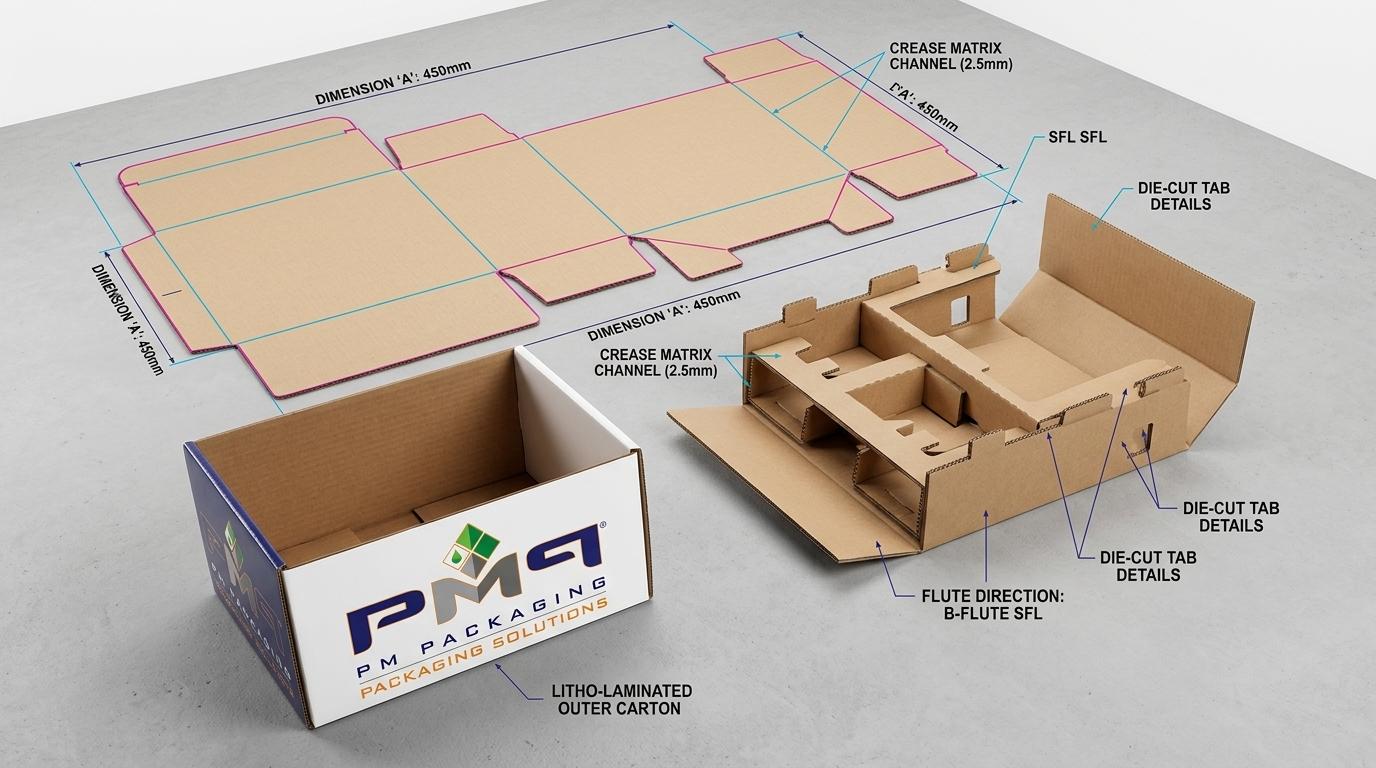
5. 100% Curbside Recyclable Suspension Inserts: Eliminating Foam
Driven by corporate ESG commitments, retailer sustainability scorecards, and state-level bans on expanded polystyrene (EPS), the electric vehicle supply industry is aggressively eliminating plastic foams and single-use plastic clamshells:
The Split-Level All-Corrugated Suspension Tray
6. Print Finishes, G7 Lithography & Anti-Counterfeiting Embellishments
In commercial retail aisles and installer distribution branches, packaging serves as the primary ambassador of clean-tech engineering excellence:
| Print & Coating Parameter | PM Packaging Engineering Standard | Functional Performance Advantage |
|---|---|---|
| Press Technology | Large-Format 6 to 8-Color Sheetfed Offset Lithography | Crisp fine-line electrical schematics and high-contrast typography |
| Color Certification | Certified G7 Master Printer (Idealliance) & GMI Certified | Spectral verification of gray balance and dot gain across press runs |
| Color Tolerance | Strict ΔE < 1.5 against Master Digital PMS Colors | Flawless corporate brand color matching (Clean Blue, EV Green, Obsidian Black) |
| Anti-Scuff Matte Coating | Cross-linked Silicone & Micro-wax Aqueous Emulsion | Prevents van transit chafing, rubbing, and cosmetic tiger-striping |
| Spot Gloss UV Finish | High-Reflective Spot UV Varnish (95+ Gloss Units) | Accentuates wallbox vehicle rendering and key clean-tech branding |
| Installer Provisioning QR | High-Contrast Serialized 2D DataMatrix Windows | Enables pre-unboxing barcode scanning for Wi-Fi pairing and utility rebate claims |
7. Pack-Out Line Velocity & Assembly Economics
For high-volume EVSE manufacturers producing tens of thousands of wallboxes monthly, packaging assembly time directly dictates factory throughput and labor cost:
| Packaging Format | Manual Assembly Time | Pack-Out Cycle Time | Total Packaging Labor Cost / 100k Units* |
|---|---|---|---|
| 2-Piece Rigid Box + EPS Foam | 28–35 seconds | 45–60 seconds | $37,500 – $50,000 |
| Standard Flexo RSC + Foam Corners | 20–25 seconds | 35–45 seconds | $29,000 – $37,500 |
| SFL RETT + 1-Piece Corrugated Tray | 8–12 seconds | 18–22 seconds | $15,000 – $18,500 |
| SFL Auto-Bottom + Pre-Folded Insert | 2.5–4 seconds | 10–14 seconds | $8,300 – $11,600 |
*Labor cost calculated at $25.00/hour fully burdened assembly labor rate.
By transitioning from complex multi-piece foam setups to an engineered SFL Auto-Bottom Carton with an Integrated Fold-Out Suspension Tray, high-volume EV hardware manufacturers reduce total pack-out labor time by up to 76%, saving tens of thousands of dollars per 100,000-unit production run while dramatically boosting manufacturing line capacity.
8. Nearshore Manufacturing, USMCA Compliance & Supply Chain Agility
EVSE supply chains face immense geopolitical, logistical, and regulatory pressures. Federal funding programs such as the National Electric Vehicle Infrastructure (NEVI) Formula Program and the Inflation Reduction Act (IRA) enforce strict domestic content and traceability standards. Concurrently, high shipping volatility and Section 301 tariffs on Chinese packaging make transpacific packaging sourcing a significant operational liability.
- • Lead Time: 10 to 14 weeks ocean freight
- • Tariff Exposure: 25% Section 301 tariffs + port demurrage
- • Working Capital: $250k+ locked up in floating inventory
- • Revision Agility: Artwork & NACS changes require months
- • Lead Time: 1 to 3 days ground freight to US hubs
- • Tariff Exposure: 0% duty (100% USMCA / T-MEC qualified)
- • Working Capital: Minimal via Just-In-Time (JIT) replenishment
- • Revision Agility: Rapid dieline & artwork updates in 24–48 hours
9. Procurement Checklist & Strategic Action Plan for EVSE Brand Directors
Before issuing an RFP or approving production tooling for a residential EV wallbox packaging program, procurement and packaging engineering teams should execute the following technical audit:
| Specification Parameter | Engineering & Procurement Standard |
|---|---|
| Structural Mass & Center-of-Gravity | Calculate dynamic drop energy (56.9 Joules) based on 36-inch ISTA 3A / 6-Amazon drop test |
| Outer Top-Sheet Substrate | 16pt to 18pt Solid Bleached Sulfate (SBS) C1S for photorealistic G7 litho print |
| Fluting Profile & Grade | E-Flute (<20 lbs) or B-Flute (20–30 lbs) with high-crush liners (44–55+ ECT) |
| Box Compression Target (BCT) | Calculated via McKee formula with minimum 4.0:1 working safety factor |
| Curbside Recyclable Suspension | 100% Curbside-Recyclable Split-Level SFL tray eliminating 100% of EPS/EPE foam |
| Retail Handling & Security | Integrated 35+ lb pull-rated handle + embedded RF/AM EAS security tags |
| Pallet Layout & Club Store Compliance | Zero pallet overhang on 48" x 40" wood pallets with 2,500+ lb stacking capacity |
| Logistics & Trade Compliance | 100% USMCA Duty-Free Origin, C-TPAT Fast-Track Clearance, VMI safety stock |
Partner with PM Packaging for Clean-Tech Hardware Scale
Residential EV charging stations and wallboxes represent the premier intersection of high-voltage industrial power and sophisticated consumer electronics. Packaging this high-value, heavy hardware requires structural engineering that eliminates transit drop damage, photorealistic print execution that commands retail shelf authority, and nearshore supply chain agility that shields brand margins from geopolitical volatility.
For more than 45 years, PM Packaging has served as the trusted commercial packaging partner for leading hardware, electronics, and industrial equipment brands across North America. With large-format sheetfed offset lithographic presses, high-speed single-face laminators, certified G7 Master color management, and state-of-the-art manufacturing facilities in Baja California and San Diego, PM Packaging delivers structural rigidity, unmatched retail visual impact, and resilient nearshore supply chain velocity.
Contact PM Packaging's structural engineering and commercial procurement team today to audit your current packaging line, review dielines, receive precision rapid prototypes, and optimize your total landed packaging economics.