
The commercial Heating, Ventilation, Air Conditioning, and Refrigeration (HVAC/R) industry represents a mission-critical aftermarket driven by rigorous energy-efficiency standards (ASHRAE 90.1, Title 24, IECC), indoor air quality (IAQ) mandates, and rapid electrification trends across heat pumps and variable refrigerant flow (VRF) systems.
In commercial environments—hospitals, data centers, cleanrooms, multi-family high-rises, commercial office parks, and educational institutions—HVAC uptime is non-negotiable. When a commercial rooftop unit (RTU), chilled-water air handling unit (AHU), or cooling tower fails, facility operators require immediate, flawless component replacement moving through wholesale distributor branches (Ferguson, Johnstone Supply, Baker Distributing, Winsupply, RE Michel, Lennox Stores, Carrier Enterprise), mechanical contractor service fleets, and direct job-sites.
The Dual Imperative of Commercial HVAC Aftermarket Packaging
- • Carry 15–65 lb concentrated kinetic mass (ECM motors, scroll compressors, pumps)
- • Prevent racking, pleat crush, and frame distortion on MERV 13–16 / HEPA air filters
- • Safeguard ultra-fragile aluminum microchannel coil fins (18–22 fins/inch) from touch damage
- • Protect sensitive electronic controls, VFDs, and sensors from ESD and field vibration
- • G7 Master photorealistic offset lithography (175–200 LPI) for counter POP/PDQ displays
- • Crisp wiring schematics, technical compatibility tables, and GS1-128 scannable barcodes
- • Cleanroom-grade, zero-linting substrates for medical and pharmaceutical air filters
- • Fast-strip, tool-free unboxing dielines accelerating service technician installation velocity
For Directors of Procurement, VP/Directors of Supply Chain, Brand Managers, and Senior Packaging Engineers at major HVAC original equipment manufacturers (OEMs) and aftermarket brands, packaging these components presents an extraordinary engineering paradox: the packaging must deliver heavy-duty structural survival under punishing warehouse stacking and van transit vibration, while projecting premium OEM brand equity and technical clarity across crowded wholesale branch counters.
Traditional packaging formats frequently fail across this spectrum:
- Standard Solid-Fiber Paperboard (SBS/CCNB) lacks the structural beam strength and Box Compression Test (BCT) capacity required to protect heavy motors, multi-pack commercial filters, or delicate heat exchangers, resulting in crushed sidewalls and field returns.
- Direct-Print Flexographic Corrugated suffers from severe flute washboarding, low-resolution printing (50–85 LPI), fiber dust contamination that fouls cleanroom filter media, and zero visual prestige on distributor sales counters.
The definitive, industry-standard solution for enterprise HVAC brands is Litho-Laminated Single Face Laminate (SFL). By combining high-resolution sheetfed offset lithography with the structural physics of microflute (E-flute, F-flute, N-flute) and single-wall corrugated board (B-flute), SFL delivers the photographic visual prestige and fine-type technical legibility of a luxury folding carton alongside the heavy-duty compressive strength, flat crush resistance, and impact absorption of industrial corrugate.
1. Multi-Channel Commercial HVAC Distribution Ecosystem
Commercial HVAC aftermarket components encounter five distinct distribution environments. Each channel imposes distinct structural, mechanical, environmental, and merchandising constraints on packaging architecture:
Master cartons of commercial pleated filters (6-packs and 12-packs), blower assemblies, and fan motors are stacked 3 to 4 pallets high (14 to 18 ft) in unconditioned warehouse bays, requiring calculated BCT ratings exceeding 700–1,200 lbs under 85%+ summer humidity. Front impulse counter zones require high-impact Litho-Laminated SFL PDQ display trays with tear-away transit hoods.
Service vans endure continuous random vibration across roads and potholes. Low-grade corrugate causes tiger-striping and scuffing that destroys barcode legibility. Interior temperatures swing from 130°F–150°F in summer heatwaves to sub-zero winters; packaging substrates and hot-melt glue seams must resist delamination and embrittlement.
Mechanical contractors require rapid unboxing velocity with tool-free tear-tapes and drop-front panels. General contractors enforce LEED v4 zero-EPS mandates, banning plastic foam blocks from job-sites and requiring 100% circular, curbside-recyclable engineered paperboard suspension inserts.
Individual cartons shipped via FedEx/UPS endure 36-inch free-fall drops and conveyor side impacts. Precision-engineered SFL microflute cartons optimize dimensional weight (DIM weight) to prevent expensive courier cubic surcharges on large filter packs and coil assemblies.
2. Product-Specific Structural Mechanics & Vulnerability Engineering
Commercial HVAC replacement components span a wide spectrum of physical characteristics—from ultra-lightweight, high-surface-area filtration media to dense, 50-pound electro-mechanical rotating assemblies. Packaging engineering must target the specific failure modes of each component class:
| HVAC Component Class | Physical Profile | Primary Transit Failure Modes | SFL Packaging Solution |
|---|---|---|---|
| Commercial Air Filters (MERV 8–16, HEPA) | Large surface area (24x24x2", 24x24x4", 24x24x12"), low mass, delicate media | Frame racking, corner rupture, pleat compression, media tear, fiber linting | E-Flute / B-Flute SFL carton with perimeter corner locks & lint-free aqueous top-liner |
| Heavy Electro-Mechanical (ECM Motors, Pumps) | High concentrated mass (15–65 lbs), off-center CG, bare steel shaft | Corner drop blowout, puncture, shaft deflection, mounting lug shear, oil stains | B-Flute / EB Double-Wall SFL with die-cut cradle inserts & grease barrier |
| Microchannel & Tube Coils (Evaporators, Reheat) | High surface area, fragile aluminum fins (18–22 FPI), copper headers | Fin bending (crushed airflow), header cracking, tube pinch, racking distortion | E-Flute / B-Flute wrap-around SFL carton with floating face standoff suspension |
| Electronic Controls & Smart Stats (VFDs, DDC) | Low mass, electrostatic sensitive, optical displays, pin headers | ESD discharge, moisture ingress, LCD cracking, connector shear, face scuffing | Anti-static E-Flute SFL with high-density SBS internal retention partitions |
| Refrigeration Valves & Driers (TXVs, Solenoids) | Dense brass/copper mass (2–12 lbs), sensitive capillary tubes | Thread damage, capillary tube fracture, desiccant breakdown, seal leaks | High-ECT E-Flute SFL with heavy SBS interlocking fold-up retention dielines |
3. Substrate Engineering & Physics: SFL vs. Flexo Corrugated vs. Solid Paperboard
Selecting the optimal packaging substrate for commercial HVAC parts requires evaluating the mechanical physics of corrugated fluting profiles against the graphic reproduction requirements of modern wholesale merchandising:
F-Flute Microflute
Flute tips are spaced closely together so the top sheet exhibits zero flute washboarding. Folds with razor-sharp 90° corners, replacing 24–28pt SBS in smart thermostats, DDC controllers, and commercial expansion valve boxes.
E-Flute Microflute
The industry workhorse balancing high vertical Edge Crush Test (44–55 ECT) with flat crush resistance (70–90 psi). Delivers flexural beam strength preventing filter sag and powers wholesale counter PDQ display trays.
B-Flute & EB Double-Wall
Engineered for heavy components exceeding 15–65 lbs (ECM blower motors, compressors, filter master shippers). Tall flute arches absorb high-G kinetic shock pulses and prevent corner seam blowout.
| Substrate Configuration | Caliper / Flute Pitch | Edge Crush Test (ECT) | Flat Crush Resistance | Print Capability & Finish |
|---|---|---|---|---|
| Solid Bleached Sulfate (SBS) | 20pt – 28pt SBS (0.020–0.028") | N/A (Solid Fiberboard) | Tensile: 120–180 lb/in | 175–200 LPI Sheetfed Litho; 90+ GE Brightness |
| SFL Microflute (F-Flute) | F-Flute (1/32", ~128 flutes/ft) | 38 – 44 ECT | 85 – 110 psi | 200 LPI G7 Master Litho; Zero washboarding |
| SFL Microflute (E-Flute) | E-Flute (1/16", ~90 flutes/ft) | 44 – 55 ECT | 70 – 90 psi | 175–200 LPI G7 Master Litho; Crisp sharp creases |
| SFL Heavy Corrugate (B-Flute) | B-Flute (1/8", ~47 flutes/ft) | 48 – 65+ ECT | 45 – 60 psi | 175 LPI Sheetfed Litho; Maximum kinetic absorption |
| SFL Double-Wall (EB Flute) | EB Double-Wall (3/16", ~0.180") | 70 – 95+ ECT | 90 – 130 psi | 175 LPI Litho; Heavy industrial multi-tier master pack |
4. Structural Dieline Engineering & Interior Protection Architecture
Dieline geometry directly determines both packaging line throughput speed at the OEM manufacturing plant and installation velocity for mechanical contractors in the field:
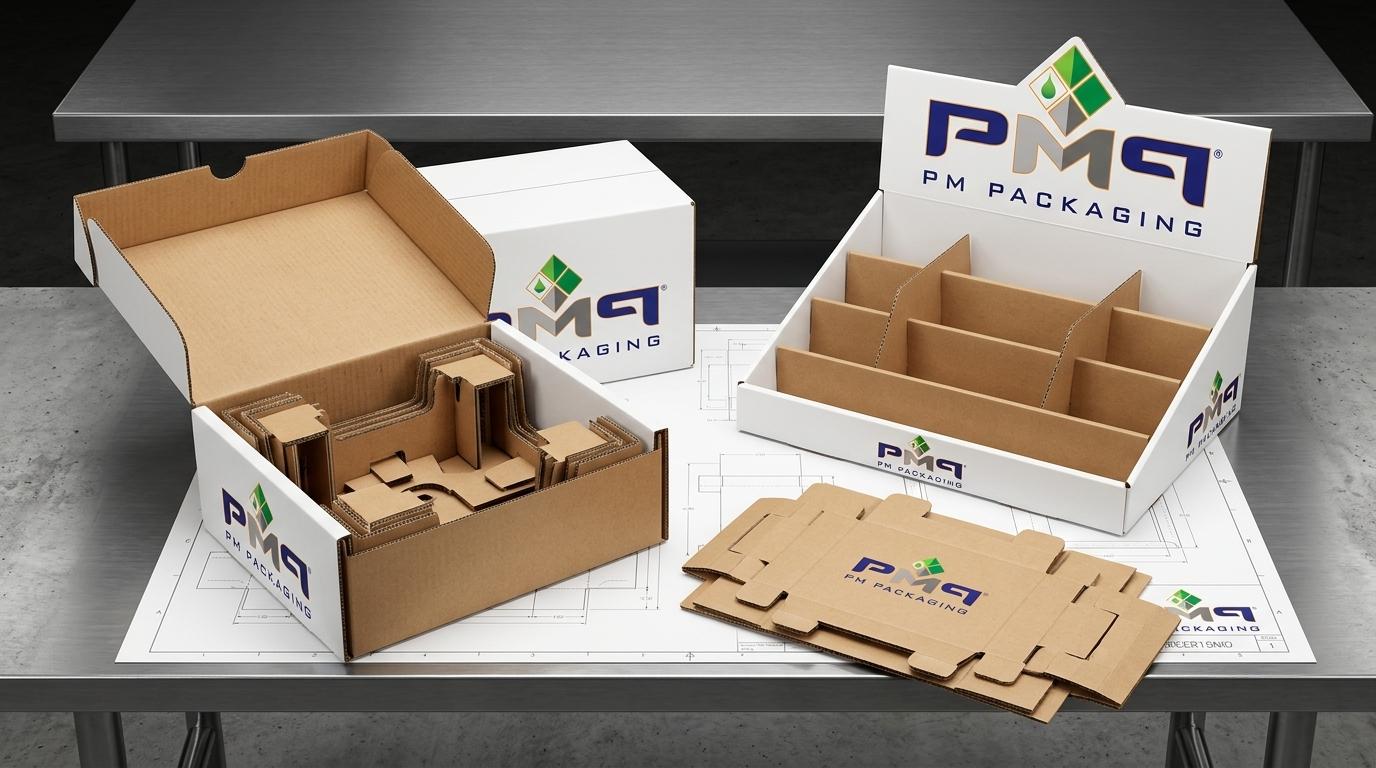
Auto-Bottom Crash Lock
1.5-second manual setup. Push-and-snap bottom eliminates bottom taping and withstands 25–45 lbs push-out forces for heavy ECM motors, TXVs, and circulating pumps.
Straight Tuck End (STE)
Supports 120–250 cartons/minute on automated packaging lines. Dual friction-lock dust flaps seal commercial thermostats, ignition controls, and VFD modules.
Roll-End Tray (RETT) + Hood
Double-wall side construction delivers 30–60 lbs stacking strength. Integrated perimeter tear-away hood converts shipping box into a retail counter display in 3 seconds.
5. Coatings, Surface Chemistry, and Contamination Control
Commercial HVAC components operate in harsh industrial environments, yet demand pristine surface finishes and zero chemical contamination prior to installation:
| Coating Chemistry | Application Technology | Primary Functional Job | Friction / Barrier Rating | Target HVAC Application |
|---|---|---|---|---|
| High-Slip Anti-Scuff Matte Aqueous | Inline Tower (Double-Cooled IR) | Eliminates transit rub on painted/gloss parts | Static CoF: 0.20–0.30; Kinetic: 0.15–0.22 | Thermostat boxes, DDC controller packs |
| Functional Moisture Barrier Varnish | Water-based Emulsion (Anilox) | Prevents humidity fiber softening in warehouses | Cobb Water Absorb: <30 g/m² (30-min) | Commercial filter master shippers |
| Oleophobic Oil & Grease Barrier | Fluorochemical-Free Dispersion | Blocks machine oil bleed-through to outer litho | Kit Rating: 7–9 (TAPPI T559) | Compressor packs, circulating pump cartons |
| Conductive / Anti-Static Coating | Carbon-Free Aqueous Dispersion | Eliminates static ESD charge accumulation | Resistivity: 10^6 – 10^9 ohms/sq | VFD drives, microprocessor PCBs, smart stats |
| Low-Dusting Lint-Free Liner Seal | Sealed Acrylic Polymer Primer | Prevents fiber shedding into cleanroom filters | Zero Shedding (IEST-RP-CC003.4) | Cleanroom HEPA/ULPA filtration packs |
6. High-Impact Retail Merchandising & Counter PDQ Strategy
In wholesale supply houses, counter display placement is the most valuable commercial real estate for driving high-margin aftermarket accessory sales:
The 2-in-1 Shipper-to-PDQ Counter Display Architecture
7. Transit Testing, Quality Protocols & Box Compression Calculations
To guarantee packaging survives commercial distribution without component damage, packaging engineers calculate minimum required Box Compression Test (BCT) using the classic McKee formula:
Standard 32 ECT Kraft corrugate delivers only ~480 lbs BCT under these dimensions, leading to bottom-tier failure. PM Packaging’s 48 ECT E/B-Flute SFL delivers >850 lbs BCT, ensuring zero-defect stacking.
8. Total Cost of Ownership (TCO) & Nearshore Sourcing Strategy
For enterprise HVAC brands sourcing packaging across North America, procurement strategy extends far beyond unit box cost. Sourcing decisions directly impact freight expenses, warehouse cash flow, and emergency summer surge replenishment:
| Financial & Operational Metric | Overseas Sourcing (Asia / China) | PM Packaging Nearshore (US-Mexico Footprint) |
|---|---|---|
| Order-to-Delivery Lead Time | 10 – 14 Weeks (Ocean + Port Clearance) | 1 – 3 Weeks (Production + 1–3 Day Ground Freight) |
| In-Transit Working Capital Lockup | High ($500k–$2M inventory on water) | Minimal (Just-In-Time replenishment cycles) |
| Tariff & Trade Barrier Exposure | Section 301 Tariffs (7.5% – 25%+) | 0% Tariffs (100% USMCA / T-MEC Origin Compliant) |
| Container Demurrage Risk | High ($2,000–$8,000/container port delays) | Zero (Direct dry-van ground freight logistics) |
| Seasonal Surge Agility | None (Air freight costs prohibit surge) | Extreme (48–72 hr surge capacity during heatwaves) |
| Color & Tooling Audit Access | Difficult (14-hr flight, visa delays) | Immediate (Minutes from San Diego Int'l Airport) |
9. Strategic Implementation Roadmap & Procurement Checklist
PM Packaging 4-Phase Onboarding Roadmap
Partner with PM Packaging for Enterprise HVAC Packaging
In the competitive commercial HVAC aftermarket, packaging is far more than a shipping container—it is a vital pillar of supply chain reliability, brand equity, contractor productivity, and revenue protection. Substandard packaging leads to bent coil fins, crushed air filter frames, damaged motor shafts, wholesale distributor returns, and eroded margins.
By partnering with PM Packaging, enterprise HVAC equipment manufacturers and filtration brands harness over 45 years of structural packaging engineering, G7 Master certified offset lithographic printing, advanced single-face lamination technology, and an agile, nearshore US-Mexico manufacturing footprint.
Contact PM Packaging's structural engineering and commercial procurement team to schedule a comprehensive packaging audit, request precision CAD prototypes, or analyze your nearshore supply chain cost savings.