
When an SFL package moves from an initial production run into monthly, quarterly, seasonal, or otherwise recurring orders, the sourcing problem changes. The priority is no longer simply designing the package.
The operational priority becomes maintaining an approved structural, material, print, tooling, and artwork specification while planning each reorder early enough to support the next production requirement. A recurring SFL program should therefore be managed as an ongoing manufacturing specification rather than treating every purchase order as a new packaging project.
The central commercial question is: "How should an established SFL packaging program be managed when the same packaging must be reordered repeatedly throughout the year?"
This guide examines how commercial procurement and packaging engineering teams control approved specifications, manage tooling assets, enforce artwork revision discipline, calculate reorder timing, and evaluate repeat-run quality over the life of an SFL packaging program.
Why Frequent Repeat Orders Change the Way an SFL Program Should Be Managed
During initial development, packaging teams focus on prototyping, graphic design approvals, CAD sample fitment, and initial retailer sell-in. Once structural design is approved and initial production concludes, commercial risk shifts toward maintaining consistency between successive production runs.
When a brand reorders packaging several times a year, subtle process drift can introduce serious supply chain friction:
- Substrate & Raw Material Availability: Paperboard top sheets and fluting mediums require lead-time coordination with paper mills to prevent sudden production gaps.
- Tooling Wear & Identification: Cutting dies and stripping fixtures undergo mechanical wear over hundreds of thousands of impressions and require scheduled maintenance.
- Artwork Version Creep: Uncontrolled file updates can result in obsolete legal copy, incorrect barcodes, or outdated marketing claims reaching press.
- Changed Product or Distribution Conditions: Minor modifications to product weight, secondary inserts, or retailer distribution requirements can quietly invalidate the previous packaging specification.
If the larger challenge is standardizing different SFL structures across a branded product family rather than managing repeat orders of an established specification, see our guide to standardizing high-volume SFL packaging across a branded product line.
What Should Stay Controlled From One SFL Order to the Next?
Repeat-order stability relies on keeping approved parameters locked while establishing explicit rules for what triggers a formal specification review:
| Control Point | What Should Be Defined | What Should Trigger Review |
|---|---|---|
| Flute & Board Construction | Liner caliper, flute profile (N, F, E, or B), and medium grade | Product weight increase, stacking failure, or mill supply shifts |
| Finished Dimensions & Dieline | Locked master CAD vector trace and crease score coordinates | Physical product revision, insert modification, or line clearance issues |
| Inserts & Partitions | Internal buffer caliper, fold sequences, and retention geometry | Accessory changes, internal rattling, or pack-out assembly delays |
| Printed Liner Specification | Paperboard top-sheet basis weight, brightness, and coating receptive layer | Surface cracking on scores, fiber tears, or lamination delamination |
| Approved Artwork Version | Master PDF file name, revision tag, and date-stamped proof | Barcode update, regulatory mandate, claims change, or branding refresh |
| Coatings & Finishes | Aqueous satin, gloss UV, matte, or foil embellishment placement | Scuffing in transit, tape adhesion issues, or aesthetic brand redesign |
| Tooling Identification | Physical die serial number, tool location, and press run count | Dull cutting knives, ragged edges, or crushed flute scores |
| Pack-Out & Pallet Setup | Master carton count, orientation, pallet tie-tier, and stretch wrap | Retailer DC routing guide change or pallet overhang issues |
Structural Specification
The structural foundation of the package must remain unchanged unless a formal re-engineering event is triggered. This includes maintaining exact carton dimensions, approved flute geometry (such as E-flute or B-flute), crease depth, tab friction fits, and internal fitment clearances. Preserving structural consistency guarantees that cartons continue to assemble smoothly without unexpected assembly line friction.
Print and Artwork Specification
Repeat print quality requires locked prepress master files and documented color management standards. Utilizing established G7 color standards ensures that brand colors and ink densities match previous production runs. Any change to copy—whether an updated barcode, a revised ingredient statement, or bilingual regulatory copy—must be managed under formal revision control to prevent obsolete plates from reaching the press.
Tooling and Production Records
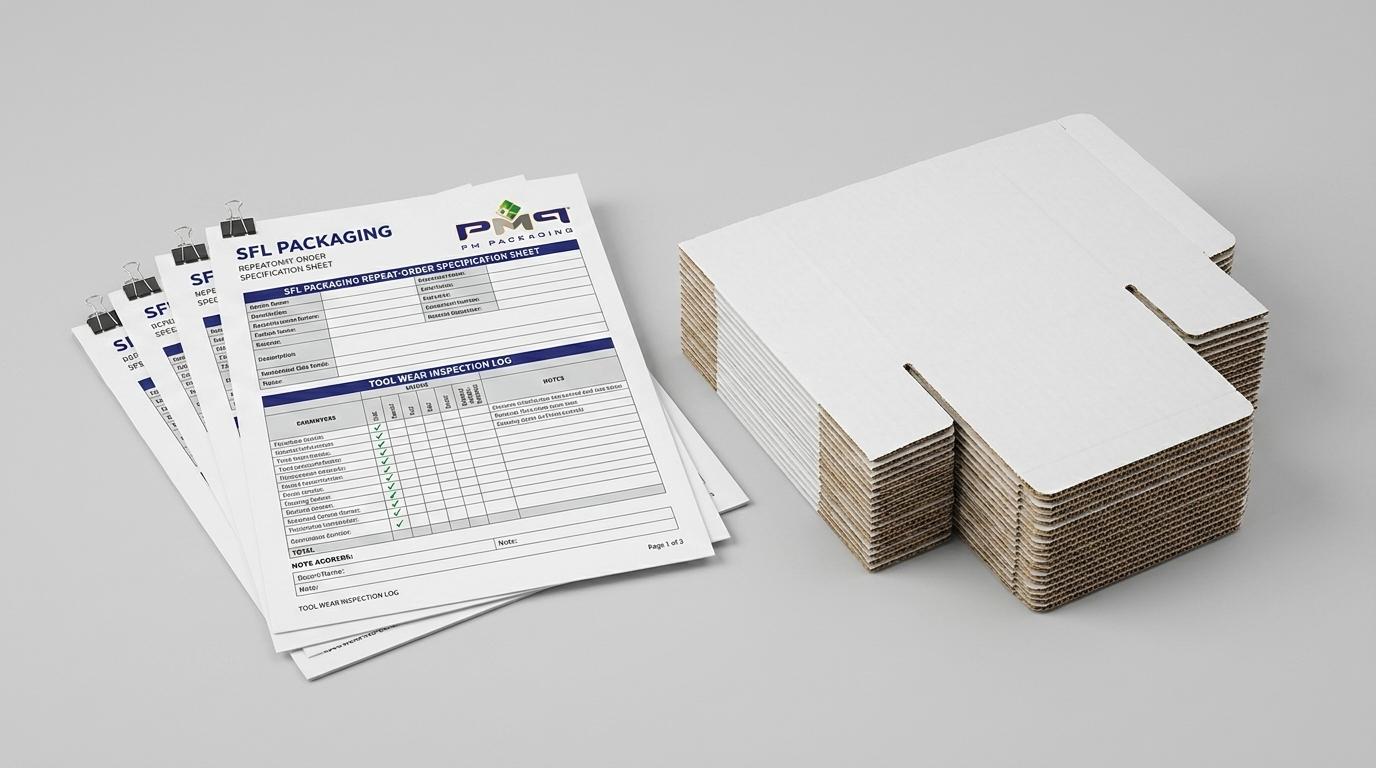
Steel-rule cutting dies and stripping boards are high-precision manufacturing assets. For recurring programs, converters maintain dedicated tooling logs tracking cumulative impression counts, knife sharpness, rubber ejection resilience, and storage conditions. Regular inspection ensures cutting knives produce clean, dust-free edges and scores that fold with uniform resistance across subsequent production cycles.
How Should Buyers Plan the Next SFL Reorder?
SFL reorders should not be placed as last-minute emergency transactions when warehouse stock approaches zero. SFL involves a two-part converting process: lithographic printing of top sheets followed by corrugating lamination, drying, die-cutting, and finishing.
Commercial procurement teams calculate replenishment lead times by auditing key project parameters:
Actual Monthly Consumption Rate: Tracking trailing 90-day warehouse pull rates rather than static annual budget averages.
Raw Material Mill Lead Times: Verifying paperboard top-sheet and corrugating medium mill availability, which can fluctuate seasonally.
Converter Scheduling Windows: Factoring in normal plate imaging, press makeready, lamination dwell time, and die-cutting queue schedules.
Planned Promotional Surges: Alerting the converter 60 to 90 days before major retail promotions to secure machine time ahead of industry peak volumes.
Establishing realistic reorder horizons based on actual mill and manufacturing lead times prevents costly expedited freight and production disruptions.
What Changes Should Trigger a Specification Review Before the Next Run?
A repeat order should never automatically assume the previous specification remains fully valid if external program conditions have shifted.
Sourcing teams should conduct a specification check if any of the following parameters change:
- Product Physical Changes: Modifications to product weight, dimensions, accessory cords, or internal plastic fitments that alter center of gravity.
- Distribution & Retail Routing Changes: Shifting from direct-to-store delivery to cross-dock retail distribution centers where pallet stacking loads increase.
- Fulfillment Line Modifications: Switching from manual pack-out to semi-automated packaging lines with tighter carton opening tolerances.
- Graphic & Regulatory Revisions: Changes to retail barcodes, nutritional or warning disclosures, or marketing claim badges.
Identifying these triggers before issuing a purchase order ensures necessary structural or prepress adjustments occur before ink hits paper.
How Should Artwork and Engineering Changes Be Controlled Between Orders?
When packaging programs run for multiple seasons, artwork updates are inevitable. Poor change control between repeat orders is a frequent root cause of scrapped inventory.
Implement strict revision management protocols between production runs:
Standardized File Nomenclature
Use structured naming conventions embedding SKU, revision letter, and date (e.g., PKG_SFL_SKU101_REV-C_202608.pdf) to eliminate confusion over which file is authorized for production.
Formal Sign-Off & Archiving
Require designated brand and technical sign-offs on final press proofs before imaging plates. Immediately archive and mark superseded files to prevent obsolete artwork from returning to the pressroom.
Disciplined change control ensures that revisions are executed cleanly without disrupting manufacturing schedules or producing non-compliant cartons.
How Should Repeat-Order Quality Be Evaluated?
Quality assurance for repeat production orders requires comparing new production lots directly against approved baseline master standards rather than relying on memory or casual visual inspection:
- Color Verification Against G7 Targets: Comparing printed sheets against approved physical drawdowns and spectrophotometer targets under standard 5000K viewing lighting.
- Lamination & Bond Strength: Testing fiber-tearing adhesion between the printed top sheet and fluted medium to verify durable lamination under varying ambient warehouse temperatures.
- Score Creasing & Fold Integrity: Auditing score stiffness to ensure cartons fold square without flute roll-over or surface liner cracking.
- Assembly & Pack-Out Compatibility: Validating that cartons erect and pack smoothly on the active fulfillment line.
Where distribution performance is critical, testing requirements should be determined based on expected handling and distribution conditions. PM Packaging's Single Face Lamination capabilities include coordinating testing protocols when included in project scope.
When Does Fulfillment or Packaging Inventory Become Part of the Repeat-Order Strategy?
For high-volume consumer brands, receiving an entire annual packaging run in a single shipment is rarely practical. Storing hundreds of pallets of packaging ties up valuable warehouse space and exposes materials to moisture or damage.
In recurring programs, integrating manufacturing with warehousing and staged release logistics creates substantial commercial value:
Scheduled Inventory Releases: Producing larger converting campaigns to capture economies of scale while staging finished cartons for monthly or bi-weekly delivery.
Co-Packing & Kitting Integration: Delivering packaging directly to contract pack-out facilities synchronized with primary product manufacturing schedules.
Palletized Finished-Goods Logistics: Coordinating master shipping cases and pallet patterns directly with downstream retail distribution centers.
When program requirements extend into contract assembly and staging, PM Packaging provides comprehensive fulfillment, packing, palletizing and inventory services to support recurring commercial programs.
Questions to Resolve Before Establishing a Recurring SFL Program
Before finalizing a long-term recurring packaging agreement with your manufacturing partner, resolve the following operational parameters:
- What is the projected annual carton volume and anticipated reorder frequency?
- Which technical specifications (flute, caliper, dieline) must remain strictly locked?
- Who holds formal sign-off authority for artwork and engineering revisions?
- What product, weight, or distribution changes trigger a formal specification review?
- What raw paperboard mill lead times govern replenishment reorder triggers?
- How are physical cutting dies and tooling maintenance records tracked over time?
- Where will packaging inventory be staged (buyer, supplier, or co-packer)?
- What testing protocols are appropriate for expected distribution handling?
Clarifying these operational rules upfront prevents miscommunication and ensures consistent packaging replenishment.
Planning a Recurring SFL Packaging Program
Managing recurring SFL packaging requires aligning annual volume, reorder cadence, approved specifications, and delivery logistics into a cohesive operating framework.
Rather than treating each order as an isolated event, brands that establish formal change-control protocols, maintain tooling assets, and plan replenishment around realistic mill lead times achieve lower total packaging costs and dependable supply continuity.
PM Packaging works with high-volume consumer brands to engineer durable single-face laminate packaging and manage recurring production programs. Explore our manufacturing capabilities on our custom Single Face Lamination packaging capabilities page.
Control SFL Quality Across Every Production Run
Established packaging programs require precision, consistency, and dependable manufacturing execution.
By locking master dielines, enforcing rigorous change controls, and planning replenishment schedules collaboratively, brands maintain premium retail presentation and uninterrupted fulfillment.
Discuss your expected annual volume, reorder frequency, current SFL specification, artwork-change process, and delivery requirements with PM Packaging. Our engineering and production specialists can help structure an optimized recurring manufacturing program.