
A large multi-SKU product line can create packaging complexity long before the first package reaches retail.
Each additional product may introduce another dieline, insert, artwork file, barcode, board specification or packaging quantity. The goal of a multi-SKU SFL program should not be to force every product into the same package. It should be to identify where products can share structural platforms, materials, graphic rules and components—and where product differences genuinely require separate engineering. A defined packaging architecture can reduce unnecessary variation while keeping each SKU easy to identify and appropriately protected.
The primary commercial question is: "How should SFL packaging be standardized across a large product line containing many different SKUs?" In buyer shorthand: we have a lot of different products and packages to manage, and we need an un-bloated packaging architecture.
This guide examines how consumer goods brands organize complex catalogs into structural families, distinguish shared components from SKU-specific variables, design adaptive inserts, maintain unified brand equity across sizes, and manage packaging inventory by SKU.
Why Multi-SKU Packaging Complexity Grows So Quickly
Packaging complexity does not grow linearly with product count—it multiplies. When a brand expands from a single hero product to 20 or 40 SKUs without an underlying packaging architecture, every new product introduction tends to generate its own unique packaging ecosystem:
- Custom Dielines for Every Product: Minor fractional dimension differences lead to dozens of distinct cutting dies, each requiring separate folder-gluer setups.
- Proliferating Internal Inserts: Designing custom inserts for every accessory kit increases tooling costs and creates assembly confusion on fulfillment lines.
- Fragmented Artwork & Inconsistent Branding: Graphic designers adapt logos and legal panels ad hoc, diluting brand recognition across retail shelves.
- Inventory Imbalance & Obsolescence: Ordering unique printed packaging for slow-moving variants ties up capital and risks substantial write-offs when graphics or regulations change.
Build a Product-to-Packaging Matrix Before Standardizing Anything
Before designing dielines or printing plates, packaging engineers and brand managers should audit the entire catalog using a structured matrix to distinguish true product differences from unnecessary packaging differences:
| Product / SKU Group | Shared Structure? | Shared Insert? | Unique Artwork? | Reason |
|---|---|---|---|---|
| Group 1: Handheld Devices (5 SKUs) | Yes (Platform A - F-Flute) | Yes (Universal Tray) | Yes (Model & Color art) | Identical device footprint across models allows complete structural uniformity. |
| Group 2: Specialty Accessories (8 SKUs) | Yes (Platform A - F-Flute) | No (SKU-Specific Die-Cut) | Yes (Unique UPC & Specs) | Shared outer box dimensions maintain shelf uniformity; custom collar secures varying parts. |
| Group 3: Flagship Bundles (3 SKUs) | No (Platform B - E-Flute) | No (Multi-Compartment) | Yes (Hero Bundle Art) | Heavier kit weight and multi-component layout require separate structural engineering. |
| Group 4: Seasonal Gift Sets (2 SKUs) | Yes (Platform B - E-Flute) | No (Gift Tray Insert) | Yes (Promotional Holiday Art) | Reuses Platform B tooling while confining seasonal risk strictly to printed top sheets. |
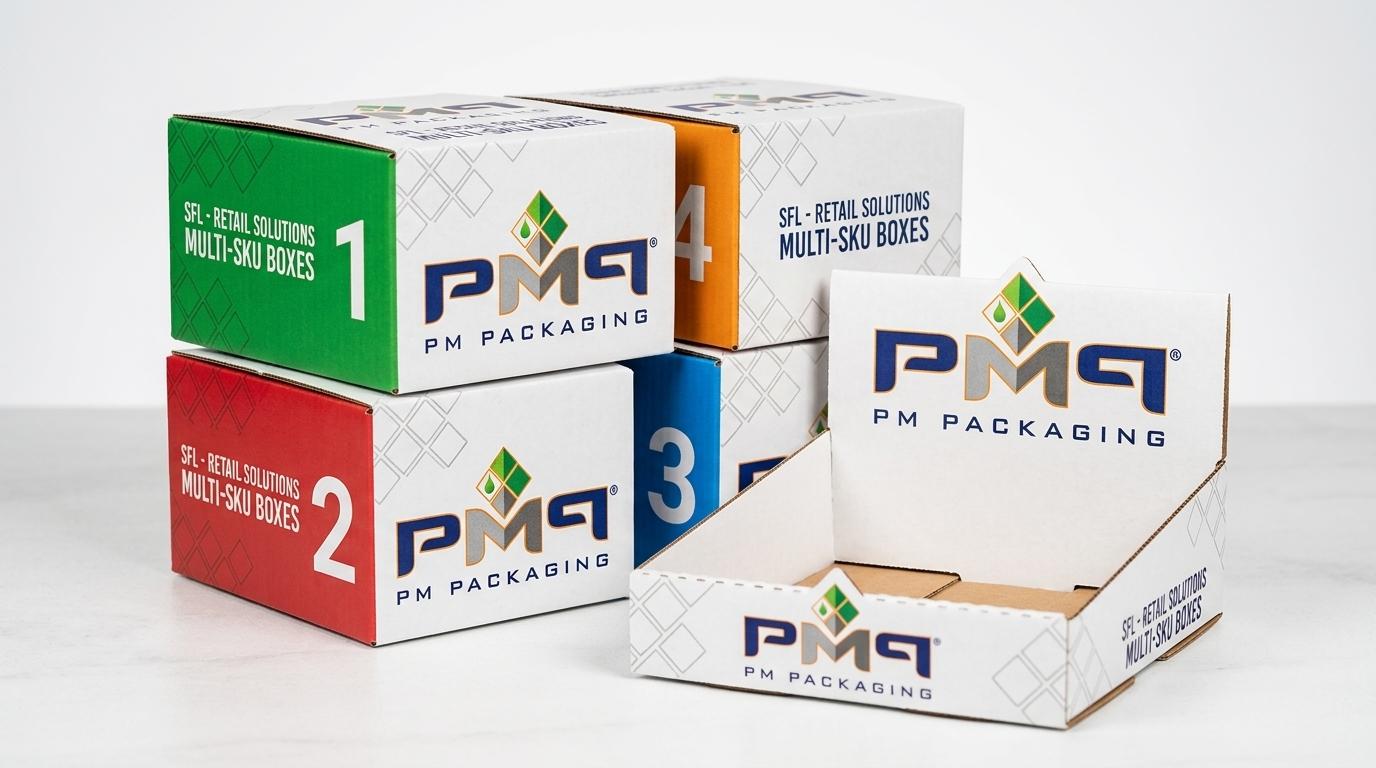
Group Products Into Structural Families
Rather than designing 30 separate boxes or attempting to force every SKU into one awkward size, high-performing multi-SKU programs organize products into logical structural tiers:
- Compact Structural Platform: Designed for lightweight accessories and single units. Utilizes N-flute or F-flute for sharp fold lines and compact retail shelf footprints.
- Mid-Size Structural Platform: Serves core standalone products. Standardizes on E-flute to balance vertical top-load resistance with crisp lithographic print surfaces.
- Heavy / Multi-Item Platform: Houses comprehensive starter kits or heavy glass bottles. Employs B-flute or heavy E-flute with auto-locking bottom tabs.
Standardize Structures Only Where the Loaded Products Actually Support It
Standardization is an operational tool, not an absolute dogma. Forcing dissimilar products into a shared box creates serious supply chain hazards:
- Internal Movement & Damage: If a compact item is placed inside an oversized box, it rattles and shifts during transit, scuffing surfaces or breaking fragile tabs.
- Wasted Freight & Material Cube: Shipping excessive empty air across thousands of units inflates paperboard tonnage, master shipper size, and shipping expenses.
- Weight-to-Board Mismatch: A board grade engineered for a 6-ounce bottle will buckle if loaded with a 3-pound jar, risking carton collapse on retail shelves.
The objective is to establish the fewest justified packaging platforms that safely support the physical variation of the catalog.
Use Inserts to Adapt Shared Packaging Platforms Carefully
Adaptive paperboard inserts allow a brand to maintain a uniform outer carton shell while customizing internal product retention:
- Shared Outer Shell + SKU-Specific Insert: Different accessory shapes share one outer carton dieline. Only the internal die-cut paperboard insert changes, preserving cutting die standardization on the outer carton.
- Universal Multi-Cavity Inserts: A single die-cut tray with knockout tabs or dual-cavity profiles holds several related product geometries, eliminating insert tooling proliferation altogether.
However, inserts add assembly labor. If folding a complex insert requires excessive manual bench time, a slightly different outer carton may prove more economical over high production runs.
Separate Shared Components From SKU-Specific Components
Successful multi-SKU architecture separates packaging elements into shared platform components and SKU-level variables:
| Component | Shared Across Family? | SKU-Specific? | Decision Driver |
|---|---|---|---|
| Structural CAD Dieline | Yes (Across Structural Tier) | No | Reuses cutting dies and folder-gluer setups across multiple printed versions. |
| Flute & Paperboard Spec | Yes | No | Enables aggregated raw material mill orders and consistent converting performance. |
| Printed Top Sheet | No | Yes | Communicates unique product imagery, shade names, ingredients, and barcodes. |
| Master Shipper Case | Yes | No | Standardizes secondary shipper dimensions and pallet cube across all variants. |
| Internal Retention Insert | Partial (Where Geometry Allows) | Partial | Customized only when product shape requires dedicated retention collars. |
Create a Graphic System That Identifies Each SKU Without Fragmenting the Brand
In a large product line, consumer visual navigation is critical. A disciplined graphic system balances brand consistency with clear variant differentiation:
- Fixed Brand Anchors: Keep brand logo placement, corporate typography, and primary color fields locked in identical coordinates across every SKU.
- Dynamic Variant Zones: Restrict SKU-specific elements—such as flavor callouts, model numbers, accent color stripes, or hero product photos—to designated panels.
- G7 Color Management: Utilizing G7 color calibration ensures corporate brand hues match precisely across separate printing plate runs.
Design SKU Identification for Operations, Not Just the Retail Shelf
When cartons look too similar, fulfillment workers, warehouse pickers, and retail stockers can easily mistake one variant for another:
- Side and Top Panel Identifiers: In warehouse racking and retail under-counter storage, cartons are rarely viewed from the front. Printing prominent variant names on side and top flaps prevents picking errors.
- High-Contrast Scannable Barcodes: Place certified GS1 UPC barcodes in uniform locations with clean white backgrounds to ensure rapid handheld scanning during order assembly.
Adapt Artwork Across Different Structural Sizes
Simply scaling artwork proportionally from a large box down to a compact box distorts typography and violates legal copy requirements. Prepress teams should establish size-adaptation rules:
- Preserve Minimum Legal Type: Maintain legible point sizes for ingredients, safety notices, and manufacturer addresses regardless of box scale.
- Proportional Brand Sizing: Scale primary logo marks to fit panel margins without crowding score folds or tuck flaps.
Forecast Packaging Demand at the SKU Level
Aggregating annual packaging demand across all SKUs masks critical velocity differences:
- Core Everyday SKUs: High-velocity variants require steady, recurring production releases to maintain retail supply continuity.
- Niche & Long-Tail Variants: Lower-volume products should be batched conservatively to avoid tying up capital in slow-turning printed stock.
- Seasonal & Promotional Runs: Time-sensitive variants must be planned with strict end-of-campaign run-out dates.
Reduce Obsolete Packaging Risk When the Product Line Changes
Printed packaging obsolescence is the primary hidden cost in multi-SKU portfolios. When a brand prints large batches of unique cartons for 30 different SKUs, any product reformulation, regulatory warning update, or retailer delisting turns inventory into scrap.
Standardizing physical structures mitigates this exposure: even if artwork changes for a specific SKU, existing cutting dies and inserts remain valid for ongoing products, isolating write-offs strictly to printed paperboard sheets.
Plan for New SKUs Without Rebuilding the Packaging System
A robust packaging architecture anticipates future catalog expansion:
- Can the upcoming product fit into an established structural platform?
- Can a new internal insert adapt the new item to an existing outer carton?
- Does the established graphic hierarchy support the new variant identifier cleanly?
- Will the new SKU utilize existing master shippers and pallet configurations?
Where Multi-SKU Standardization Should Stop
Packaging standardization should cease when it compromises product integrity or increases overall program costs. Do not force products into a shared platform if:
- A heavier product causes an otherwise shared carton to bulge or fail top-load tests.
- Excessive internal void space creates significant pallet cube inefficiency.
- An intricate adaptive insert requires more assembly labor than a right-sized separate carton.
Example: Building an SFL Architecture Across a Consumer Product Family
Consider a hypothetical commercial program: an audio brand manufactures 18 distinct products, including wireless earbuds, portable speakers, studio monitors, and multi-component microphone bundles.
Rather than maintaining 18 bespoke carton sizes, the brand engineers three structural platforms:
- Platform A (Compact F-Flute): Houses 8 earbud models and accessory cables using shared outer dimensions and a standardized tuck closure.
- Platform B (Mid-Size E-Flute): Houses 6 portable speaker models, utilizing adaptive paperboard collar inserts to secure different speaker shapes.
- Platform C (Heavy B-Flute): Houses 4 studio monitor and bundle kits with snap-lock bases and integrated multi-compartment partitions.
By consolidating 18 products into three structural platforms, the brand reduces cutting die setups, standardizes master shippers, and maintains uniform retail shelf impact.
Questions to Ask Before Standardizing a Multi-SKU SFL Program
Review these strategic questions with your packaging manufacturer before establishing a multi-SKU platform:
- ✓How many total SKUs exist in the active catalog, and how many new variants are planned?
- ✓Which products share similar dimensions and can logically share a structural dieline?
- ✓Which products have loaded weights that require heavier flute profiles (e.g., E-flute or B-flute)?
- ✓Can internal paperboard inserts adapt varying products into a standardized outer shell?
- ✓Are variant identifiers clearly visible from side and top panels for warehouse pickers?
- ✓What is the projected sales velocity by SKU, and which carry high obsolescence risk?
When the Bigger Problem Is Retail Execution at Scale
Once the SKU architecture is established, a different set of questions appears around pack-out, master cases, displays, distribution handling, store setup and recurring retail supply.
For brands scaling an approved package across national distribution, retail-ready display formats, and planned replenishment, read our operational guide to engineering SFL for a high-volume retail packaging program.
Build an SFL Architecture That Can Grow With the Product Line
Multi-SKU packaging succeeds when brand consistency, structural efficiency, and operational simplicity are balanced across the product line.
Discuss your SKU count, product dimensions and weights, current packaging structures, insert requirements, artwork versions, and expected product-line growth with PM Packaging to build a scalable SFL architecture.
Standardize Your Multi-SKU SFL Portfolio
Partner with PM Packaging's structural engineering specialists to group products into shared platforms, engineer adaptive inserts, and eliminate packaging inventory bloat.