
Packaging capability proves a converter can manufacture your exact dieline and finish—packaging capacity proves they have open press hours and labor to ship 3 million units without delaying your launch.
High-volume procurement teams must evaluate both technical capabilities (folding cartons, SFL lamination, rigid luxury boxes, foil stamping, structural CAD engineering) and net available capacity (press utilization, die-cutter throughput, setup changeovers, paperboard buffers, and multi-shift staffing).
Evaluate technical capability and net available capacity simultaneously.
Uncover hidden line bottlenecks across printing, laminating, die-cutting, foil stamping, and folding-gluing; measure the impact of multi-SKU setup changeovers; and verify equipment redundancy for mission-critical retail rollouts.
Align packaging capability and high-volume capacity with PM Packaging.
What Is Packaging Capability?
Packaging capability defines what a manufacturer is technically equipped to engineer and convert.
It encompasses structural engineering expertise, press color management, substrate versatility, convertibility (folding cartons, SFL, rigid boxes, blister cards), and specialized inline/offline finishing (foil stamping, embossing, soft-touch coatings, windowing).
What Is Packaging Capacity?
Packaging capacity defines how many finished units a converter can reliably deliver within a specified timeframe.
Available capacity factors in current press utilization, bottlenecking operations (die-cutting vs folder-gluers), changeover setup allowances, substrate lead times, warehouse staging space, and multi-shift labor pools.
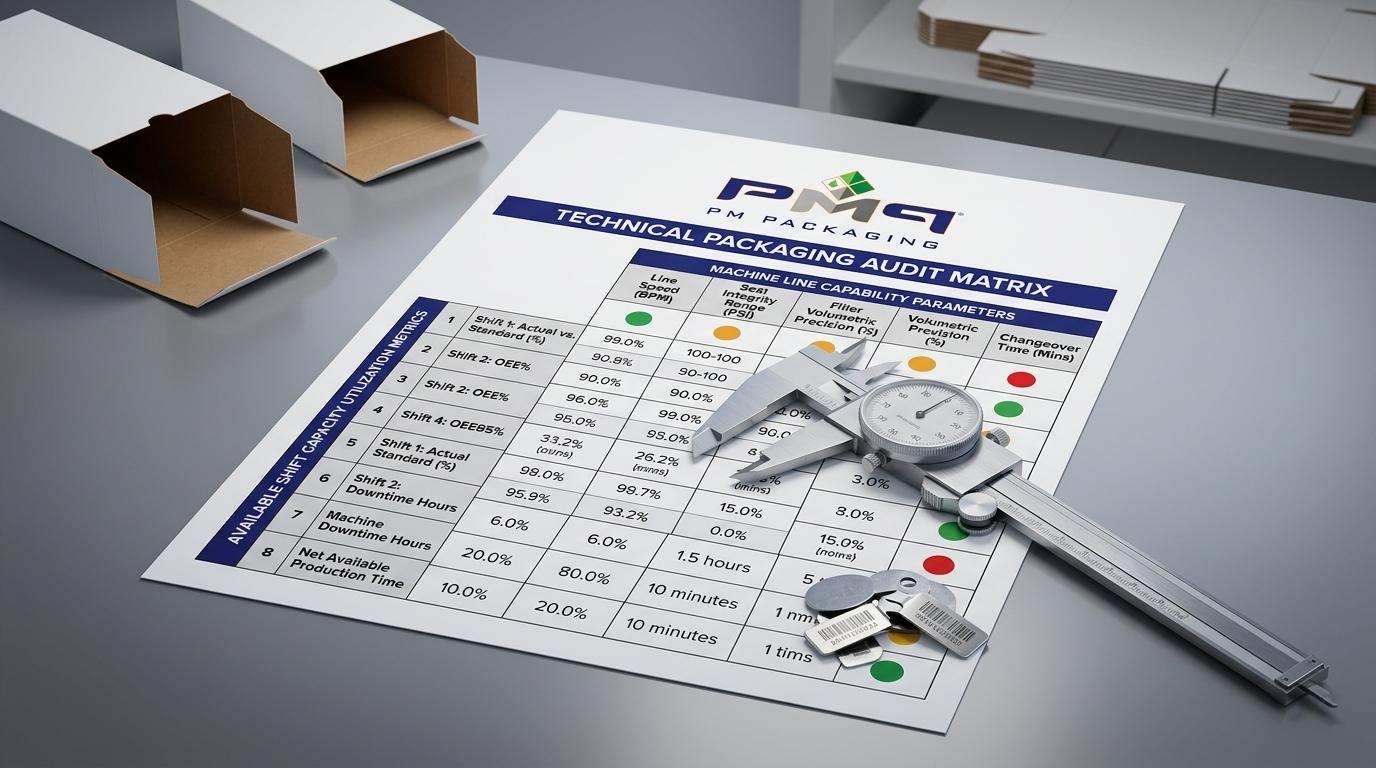
Strategic audit framework:
- Capability Audit: Verify press sheet size, structural CAD, & foil/emboss dies
- Capacity Audit: Measure net available press hours & folder-gluer throughput
- Bottleneck Identification: Map the narrowest manufacturing step from print to pack
- Multi-SKU Setup Impact: Calculate changeover setup deductions across short runs
- Substrate Supply Security: Audit paperboard & corrugated sheet inventory buffers
- Equipment Redundancy: Ensure secondary backup lines exist for critical steps
PM Packaging combines technical capabilities in paperboard folding cartons, SFL packaging, rigid boxes, blister cards, and POP retail displays with scalable high-volume manufacturing capacity.
Discuss Large-Scale Packaging Requirements With PM Packaging
PM Packaging works with consumer product leaders to audit packaging specifications and deliver high-volume commercial runs across diverse retail applications.
PM Packaging offers capability and capacity across:
- Paperboard folding cartons (STE, RTE, auto-bottom, windowed cartons)
- Single-face laminated (SFL) cartons & heavy product packaging
- Rigid luxury packaging, shoulder-neck boxes, & drawer boxes
- Blister cards, paperboard sleeves, & custom structural inserts
- Corrugated retail floor displays, counter units, & PDQ trays
- Co-packing fulfillment, master case packing, & pallet logistics
PM Packaging conducts technical audits to align structural capability with available capacity, guaranteeing 100% on-time execution for national retail programs.
Evaluating Suppliers for a High-Volume Packaging Program?
Capability determines whether a supplier can make your package—capacity determines whether they can deliver millions of units on schedule.
Audit machine capabilities, verify net available press hours, identify bottleneck operations, and ensure equipment redundancy.
Secure the perfect combination of structural capability and commercial capacity.
Evaluating suppliers for a high-volume packaging program? Contact PM Packaging to discuss your packaging requirements, projected quantities, and production schedule. PM Packaging can help evaluate your program to ensure dependable commercial-scale production.