
On modern, high-speed automated packaging lines operating between 200 and 500+ cartons per minute (CPM), secondary packaging is no longer merely a graphic enclosure—it is a high-precision mechanical component.
When an automated continuous-motion cartoner (such as platforms from Syntegon, R.A Jones, Schubert, Marchesini, or Bradman Lake) jams, line efficiency drops catastrophically. The associated Overall Equipment Effectiveness (OEE) losses, line clearances, product scrap, and downtime can cost enterprise brands tens of thousands of dollars per shift.
Packaging engineers and plant operations directors frequently discover that cartoning line jams are rarely caused by the mechanical servos or vacuum cups themselves.
Instead, root causes almost universally trace back to micro-scale structural deficiencies in the folding carton blank:
Misaligned Grain Direction
Causes panel bowing, vacuum feeder mis-picks, and asymmetrical carton squaring (“parallelogramming”).
Improper Crease Matrix Sizing
Results in excessive crease opening force, carton spring-back, or cracked clay surface liners.
Inadequate 180° Pre-Breaking
Leaves residual fiber memory on Scores 1 & 3 that resists square erection inside flight lug carousels.
Hygroscopic Moisture Swings
Alters board stiffness and crease pliability between the converting facility and the packaging floor.
At PM Packaging, drawing on more than 45 years of folding carton engineering and manufacturing experience across our San Diego design headquarters and advanced Baja California converting facilities, we engineer folding cartons to micron-level tolerances.
1. The Physics of Paperboard Fiber Alignment: Machine Direction (MD) vs. Cross Direction (CD)
Paperboard is an anisotropic, viscoelastic material. During the fourdrinier or multi-ply cylinder papermaking process, virgin or recycled cellulose fibers suspended in an aqueous slurry align predominantly in the direction of the moving wire screen. This creates two distinct mechanical axes:
Machine Direction (MD)
Parallel to the paper machine web travel. Fibers are oriented longitudinally, resulting in maximum tensile strength, bending resistance, and stiffness with low moisture expansion.
Cross Direction (CD)
Perpendicular to web travel. Fibers are oriented across their diameters, yielding 30% to 50% lower bending resistance, higher elasticity, and significantly greater hygroscopic dimensional instability.
1.1 The Taber Stiffness Ratio (MD : CD)
The fundamental metric governing carton erection and structural rigidity is Taber Stiffness (measured in Taber Stiffness Units or milliNewton-meters, mN·m, per TAPPI T 489 / ASTM D 5342). For folding boxboard substrates, the ratio of Machine Direction stiffness to Cross Direction stiffness typically ranges from 1.8:1 to 3.0:1:
1.2 Strategic Grain Orientation in Carton Architecture
In high-speed cartoning, blank orientation across the die sheet dictates how the carton erects, fills, and closes. Packaging engineers must optimize grain direction based on the primary mechanical requirements of the cartoning platform:
Carton Blank Grain Orientation Engineering Table
| Structural Feature | Preferred Grain Alignment | Engineering Rationale | High-Speed Impact |
|---|---|---|---|
| Main Body Panels (Front, Back, Sides) | Grain Parallel to Body Creases (Vertical) | Bending resistance is lower across CD, allowing primary body scores to fold effortlessly with minimal opening force (Fo). | Maximizes squareness during rotary vacuum erection; eliminates panel belly bowing. |
| Top & Bottom Tuck Flaps | Grain Perpendicular to Tuck Creases | Flaps retain high MD stiffness along length, resisting deflection when pushed by mechanical tucker blades. | Prevents flap crumpling, corner crushing, and tuck-ear jamming at 350+ CPM. |
| Top-Load Compressive Stacking (BCT) | Grain Parallel to Corner Posts (Vertical) | Columnar load resistance of paperboard is up to 2.5× higher in MD than CD. | Prevents sidewall bulging and carton collapse during case packing and palletization. |
| Rotary Vacuum Feeders | Grain Oriented to Prevent Camber | Wide panels flex along CD. If suction cups pull against excessive CD curl, vacuum seal failure occurs. | Eliminates blank mis-feeds, double-sheet pulls, and vacuum-loss sensor trips. |
Engineering Rule of Thumb: For reverse-tuck (RTE) and straight-tuck (STE) cartons on continuous-motion cartoners, orienting the grain strictly parallel to the primary body score lines minimizes the torque required to break the carton open, ensuring rapid, symmetrical squaring in transport lugs.
2. Creasing Mechanics & Delamination Shear Dynamics
Creasing paperboard is fundamentally different from scoring corrugated board or bending sheet metal. Paperboard cannot be bent cleanly without cracking unless the internal structure is intentionally delaminated within the creasing zone.
The Delamination Shear Zone: 3-Stage Mechanical Sequence
Compressive Indentation
The top liner and clay coating are compressed beneath the rounded crown radius (R = 0.5 × Pt) of the creasing rule without puncturing the surface liner.
Internal Delamination (Z-Direction Shear)
As the board is driven down into the female matrix channel, high shear stress breaks the hydrogen bonds between internal fiber plies, creating a controlled delamination delinking individual layers.
Hinge Formation
When folded 90° or 180°, inner plies buckle inward in a smooth multi-layer female bead while outer plies stretch smoothly over the external radius without clay coat cracking.
3. Mathematical Formulas for Crease Matrix and Counter Die Engineering
Precision tooling requires exact mathematical relationships between paperboard caliper (T), creasing rule thickness (Rt), matrix channel width (W), and matrix channel depth (D).
Equal to uncompressed caliper for SBS/FBB; slightly reduced to 0.95 × T for CCNB/CRB due to higher fiber compressibility.
Where Rt is rule thickness (2-pt = 0.028", 3-pt = 0.042") and k is substrate factor (1.35 to 1.65).
3.3 Crease Tooling Matrix Engineering Table (Imperial & Metric)
The following matrix represents PM Packaging’s standardized die-making specifications for high-speed cartoning applications across standard calipers:
| Caliper (T) | Substrate | Rule (Rt) | Depth (D) | Factor (k) | Calculated Width (W) | Matrix Ref |
|---|---|---|---|---|---|---|
| 14 pt (0.014") | SBS / FBB | 2-pt (0.028") | 0.014" (0.36mm) | 1.50 | 0.049" (1.24mm) | 0.35 × 1.20 mm |
| 16 pt (0.016") | SBS / CUK | 2-pt (0.028") | 0.016" (0.41mm) | 1.50 | 0.052" (1.32mm) | 0.40 × 1.30 mm |
| 18 pt (0.018") | SBS / FBB | 2-pt (0.028") | 0.018" (0.46mm) | 1.50 | 0.055" (1.40mm) | 0.45 × 1.40 mm |
| 18 pt (0.018") | CCNB / CRB | 2-pt (0.028") | 0.017" (0.43mm) | 1.40 | 0.053" (1.35mm) | 0.45 × 1.30 mm |
| 20 pt (0.020") | SBS / CUK | 2-pt (0.028") | 0.020" (0.51mm) | 1.55 | 0.059" (1.50mm) | 0.50 × 1.50 mm |
| 24 pt (0.024") | SBS / CUK | 3-pt (0.042") | 0.024" (0.61mm) | 1.55 | 0.079" (2.01mm) | 0.60 × 2.00 mm |
| 28 pt (0.028") | CUK / SUS | 3-pt (0.042") | 0.028" (0.71mm) | 1.60 | 0.087" (2.21mm) | 0.70 × 2.20 mm |
| 32 pt (0.032") | Heavy SBS/CUK | 3-pt (0.042") | 0.032" (0.81mm) | 1.60 | 0.093" (2.37mm) | 0.80 × 2.40 mm |
4. Crease-to-Board Stiffness Ratio (CBR) and Opening Force Dynamics
On automated cartoning equipment, flat-folded carton sleeves are picked from a magazine by rotary vacuum cups and pulled open into a continuous-motion flight lug carousel. The mechanical resistance of the scorelines determines whether the carton pops cleanly into a perfect 90° rectangle or resists opening, causing vacuum breakaway and line stoppage.
Where Bc = Crease Bending Resistance (90° dwell) and Bb = Board Bending Resistance (15° bend) per TAPPI T 577.
Ruptured Scoreline
Fractured surface liner, panel fluting, ink peeling. Lacks spring-back to stay engaged against flight lugs.
Balanced Erection
Clean 90° squaring, high-speed vacuum pick, continuous flight lug seating at 400+ CPM with zero jam rate.
Rigid Score / Line Jam
Panel belly bulging, vacuum cup breakaway, cartoner feeder trips, and automatic leaflet inserter crashes.
5. Folder-Gluer Pre-Breaking Dynamics (Scores 1 and 3)
Even with mathematically perfect die creasing, a folding carton directly off a flatbed die-cutter possesses high elastic memory. If the sleeve is glued without breaking this memory, the carton behaves like a rigid spring on the packaging line.
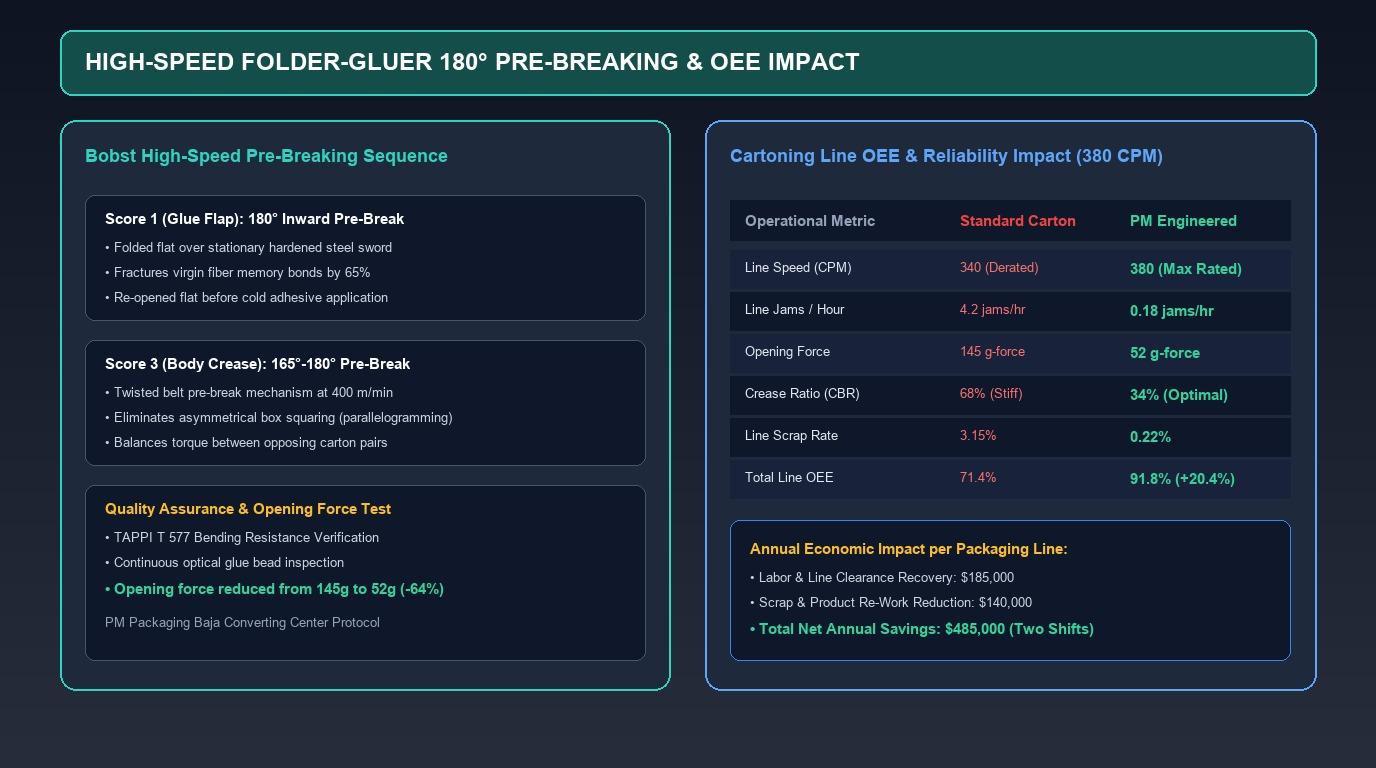
To guarantee high-speed runnability, PM Packaging executes a rigorous pre-breaking protocol on high-speed folder-gluers (such as our Bobst Masterfold and Signature lines) prior to cold-glue extrusion and compression:
Score 1 (Glue Flap Crease) — Full 180° Pre-Break
Folded 180° inward over a stationary hardened steel pre-break sword and reopened flat. Fractures secondary hydrogen bonds, reducing fold resistance by over 60%.
Score 3 (Opposing Body Crease) — 135° to 180° Pre-Break
Folded 135° to 180° inward using high-speed belt twists and reopened prior to reaching the final folding section.
Scores 2 & 4 (Final Seam Creases)
Folded during the final gluing sequence to complete the carton tube with cold PVA adhesive and controlled compression belt curing.
6. Substrate-Specific Matrix Behaviors: SBS, CUK, CCNB, and FBB
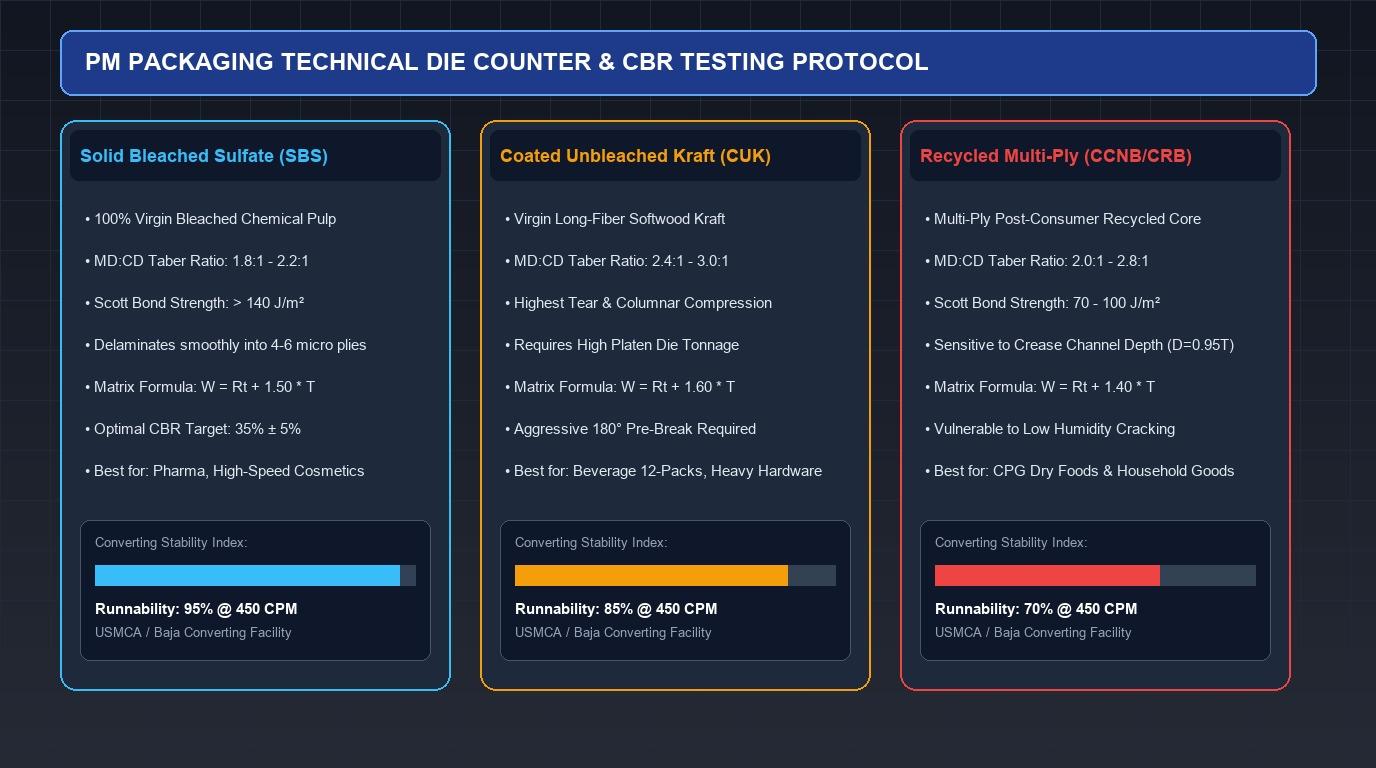
Selecting the correct combination of rule profile, matrix depth, and channel width requires understanding the physical composition and ply bonding of each paperboard substrate:
Solid Bleached Sulfate (SBS)
- 100% virgin chemical softwood and hardwood pulp fibers.
- High Scott Bond ply strength (>140 J/m²). Delaminates cleanly into 4 to 6 micro-plies.
- The gold standard for pharmaceutical, premium cosmetics, and confectionery cartoning.
Coated Unbleached Kraft (CUK / SUS)
- Long virgin softwood fibers with highest tear and puncture resistance.
- Requires wider matrix channels (W = Rt + 1.60 × T) and higher die tonnage.
- Essential for beverage multi-packs (4, 6, 12, 24-packs) and heavy hardware.
Clay Coated Newsback (CCNB / CRB)
- Multi-ply recycled newsprint and mixed paper with short fiber lengths.
- Sensitive to matrix depth; requires precise D = 0.95T to prevent board cutting.
- Widely used in dry foods, laundry cartons, and value consumer goods.
Folding Boxboard (FBB)
- Bleached chemical pulp outer layers sandwiching a bulky CTMP mechanical core.
- Delivers exceptional bending stiffness at lower basis weights.
- High-efficiency alternative to SBS for global brand supply chains.
7. Environmental Hygrometry & Dimensional Creep Controls
Paperboard is hygroscopic; it absorbs and desorbs ambient moisture until it reaches equilibrium with the relative humidity (RH) of the surrounding air. Across a 12-inch wide carton blank, a 4% moisture swing causes a dimensional shift of 0.012 inches (0.30 mm) along the cross direction. On tight-clearance cartoner tucking guides (±0.015"), this expansion causes tuck flap jamming and tucker finger crashes.
PM Packaging Environmental Quality Protocols
8. Case Study: Root-Cause Diagnostics & Cartoner OEE Optimization
A Fortune 500 consumer health brand operating continuous-motion horizontal cartoners at 380 CPM experienced persistent disruptions: line jam rates of 4.2 stops/hour, depressed OEE of 71.4%, and 3.15% product scrap.
PM Packaging forensically identified that the incumbent supplier nested blanks with the grain perpendicular to body scores (causing panel bowing and vacuum loss) and skipped pre-breaking on Score 3.
380 CPM Cartoning Line Performance Optimization
| Performance Metric | Incumbent Carton | PM Packaging Solution | Net Delta |
|---|---|---|---|
| Line Speed (CPM) | 340 (derated) | 380 (full design) | +11.8% |
| Line Stops / Hour | 4.2 jams/hr | 0.18 jams/hr | -95.7% |
| Carton Opening Force | 145 g-force | 52 g-force | -64.1% |
| Crease Ratio (CBR) | 68% | 34% | -50.0% |
| Line Scrap Rate | 3.15% | 0.22% | -93.0% |
| Overall OEE | 71.4% | 91.8% | +20.4% |
Total Validated Annual Savings: $485,000 across two operational shifts (scrap reduction, labor recovery, and OEE gain).
9. High-Speed Cartoning Diagnostic Troubleshooting Matrix
When automated lines experience mis-feeds or structural deformation, packaging engineers can utilize this matrix to isolate root causes between machine mechanical settings and converting tolerances:
| Operational Symptom | Primary Mechanical Root Cause | Converting & Tooling Root Cause | Corrective Action & Verification |
|---|---|---|---|
| Vacuum Cup Dropout at Infeed | Worn suction cups; low vacuum (<18 inHg); feeder timing. | Panel camber due to grain running perpendicular to body scores; low RH curl. | Re-orient layout for parallel grain; verify board moisture 6.5% - 7.5%. |
| Carton Parallelogramming (Out of Square) | Flight lug spacing too wide; worn overhead belts. | CBR > 55%; unequal pre-break between Scores 1 and 3; asymmetrical matrix. | Verify 180° pre-break; recalibrate matrix width W = Rt + (k × T). |
| Tuck Flap Buckling / Crushing | Tucker finger timing too early; guide rail clearance too tight. | Flap grain running parallel to tuck crease (lacks MD columnar strength). | Ensure grain runs perpendicular to tuck score; sharpen tuck score radius. |
| Clay Coat Cracking / Ink Flaking | Excessive folding bar pressure on cartoning line. | Matrix channel width too narrow (W < Rt + 1.3T); shallow matrix depth. | Widen female matrix channel; apply inline soft-crease coating; evaluate SBS. |
| Carton Bulging (“Pillow Effect”) | Over-packing product volume; excess air pressure. | Grain direction running horizontally; score memory pushing panels outward. | Re-orient grain vertically parallel to body creases; verify pre-break forces. |
| Glue Flap Delamination / Pop-Open | Insufficient glue volume; compression belt speed too fast. | Lack of mechanical skiving on high-gloss UV barrier coating; wax migration. | Implement inline mechanical diamond-wheel skiving or plasma corona treatment. |
10. The PM Packaging Nearshore Manufacturing Advantage
For enterprise brands operating high-speed packaging lines in North America, achieving zero-jam converting quality requires tight collaboration between structural engineers, die makers, and line operations:
Advanced Manufacturing Footprint
- San Diego HQ: Structural design, CAD sampling, & engineering.
- Baja Converting Centers: High-volume converting in Tijuana & Mexicali.
- Large-Format Presses: 6-to-8 color litho with G7 Master certification.
- High-Speed Automation: Bobst die-cutters & Masterfold pre-breakers.
Supply Chain Agility & TCO
- 1 to 3 Days Transit: Direct ground freight across West Coast & Southwest.
- 72-Hour Tooling Iterations: Rapid counter adjustments and line validation.
- USMCA / IMMEX Compliant: 100% tariff-free cross-border logistics.
- Certifications: ISO 9001:2015, SQF Food Safety, FSC, & GMI.
Ready to Optimize Your High-Speed Cartoning Runnability?
Achieving maximum OEE on 300+ CPM automated cartoning lines requires eliminating structural variability at the source.
By enforcing rigorous paperboard grain alignment, calculating precision crease matrix geometries, measuring Crease-to-Board Ratios, and executing 180° folder-gluer pre-breaking, packaging engineers transform folding cartons from an operational risk into a competitive advantage.
Contact PM Packaging today to schedule an on-site cartoning line audit, request precision-engineered sample blanks, or discuss nearshore high-volume manufacturing solutions for your brand.