
In modern consumer electronics, hardware ecosystems are defined by modularity, interoperability, and continuous catalog expansion.
Leading brands in smart home automation, high-performance PC gaming peripherals, pro-creator audiovisual gear, connected fitness devices, and modular mobile power systems no longer bring single standalone products to market. Instead, they launch complex families of interconnected devices: primary hub controllers, satellite expansion modules, swappable sensor pods, mounting docks, specialized peripheral grips, and multi-protocol connectivity accessories.
While modular hardware architectures unlock unprecedented market agility and customer lifetime value (LTV), they frequently trigger a silent, catastrophic operational crisis within corporate packaging supply chains: uncontrolled SKU sprawl and packaging dieline proliferation.
The Multi-SKU Packaging Proliferation Dilemma
- •35 Unique SKUs = 35 Bespoke Outer Dielines
- •$140,000+ in Redundant Cutting Die Tooling
- •35 Isolated Print Makereadys & Plate Sets
- •45–60 Min Packing Line Changeover Downtime
- •Mismatched Retail Facings at Best Buy / Target
- •42% Average Pallet Air Void (Wasted Freight)
- •12–16 Week Ocean Transit Lead Times (Asia)
- •35 Unique SKUs = 4 Standardized Outer Boxes
- •Under $18,000 Total Universal Steel-Rule Dies
- •Shared Lithographic Gang Runs (qikCombo™)
- •Sub-5 Minute Universal Jig Changeovers
- •Uniform “Billboard” Brand Presence on Shelf
- •>92% Pallet Cube Utilization (Zero Waste)
- •1–3 Day Nearshore Ground Freight (Baja-to-US)
When every newly engineered hardware variant, regional accessory bundle, or peripheral revision receives a bespoke packaging footprint, brand owners incur compounding financial and logistical penalties. Procurement teams face soaring tooling line-items, fragmented lithographic print volumes that destroy economies of scale, crippling minimum order quantities (MOQs), and massive inventory carrying liabilities. Simultaneously, contract packaging (co-packer) operations stall due to chronic line re-tooling, while retail logistics suffer from chaotic pallet overhang, low cube density, and fragmented retail shelf displays.
For Directors of Packaging Engineering, VP/Directors of Supply Chain, Brand Operations Managers, and Procurement Executives, resolving this challenge requires transitioning from ad-hoc dieline creation to a disciplined Modular Packaging Harmonization Framework.
This comprehensive technical blueprint provides the mathematical, structural, graphic, and supply chain methodology to collapse sprawling multi-SKU catalogs into a streamlined family of standardized outer chassis, universal internal insert platforms, shared lithographic gang-runs, and high-velocity nearshore fulfillment programs—leveraging PM Packaging's 45+ years of converting expertise and dual-region US-Mexico manufacturing infrastructure.
1. The Commercial and Logistical Crisis of Dieline Proliferation
To understand the urgent commercial necessity of dieline harmonization, enterprise leaders must examine the compounding lifecycle costs of bespoke packaging design across five critical operational vectors:
                  THE EXPONENTIAL COST SPIRAL OF UNHARMONIZED PACKAGING

   [ Hardware Engineering ] ──▶ Releases 25 New Modular Ecosystem SKUs / Accessories
             │
             ▼
   [ Ad-Hoc Dieline Design ] ──▶ 25 Unique Box Dimensions (Width × Depth × Height)
             │
             ▼
   ┌───────────────────────────┬───────────────────────────┬───────────────────────────┐
   │    TOOLING & SOURCING     │    PRINT & CONVERTING     │   CO-PACKER FULFILLMENT   │
   │ • 25 Cutting Dies ($75k)  │ • 25 Isolated Press Runs  │ • 45m Line Reset per SKU  │
   │ • 25 Thermoform Molds     │ • 25 Plate & Setup Fees   │ • 25 Custom Jigs Required │
   │ • 25 Custom Shippers      │ • High Sub-MOQ Unit Costs │ • Chronic Line Stoppages  │
   └───────────────────────────┴───────────────────────────┴───────────────────────────┘
             │                                                           │
             ▼                                                           ▼
   [ WAREHOUSE & FREIGHT ] ───────────────────────────────▶ [ RETAIL & SHELF EXECUTION ]
   • 25 Mismatched Master Cases                            • Chaotic Planogram Facing Footprints
   • 35–50% Pallet Air Void Inefficiency                   • Shelf Incoherence at Best Buy/Target
   • High Inbound & Outbound Freight Costs                 • Incompatible Display Trays & Endcaps
1. Tooling Amortization and Capital Expenditure Inflation
In a bespoke packaging strategy, every unique carton, folding sleeve, thermoformed insert, or rigid setup box requires dedicated tooling:
- Steel-Rule Die Sets & Stripping Tooling: $2,500 to $4,500 per folding carton dieline
- Thermoformed Tray CNC Aluminum Tooling: $4,500 to $12,000 per mold cavity layout
- Rigid Box Wrapping Plates & Forming Blocks: $3,000 to $6,000 per bespoke size
- Rotary Corrugated Cutting Dies for Master Shippers: $1,500 to $3,000 per SKU
Across a moderate 30-SKU consumer electronics lineup, tooling capital expenditures quickly exceed $150,000 to $250,000 before a single production unit is converted. When hardware undergoes mid-generation industrial design updates, this tooling is rendered obsolete, resulting in complete asset write-downs.
2. Fragmentation of Print Volume & Inability to Scale Lithography
Offset lithographic printing achieves extraordinary per-unit cost efficiency at high volumes (e.g., 50,000 to 500,000+ impressions) on large-format 6-to-8 color presses. However, when an enterprise splits its volume across 30 bespoke dielines, individual SKU runs collapse into fragmented sub-lots of 3,000 to 8,000 units.
This forces converters to charge separate makeready fees, press wash-up charges, and plate-imaging costs for every run. Brands miss the threshold for gang-run economies of scale, driving per-unit packaging costs up by 40% to 75%.
3. Contract Packaging (Co-Packer) Line Latency and Setup Inefficiencies
On automated or semi-automated packaging lines, every dimension change requires mechanical downtime:
- Adjusting carton magazine feeder rails
- Swapping pick-and-place suction cups and pneumatic stroke lengths
- Resetting automated glue guns and compression belts
- Reconfiguring manual pack-out jigs and operator training SOPs
When a co-packer must re-tool lines every 5,000 units, line utilization drops below 55%, driving up contract packaging labor tariffs and introducing packaging assembly defects during ramp-up phases.
4. Master Shipper Sprawl and Pallet Cube Degradation
Mismatched primary packaging dimensions force procurement to source dozens of distinct secondary master corrugated shippers. Mismatched outer shippers cannot be uniformly interlocked on standard 48" × 40" Grocery Manufacturers Association (GMA) pallets. The resulting pallet footprints suffer from:
- Severe Pallet Under-Hang / Over-Hang: Causing edge crush degradation and transit damage
- Excess Air Void: Shipping “empty volume” across transoceanic containers and domestic long-haul trailers, driving up carbon emissions and Freight-All-Kinds (FAK) tariffs
- Warehouse Slotting Chaos: Distribution centers must maintain dozens of distinct warehouse storage bin sizes
5. Planogram Fragmentation at Mass Retail
When an unharmonized modular hardware family reaches retail displays (e.g., Best Buy, Target, Walmart, Apple Premium Resellers), the lack of dimensional cohesion shatters brand presence. Differing box heights, widths, and depths create an irregular, cluttered shelf silhouette that weakens consumer recognition and makes standardized Point-of-Purchase (POP) PDQ trays or power-wing sidekicks structurally impossible.
2. The Mathematical Foundation of Dieline Harmonization
Dieline harmonization is the engineering discipline of rationalizing an entire hardware portfolio's outer dimensions into a synchronized, mathematically proportional Modular Dimensional Grid (MDG).
                       THE MODULAR PACKAGING DIMENSIONAL GRID (1:2:4 RATIO)

     +-----------------------+   +-----------------------------------------------+
     |                       |   |                                               |
     |   SIZE A: COMPACT     |   |               SIZE B: STANDARD                |
     |   (1x Width, 1x Depth)|   |              (2x Width, 1x Depth)             |
     |   120mm × 100mm × 45mm|   |              240mm × 100mm × 45mm             |
     |                       |   |                                               |
     +-----------------------+   +-----------------------------------------------+

     +-----------------------------------------------+   +-----------------------------------------------+
     |                                               |   |                                               |
     |               SIZE C: EXTENDED                |   |                SIZE D: HERO HUB               |
     |              (2x Width, 2x Depth)             |   |              (2x Width, 2x Depth, 2x H)       |
     |              240mm × 200mm × 45mm             |   |              240mm × 200mm × 90mm             |
     |                                               |   |                                               |
     +-----------------------------------------------+   +-----------------------------------------------+
The Proportional Geometry Grid
A successful harmonization framework establishes a core base unit of measure (X0, Y0, Z0) where all outer carton dimensions function as integer multiples or standardized subdivisions:
By locking dimensions into synchronized aspect ratios (such as a 1:2:4 modular progression), packaging engineers ensure three non-negotiable physical benefits:
- Perfect Tessellation in Master Shippers: Two Size A boxes precisely equal the footprint of one Size B box; two Size B boxes precisely equal one Size C box. A single standardized master shipper carton can hold varying combinations of SKUs with zero internal void space.
- Optimized Pallet Tessellation: Master shippers pack out in interlocking tie-and-high (Ti × Hi) configurations with zero pallet overhang, achieving >92% pallet cubic volume efficiency.
- Retail Shelf Planogram Cohesion: The standardized front facings create a unified, architectural brand presence on retail shelves.
                      MODULAR MASTER SHIPPER TESSELLATION MATRIX

       +---------------------------------------------------------------+
       |             STANDARDIZED MASTER SHIPPER OUTER PROFILE         |
       |                   (490mm × 410mm × 200mm)                     |
       +===============================+===============================+
       |                               |  [ SIZE A ]   |  [ SIZE A ]   |
       |       SIZE C: EXTENDED        |  120×100×45   |  120×100×45   |
       |         240×200×45            +---------------+---------------+
       |                               |  [ SIZE A ]   |  [ SIZE A ]   |
       |                               |  120×100×45   |  120×100×45   |
       +===============================+===============================+
       |       SIZE B: STANDARD        |       SIZE B: STANDARD        |
       |         240×100×45            |         240×100×45            |
       +-------------------------------+-------------------------------+
       * Universal Master Shipper accommodates 100% modular pack combinations with 0% void fill.
The Pallet & Transit Optimization Formula
To calculate the volumetric savings achieved through dieline harmonization, supply chain engineers utilize the Pallet Cubic Efficiency (Peff) formula:
In unharmonized packaging systems, Peff averages between 48% and 62%, meaning over one-third of the freight spend is allocated to transporting air. In a PM Packaging harmonized modular architecture, Peff consistently reaches 88% to 94%, generating immediate six-figure freight savings across high-velocity retail distribution networks.
3. Structural Substrate Selection Across the Harmonized Architecture
Harmonizing outer dielines does not mean compromising on structural rigidity or premium aesthetics. Consumer electronics hardware varies dramatically in density—from ultra-lightweight magnetic wireless charging pucks (80 grams) to heavy metal smart home control hubs and desktop audio amplifiers (1,200+ grams). Packaging engineers must match the structural substrate to the functional weight tier while preserving uniform exterior dimensions.
| Hardware Classification | Weight / Density Tier | Optimal Substrate | Key Engineering Metric |
|---|---|---|---|
| Satellite Sensors / Swappable Modules | Ultra-Lightweight (<150g) | 16pt – 20pt SBS Virgin Paperboard | High folding memory; G7 high-gloss print |
| Primary Core Controllers / Modular Battery Packs | Medium Density (150g – 450g) | 24pt – 28pt SBS or Coated Unbleached SUS | 120+ Taber Stiffness; tear-resistant corners |
| Pro Desktop Docks / Multi-Module Hub Kits | Heavy / Impact Prone (450g – 1,500g+) | Litho-Laminated SFL E-Flute / F-Flute | 32 ECT to 44 ECT; zero crush deflection |
| Flagship Ecosystem Kits / Pro Creator Bundles | Premium Luxury ($250+ MSRP) | 60pt – 80pt Greyboard Rigid Setup Box | >180 lbs BCT; 90° crisp CNC V-groove |
   1. SOLID BLEACHED SULFATE (SBS) FOLDING CARTON (18pt – 28pt)
      ┌────────────────────────────────────────────────────────┐ ◀ Clay Coating (G7 Offset Print)
      ├────────────────────────────────────────────────────────┤ ◀ 100% Virgin Bleached Pulp
      └────────────────────────────────────────────────────────┘ ◀ Smooth White Back Coating

   2. LITHO-LAMINATED SINGLE FACE LAMINATE (SFL) MICROFLUTE
      ┌────────────────────────────────────────────────────────┐ ◀ 12pt–16pt SBS Top Liner (Litho)
      ░░░░░░░░░░░░░░░░░░░░░░░░░░░░░░░░░░░░░░░░░░░░░░░░░░░░░░░░░ ◀ Water-Based Laminating Adhesive
      /\/\/\/\/\/\/\/\/\/\/\/\/\/\/\/\/\/\/\/\/\/\/\/\/\/\/\/\ ◀ F-Flute (1/32") or E-Flute (1/16")
      ──────────────────────────────────────────────────────── ◀ Kraft / White Back Linerboard

   3. LUXURY RIGID SETUP BOX CORE (60pt – 80pt)
      ┌────────────────────────────────────────────────────────┐ ◀ 100lb Litho Art Paper Outer Wrap
      ████████████████████████████████████████████████████████ ◀ 70pt High-Density Solid Greyboard
      └────────────────────────────────────────────────────────┘ ◀ 80lb Woodfree Paper Inner Liner
Substrate Option A: Premium Solid Bleached Sulfate (SBS) Folding Paperboard
Solid Bleached Sulfate is the premier choice for compact-to-midsize consumer electronics modules. Double clay coating on 100% virgin bleached wood fiber delivers an ultra-smooth surface for G7 Master photorealistic printing, fine micro-text, and intricate cold foil embellishments. High Taber stiffness across machine direction (MD) and cross direction (CD) ensures crisp, clean 180-degree pre-breaks and precise tuck-end closure retention, while maintaining 100% FSC/SFI certified curbside recyclability.
Substrate Option B: Litho-Laminated Single Face Laminate (SFL) Microflute
When modular hardware exceeds 450 grams—such as high-capacity external power banks, multi-port Thunderbolt docks, or pro-grade camera motorized heads—standard paperboard suffers from sidewall bowing and corner tearing under drop impacts. PM Packaging laminates a high-resolution printed 12pt to 16pt SBS top sheet to an E-flute (1/16" caliper) or F-flute (1/32" caliper) single-face corrugated structure. This delivers Edge Crush Test (ECT) ratings from 32 ECT to 44 ECT and Box Compression Test (BCT) values exceeding 140 lbs, eliminating the need for bulky double-wall outer packaging while maintaining identical exterior dimensions to adjacent SBS folding cartons.
Substrate Option C: Precision Rigid Setup Box Core with CNC V-Grooving
For flagship ecosystem starter kits and pro-tier creator hardware ($250+ MSRP), PM Packaging converts 60pt to 80pt high-density recycled chipboard cores wrapped in 100lb litho art paper or soft-touch specialty paper. High-speed CNC 90-degree V-grooving cuts through the greyboard core while leaving the outer wrapper paper pristine, delivering razor-sharp 90-degree outer corners. Integrated neodymium disc magnets (NdFeB) paired with hidden steel striker plates deliver an audible, premium unboxing snap.
4. Dieline Architecture Rationalization: The 4-Chassis Framework
By applying dieline harmonization principles, consumer electronics brands can collapse complex catalogs of 30 to 50 individual SKUs into four standardized master outer dielines.
| Dieline Chassis | Footprint (W×D×H) | Primary Packaging Style | Target Hardware Ecosystem SKUs |
|---|---|---|---|
| Chassis 1: “Micro-Module” | 110mm × 85mm × 35mm | Straight Tuck End (STE) with Friction-Lock Dust Flaps | Compact Satellite Sensors, USB Dongles, Earbuds, Pogo Adapters |
| Chassis 2: “Standard Module” | 170mm × 110mm × 45mm | Auto-Bottom Crash Lock with 5th Panel Window Option | Primary Handheld Controllers, Wireless Chargers, Remote Hubs |
| Chassis 3: “Ecosystem Hub” | 220mm × 170mm × 55mm | STE or Glued Sleeve + Rigid Inner Sliding Caddy | Multi-Module Starter Kits, Smart Audio Hubs, Base Stations |
| Chassis 4: “Pro Creator Kit” | 340mm × 220mm × 75mm | Hinged Book-Style Box or SFL Carrying Case | Flagship Bundles, Studio Rigs, Full Modular Accessory Suites |
   CHASSIS 1: STRAIGHT TUCK END (STE)     CHASSIS 2: AUTO-BOTTOM CRASH LOCK
   +---------------------------------+    +---------------------------------+
   |      TOP TUCK FLAP (FRICTION)   |    |      TOP TUCK FLAP (FRICTION)   |
   +=================================+    +=================================+
   | [D1] |       FACE PANEL       | |    | [D1] |       FACE PANEL       | |
   | Dust |      110mm × 85mm      |D2|   | Dust |     170mm × 110mm      |D2|
   | Flap |                        | |    | Flap | (Optional Clear Window)| |
   +------+------------------------+-+    +------+------------------------+-+
   |             BODY PANEL          |    |             BODY PANEL          |
   |            Depth: 35mm          |    |            Depth: 45mm          |
   +=================================+    +=================================+
   |     BOTTOM TUCK FLAP (STE)      |    |  PRE-GLUED AUTO-BOTTOM BASE     |
   | (Tucks rearward; clean facing)  |    |  (Locks automatically in 0.5s)  |
   +---------------------------------+    +---------------------------------+
   * Best for: High-Speed Automated Lines * Best for: Rapid Manual Pack-Out Lines
Chassis 1: Straight Tuck End (STE) with Friction-Lock Dust Flaps
The top and bottom closure flaps fold and tuck directly from the front panel to the rear panel, ensuring a clean, seamless front facing with no visible raw paperboard edges. Engineered with precise score-line allowances (+0.25mm rule offsets), Chassis 1 runs at high speeds (120 to 180 cartons/minute) on automated cartoning equipment. It can also incorporate a fold-away hanging tab (SOM / Euro-slot) for pegged retail displays at Best Buy or airport electronics retailers.
Chassis 2: Auto-Bottom Crash Lock with Optional Clear Window
The bottom panels are pre-glued in PM Packaging's specialized multi-point folder-gluers (Bobst Expertfold). When opened from flat, the bottom flaps snap and lock into a rigid, load-bearing base instantly. This reduces manual carton erection time from 8.0 seconds down to 0.8 seconds per unit (an 800% speed improvement on contract packing lines) while supporting internal hardware payloads up to 800 grams without risk of bottom-panel separation.
Chassis 3: Glued Outer Sleeve with Sliding Rigid Caddy
A two-piece architecture featuring a high-gloss printed 4-sided paperboard sleeve enclosing a rigid SBS or microflute inner sliding caddy tray. This allows the brand to maintain a single standardized internal structural tray while swapping only the low-cost outer printed sleeve for language localizations (English, French, German, Japanese) or carrier-specific branding (Verizon, AT&T, T-Mobile).
Chassis 4: Hinged Book-Style Magnetic Box or SFL Carrying Chassis
Designed for complex modular hardware ecosystems featuring multiple sub-components. Integrates concealed NdFeB magnetic closures, reinforced inner sidewalls, and an optional integrated die-cut handle for consumer grab-and-go portability.
5. Universal Insert Architecture: Engineering Internal Modularity
Standardizing outer box dimensions across diverse hardware SKUs creates a primary mechanical challenge: how to securely immobilize components of varying shapes, sizes, and center-of-gravity profiles within a uniform outer cavity. The solution lies in Universal Internal Insert Architecture—engineering smart, modular insert platforms that adapt dynamically to different product configurations.
| Modularity Strategy | Engineering Substrate | Operating Mechanism | Best Use Application |
|---|---|---|---|
| 1. Universal Base Tray + Modular Collars | 18pt – 24pt Virgin SBS Paperboard | Pre-scored perimeter locks into universal outer chassis frame | High-volume modular accessories with varying heights |
| 2. Multi-Cavity Molded Pulp with Swappable Dies | Thermoformed Dry-Fiber Molded Paper Pulp | Single master mold featuring CNC swappable cavity tool inserts | Plastic-free consumer electronics; FSC corporate ESG programs |
| 3. High-Density Closed Cell EVA with Kiss-Cuts | Antistatic (ESD-Safe) Cross-Linked EVA (38–45 Shore A) | CNC waterjet/routing with micro-perforated customizable knockouts | Heavy pro-audio, precision optics, & creator hardware kits |
   STRATEGY 1: UNIVERSAL SBS BASE TRAY WITH INTERCHANGEABLE NESTING COLLARS
   +-----------------------------------------------------------------------+
   |            UNIVERSAL BASE TRAY PERIMETER (160mm × 100mm)              |
   |  +---------------------------------+  +----------------------------+  |
   |  |     PERMANENT ACCESSORY WELL    |  |   MODULAR HARDWARE NEST    |  |
   |  |   (Braided USB-C / Power Dock)  |  |  +----------------------+  |  |
   |  |                                 |  |  | [Adapter Collar A]   |  |  |
   |  |   Fits 100% of all ecosystem    |  |  | Fits SKU 1: Hub Pod  |  |  |
   |  |   accessory configurations      |  |  | (Swappable in 0.5s)  |  |  |
   |  +---------------------------------+  +--+----------------------+--+  |
   +-----------------------------------------------------------------------+

   STRATEGY 3: MULTI-SKU EVA INSERT WITH KISS-CUT BREAKAWAY SPACER PLUGS
   +-----------------------------------------------------------------------+
   |            HIGH-DENSITY ESD-SAFE EVA FOAM CHASSIS (38 SHORE A)        |
   |  +-----------------------------------------------------------------+  |
   |  |                   UNIVERSAL PRIMARY CAVITY                      |  |
   |  |  +-----------------------------------------------------------+  |  |
   |  |  | [Outer Perimeter]: Fits Flagship "Pro" Model Hardware     |  |  |
   |  |  |  ░░░░░░░░░░░░░░░░░░░░░░░░░░░░░░░░░░░░░░░░░░░░░░░░░░░░░░░░ │  |  |
   |  |  |  ░ [Kiss-Cut Foam Shim Plug]: Removable for "Pro" Model; ░ │  |  |
   |  |  |  ░ Kept in place to snugly secure "Standard" Slim Model  ░ │  |  |
   |  |  +-----------------------------------------------------------+  |  |
   |  +-----------------------------------------------------------------+  |
   +-----------------------------------------------------------------------+
   * Single EVA tool serves 2 to 4 distinct hardware iterations via kiss-cut perimeter plugs.
Strategy 1: Precision-Folded SBS Universal Trays with Modular Collars
By utilizing 100% paperboard folding mechanics, packaging engineers eliminate all plastic blister and thermoform tooling costs. A universal SBS tray forms the outer bounding perimeter, snapping securely into the master chassis. Low-cost, die-cut SBS adapter collars drop into the main cavity. Changing from an audio transmitter to a motorized camera gimbal requires changing only a $0.06 die-cut paperboard collar, rather than engineering a complete packaging system. Integrated retention flaps secure coiled USB-C cables, dongles, and quick-start literature without polybags, twist ties, or tape.
Strategy 2: Molded Fiber Pulp with Modular CNC Tooling Inserts
For enterprise brands with zero-plastic packaging mandates, PM Packaging builds a single master thermoforming mold base ($12,000 CapEx). Instead of machining an entirely new mold for every SKU, engineers fabricate small modular aluminum tool inserts ($1,800 CapEx each) that bolt directly into the master tool frame. This delivers ultra-smooth, particulate-free dry-fiber molded pulp trays with crisp 1.0mm draft angles, full curbside recyclability, and 70% lower tooling costs across multi-SKU lifecycles.
Strategy 3: ESD-Safe EVA Foam with Kiss-Cut Knockout Plugs
For sensitive micro-electronics, optical sensors, and pogo-pin connectors, PM Packaging formulates EVA foam with permanent dissipative ionic additives, maintaining surface resistivity between 106 and 109 Ohms/sq to prevent latent electrostatic gate-oxide destruction during packing and transit. The foam insert is die-cut with concentric, micro-perforated knockout rings. For smaller satellite modules, the foam rings remain in place; for larger pro-grade modules, packing line operators simply push out the center slug, adapting the cavity in 1.0 second.
6. Print Production Economics: Gang-Runs and the qikCombo™ Advantage
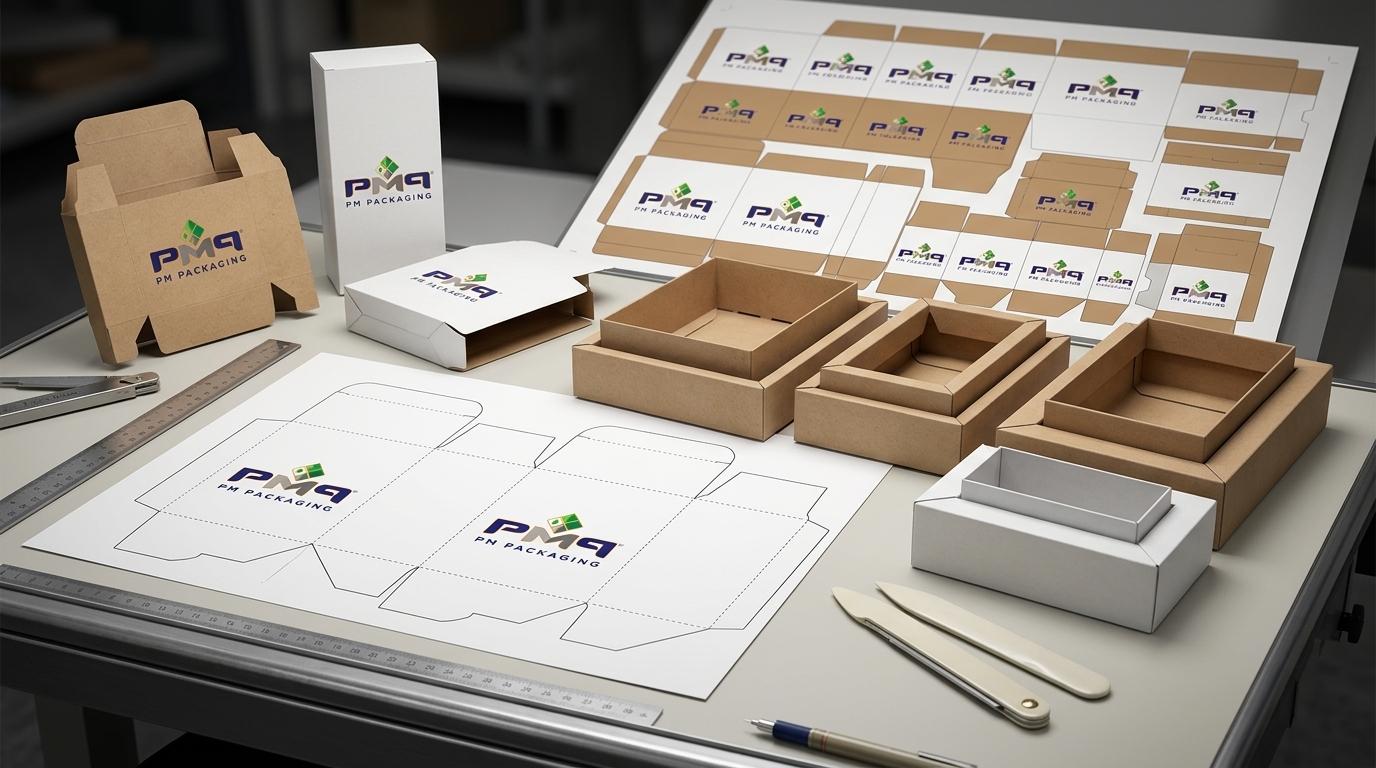
The most immediate financial return of dieline harmonization occurs in the pressroom. When multiple SKUs share identical dielines, sheet layouts, and substrate calipers, procurement teams can transition from costly isolated print runs to high-efficiency offset lithographic gang-runs.
| Print Economics Vector | Unharmonized (Isolated Runs) | Harmonized Gang-Run (PM Packaging) |
|---|---|---|
| 1. Sheet Layout | 1 SKU per sheet (Dedicated) | 4 to 12 SKUs grouped per press sheet |
| 2. Press Makeready Waste | 350 sheets lost per SKU (30 SKUs = 10,500 wasted sheets) | 350 sheets lost once across 8 SKUs (75% paperboard waste reduction) |
| 3. Printing Plate Sets | 30 complete sets (120 plates) • Tooling: ~$18,000 | 4 master plate sets (16 plates) • Tooling: ~$2,400 (-86% CapEx) |
| 4. Press Run Time | 30 setup wash-ups (22.5 hours); high press hourly tariffs | 4 continuous runs (3.0 hours); maximum throughput efficiency |
| 5. Minimum Order Qty | 10,000 units / SKU mandatory | 2,500 units / SKU economically viable |
| TOTAL UNIT PACK COST | $1.48 / Unit | $0.62 / Unit (-58% Savings) |
                LARGE-FORMAT OFFSET PRESS GANG-RUN SHEET IMPOSITION (40" × 56")

    +-------------------------------------------------------------------------+
    |  [ SKU 1: Smart Hub ]  |  [ SKU 1: Smart Hub ]  |  [ SKU 2: Remote Pod ]|
    |   Chassis 2 (Face/Back)|   Chassis 2 (Face/Back)|   Chassis 2 (Face/Back)|
    +------------------------+------------------------+-----------------------+
    |  [ SKU 3: Sensor Kit ] |  [ SKU 4: Power Pack ] |  [ SKU 5: Audio Link ]|
    |   Chassis 2 (Face/Back)|   Chassis 2 (Face/Back)|   Chassis 2 (Face/Back)|
    +------------------------+------------------------+-----------------------+
    |  [ SKU 6: Pro Mic Pod ]|  [ SKU 7: Dock Module ]|  [ SKU 8: Expansion ] |
    |   Chassis 2 (Face/Back)|   Chassis 2 (Face/Back)|   Chassis 2 (Face/Back)|
    +-------------------------------------------------------------------------+
    * 8 distinct product lines produced simultaneously on a single 8-color offset run.
The qikCombo™ Shared Production Architecture
PM Packaging's proprietary qikCombo™ manufacturing program enables consumer electronics brands to gang-run multiple part numbers across shared large-format press sheets:
- Color Consistency via G7 Master Calibration: Running 8 distinct SKUs on a single press sheet requires absolute color management. PM Packaging utilizes Idealliance-certified G7 Master press calibration, closed-loop spectrophotometers, and automated ink-key regulation to lock Delta-E (ΔE) color drift below 1.5 across the entire sheet.
- Dynamic Ratio Imposition: If sales velocity for SKU A is 4× higher than SKU B, PM Packaging allocates 4 sheet positions to SKU A and 1 sheet position to SKU B, producing perfectly balanced replenishment quantities without excess inventory buildup.
- Agile Turnaround: Transforms high-volume folding carton lead times from 8–10 weeks down to 10 business days, allowing brands to respond dynamically to retail demand spikes.
7. Contract Packaging (Co-Packer) Line Velocity & Automation Feasibility
Contract packaging labor and line downtime represent significant components of Total Landed Cost. When primary packaging dielines are unharmonized, co-packer operations become severe bottlenecks.
                       CO-PACKER LINE CHANGEOVER TIME BREAKDOWN

    UNHARMONIZED PACKAGING SYSTEM (45–60 MINUTE CHANGEOVER PER SKU)
    ┌──────────────────────┬──────────────────────┬──────────────────────┬─────────────┐
    │ Machine Rail Re-align│ Glue Head Adjustment │ Jig Swapping / Setup │ Test Cycles │
    │ (15 Minutes)         │ (12 Minutes)         │ (15 Minutes)         │ (10 Minutes)│
    └──────────────────────┴──────────────────────┴──────────────────────┴─────────────┘

    HARMONIZED MODULAR ARCHITECTURE (SUB-5 MINUTE CHANGEOVER PER SKU)
    ┌───────────┬───────────┐
    │ Swap Insert│ Purge Feed│
    │ (2 Min)   │ (2 Min)   │
    └───────────┴───────────┘ (Zero mechanical rail adjustments; universal outer chassis)
Eliminating Automated Cartoning Downtime
On fully automated packaging lines (cartoner → automated leaflet inserter → checkweigher → case packer):
- Zero Mechanical Rail Adjustments: Because the outer carton dimensions (Chassis 2) remain 100% identical whether packaging a smart remote, a charging station, or an audio module, the carton magazine, vacuum feed cups, pusher arms, and discharge belts never require mechanical realignment.
- Universal Vision System Inspection: Automated barcode and optical character recognition (OCR) camera systems remain fixed at a single focal height. Only the digital reference image changes, cutting vision system recalibration time from 20 minutes to zero.
- Automated Case Packing Synchronization: Robotic case packers load master corrugated shippers using permanent end-of-arm tooling (EOAT), completely eliminating gripper tool changeover downtime.
| Operational Parameter | Unharmonized Packaging Catalog | Harmonized Modular Architecture |
|---|---|---|
| Cartoning Line Speed | 45 – 65 Units / Minute | 110 – 140 Units / Minute (+115%) |
| Daily SKU Changeovers | 4 Changeovers @ 50 min = 3.3 hrs downtime | 4 Changeovers @ 4 min = 16 min downtime |
| Effective Shift Run-Time | 4.7 Hours / 8-Hour Shift | 7.7 Hours / 8-Hour Shift (+64%) |
| Pack-Out Labor Cost / Unit | $0.42 / Unit | $0.14 / Unit (-66% Labor Spend) |
| Assembly Defect Rate | 1.8% (Crushed tucks/misaligns) | 0.08% (PPM Quality Level) |
8. Mass Retail Merchandising & Shelf Presence Synchronization
At mass retail (Best Buy, Target, Walmart, Apple Premium Resellers, Costco), brand equity is won or lost on shelf geometry. Dieline harmonization transforms chaotic retail shelving into an authoritative, cohesive “Billboard Effect.”
                      RETAIL SHELF PRESENTATION COMPARISON

    UNHARMONIZED CATALOG: CHAOTIC SHELF SILHOUETTE (WEAK BRAND RECOGNITION)
    +---------+  +---------------+  +-------+  +-------------------+  +-----+
    |  SKU 1  |  |     SKU 2     |  | SKU 3 |  |       SKU 4       |  |SKU 5|
    | (Tall)  |  |    (Wide)     |  | (Low) |  |   (Extra Deep)    |  |(Tiny|
    +---------+  +---------------+  +-------+  +-------------------+  +-----+
    * Fragmented eye tracking; incompatible with standardized PDQ display trays.

    HARMONIZED MODULAR GRID: UNIFIED BRAND "BILLBOARD" PRESENCE
    +-------------------+  +-------------------+  +-------------------+
    |      CHASSIS 2    |  |      CHASSIS 2    |  |      CHASSIS 2    |
    |  Hardware Pod A   |  |  Hardware Pod B   |  |  Hardware Pod C   |
    |   170mm × 110mm   |  |   170mm × 110mm   |  |   170mm × 110mm   |
    +===================+  +===================+  +===================+
    |      CHASSIS 1    |  |      CHASSIS 1    |  |      CHASSIS 1    |
    |   Satellite Mod   |  |   Satellite Mod   |  |   Satellite Mod   |
    +-------------------+  +-------------------+  +-------------------+
    * Architectural symmetry; instant consumer recognition; universal PDQ tray integration.
Universal PDQ Trays and Power-Wing Sidekicks
Retailers increasingly demand that consumer electronics brands deliver products in shelf-ready Point-of-Purchase Display Trays (PDQs). Because Chassis 1, 2, and 3 share mathematically proportional footprints (1:2 aspect ratios), PM Packaging engineers a single universal PDQ tray dieline. The same corrugated PDQ tray holds 8 units of Chassis 2, or 16 units of Chassis 1, or a 4+8 mixed promotional bundle without requiring custom dividers or separate tooling. For club stores (Costco, Sam's Club), harmonized cartons stack in interlocking tiers withstanding >2,200 lbs of dynamic compressive load without corner post collapse.
| Retail Vector | Traditional Unharmonized Catalog | PM Packaging Harmonized System |
|---|---|---|
| Best Buy Planogram Reset | 6 Unique Shelf Depths Required | Single Uniform 8" Shelf Depth |
| Target Endcap Compliance | High Risk of Shelf Overhang | 100% Compliant Drop-In Footprint |
| Walmart PDQ Mandate | 12 Unique PDQ Corrugated Trays | 2 Standardized Universal PDQ Trays |
| Amazon SIOC Compliance | 18 Non-Compliant Box Sizes | 100% Tier 1 / Tier 2 SIOC Certified |
9. Total Cost of Ownership (TCO) Financial Model: Bespoke vs. Harmonized
To demonstrate the financial impact to executive leadership (CFO, VP Supply Chain, Head of Procurement), packaging engineers must evaluate programs using an exhaustive Total Cost of Ownership (TCO) model.
| Cost Driver Category | Bespoke Dieline Strategy | PM Packaging Harmonized Program |
|---|---|---|
| 1. Packaging Tooling (Dies, Molds, Jigs) | 25 Cutting Dies: $87,500 25 Thermoform Molds: $150,000 Subtotal: $237,500 | 4 Universal Cutting Dies: $14,000 4 Master Mold Inserts: $28,000 Subtotal: $42,000 (-82% CapEx) |
| 2. Unit Print Production (Board, Ink, Varnish) | 25 Isolated Litho Runs Avg: $1.32 / Unit Annual: $1,584,000 | Grouped qikCombo™ Gang Runs Avg: $0.68 / Unit Annual: $816,000 (-48.5% Spend) |
| 3. Contract Packaging (Co-Packer Assembly) | $0.38 / unit (High changeover) Annual: $456,000 | $0.14 / unit (Continuous run) Annual: $168,000 (-63.1% Spend) |
| 4. Inbound / Outbound Freight & Logistics | 58% Pallet Cube Efficiency 1,420 Pallets Shipped Annual: $383,400 | 92% Pallet Cube Efficiency 896 Pallets Shipped (-37% Pallets) Annual: $241,920 (-36.9% Freight) |
| 5. Inventory Obsolescence & Working Capital | 4.2% Scrap on EOL / Design Mods Annual: $66,528 | 0.6% Scrap (Universal outer shells) Annual: $4,896 (-92.6% Scrap) |
| TOTAL ANNUAL SPEND | $2,727,428 | $1,272,816 |
| 3-YEAR NET ACCUMULATED SAVINGS | $4,363,836 TOTAL PROGRAM SAVINGS | |
10. Nearshore Supply Chain Velocity: The US-Mexico Advantage
Implementing a harmonized modular packaging architecture requires a responsive manufacturing partner capable of executing agile gang-runs and just-in-time replenishment. Sourcing multi-SKU packaging from transpacific overseas suppliers (China, Vietnam) introduces severe vulnerabilities that undermine dieline harmonization.
| Supply Chain Metric | Transpacific Overseas (China) | Nearshore US-Mexico (PM Packaging) |
|---|---|---|
| 1. Lead Time to US DCs | 10 to 14 Weeks (Ocean Freight) | 1 to 3 Days (Ground Freight) |
| 2. Import Tariffs | 7.5% – 25% Section 301 Tariffs | 0% USMCA Tariff-Free (Duty-Free) |
| 3. Minimum Order Qty | 10,000 – 25,000 Units / SKU | 2,500 Units / SKU via qikCombo™ |
| 4. SKU Version Agility | Slow (60-day lag to update copy) | Immediate (48-hr plate revisions) |
| 5. Working Capital Lock | 90+ Days Tied Up in Ocean Float | Under 10 Days Inventory Cash-Cycle |
| 6. Border Security Clearance | Congested Port Demurrage Risks | C-TPAT & OEA Fast-Track Clearance |
   PM PACKAGING SAN DIEGO HQ          PM PACKAGING ADVANCED CONVERTING
   [ Structural Design & R&D ]        [ Tijuana & Mexicali Facilities ]
             │                                       │
             ▼                                       ▼
   • Precision CAD Dieline Modeling       • Large-Format Offset Litho Printing
   • 3D Digital Virtual Rendering         • Auto-Bottom High-Speed Folding-Gluing
   • ISTA 3A Drop Shock Prototyping       • CNC Foam Routing & Pulp Thermoforming
             │                                       │
             └───────────────────┬───────────────────┘
                                 │
                                 ▼ (Direct Fast-Track Cross-Border Dispatch)
             ┌───────────────────────────────────────┐
             │ C-TPAT / FAST Border Clearance (<2hr) │
             └───────────────────┬───────────────────┘
                                 │
         ┌───────────────────────┼───────────────────────┐
         ▼                       ▼                       ▼
   [ US West Coast DCs ]   [ Silicon Valley R&D ]  [ Texas / Mid-West Hubs ]
       (Next-Day Ground)       (Same-Day Transit)       (48-Hour Ground)
Key Pillars of the PM Packaging Nearshore Footprint
- Dual-Region Engineering & Manufacturing: Headquartered in San Diego, CA with design engineering, rapid prototyping, and customer support, backed by world-class high-volume converting facilities in Baja California (Tijuana and Mexicali).
- 100% USMCA / T-MEC Tariff-Free Compliance: All folding cartons, microflutes, and rigid setup boxes qualify under North American Rules of Origin, completely eliminating Section 301 tariffs and customs exposure.
- IMMEX & Virtual Transfer Integration: Seamlessly coordinates with tier-1 electronics manufacturing service (EMS) providers and contract packagers operating in Baja California maquiladoras via virtual pedimento transfers—delivering zero-tariff secondary packaging directly to assembly lines.
- Vendor Managed Inventory (VMI) Hubs: PM Packaging maintains safety stock of harmonized outer carton blanks in secure border logistics hubs. When hardware production schedules ramp up, localized SKU graphics are printed and finished on demand, slashing packaging inventory holding costs.
11. Engineering Implementation Roadmap for Brand Procurement Teams
To successfully transition an enterprise consumer electronics brand from unharmonized packaging sprawl to a modular harmonized architecture, procurement and engineering teams should execute the following 5-phase roadmap:
Phase 1: Hardware Catalog & Dimensional Audit (Weeks 1–2)
Catalog 100% of current and pipeline SKUs, physical weights, and ecosystem accessories. Map existing pallet efficiencies, box sizes, and historical tooling spend to establish baseline cost metrics.
Phase 2: Modular Grid Formulation & CAD Prototyping (Weeks 3–4)
PM Packaging engineers the 4-Chassis Modular Dimensional Grid. Structural designers develop universal insert CAD dielines and 3D digital virtual fit models for every hardware variant.
Phase 3: ISTA Drop-Shock & Cartoning Line Validation (Weeks 5–6)
Produce physical CAD sample prototypes on production-grade SBS and SFL substrates. Execute ISTA 3A dynamic drop-shock and BCT compression testing. Validate high-speed folding on automated cartoner/co-packer lines.
Phase 4: Gang-Run Imposition & G7 Color Targeting (Weeks 7–8)
Group multi-SKU artwork files onto qikCombo™ master press sheets. Lock G7 Master digital color targets, Delta-E tolerances, and ink densities across all surface finishes.
Phase 5: Full Production Rollout & VMI Buffer Stock (Weeks 9+)
Transition commercial production to Baja California converting plants. Establish VMI safety stock buffers at border logistics hubs to ensure continuous 1–3 day ground replenishment to North American distribution centers.
12. Strategic Conclusion & Partnering with PM Packaging
In the competitive landscape of modern consumer electronics, packaging is no longer a peripheral operational detail—it is a critical driver of gross margin, supply chain resilience, and brand authority. Uncontrolled dieline sprawl and bespoke packaging development waste millions in redundant tooling, fragmented print runs, co-packer downtime, and inefficient freight logistics.
By standardizing on a Modular Dieline Harmonization Framework, enterprise brands unlock transformational business advantages:
- Slash Tooling CapEx by >80% through universal master cutting dies and swappable insert tooling
- Reduce Unit Packaging Costs by 40% to 60% via large-format offset lithographic gang-runs (qikCombo™)
- Triple Co-Packer Line Velocity by eliminating mechanical carton feeder and cartoner realignments
- Maximize Freight & Pallet Cube Density (>92%), shipping products rather than empty air
- Accelerate Time-to-Market from Months to Days by leveraging PM Packaging's nearshore US-Mexico manufacturing infrastructure
PM Packaging at a Glance
- •Headquarters & Design Engineering: San Diego, California
- •Advanced Converting & Manufacturing: Tijuana & Mexicali, Baja California
- •Core Capabilities: Folding Cartons (SBS/CCNB), SFL Microflute (E/F-Flute), Rigid Setup Boxes
- •Specialty Programs: qikCombo™ Gang Runs, Blister Cards, Universal Inserts, POP PDQ Displays
- •Certifications: G7 Master Printer, ISO 9001:2015, GMI Certified, SQF Compliant, FSC/SFI
- •Logistics Advantage: 1–3 Day Ground Freight to US DCs | 100% USMCA Tariff-Free | C-TPAT / OEA
Partner with PM Packaging for Multi-SKU Excellence
With over 45 years of specialized packaging engineering, certified G7 Master printing facilities, ISO 9001:2015 quality systems, and advanced converting plants in San Diego and Baja California, PM Packaging is the definitive manufacturing partner for consumer electronics brands scaling modular hardware ecosystems.
Ready to audit your hardware catalog and eliminate packaging SKU sprawl? Visit pmpackaging.com or connect with our engineering team to model your custom Dieline Harmonization and qikCombo™ production program.