
Across North America’s advanced manufacturing landscape, the industrial mega-corridor of Baja California—anchored by Tijuana and Mexicali—stands as the primary manufacturing and assembly engine for enterprise brands.
Scaling commercial automotive packaging requires targeted engineering: Automotive replacement parts require rigorous corrosion protection, high structural crush resistance for dense cast iron components, and strict barcode readability for automated distribution centers. PM Packaging partners with high-volume brands to ensure G7 color consistency, structural durability, and predictable replenishment.
The Dual-Hub Baja California JIT Packaging Infrastructure
2-4 Hr Milk-RunsStructural CAD Design • Pre-Press & Plate Making • Contract G7 Proofs • Rapid Sample Prototyping
6-8 Color Large-Format Offset Presses • High-Speed Bobst Die-Cutters • Litho-Lamination (E/F/N/B SFL) • Water-Based Heat-Seal Coating • IMMEX • USMCA 100% Origin • ISO 9001:2015 • C-TPAT / OEA
Otay Mesa, El Florido, Valle Bonito • Class I-III Medical, OTC, High-End Electronics • Line-Side Kanban Milk-Runs
Silicon Border, Calexico East, Mexicali II • Aerospace, Automotive Tier-1, Appliances • Local Hub VMI & Heavy SFL
The Penalty of Stockouts & Bloat
- × Expensive Floor Space: $0.85 to $1.20+/sq ft/mo consumed by empty packaging.
- × Idle Assembly Lines: $3,000 to $5,000/hr line downtime from carton shortages.
- × Retail Penalties: 3% to 5% gross OTIF invoice chargebacks for missed distribution.
- × Emergency Air Freight: $20k–$50k chartered air to avert retail stockouts.
The PM Packaging Nearshore Advantage
- ✓ 2 to 4-Hour Milk-Runs: Daily JIT line-side delivery directly to assembly docks.
- ✓ IMMEX Pedimento V1: 0% Mexican IVA, eliminating customs brokerage handoffs.
- ✓ 97% Safety Stock Reduction: Frees up hundreds of thousands in working capital.
- ✓ 45+ Years Converting Mastery: Dual-border engineering and converting scale.
1. The Operational Reality of Baja California Assembly Plants
Rather than treating automotive packaging as generic paperboard, engineering teams must account for product geometry, hanging shelf wear, moisture barriers, and high-speed automated cartoning line tolerances.
Tijuana vs. Mexicali Manufacturing Ecosystem Comparison
| Operational Vector | Tijuana Industrial Cluster | Mexicali Industrial Cluster |
|---|---|---|
| Primary Industry Sectors | Class I-III Medical Devices, OTC Pharmaceuticals, High-End Audio/Electronics, Precision Optics. | Aerospace Systems, Automotive Tier-1/2, Major Appliances, Commercial Power Hardware, Lawn/HVAC Equipment. |
| Primary Substrate Demands | 14pt-24pt SBS Folding Cartons, Trapped/Heat-Seal Blister Cards, Luxury Rigid Setup Boxes with EVA Foam. | Heavy-Duty Litho-Laminated SFL (E/F/B-Flute), 24pt-32pt CUK/SUS Cartons, Reinforced Master Shippers & Pallet Trays. |
| Environmental Operating Conditions | Coastal marine layer; high relative humidity (70%–90% RH); moderate ambient temperatures (55°F–80°F). | Extreme Sonoran Desert climate; summer heat exceeding 115°F (46°C); ultra-low humidity (<15% RH); thermal cycling. |
| Substrate Risk Profile | Moisture absorption, fiber swelling, loss of Taber stiffness, panel bulging, reduced BCT stacking strength. | Moisture loss, fiber embrittlement, score line cracking during 180° folding, hot-melt adhesive crystallization. |
| Pack-Out Velocity Profile | High-speed automated cartoners (250–450 cpm), rotary blister sealers, cleanroom kitting cells. | High-speed cartoners, semi-automated assembly, heavy mechanical pack-out, automated tray formers. |
The Tijuana Hub: High-Mix, High-Velocity, Cleanroom-Adjacent Packaging
Tijuana’s manufacturing corridors—concentrated in Otay Mesa, El Florido, Parque Industrial Pacifico, and Valle Bonito—represent the largest medical device cluster in North America. Secondary packaging staged near Class 7 and Class 8 cleanrooms must exhibit zero paper dust, clean die-cut edges (using micro-perforation and diamond-honed rotary steel-rule dies), and non-shedding aqueous coatings. Packaging runs shift rapidly based on hospital demand and retail signals, requiring agile, serialized lots with 100% GS1 and 2D DataMatrix barcode readability.
The Mexicali Hub: Heavy Hardware, Thermal Extremes & High Structural Demands
Mexicali’s industrial zones—including Silicon Border, Parque Industrial Mexicali, and Calexico East—specialize in heavy commercial hardware, avionics, automotive electronics, and countertop appliances. Products weigh 5 to 50+ lbs, demanding high Edge Crush Test (ECT) and Box Compression Test (BCT) ratings achieved through litho-laminated Single Face Laminate (SFL) microflutes (E, F, and B-flute). Packaging must be engineered with moisture conditioning so paperboard scores do not crack under 115°F+ dry desert heat.
2. Supply Chain Architecture: Offshore vs. Cross-Country vs. Nearshore Baja
PM Packaging manufactures engineered automotive parts packaging, line-side kits, and retail aftermarket cartons with certified Delta-E color consistency and high-speed box converting. High-speed gang printing and shared dielines reduce per-unit tooling costs while clear technical graphics guide buyers directly to the correct model.
Transpacific Offshore
- Lead Time: 8 to 14 weeks
- Ocean freight + port demurrage
- Double customs crossings & Section 301 tariffs
- High minimum order quantities (MOQs)
U.S. Domestic / Midwest
- Lead Time: 2 to 4 weeks
- Cross-country freight ($4k–$7k/truck)
- Border brokerage handoffs & IVA outlays
- Limited on-site engineering support
Local Baja Integrated
- Lead Time: 1 to 3 days (Replenishment)
- Transit: 2 to 4 hours (Milk-runs)
- IMMEX Pedimento V1 (0% Mexican IVA)
- 100% USMCA Origin & Same-Day Support
The True Cost of “Shipping Empty Air”
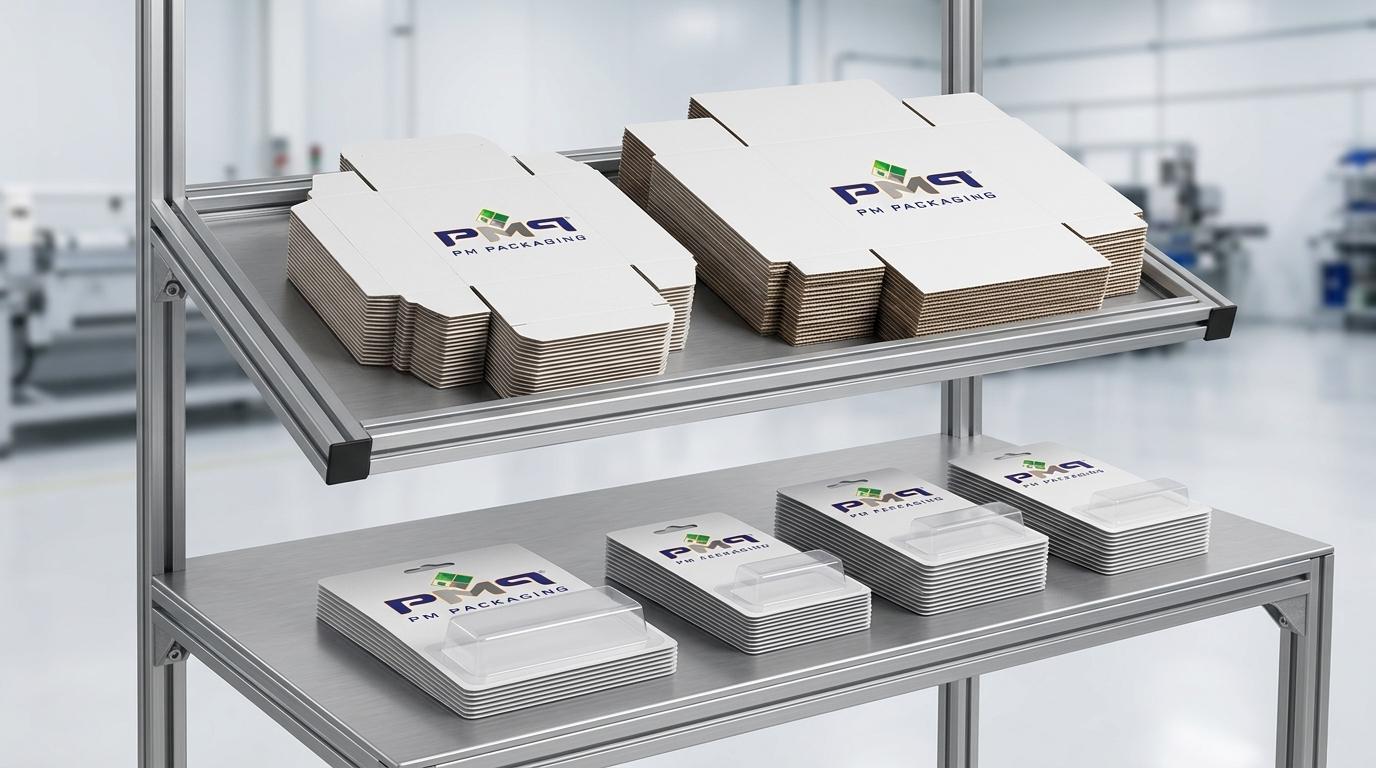
Packaging materials are inherently high-volume, low-density products. Shipping packaging blanks across the Pacific Ocean or across the United States forces brands to pay premium freight rates to transport air. In a volatile freight market, ocean container spot rates ($4,000 to $12,000+ per 40ft container) add $0.04 to $0.18 in pure freight overhead to every folding carton. PM Packaging converts paperboard substrates directly in Baja California from compact mill rolls, passing massive freight savings directly to buyers.
3. Regulatory Mechanics: IMMEX Virtual Transfers, USMCA & Customs Synchronization
Procuring packaging for Mexican assembly plants requires navigating specialized customs and tax frameworks. Missteps lead to unexpected value-added tax (IVA) assessments, customs fines, and border impoundments.
Customs & Regulatory Synchronization Workflow
PM Packaging (IMMEX entity) ships secondary packaging directly to your Tijuana or Mexicali assembly plant via dedicated milk-run trucks.
Transferencias Virtuales executed under Pedimento Clave V1. 0% Mexican IVA applied; zero physical border crossing required for packaging delivery.
Assembled products packed in 100% USMCA-origin packaging clear into the U.S. tariff-free under Form 434 via C-TPAT / FAST lanes.
IMMEX Virtual Transfers (Pedimentos V1)
Under Mexico’s foreign trade regulations, IMMEX-certified assembly plants are exempt from paying the standard 16% Value-Added Tax (IVA) on raw materials and components, provided finished goods are exported. When buying packaging from uncertified suppliers outside Mexico, bringing boxes across the border requires paying import duties, brokerage fees, and posting IVA bonds. As an IMMEX-certified manufacturer operating within Baja California, PM Packaging executes Transferencias Virtuales using Pedimentos Clave V1, completely eliminating border wait times, broker fees, and cash-trapping IVA outlays.
100% USMCA / T-MEC Tariff-Free Compliance
When finished goods cross back into the United States through Otay Mesa or Calexico, packaging materials are scrutinized under USMCA Rules of Origin. If packaging from China or Southeast Asia is integrated into a product assembled in Mexico, it fails North American Regional Value Content (RVC) tests and can jeopardize the tariff-free status of the entire finished product. PM Packaging utilizes virgin and recycled paperboard sourced exclusively from certified North American paper mills (FSC and SFI certified), backed by complete USMCA Certificates of Origin (CBP Form 434 compliance).
C-TPAT & OEA Fast-Track Clearance
PM Packaging maintains Tier-II/Tier-III C-TPAT certification with U.S. Customs and Border Protection and OEA certification with Mexico’s SAT. Dedicated commercial FAST lanes at Otay Mesa and Calexico East reduce border crossing transit times from 6–10 hours during peak congestion to under 45 minutes, ensuring uninterrupted daily replenishment.
4. JIT Inventory Replenishment Frameworks & Safety Stock Mathematics
To eliminate warehouse bloat in Tijuana and Mexicali while insuring against stockouts, procurement teams deploy structured pull-replenishment architectures.
JIT Packaging Replenishment Methodology Matrix
| Program Model | Inventory Ownership | Replenishment Trigger | In-Plant Footprint | Best-Fit Application |
|---|---|---|---|---|
| Local Hub VMI (Vendor-Managed) | Supplier (PM Pkg) until scanned at line | Real-time ERP min-max consumption signals | 1 to 2 days line-side; zero warehouse | High-volume runner SKUs (Top 20% volume) |
| Two-Bin / Pallet Line-Side Kanban | Plant Owned / Scanned upon transfer | Visual barcode scan of empty pallet tag | 2 to 3 pallet positions per active line | Steady-state automated cartoning lines |
| qikCombo™ Shared Production Runs | Plant Owned upon delivery batch | Scheduled production cycles (10-day cycle) | 3 to 5 days safety stock in local hub | Multi-SKU catalogs, regional language SKUs |
| Emergency Surge Safety Stock | Supplier Reserved Buffer Agreement | Expedited ERP order release (<24 hrs) | Zero footprint; staged at PM Baja plant | Retail promotions, holiday volume spikes |
Safety Stock Optimization Formula
Where SS = Required Safety Stock (units), Z = Service level factor (2.33 for 99% fill-rate target), L = Replenishment lead time (days), σD = Demand standard deviation, D = Average daily demand, and σL = Supplier lead time variance.
Safety Stock Requirement Comparison (100,000 Units/Day Demand)
| Parameter | Offshore Supplier (Asia) | PM Packaging Nearshore (Baja) |
|---|---|---|
| Average Daily Demand (D) | 100,000 folding cartons | 100,000 folding cartons |
| Average Lead Time (L) | 70 days (Ocean + Customs + Dray) | 2 days (Local Nearshore Milk-Run) |
| Lead Time Variance (σL) | 14 days (Port congestion, holds) | 0.25 days (Dedicated freight) |
| Required Safety Stock (SS) | 3,284,500 units | 71,400 units (>97% reduction) |
| Warehouse Footprint Required | 55 to 65 Pallet Positions | 2 to 3 Pallet Positions |
| Working Capital Locked in Buffer | $821,125 (@ $0.25/carton) | $17,850 (@ $0.25/carton) |
5. Structural Engineering & Substrate Science for Baja’s Harsh Climates
Secondary packaging staged on high-speed assembly lines in Baja California must perform flawlessly under challenging environmental and mechanical conditions. PM Packaging engineers substrates specifically for the physical stresses of the region.
Environmental Substrate Engineering Matrix
| Environmental Stressor | Failure Mechanism Without Control | PM Packaging Engineered Solution |
|---|---|---|
| Mexicali Desert Heat (>115°F / <15% RH) | Moisture drops below 4.5%; paperboard fibers become brittle; 180° score lines split. Hot melt glues crystallize and pop. | Controlled humidification chamber storage; calibrated crease matrix depth/width ratios; high-tack heat-resistant hot melt glues stable to 160°F (71°C). |
| Tijuana Coastal Marine Layer (70%–90% RH) | Moisture exceeds 9.5%; fiber matrix swells; Taber bending stiffness drops 25–40%; cartons bow and vacuum cups fail to erect square. | High-barrier inline aqueous/UV seal coats; grain direction parallel to main carton scores; virgin fiber SBS/CUK substrate formulation. |
| Cleanroom Staging (Class 7/8 Medical Devices) | Airborne particulate shedding from rough die-cuts or unsealed edges contaminates sterile cleanrooms. | 100% micro-perforated diamond die-cut edges; full-bleed aqueous edge sealing; anti-static de-ionizing air blowers on gluers. |
| High-Speed Automated Cartoning (250–450+ cpm) | Spring-back memory resists vacuum opening; carton misfeeds and jams packaging plows, halting line. | 180° in-line mechanical score pre-breaking on creases #1 and #3 on high-speed Bobst folder-gluers; opening force strictly < 40 gf/cm. |
Substrate Selection Guide for Assembly Pack-Out
| Packaging Format | Caliper / Flute | Target Product Weight | Key Structural Advantage | Assembly Velocity |
|---|---|---|---|---|
| Straight Tuck (STE) Folding Carton | 14pt - 22pt SBS / FBB | 0.1 lbs to 2.5 lbs | High-speed automated line feeding; clean aesthetics | 250 - 450+ cpm on continuous cartoners |
| Auto-Bottom (Crash Lock) Folding Carton | 18pt - 28pt SBS / CCNB / CUK | 1.0 lbs to 6.0 lbs | 1-second manual snap lock; 75% labor savings | 25 - 45 units/min per manual station |
| Litho-Laminated SFL Microflute Carton | F-Flute (1/32") / E-Flute (1/16") SBS | 3.0 lbs to 15.0 lbs | High crush resistance; retail shelf impact | 60 - 150 cartons/min automated/manual |
| Litho-Laminated SFL Heavy Master Box | B-Flute (1/8") / Double Wall Micro | 10.0 lbs to 45.0 lbs | Replaces brown master shippers; club pallet ready | Manual packout / automated case sealer |
| qikCombo™ Blister Cards (Trapped/Seal) | 20pt - 26pt Heat-Seal Coated SBS | 0.2 lbs to 3.0 lbs | High visual theft deterrence; automated sealing | 15 - 35 cycles/min on rotary sealers |
| Luxury Rigid Box (Magnetic / Shoulder) | 40pt - 100pt Chip wrapped in Art Paper | 0.5 lbs to 8.0 lbs | Ultra-premium unboxing; custom EVA foam kitting | Staged pre-assembled; direct manual pack |
6. Managing Multi-SKU Complexities: The qikCombo™ Program
Assembly operations in Baja California frequently manage expansive product catalogs with dozens or hundreds of active SKUs—ranging from regional language variations to multi-voltage hardware SKUs.
qikCombo™ Gang-Run Packaging Architecture
Large-Format Offset Lithographic Combo Sheet (60" x 40" Master Press Sheet)
7. Total Cost of Ownership (TCO) Financial Model
When evaluating packaging proposals for Tijuana and Mexicali assembly plants, sophisticated procurement executives look beyond the initial piece price on a purchase order. They quantify the Total Landed Cost of Ownership (TCO).
Total Cost of Ownership (TCO) Breakdown (Annual 5,000,000 Units)
| Cost Component | Offshore Supplier (Asia) | PM Packaging Nearshore Program |
|---|---|---|
| Base Purchase Order Price (5M units) | $1,050,000 ($0.21/ea) | $1,150,000 ($0.23/ea) |
| International Ocean & Drayage Freight | $185,000 (15x 40ft HQ) | $0 (Included in local JIT delivery) |
| U.S. Cross-Country Long-Haul Freight | $45,000 | $0 (Local Baja facility transit) |
| Customs Brokerage, In-Bond & Demurrage | $28,000 | $0 (IMMEX Virtual Pedimento V1) |
| Working Capital Carrying Cost (WACC @ 12%) | $86,400 (75-day pipeline) | $4,600 (3-day buffer pipeline) |
| Plant Warehouse Floor Rent (Space Allocation) | $65,000 (6,000 sq ft) | $4,500 (400 sq ft line-side) |
| Packaging Jam Scrap & Line Downtime | $95,000 (19 hrs stops) | $5,000 (<1 hr stops / local engineer) |
| Obsolescence Scrap (Artwork / Regulatory Rev.) | $78,000 (Unused offshore) | $0 (Agile pull replenishment) |
| Emergency Air Freight to Avert Line Shutdowns | $42,000 (Chartered air) | $0 (Same-day plant replenishment) |
| TOTAL LANDED COST OF OWNERSHIP (TCO) | $1,674,400 | $1,164,100 |
| Effective Net Landed Unit Cost | $0.335 per unit | $0.233 per unit |
| NET ANNUAL SAVINGS WITH PM PACKAGING | ── | $510,300 (30.5% TCO Savings) |
8. Supplier Qualification Audit Checklist for Nearshore Packaging
Before selecting a packaging partner to supply assembly facilities in Tijuana or Mexicali, supply chain directors should execute a comprehensive technical audit across four core operational pillars:
Manufacturing Scale & Asset Redundancy
- ✓ Large-format 6-8 color offset presses with inline aqueous and UV coating towers (G7 Master Certified).
- ✓ Redundant high-speed die-cutters (Bobst) with dynamic stripping and blanking capabilities.
- ✓ High-precision folder-gluers equipped with 180° mechanical pre-breakers and electronic glue detection.
- ✓ In-house litho-lamination lines for high-ECT Single Face Laminate (SFL) microflute production.
Regulatory & Trade Compliance
- ✓ Active Mexican IMMEX registration enabling seamless Pedimento V1 Virtual Transfers (0% IVA).
- ✓ 100% USMCA / T-MEC Certificate of Origin compliance (CBP Form 434) using North American board.
- ✓ Tier-II / Tier-III C-TPAT certification and Mexican OEA accreditation for FAST lane border transit.
- ✓ FDA direct/indirect food contact compliance and ISO cleanroom packaging protocols.
Quality Systems & Color Consistency
- ✓ ISO 9001:2015 certified quality management systems across all converting plants.
- ✓ Idealliance G7 Master Printer certification with closed-loop color controls (ΔE < 1.5).
- ✓ GMI certification for Walmart, Target, and national mass-retail packaging compliance.
- ✓ FSC (Forest Stewardship Council) and SFI chain-of-custody environmental certifications.
JIT Logistics & Line-Side Service Capabilities
- ✓ Dedicated local logistics fleet providing 2-to-4 hour daily milk-runs directly to plant receiving docks.
- ✓ Vendor-Managed Inventory (VMI) infrastructure with local staging hubs in Tijuana and Mexicali.
- ✓ 24/7 on-site structural packaging engineering support to resolve machine kinematics within hours.
- ✓ Agile combo-run programs (qikCombo™) for cost-effective multi-SKU catalog replenishment in 10 days.
9. Conclusion & Implementation Roadmap
For enterprise brands operating assembly plants in Tijuana and Mexicali, secondary packaging is not a commodity purchase—it is a critical operational component that directly governs assembly line uptime, warehouse economics, and retail compliance.
Synchronize Your Maquiladora Packaging with PM Packaging
By partnering with PM Packaging, enterprise procurement teams replace volatile transpacific supply chains and costly cross-country trucking with a synchronized, nearshore manufacturing infrastructure backed by 45+ years of converting mastery.
Next Steps for Supply Chain & Procurement Leaders
- 1. Request a Line-Side Packaging Audit: PM Packaging structural engineers will inspect your automated cartoning lines and manual pack-out cells in Tijuana or Mexicali to identify dieline and speed optimizations.
- 2. Execute a TCO Landed Cost Analysis: Submit your current SKU bill of materials to calculate freight, warehouse space, and working capital savings under a PM Packaging VMI program.
- 3. Pilot a qikCombo™ Trial: Consolidate multi-SKU blister cards or cartons into a 10-day shared production run to experience nearshore agility firsthand.