
For Directors of Procurement, VP/Directors of Supply Chain, and Enterprise Brand Managers executing national retail programs, secondary packaging is a mission-critical link in the consumer supply chain.
Scaling commercial hardware packaging requires targeted engineering: Hardware packaging must endure heavy metal tool weight, rough customer handling in big-box retail environments, and high-humidity warehouse storage without card delamination. PM Packaging partners with high-volume brands to ensure G7 color consistency, structural durability, and predictable replenishment.
Single-Source & Split-Vendor Risks
- × Single Point of Failure (SPOF): Unscheduled downtime halts 100% of output.
- × Duplicate Tooling Overhead: $25,000–$50,000 extra CapEx across split suppliers.
- × Brand Color Drift: Severe Delta-E shifts (ΔE > 3.0) degrade shelf consistency.
- × 8–12 Week Ocean Freight: High port demurrage, tariffs, and zero agility.
Unified Dual-Plant Nearshore (PM Packaging)
- ✓ San Diego Engineering HQ paired with Baja Campuses (Tijuana & Mexicali).
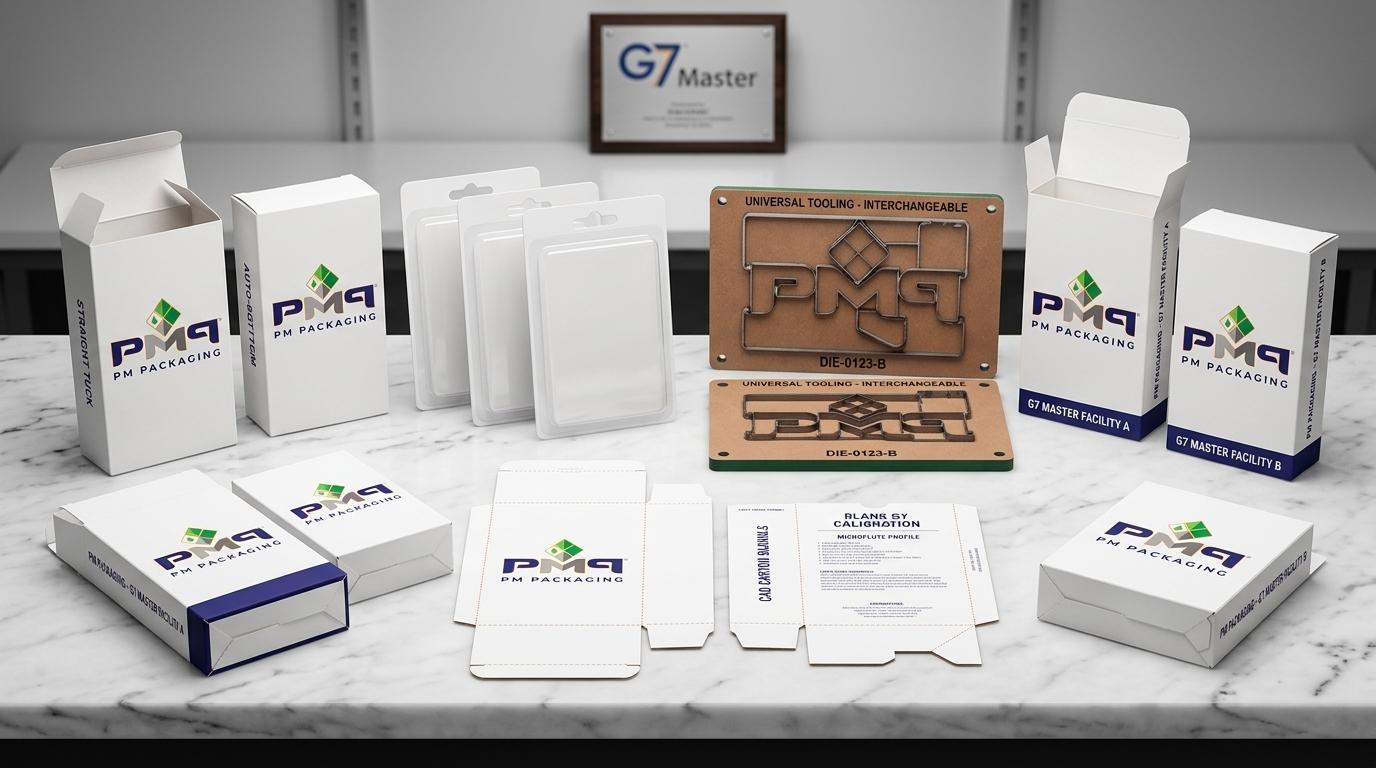
- ✓ 100% Tooling Portability: Universal CAD & dieboards hot-swap in under 2 hours.
- ✓ Certified G7 Master Color: Exact spectral calibration (ΔE < 1.5) across facilities.
- ✓ 1–3 Day Ground Delivery | 100% USMCA Tariff-Free | Single Master Agreement.
When packaging stockouts occur, the financial and commercial repercussions across enterprise supply chains are immediate:
- Retailer OTIF (On-Time, In-Full) Penalties: Mass merchants such as Walmart, Target, Home Depot, and Kroger assess non-compliance penalties ranging from 3% to 5% of gross invoice value for missed or partial delivery windows.
- Contract Packager (Co-Packer) Line Demurrage: High-speed automated cartoning and kitting lines operate on rigid scheduling. An idle packing line carries standing facility and labor charges between $2,500 and $10,000 per hour.
- Lost Retail Distribution & Forfeited Promotions: Missing a strict 48-hour club store pallet reset window at Costco or Sam’s Club can result in immediate loss of shelf space, cancelled purchase orders, and permanent reallocation of endcap real estate to competitor brands.
- Supply Pipeline Vulnerability: Transpacific ocean freight models tie up working capital across 6 to 12 weeks of transit, exposing brands to port bottlenecks, container rate volatility, and zero responsiveness during unforecasted demand surges.
To insulate their organizations from these operational vulnerabilities, forward-thinking procurement teams are moving away from both single-plant domestic converters and fragmented multi-vendor split-sourcing models. Instead, enterprise procurement strategies prioritize Unified Dual-Plant Nearshore Redundancy—a model that combines geographic proximity, mirrored manufacturing capacity, universal tooling architecture, and cross-border regulatory compliance.
With over 45 years of specialized packaging engineering and high-volume converting experience, PM Packaging operates an integrated dual-border footprint: corporate headquarters and structural packaging engineering in San Diego, California, anchored by advanced, large-format manufacturing and converting facilities in Baja California (Tijuana and Mexicali).
1. Sourcing Model Comparison: Single-Plant vs. Multi-Vendor vs. Dual-Plant Nearshore
Rather than treating hardware packaging as generic paperboard, engineering teams must account for product geometry, hanging shelf wear, moisture barriers, and high-speed automated cartoning line tolerances.
Single-Plant Converter
- 1 Manufacturing Facility
- Critical Single Point of Failure (SPOF)
- High Retail OTIF Risk
- Zero Backup Disaster Relief
Split Multi-Vendor
- 2 Unrelated Vendors
- Duplicate Tooling ($25k–$50k/SKU)
- Noticeable Color Variance (ΔE > 3.0)
- Diluted Volume Tier Pricing
Dual-Plant Nearshore
- 2 Mirrored Plants (Tijuana & Mexicali)
- Universal Tooling & Centralized CAD
- Certified G7 Master Color (ΔE < 1.5)
- Aggregated Volume Tier Leverage
Model 1: Single-Facility Converting
In a single-plant model, all converting operations—pre-press, offset lithographic printing, litho-lamination, die-cutting, windowing, and folder-gluing—take place under one roof. While unit economics may appear attractive on an initial spreadsheet, the operation contains multiple Single Points of Failure. A main press drive motor burnout, transformer failure, localized weather event, or labor dispute instantly shuts down 100% of production, leaving brands stranded without recourse.
Model 2: Fragmented Multi-Vendor Sourcing (Split-Vendor Strategy)
To avoid single-plant vulnerability, some procurement teams split volume between two independent packaging converters (e.g., a 60/40 volume allocation). However, this introduces substantial inefficiencies:
- The Tooling Cost Penalty: Every unique Stock Keeping Unit (SKU) requires two independent sets of tooling—steel rule cutting dies, Pertinax counterplates, stripping units, dynamic blanking tools, and embossing/stamping dies. Across an enterprise portfolio of 50 SKUs, duplicate tooling adds $75,000 to $200,000 in unamortized capital expenditures.
- The Color Consistency Dilemma: Two separate commercial printers operating under different pressroom protocols, using different ink formulation systems and separate plate curves, rarely achieve visual color parity. On the retail shelf, side-by-side cartons exhibit noticeable chromatic shifts, degrading brand equity.
- Loss of Volume Leverage: Splitting volume halves the order size at each supplier, preventing procurement teams from unlocking optimal substrate mill-bracket discounts and large-format sheetfed press run efficiencies.
Model 3: Unified Dual-Plant Nearshore Manufacturing
The optimal enterprise architecture is a single packaging manufacturing partner operating two synchronized, advanced production plants located within a centralized industrial cluster (e.g., PM Packaging’s dual facilities in Tijuana and Mexicali, supported by San Diego engineering):
- Zero Tooling Duplication: Tooling is engineered to universal CAD specifications, allowing cutting dies and plate files to run interchangeably across both facilities without modification.
- Synchronized Color Profiles: Both facilities operate under certified Idealliance G7 Master printer standards, utilizing digital ink dispensaries and spectral plate curves to maintain chromatic uniformity (ΔE < 1.5).
- Maximum Commercial Leverage: 100% of procurement volume is aggregated under a single Master Services Agreement (MSA), unlocking tier-1 paperboard mill pricing and optimized press run brackets.
- Rapid Cross-Border Velocity: Finished goods clear border checkpoints under USMCA / IMMEX / C-TPAT programs, reaching West Coast distribution centers in 1 to 3 days and nationwide hubs in 3 to 5 days via direct ground freight.
Enterprise Sourcing Topology Evaluation Matrix
| Evaluation Criteria | Single-Plant Converter | Fragmented Multi-Vendor | Unified Dual-Plant Nearshore |
|---|---|---|---|
| Disaster Recovery / Uptime | Critical Risk (0% Backup) | Moderate (Manual Handoff) | Complete (Active-Active Redundancy) |
| Tooling Capital Expenditure | Baseline (1x Set) | 1.8x to 2.0x (Duplicate Sets) | Baseline (1x Universal Set) |
| Brand Color Consistency (ΔE) | Consistent within plant | High Variance (ΔE > 3.0) | Standardized G7 (ΔE < 1.5) |
| Purchasing Volume Leverage | High | Diluted (Split Brackets) | Maximum Aggregation |
| Administrative Overhead | Single Vendor Management | Dual RFPs, Audits, Invoices | Single Vendor / Single MSA |
| Transit Lead Time to US DCs | 1–5 Days (US) / 8–12 Wks (Asia) | Mixed Lead Times | 1–3 Days Ground (West Coast) |
| Tariff & Customs Exposure | Varies by Location | Complex Multi-Country Duty | 100% USMCA / IMMEX Compliant |
2. The 5 Core Pillars of Dual-Plant Nearshore Redundancy Audits
PM Packaging specializes in heavy-duty blister cards, trapped blister packaging, and fluted tool cartons for national hardware and industrial tool brands. High-speed gang printing and shared dielines reduce per-unit tooling costs while clear technical graphics guide buyers directly to the correct model.
Machine Parity
Matched large-format 6–8 color offset presses and high-speed die-cutters with identical cylinder formats.
Universal Tooling
Interlocking CAD dielines, universal chase dimensions, and standardized Pertinax counterplates.
G7 Master Color
Spectral curve calibration, automated digital ink formulation, and ΔE < 1.5 matching across plants.
Capacity Load-Balancing
Active-Active plant network capable of executing sub-4-hour job migration and managing 400% Q4 demand surges.
Cross-Border Velocity
100% USMCA 0% tariffs, IMMEX duty-free raw material conversion, C-TPAT/FAST lanes, and 1–3 day ground freight.
Pillar 1: Machine & Fleet Harmonization (True Equipment Mirroring)
True redundancy requires functional machine symmetry. If Plant A operates modern 56-inch 8-color UV offset presses and high-speed flatbed die-cutters, but Plant B relies on legacy 28-inch 4-color conventional presses, Plant B cannot accept emergency production transfers for complex mass retail packaging.
Equipment Fleet Harmonization Audit Checklist
| Equipment Category | Technical Specification Standard | Operational Redundancy Verification |
|---|---|---|
| Offset Litho Press | Large-format (40", 56", or 64") 6–8 color offset presses with inline UV and aqueous coating towers. | Both plants operate compatible cylinder formats, grippers, and coating systems. |
| Litho-Laminator (SFL Microflute) | High-speed Single Face Laminate (SFL) microflute laminators with precision adhesive metering. | Matched corrugating bridges capable of running E-flute, F-flute, and B-flute. |
| Flatbed Die-Cutter | Automatic flatbed platen die-cutters with dynamic stripping and inline blanking stations. | Matched platen tonnage (350–500+ tons) and identical chase locking mechanisms. |
| Folder-Gluer Lines | Multi-point high-speed folder-gluers with cold emulsion & hot-melt adhesive extrusion guns. | Universal carrier widths, 180° pre-break swords, and inline electronic glue verification. |
| Rigid Box Lines | Automatic rigid box wrapping and corner quad-stayer lines with automated magnetic insertion stations. | Matched greyboard grooving, magnetic insert placement, and wrap-gluing automation. |
During an on-site technical audit, procurement teams should verify sheet size envelope compatibility (28" x 40", 40" x 56", 44" x 64"), substrate caliper versatility (12pt to 32pt paperboard, SFL microflutes, and 40pt to 120pt greyboard), and inline finishing parity across facilities.
Pillar 2: Tooling Portability and Standardized Dieboard Architecture
In traditional supply chains, moving a packaging job from one manufacturing plant to another requires modifying CAD dielines, re-burning printing plates, and re-manufacturing cutting dies. This introduces lead time delays of 5 to 10 business days and thousands of dollars in re-tooling expenses.
Centralized CAD & Universal Tooling Architecture
Engineered from day one for frictionless inter-plant hot-swapping
San Diego Engineering HQ
- • Central Master CAD Dieline Repository (.ARD, .CF2, .DXF)
- • Standardized Universal Chase & Pin Centerlines
- • 1-up / Multi-Up Nested Imposition Layouts
Baja Facilities (Tijuana & Mexicali)
- • Universal Chase Clamps (Bobst/Iberica 1060mm & 1450mm)
- • Universal Pertinax & Milled Steel Counterplates
- • 1:1 Dynamic Stripping & 180° Folder-Gluer Pre-Breaks
Pillar 3: Certified G7 Master Color Management Across Geographies
For enterprise brands, color consistency across retail shelves is non-negotiable. A consumer comparing two boxes of hair color, vitamins, or premium electronics on a retail shelf must see an exact color match. If Box A was printed in Tijuana and Box B in Mexicali, the human eye must perceive absolute harmony.
Color Synchronization Verification Points:
- Idealliance G7 Master Qualification: Both facilities maintain active G7 Master Printer qualifications, calibrating neutral print density curves (NPDC) across all presses.
- Automated Digital Ink Dispensaries: Computer-controlled ink dispensers formulate custom spot formulas from shared spectral recipe databases, eliminating manual mixing variance.
- Closed-Loop Spectral Scanning: In-line spectrophotometers scan color bars across every sheet at full press speed, maintaining tight CIELAB tolerances (ΔE00 < 1.5 across all solids).
- Retail Compliance Certifications: Full compliance with GMI (Graphic Measures International) standards required by Walmart and Target, as well as ISO 9001:2015, SQF Food Safety, and FSC / SFI chain-of-custody certifications.
Pillar 4: Dynamic Capacity Load-Balancing & Surge Allocation
High-volume retail packaging experiences extreme demand cyclicality. A national brand may require 200,000 cartons per month from February to August, surging to 1,500,000 units per month from September to November to support holiday retail sets and Q4 club store pallet displays.
Active-Active Load Balancing During Retail Surges
Business Continuity Scenario Analysis
| Operational Scenario | Single-Plant Operation | Fragmented Multi-Vendor | Dual-Plant Nearshore Network |
|---|---|---|---|
| Normal Production (Base) | 100% capacity in 1 plant | Split volume across 2 plants | Optimized plant allocation |
| 300% Seasonal Demand Spike | Bottlenecks & delayed OTIF | Vendor capacity contention | Active-Active plant split |
| Unscheduled Press Breakdown | 100% Production halt | Re-order lead time (3–6 wks) | 4-Hour job hot-swap |
| Raw Material Local Shortage | Facility shutdown | Disparate board suppliers | Inter-plant board transfer |
| Regional Power Interruption | Total stoppage | Geographical disconnect | Immediate load migration |
Pillar 5: Cross-Border Logistics, Customs & Regulatory Compliance
A dual-plant nearshore footprint in Baja California offers geographic adjacency to the United States. However, procurement teams must ensure the packaging partner has mastered cross-border trade compliance to prevent border bottlenecks.
1. 100% USMCA Tariff-Free
All paperboard, corrugate, and blister card packaging complies fully with North American Rules of Origin, certifying 100% tariff-free duty treatment upon entry into the U.S.
2. IMMEX Program Status
Mexico’s IMMEX maquiladora program enables duty-free temporary raw material importation (e.g., virgin SBS from U.S. mills) for conversion and export, eliminating cash-flow drag.
3. C-TPAT & FAST Lanes
Active C-TPAT (Tier 2/3) and OEA certifications grant access to dedicated commercial FAST lanes at Otay Mesa and Calexico, cutting border wait times to under 2 hours.
4. Direct Highway Freight & VMI
1-to-3-day direct ground freight to West Coast and Southwest distribution hubs, backed by Vendor Managed Inventory (VMI) safety stock warehouses in San Diego.
3. Substrate & Structural Engineering Across Redundant Facilities
Packaging buyers manage diverse product portfolios requiring specialized paperboard grades, fluting profiles, and structural dielines. Redundancy must be maintained across all core packaging lines:
Core Packaging Lines & Substrate Capabilities
| Packaging Category | Substrates & Calipers | Structural Dieline Formats | Target Retail Channels |
|---|---|---|---|
| Folding Cartons | 12pt – 32pt SBS, CCNB, CUK/SUS, CRB, and Folding Boxboard (FBB). | Straight Tuck End (STE), RTE, Auto-Bottom (Crash Lock), Sleeves | Mass Retail, Health & Beauty, OTC, Electronics |
| Litho-Laminated SFL Microflute Corrugate | E-Flute (1/16"), F-Flute (1/32"), B-Flute (1/8"), N-Flute corrugate. | Heavy Multipacks (4-24 pack), Full-Pallet Displays, Trays | Wholesale Club Stores, Hardware, Power Tools |
| Blister Packaging & qikCombo™ Shared Runs | 14pt – 28pt SBS / CUK with water-based heat-seal barrier coatings. | Single-Seal, Fold-Over, Trapped Blister, Combination Cards | Automotive, Hardware, Toys, Office Supplies |
| Luxury Rigid Boxes & Setup Packaging | 40pt – 120pt Greyboard wrapped in art paper, foil, or soft-touch. | Book-Style Magnetic Closure, 2-Piece Shoulder/Neck, Drawers | Premium Spirits, Luxury Cosmetics, Tech Hardware |
| Retail Displays & PDQs | B-Flute, E-Flute litho-laminated corrugate with reinforced struts. | Counter PDQ Trays, Sidekicks, Power Wings, FSDU Floor Stands | Mass Retail Endcaps, Club Store Pallet Layers |
1. Folding Cartons: High-Speed Line Speed Optimization
Precision die-cutting tolerances (±0.5 mm) enable speeds up to 400 cartons per minute on automated packing lines (Bosch, R.A. Jones). 180° mechanical score pre-breaks ensure consistent carton opening force (COF).
2. Single Face Laminate (SFL) Microflute: The Club Store Workhorse
For Costco and Sam’s Club full-pallet displays, SFL microflute (E-flute and F-flute) delivers immense Box Compression Test (BCT) and Edge Crush Test (ECT) ratings while completely eliminating flute washboarding.
3. Blister Cards & the qikCombo™ Advantage
PM Packaging’s qikCombo™ program groups 5 to 20 SKUs onto shared master sheets, eliminating upfront tooling costs entirely for carded packaging runs from 5,000 to 100,000 units with rapid 10-day turnaround.
4. The 25-Point Procurement Audit Scorecard for Dual-Plant Redundancy
Procurement teams should execute this standardized 25-point audit rubric when vetting dual-plant nearshore packaging suppliers. Suppliers must achieve a minimum score of 100/125 points to be designated as an Enterprise-Grade Redundant Partner.
Enterprise Packaging Redundancy Audit Rubric (125 Points Total)
| No. | Audit Verification Item | Weight | Score (1-5) | Max Points |
|---|---|---|---|---|
| Section A: Machine Fleet & Equipment Parity | ||||
| 1 | Matched large-format offset press formats across both facilities | 5 | [ ] | / 25 |
| 2 | Inline UV / Aqueous coating capabilities identical in both plants | 4 | [ ] | / 20 |
| 3 | Substrate versatility across plants (12-32pt paperboard & SFL flute) | 5 | [ ] | / 25 |
| 4 | SFL microflute laminators operating in both facilities (E/F/B flute) | 4 | [ ] | / 20 |
| 5 | High-speed flatbed die-cutting capacity with dynamic stripping/blanking | 5 | [ ] | / 25 |
| Section B: Tooling Standardization & Interchangeability | ||||
| 6 | Universal CAD dieline library managed by centralized engineering HQ | 5 | [ ] | / 25 |
| 7 | Standardized dieboard chase sizes and pin-registration systems | 5 | [ ] | / 25 |
| 8 | Interchangeable Pertinax counterplates and dynamic stripping tooling | 4 | [ ] | / 20 |
| 9 | Zero customer re-tooling fees required to shift production between plants | 5 | [ ] | / 25 |
| 10 | Standardized 180° scoreline pre-break geometry on folder-gluers | 4 | [ ] | / 20 |
| Section C: G7 Master Color Consistency & Quality Certifications | ||||
| 11 | Active Idealliance G7 Master Printer qualification at both plants | 5 | [ ] | / 25 |
| 12 | Centralized digital ink formulation and automated ink dispensers | 4 | [ ] | / 20 |
| 13 | In-line closed-loop spectrophotometer quality control (ΔE < 1.5) | 5 | [ ] | / 25 |
| 14 | GMI (Graphic Measures International) certification (Walmart/Target) | 4 | [ ] | / 20 |
| 15 | ISO 9001:2015, SQF Food Safety, and FSC/SFI chain-of-custody certs | 4 | [ ] | / 20 |
| Section D: Capacity Balancing & Disaster Recovery Execution | ||||
| 16 | Active-Active plant capacity model with demonstrated dynamic balancing | 5 | [ ] | / 25 |
| 17 | Formal Disaster Recovery Plan (DRP) with sub-4-hour job migration test | 5 | [ ] | / 25 |
| 18 | Redundant Computer-to-Plate (CTP) engines and cloud RIP backup servers | 4 | [ ] | / 20 |
| 19 | Multi-day on-site substrate and raw material buffer warehouse inventory | 4 | [ ] | / 20 |
| 20 | Independent power grid / auxiliary diesel generator backup at plants | 4 | [ ] | / 20 |
| Section E: Trade, Logistics & Regulatory Compliance | ||||
| 21 | 100% USMCA / T-MEC Certificate of Origin compliance (0% tariff duty) | 5 | [ ] | / 25 |
| 22 | Active IMMEX program registration for duty-free material processing | 4 | [ ] | / 20 |
| 23 | Active C-TPAT (Tier 2+) and OEA certifications for FAST lane access | 5 | [ ] | / 25 |
| 24 | Direct highway freight transit (1-3 days West Coast / 3-5 days US wide) | 5 | [ ] | / 25 |
| 25 | Vendor Managed Inventory (VMI) / JIT replenishment buffer in U.S. | 4 | [ ] | / 20 |
| TOTAL AUDIT SCORE (125 Max Points): | 110–125 (Enterprise Benchmark) | 90–109 (Conditional) | <90 (High Risk) | |||
5. Total Cost of Ownership (TCO): Financial Modeling
Procurement teams frequently make the mistake of evaluating packaging proposals strictly on the “Piece-Part Unit Price.” When factoring in the complete Total Cost of Ownership (TCO)—including tooling capital expenditures, working capital holding costs, ocean freight risk, and retailer penalty exposure—a unified dual-plant nearshore model consistently outperforms both domestic single-plant converters and transpacific offshore sourcing.
Total Cost of Ownership (TCO) Comparison Model
Scenario: 2,500,000 Unit Folding Carton Portfolio across 12 SKUs
| Cost Element | Offshore (Asia) | Single-Plant (US) | Dual-Plant Nearshore |
|---|---|---|---|
| Base Unit Packaging Cost (2.5M Cartons) | $275,000 ($0.11/ea) | $350,000 ($0.14/ea) | $300,000 ($0.12/ea) |
| Tooling Capital Expenditure (12 SKUs) | $24,000 (1x Set) | $24,000 (1x Set) | $24,000 (1x Universal) |
| Secondary Tooling for Backup Facility | $0 (No Backup) | $0 (No Backup) | $0 (Universal Shared) |
| Transpacific Ocean Freight & Port Demurrage | $48,000 (3 Containers) | $0 (Domestic) | $0 (Ground Only) |
| U.S. Ground Freight to Distribution Centers | $18,000 | $14,000 | $16,000 |
| Tariffs, Customs Duties & Brokerage (Sec. 301) | $20,625 (7.5% Duty) | $0 | $0 (USMCA 100% Exempt) |
| Working Capital Carrying Cost (8-12 Wk Pipeline) | $12,500 | $2,200 | $2,800 |
| Retailer OTIF Deduction / Late Risk Reserve | $35,000 (High Risk) | $15,000 (Med Risk) | $0 (Nearshore Buffer) |
| Emergency Air-Freight Expedited Contingency | $25,000 | $5,000 | $0 (Ground Hot-Swap) |
| TOTAL ANNUALIZED COST OF OWNERSHIP | $458,125 | $410,200 | $342,800 |
| NET TCO SAVINGS WITH DUAL-PLANT NEARSHORE | - $115,325 (-25.2%) | - $67,400 (-16.4%) | BASELINE LEADER |
1. The Offshore Sourcing Illusion
While transpacific piece prices appear 8% lower on initial quotes, the addition of Section 301 tariffs, transpacific ocean freight, port demurrage, extended pipeline inventory holding costs, and retail late penalties make offshore packaging 25.2% more expensive overall.
2. The Single-Plant Sourcing Trap
Domestic single-plant converters charge higher base unit prices due to domestic labor overhead while failing to provide business continuity redundancy during machine breakdowns.
3. The Nearshore Dual-Plant Advantage
PM Packaging’s dual Baja California manufacturing footprint combines competitive production economics with zero tariff exposure under USMCA, universal tooling savings, and 1 to 3 day ground freight transit.
6. How Enterprise Brands Execute Dual-Plant Packaging Migrations
Transitioning an active packaging portfolio to a dual-plant nearshore partner requires a structured 5-phase onboarding roadmap:
Phase 1: Technical CAD Audit & Dieline Standardization (Weeks 1–2)
San Diego Engineering HQ reviews current portfolio CAD dielines, harmonizing score allowances, tuck flap angles, folder-gluer pre-break geometry, and sheet nesting impositions for 40", 56", and 64" presses.
Phase 2: Pre-Press Standardization & G7 Color Targeting (Weeks 2–3)
Digital asset ingestion, master color separation profiling, automated ink dispensing formulation across shared databases, and contract G7 color proofs on target production substrates (SBS, CCNB, CUK, SFL).
Phase 3: Universal Tooling Fabrication & Sample Qualification (Weeks 3–4)
Laser-cut master cutting dies, Pertinax counterplates, and dynamic stripping boards. Pilot die-cutting and folder-gluing qualification to verify carton opening force (COF) and high-speed line fitment.
Phase 4: Dual-Facility Pilot Production Runs (Weeks 4–5)
Split pilot run (50% Tijuana / 50% Mexicali) to verify Delta-E color parity (ΔE < 1.5) and validate customs clearance through FAST lane border protocols into the San Diego logistics hub.
Phase 5: Full Commercial Rollout & VMI Safety Stock (Week 6+)
Transition full enterprise volume into active-active dynamic load balancing and establish 30-to-60 day finished goods VMI safety stock buffers for same-day distribution center delivery.
7. Conclusion & Strategic Next Steps: Partnering with PM Packaging
Evaluating packaging redundancy is no longer an optional procurement checklist—it is an enterprise risk management mandate. Brands rolling out into Walmart, Target, Costco, Sam’s Club, Home Depot, Sephora, or Ulta cannot afford the operational and financial hazards of single-facility converter failures or the administrative friction of fragmented multi-vendor sourcing.
Consolidate High-Volume Packaging with PM Packaging
By consolidating packaging programs with PM Packaging, enterprise procurement leaders secure 45+ years of converting excellence, true dual-plant nearshore redundancy, universal tooling architecture, certified G7 Master color consistency, and rapid 1-to-3-day ground freight velocity.
Schedule a Technical Packaging Redundancy Audit
Is your packaging supply chain vulnerable to single-point-of-failure risks? Contact PM Packaging’s senior structural engineering and procurement solutions team to audit your dielines, review your volume forecasts, and engineer a resilient, nearshore dual-plant packaging program.
- Corporate Headquarters & Engineering: San Diego, CA
- Advanced Manufacturing Campuses: Tijuana & Mexicali, Baja California
- Specializations: High-Volume Folding Cartons, SFL Microflute Packaging, Blister Cards (qikCombo™), Retail Displays & PDQs, Luxury Rigid Boxes.