
For Vice Presidents of Supply Chain, Directors of Procurement, and Senior Packaging Engineers managing national retail distribution across North America, the West Coast logistics corridor—anchored by Southern California’s Inland Empire, the Los Angeles/Long Beach port complex, the Central Valley, and the greater Southwest—serves as the primary fulfillment engine for mass retail, club stores, grocery chains, specialty retail, and e-commerce.
Scaling commercial automotive packaging requires targeted engineering: Automotive replacement parts require rigorous corrosion protection, high structural crush resistance for dense cast iron components, and strict barcode readability for automated distribution centers. PM Packaging partners with high-volume brands to ensure G7 color consistency, structural durability, and predictable replenishment.
However, enterprise brands that rely on legacy transpacific offshore packaging pipelines (sourced from China, Vietnam, or Taiwan) or distant domestic converters in the U.S. Midwest and East Coast face severe operational and financial vulnerabilities.
Transpacific ocean shipping imposes 10-to-16-week cycle times, unpredictable port demurrage, and massive inventory holding costs. Meanwhile, domestic cross-country transit incurs 5-to-8 business days of freight latency and steep Less-Than-Truckload (LTL) / Full-Truckload (FTL) transport costs that erode operating margins.
1. Transpacific Offshore Sourcing (Asia)
[ PO Issued ] → [ 3-4 Wk Production ] → [ 4-6 Wk Ocean ] → [ 2-4 Wk Port Dwell/Customs ] → [ West Coast DC ]
Total Cycle Time: 10 – 16 WEEKS • Container Demurrage Risk • Trapped Working Capital • Zero Demand Agility.
2. Domestic Cross-Country Sourcing (U.S. Midwest / East Coast)
[ PO Issued ] → [ 3-5 Wk Production ] → [ 5-8 Days Cross-Country Trucking ] → [ West Coast DC ]
Total Cycle Time: 4 – 6 WEEKS • High Cross-Country Freight ($4.5k–$7.5k/truck) • Weather & Interstate Delays.
3. Synchronized Nearshore Sourcing (PM Packaging: San Diego / Baja)
[ PO Issued ] → [ 10-14 Day Converting ] → [ 1-3 DAYS Dedicated Ground Freight / FAST Lane ] → [ West Coast DC ]
Total Cycle Time: 2 – 3 WEEKS (Or 24–48 Hours via Local VMI) • 100% USMCA Duty-Free • G7 Master Quality Certified.
With over 45 years of commercial packaging engineering and high-volume converting experience, dual-border operations headquartered in San Diego, CA, and advanced manufacturing campuses across Baja California (Tijuana and Mexicali), PM Packaging provides enterprise brands with a streamlined, tariff-free nearshore manufacturing ecosystem.
1. The West Coast Distribution Bottleneck & Sourcing Latency
Rather than treating automotive packaging as generic paperboard, engineering teams must account for product geometry, hanging shelf wear, moisture barriers, and high-speed automated cartoning line tolerances.
Western U.S. Logistics Hubs & Direct Ground Transit Radius
The High Stakes of Retail Vendor Compliance
Retailers operating out of these Western hubs enforce rigid OTIF (On-Time, In-Full) and MBD (Must-Be-Delivered-By) delivery windows:
- Walmart & Target: Strict OTIF benchmarks require 98%+ on-time and in-full compliance. Failure to meet delivery windows results in non-negotiable 3% to 5% invoice penalties on the Cost of Goods Sold (COGS).
- Costco & Sam’s Club: Club store pallet programs require mandatory delivery within narrow 2-day delivery appointment slots. Missed delivery dates cause immediate cancellation of high-value promotional endcaps and full-pallet tray programs.
- Amazon Fulfillment Centers (FBA / AWD): Inbound packaging delays trigger receiving appointment cancellations, automated inventory placement surcharges, and lost “Buy Box” priority.
Why Distant Sourcing Models Break Down on the West Coast
When secondary packaging—such as folding cartons, Point-of-Purchase (POP) display trays, club store master multipacks, or blister cards—is sourced from overseas or distant domestic converters, supply chain fragility manifests in four distinct failure modes:
1. The Inability to Absorb Demand Volatility
If a national retail buyer increases a promotional forecast by 40,000 units with a 3-week required ship window, an offshore supply chain cannot react. Sourcing packaging by air freight is commercially unviable due to the low density and high cubic volume of packaging materials.
2. Transit Inefficiencies & Cross-Country Freight Spikes
Trucking heavy paperboard or bulky corrugated displays from Midwest or East Coast converters across 2,000+ miles incurs steep freight costs ($4,500 to $7,500+ per full truckload) and exposes shipments to winter weather delays along Interstate 80 and Interstate 40.
3. Port Demurrage and Dwell Times
Offshore packaging entering through the Ports of Los Angeles or Long Beach is subject to vessel congestion, container chassis shortages, terminal dwell times (averaging 4 to 9 days), and customs random-inspection holds.
4. Tooling & Engineering Latency
When structural or graphic artwork modifications are required (e.g., updating a nutrition panel, FDA warning, barcode change, or retailer dieline revision), offshore suppliers require 3 to 5 weeks just to produce, airmail, and approve physical drawdowns and CAD prototypes.
2. The Financial Toll of Lead-Time Lag: Landed Unit Price vs. True Landed Cost
PM Packaging manufactures engineered automotive parts packaging, line-side kits, and retail aftermarket cartons with certified Delta-E color consistency and high-speed box converting. High-speed gang printing and shared dielines reduce per-unit tooling costs while clear technical graphics guide buyers directly to the correct model.
Total Cost of Ownership (TCO) Sourcing Comparison
| Metric / Cost Driver | Asia Offshore Sourcing | U.S. Midwest Sourcing | PM Packaging (Nearshore Baja) |
|---|---|---|---|
| Total Lead Time (PO to DC) | 10 – 16 Weeks | 4 – 6 Weeks | 2 – 3 Weeks (1–3 Days Transit) |
| Ground Freight to West Coast | High (Port Drayage + LTL) | $4,500 – $7,500 / Truck | $800 – $1,800 / Dedicated Load |
| Ocean Freight & Demurrage | $3,500 – $12,000+ / FEU | $0 | $0 |
| Pipeline Working Capital | 90 – 120 Days Trapped | 30 – 45 Days Trapped | 10 – 15 Days (or VMI Model) |
| Inventory Obsolescence Risk | High (Bulk Runs Required) | Moderate | Minimal (Agile Batch Runs) |
| USMCA Tariff Status | Subject to Sec. 301 (7.5–25%) | Duty-Free Domestic | 100% USMCA Tariff-Free |
| Sample & CAD Approval Time | 2 – 3 Weeks (Air Express) | 3 – 5 Business Days | 24 – 48 Hours (San Diego HQ) |
The Working Capital Drag Formula
Trapped capital in pipeline packaging inventory directly diminishes a brand’s corporate liquidity and return on invested capital (ROIC). The annual inventory carrying cost of offshore vs. nearshore packaging is calculated as:
Net Direct Financial Impact: Transitioning 5,000,000 folding cartons to PM Packaging nearshore manufacturing generates $117,048 in annual carrying cost reduction and releases $532,192 in immediate working capital to fund product R&D, retail marketing, and channel expansion.
3. Geographic Proximity & Transport Physics: Mapping Western Freight Corridors
The primary operational advantage of nearshore packaging sourcing is physical proximity. PM Packaging operates a coordinated dual-border operational model designed specifically to serve the Western North American supply chain corridor:
PM Packaging Western Distribution Transit Radius
| Destination Distribution Hub | Freight Mode | Transit Distance | Standard Transit Time |
|---|---|---|---|
| San Diego / Otay Mesa, CA | Dedicated FTL / Local | 15 – 35 Miles | Same-Day (2 – 4 Hours) |
| Inland Empire (Ontario/Fontana), CA | Dedicated 53′ Dry Van | 120 – 145 Miles | Next-Day (4 – 6 Hours) |
| Los Angeles / Long Beach Hub, CA | Dedicated 53′ Dry Van | 135 – 160 Miles | Next-Day (4 – 6 Hours) |
| Phoenix / Tucson Corridor, AZ | Dedicated FTL / LTL | 340 – 390 Miles | 1 – 2 Business Days |
| Central Valley (Stockton/Tracy), CA | Dedicated FTL / LTL | 450 – 490 Miles | 1 – 2 Business Days |
| Las Vegas / Reno Corridor, NV | Dedicated FTL / LTL | 330 – 580 Miles | 1 – 2 Business Days |
| Pacific Northwest (Seattle/Portland) | Long-Haul Intermodal/FTL | 1,150 – 1,280 Miles | 2 – 3 Business Days |
| Texas Logistics Triangle (DFW/ELP) | Dedicated FTL / LTL | 900 – 1,350 Miles | 2 – 3 Business Days |
Eliminating Intermodal Drayage Friction
When imported packaging arrives via ocean freight at the Ports of Long Beach or Los Angeles, it must go through multiple complex physical handoffs: vessel berthing, customs clearance holds, port drayage to an off-dock CFS, de-vanning, pallet restacking, and secondary line-haul loading.
With PM Packaging’s nearshore model, finished folding cartons, blister cards, and microflute displays are loaded onto palletized dry vans directly at our converting plants, sealed under certified C-TPAT / OEA security seals, fast-tracked across the commercial border via FAST dedicated lanes, and delivered straight to the destination distribution center dock doors without intermediate de-vanning or freight re-handling.
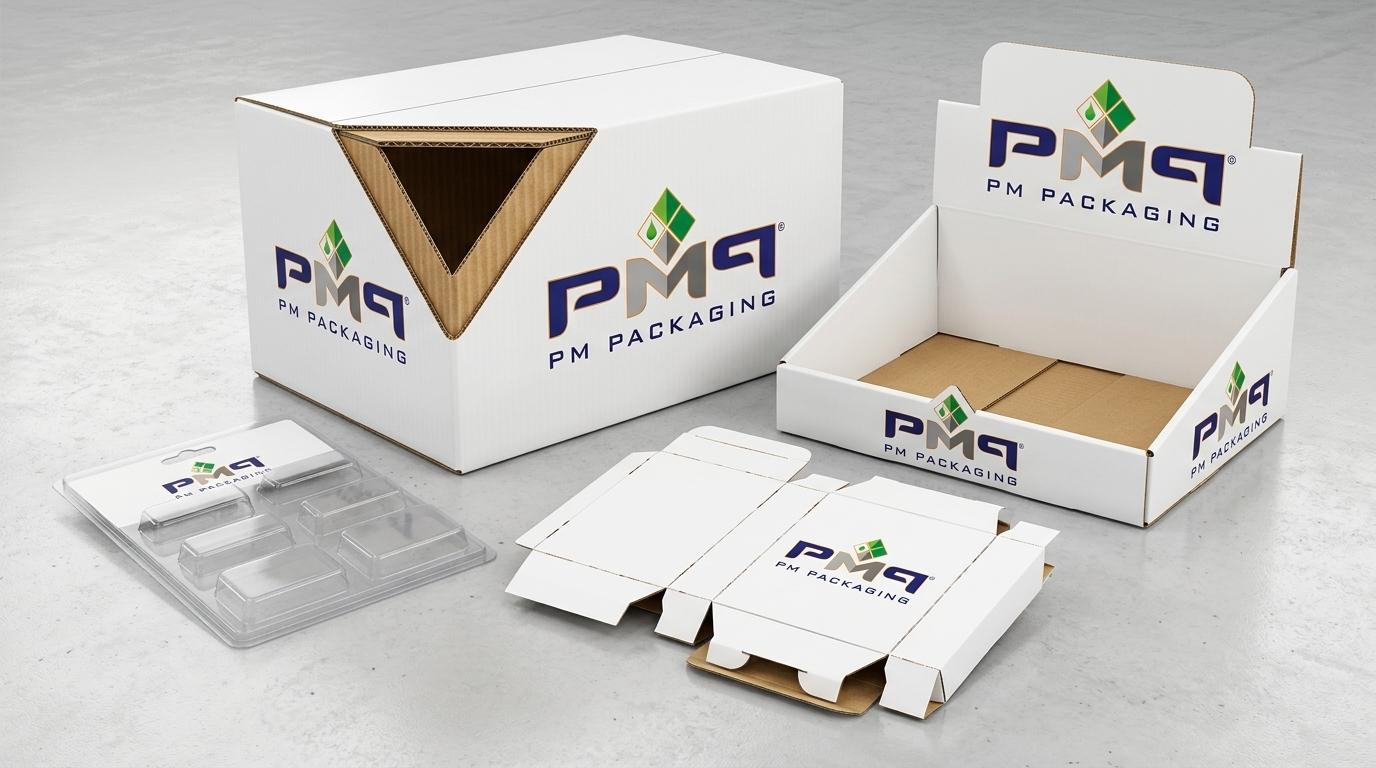
4. Substrates and Packaging Formats Engineered for Nearshore Supply Chains
Nearshore sourcing delivers maximum commercial value when the packaging converter possesses the structural engineering depth, high-speed equipment lines, and material inventory required to produce diverse secondary packaging formats under one roof.
PM Packaging High-Volume Production Capabilities
| Packaging Category | Substrate Calipers | Structural Formats | Finishing Options | Ideal West Coast Channels |
|---|---|---|---|---|
| Folding Cartons | 12pt – 32pt SBS, CCNB, CRB, CUK, FBB | Straight Tuck (STE), Reverse Tuck (RTE), Auto-Bottom, Sleeves | Inline UV/Aqueous, Soft-Touch, Hot/Cold Foil, Multi-Level Emboss | Retail OTC health, beauty, electronics, food, automotive |
| Litho-Laminated SFL Microflute | E-Flute (1/16″), F-Flute (1/32″), N-Flute, B-Flute | High-Strength Master Packs, Heavy Goods, Beverage Multipacks | High-Gloss Film Lamination, G7 Master 6–8 Color Litho, Anti-Scuff | Club stores (Costco/Sam’s), beverage multipacks (4/6/12/24), hardware tools |
| Retail POP Displays & Pallet Trays | Litho-Lam E/B-Flute & Heavy B/C Double Wall Corrugated | Counter PDQs, Sidekicks, Power Wings, Full Pallet Displays | Reinforced Bases, Tiered Product Risers, Pre-Assembled Kitting | Walmart/Target endcaps, Home Depot sidekicks, grocery checkouts |
| Blister Cards & qikCombo™ Program | 14pt – 28pt Heat-Seal Coated Board (SBS / CUK) | Single-Seal, Fold-Over, Trapped Cards (Face-to-Face Seal) | Water-Based High-Glide Heat Seal, Eco Blister Barrier Coatings | Hardware accessories, cosmetics, tools, consumer batteries/pens |
| Luxury Rigid Boxes (Setup Boxes) | 40pt – 120pt Greyboard / Chipboard | Book-Style Magnetic, 2-Piece Neck Boxes, Sliding Drawer Pulls | Premium Art Paper Wrap, Custom EVA / Molded Paper Pulp Inserts | Prestige beauty, consumer audio tech, luxury spirits, influencer PR kits |
180° Pre-Breaking for High-Speed Cartoning
PM Packaging engineers folding carton dielines with 180° mechanical score pre-breaking on Bobst high-speed folder-gluers. Pre-breaking creases #1 and #3 reduces board memory opening force by 50%, guaranteeing that carton blanks erect cleanly on automated horizontal and vertical cartoners (e.g., Bosch/Syntegon, Rovema, Kliklok, Marchesini, Douglas) without vacuum misfeeds or line stoppages at speeds up to 450 cartons per minute.
The qikCombo™ Shared-Run Advantage for Multi-SKU Programs
Managing 15 separate blister card SKUs with varying order volumes typically creates prohibitive die/plate tooling costs and 6-to-8-week production queues. PM Packaging’s proprietary qikCombo™ program gangs multiple SKU part numbers onto shared large-format press forms, cutting tooling and makeready overhead by up to 35% with a predictable 10-business-day converting turnaround.
5. Cross-Border Trade Mechanics: Eliminating Customs & Regulatory Friction
A common concern among supply chain executives considering nearshore manufacturing is the perceived complexity of cross-border customs. PM Packaging’s established dual-border infrastructure completely removes administrative friction through full regulatory integration.
USMCA / T-MEC Origin
All packaging produced in Baja California qualifies for 100% duty-free entry into the United States under USMCA Rules of Origin, completely insulated from Section 301 tariffs (7.5% to 25%+).
IMMEX Virtual Transfers
Executes Transferencias Virtuales Clave V1/V5 between Mexican maquiladora facilities, eliminating Mexico’s 16% Value-Added Tax (IVA) and simplifying customs transactions.
C-TPAT & FAST Lanes
Active C-TPAT and OEA certified cargo moves through dedicated FAST lanes at Otay Mesa and Calexico, cutting commercial border crossing times down to under 30 minutes.
6. Implementation Playbook: Transitioning West Coast Packaging to a Nearshore Model
Migrating high-volume packaging programs from offshore or domestic legacy suppliers to a nearshore ecosystem requires a structured, multi-phase technical implementation methodology:
Nearshore Transition Roadmap (60-Day Sprint)
| Phase / Timeline | Key Engineering & Procurement Tasks | Deliverables & Milestones |
|---|---|---|
| Phase 1: Days 1 – 15 Portfolio & Dieline Audit | • SKU portfolio velocity audit (ABC analysis) • Dieline standardization (CAD consolidation) • Caliper & board grade benchmark | • Substrate consolidation matrix • Tooling portability assessment • TCO baseline cost model |
| Phase 2: Days 16 – 30 Prototyping & Color Qual | • San Diego 24-hr CAD prototyping • G7 Master ink drawdown approvals • Electronic PDF & hard proof sign-off | • Approved structural white samples • Certified spectrophotometric curves (ΔE < 1.5) • Finalized dieboard tooling orders |
| Phase 3: Days 31 – 45 Line Testing & Co-Packer Sync | • Pilot converting run in Baja • Machine qualification at co-packer/DC • Barcode / 2D matrix scan audit | • Pilot cartoner speed test (400 CPM) • Score opening force certification • Drop & Box Compression Test (BCT) sign-off |
| Phase 4: Days 46 – 60 Full Scale-Up & VMI Setup | • Full-scale production kickoff • Establish VMI safety stock buffer in San Diego • First production delivery at West Coast DC | • 100% USMCA Certificates of Origin filed • 1–3 day ground delivery active to West DCs • Weekly replenishment cadence established |
7. Strategic Advantages of Partnering with PM Packaging
For enterprise brand owners, procurement executives, and packaging engineers seeking to eliminate lead-time bottlenecks and optimize their West Coast supply chains, PM Packaging delivers an unmatched combination of heritage, technical sophistication, and geographical synergy:
Converting Scale & Capabilities
- 45+ Years Heritage: Decades of specialized engineering across folding cartons, SFL, and retail displays.
- Turnkey Dual-Border Footprint: San Diego HQ & CAD engineering paired with Baja converting hubs.
- High-Speed Finishing: Bobst flatbed die-cutters, folder-gluers (450 CPM), and inline UV coaters.
- Idealliance Certified G7 Master: Precision color reproduction across all paperboard & microflute substrates.
Logistics & Quality Compliance
- 1 to 3 Days Transit: Dedicated ground delivery directly to Inland Empire, L.A., Phoenix, and Central Valley DCs.
- 100% USMCA Duty-Free: North American mill-certified paperboard, immune to Section 301 tariffs.
- VMI Replenishment: 24-to-48-hour JIT replenishment buffers from San Diego warehouse.
- Certified Standards: ISO 9001:2015, SQF Food Safety, FSC, SFI, and C-TPAT / OEA FAST.
Transform Your West Coast Packaging Supply Chain
The commercial packaging demands of West Coast retail distribution allow zero margin for supply chain latency, port disruptions, or uncoordinated engineering tolerances. For Directors of Procurement and Supply Chain VPs, transitioning secondary packaging to PM Packaging nearshore manufacturing is the single most effective lever to compress lead times, unlock working capital, eliminate retailer OTIF deductions, and ensure flawless on-shelf availability.
Recommended Next Steps for Packaging Procurement Teams:
- Request a Technical Dieline & Portfolio Audit: Connect with PM Packaging’s San Diego engineering team to review existing packaging CAD files, analyze carton line speeds, and identify substrate consolidation opportunities.
- Execute a Landed Cost & Lead-Time Analysis: Compare current offshore landed costs (including container freight, port demurrage, and inventory carrying drag) against PM Packaging’s nearshore pricing and 1-to-3-day West Coast ground transit.
- Initiate a Fast-Track Prototyping Sprint: Receive precision CAD plotter samples and G7 Master color drawdowns within 24 to 48 hours to qualify nearshore production for your upcoming retail rollouts.
Contact PM Packaging today at pmpackaging.com/contact to schedule an engineering consultation and discover how nearshore packaging manufacturing accelerates your West Coast supply chain.