
For national brands supplying major retail chains—such as Walmart, Target, The Home Depot, AutoZone, and Sephora—packaging must perform reliably across diverse climates. A blister card that seals cleanly in a packaging facility can face severe stress when transported through humid distribution corridors, non-conditioned trailers, and regional distribution centers across the Southeast and Gulf Coast.
When elevated humidity compromises packaging integrity, the primary failure mode is heat-seal blister card delamination: the thermoformed blister flange separates from the printed paperboard backing card. This causes dropped merchandise, unsaleable inventory, and retailer chargebacks.
Preventing delamination requires a coordinated strategy across paperboard selection, heat-seal coating formulations, structural card format, and supply chain speed.
Root Causes of Delamination in Humid Channels
Paperboard is naturally hygroscopic, absorbing moisture from surrounding air. In high-humidity transit and storage environments, several factors threaten seal integrity:
Fiber Matrix Softening
Absorbed moisture weakens the internal bond between paper fibers. Under transit vibration or product weight, the card can delaminate within its own paper layers.
Thermal and Humidity Cycling
Moving between refrigerated cross-docks, hot trailers, and air-conditioned stores creates expansion cycles that stress seal perimeters.
Moisture Infiltration at Seal Edges
Uneven or generic heat-seal coatings allow moisture to penetrate the interface between the plastic flange and the printed paperboard.
Static Pegboard Hanging Stress
Heavy retail items—including automotive accessories, hand tools, and plumbing hardware—place continuous downward peel forces on the upper seal flange.
Strategic Engineering Solutions to Prevent Delamination
Leading retail brands protect shelf presentation and profit margins through targeted material and structural safeguards:
1. Specifying High-Bond Virgin Paperboard
Substrate selection is the first line of defense. Premium virgin paperboard provides tightly interwoven wood fibers that deliver superior internal ply-bond strength compared to recycled alternatives. This dense fiber structure resists moisture absorption, maintaining rigidity and preventing fiber separation in humid environments.
2. Moisture-Resistant Heat-Seal Formulations
A dependable heat-seal coating must form a moisture-resistant barrier that permanently locks into the paperboard fibers. High-solids, engineered heat-seal coatings create a deep, fiber-tearing bond that maintains holding strength even after prolonged exposure to atmospheric moisture.
3. Selecting the Right Blister Card Architecture
Matching the packaging format to the product's mass and retail environment is critical:
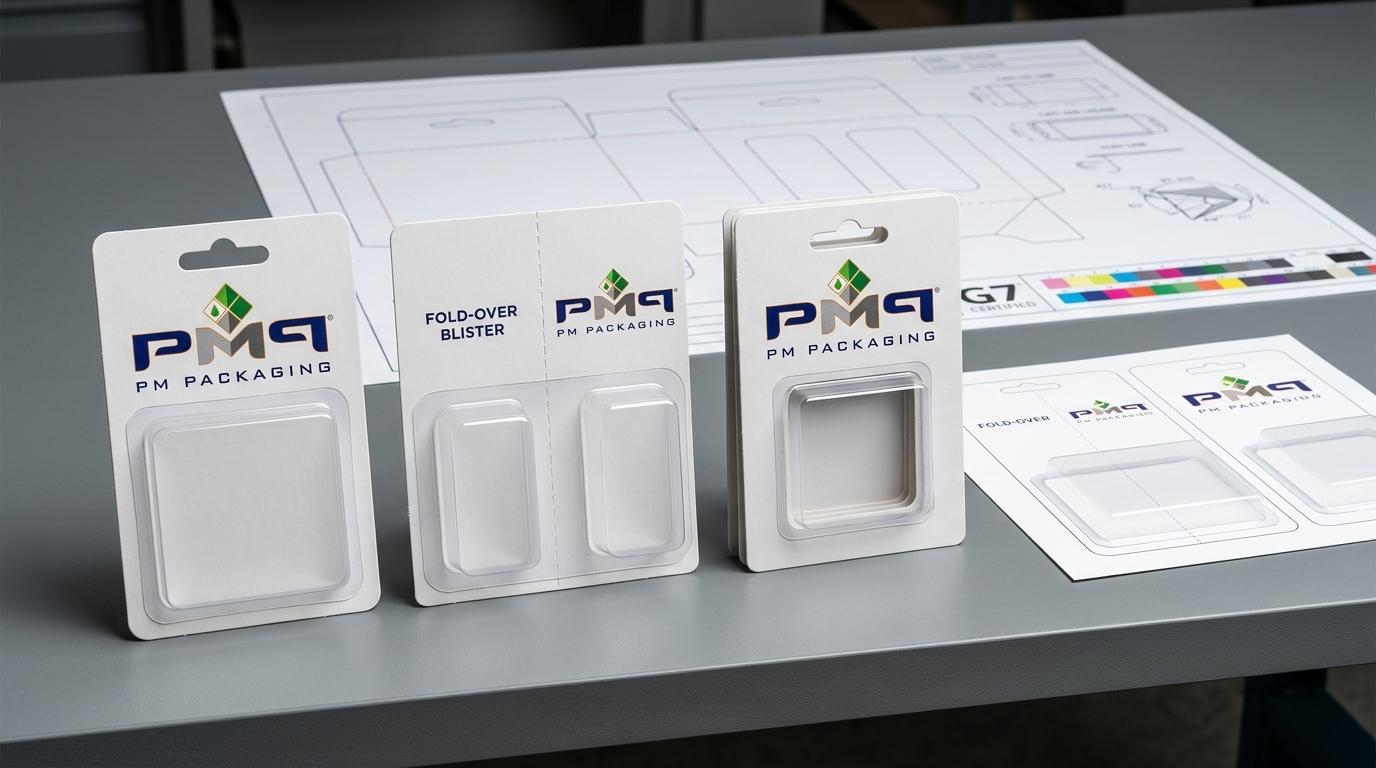
- Face-Seal Blister Cards: The blister flange seals directly to the coated front face of the paperboard card. Engineered with wide sealing flanges and moisture-resistant coatings, face-seal cards deliver cost-effective, high-impact presentation for lightweight personal care, beauty items, and small hardware.
- Fold-Over Blister Cards: Designed with a center score, fold-over cards sandwich the thermoform flange between two heat-sealed paperboard panels. This paperboard-to-paperboard bond encases the flange securely, distributing product weight across the card and eliminating peg-hook tear-out.
- Trapped Blister Cards: The thermoformed blister is captured inside two laminated paperboard panels with die-cut windows. With no exposed plastic flange edges, trapped cards provide exceptional tamper resistance, structural strength, and zero peel edges for humidity to exploit.
Blister Card Performance in Humid Distribution Environments
Evaluating packaging formats across key operational and environmental criteria helps brand teams specify the right card architecture for their distribution network:
| Performance Attribute | Standard Commodity Face-Seal | Moisture-Engineered Face-Seal | Fold-Over Blister Card | High-Security Trapped Card |
|---|---|---|---|---|
| Humidity Resistance | Low to Moderate; prone to edge curl | High; sealed barrier protection | Exceptional; dual-panel strength | Maximum; fully enclosed flange |
| Peel Stress Resistance | Vulnerable under heavy payloads | Optimized for light-to-mid weights | High; paperboard-to-paperboard bond | Complete structural containment |
| Ideal Product Weight | Under 4 oz (sundries, stationery) | Up to 12 oz (personal care, crafts) | 12 oz to 2+ lbs (tools, auto parts) | High-value, heavy, or multi-piece items |
| Assembly Method | High-speed automated rotary lines | Automated and semi-automated lines | Standard fold-over sealing platens | Automated trapping / cartoning |
| Retail Channel Suitability | Regional retail, dry environments | National mass merchants, pharmacy | Hardware, automotive, club stores | Consumer electronics, prestige retail |
Managing Multi-SKU Assortments with qikCombo™
Maintaining consistent heat-seal coating quality across wide product catalogs can be challenging when ordering separate short-run print batches. Sourcing across fragmented production lots often introduces coating variations between runs.
PM Packaging resolves this challenge with its proprietary qikCombo™ manufacturing program. By combining multiple blister card SKUs onto shared production runs, qikCombo™ provides brands with:
- Uniform Coating and Board Quality: Every SKU receives the exact same certified moisture-resistant heat-seal coating and premium virgin paperboard substrate.
- Low Minimum Order Quantities: Order as few as 5,000 units per SKU without setup penalties, aligning inventory directly with retail demand.
- Fast 10-Day Turnaround: Responsive 10-business-day production cycles keep packaging lines supplied without excess safety inventory.
Nearshore Agility: Minimizing Transit Moisture Risks
A key risk factor in blister card performance is overseas supply chain exposure. Sourcing packaging from across the Pacific exposes paperboard to 6 to 12 weeks of maritime humidity, port congestion, and harsh container environments before reaching the packaging line.
Backed by over 45 years of commercial packaging expertise, PM Packaging provides an agile nearshore alternative. Headquartered with structural engineering in San Diego, California, and operating high-capacity converting facilities in Baja California (Tijuana and Mexicali), PM Packaging delivers:
Rapid Ground Delivery
1 to 3-day ground transit to West Coast and Southwest distribution hubs (3 to 5 days nationwide), keeping paperboard clean and fresh.
100% Tariff-Free USMCA Integration
Fully compliant North American trade terms that eliminate import tariffs and port delays.
Certified Quality Management
ISO 9001 certified manufacturing, G7 Master certified color consistency, and FSC/SFI certified sustainable paperboard sourcing.
Protect Your Retail Shelf Presence with PM Packaging
Delamination in humid retail distribution channels is entirely preventable with the right combination of substrate engineering, coating technology, and structural format. By optimizing your blister card packaging, your brand ensures flawless shelf presentation, protects retail compliance, and eliminates costly channel returns.
Ready to evaluate your blister card packaging for humidity resistance and high-speed efficiency? Connect with the packaging specialists at PM Packaging today to schedule a structural line audit and request custom sample cards.