
For Vice Presidents of Supply Chain, Chief Procurement Officers, and packaging engineering leaders at multinational enterprises, the strategic migration toward nearshore manufacturing in North America has evolved from a tactical cost-saving initiative into a core corporate resilience imperative.
Across consumer electronics, medical devices, Over-the-Counter (OTC) pharmaceuticals, personal care, specialty food and beverage, automotive aftermarket, and retail consumer goods, brands are consolidating assembly and contract packaging (co-packing) operations into the advanced industrial corridor of Baja California (Tijuana, Mexicali, Tecate) and northern Mexico.
However, moving primary assembly closer to North American retail channels solves only half of the operational equation: if secondary packaging is mismanaged from a trade compliance and origin standpoint, multi-million-dollar retail programs face severe financial gridlock.
Offshore Packaging Import (Non-Originating)
- × 8–12 week transpacific ocean lead times and high container freight risk.
- × Disqualifies finished goods Regional Value Content (RVC) thresholds by adding to VNM.
- × 16% upfront Mexican Value-Added Tax (IVA) cash tie-ups at commercial ports.
- × Vulnerable to Section 301 punitive tariffs (up to 25%) and customs border holds.
Synchronized Nearshore Converting (Originating)
- ✓ 1–3 day ground delivery directly from San Diego HQ & Baja converting hubs.
- ✓ 100% USMCA qualifying originating regional content (HS 4819 Tariff Shift).
- ✓ IMMEX Clave V1 virtual transfer (0% cash IVA impact under Annex 30 certification).
- ✓ G7 Master pressrooms and machine-qualified carton velocity up to 450+ CPM.
Under the United States-Mexico-Canada Agreement (USMCA / T-MEC / CUSMA), packaging is governed by nuanced legal provisions that directly impact whether a finished consumer product qualifies for preferential duty-free treatment. Misinterpreting Article 4.14 (Retail Packaging) versus Article 4.15 (Shipping Packaging), botching Regional Value Content (RVC) calculations, or utilizing uncertified offshore paperboard can trigger punitive duty assessments, 16% Mexican IVA cash blockages, border holds at ports of entry, and customs audit clawbacks reaching back five years.
With over 45 years of commercial converting leadership, dual-border operations headquartered in San Diego, California, and advanced manufacturing infrastructure in Baja California, PM Packaging partners with enterprise brands to engineer 100% USMCA-compliant, tariff-free packaging programs.
1. USMCA Chapter 4 Rules of Origin: Retail vs. Shipping Packaging
The foundational compliance challenge for packaging buyers lies in understanding how USMCA differentiates between packaging that reaches the retail consumer and packaging used solely for transportation protection.
Retail Packaging & Containers
- Printed Folding Cartons (SBS, CCNB, CRB, FBB)
- Single Face Laminate (SFL) Retail Multipacks
- Retail Blister Cards & Trapped Blister Units
- Luxury Rigid Setup Boxes & Drawer Sleeves
- Pre-Packed Retail Counter PDQ Trays
Shipping Packaging & Containers
- Master Outer Corrugated Shippers (RSC, FOL)
- Corrugated Pallet Layer Pads & Tier Sheets
- Dunnage, Corner Protectors & Edge Boards
- Stretch Wrap, Strapping & Pallet Caps
- Heavy Distribution Wooden/Plastic Pallets
The RVC Dilution Risk: How Offshore Packaging Destroys Duty-Free Status
When finished consumer products are evaluated under the Transaction Value Method, non-originating retail packaging increases the Value of Non-Originating Materials (VNM):
Critical Vulnerability: If a product’s baseline RVC sits near the statutory threshold (for example, 55% baseline vs. 50% USMCA minimum requirement), adding $8.00 of non-originating Asian retail packaging can instantly push total RVC below 50%, stripping the entire multi-million dollar shipment of its USMCA duty-free qualification.
2. HS Tariff Classifications for Paperboard & Converted Packaging
Accurate Harmonized System (HS) classification is the cornerstone of trade compliance. Secondary packaging materials and raw substrate inputs fall primarily under Chapter 48 of the Harmonized Tariff Schedule (HTS).
Specific Rule for Heading HS 4819
This Change in Tariff Heading (CTH) rule means that converting raw paperboard rolls or sheeting (HS 4802, 4804, 4805, or 4810) into finished folding cartons (HS 4819.20), litho-laminated SFL microflute containers (HS 4819.10), or blister cards/rigid boxes (HS 4819.50) confers 100% USMCA originating status to the packaging, provided converting occurs in North America.
Packaging Substrate & Converted HTS Code Matrix
| Material / Component | Caliper / Flute | HTS Subheading | Commercial Packaging Application |
|---|---|---|---|
| Solid Bleached Sulfate (SBS) | 12pt to 28pt C1S & C2S Virgin | 4810.92.00 | Cosmetics, OTC wellness, luxury retail cartons, pharmaceutical packaging |
| Coated Unbleached Kraft (CUK / SUS) | 14pt to 30pt Kraft High-Tear | 4810.32.00 | Heavy retail cartons, beverage multipacks (4/6/12 packs), hardware tools |
| Clay Coated Newsback (CCNB / CRB) | 16pt to 32pt 100% Recycled | 4810.99.00 | High-volume consumer goods, dry food, household hardware, automotive aftermarket |
| Folding Boxboard (FBB / GC1 / GC2) | 14pt to 26pt Multi-Ply | 4810.92.00 | Consumer tech, premium personal care, high-stiffness lightweight cartons |
| Litho-Laminated SFL Microflute | E-Flute (1/16") / F-Flute (1/32") | 4819.10.00 | Costco/Sam’s Club master trays, consumer electronics, power tool packaging |
| Converted Folding Cartons | STE, RTE, Auto-Bottom Blanks | 4819.20.00 | High-speed continuous motion automated cartoning lines (250-450+ CPM) |
| Heat-Seal Blister & Insert Cards | 20pt to 30pt SBS + Varnish | 4819.50.00 | Retail hang-tab cards, trapped blisters, qikCombo™ shared-run programs |
| Rigid Setup Gift Boxes | 40pt - 120pt Greyboard + Wrap | 4819.50.00 | Two-piece neck boxes, magnetic closure book-boxes, drawer presentation packs |
3. RVC Calculation Methodologies for Packaging Programs
When a brand’s finished consumer product must qualify under USMCA Regional Value Content rules, packaging procurement directly influences the mathematical outcome. Enterprise supply chain directors utilize two primary calculation formulas under USMCA Article 4.5.
Transaction Value Method (TVM)
- TV: Transaction Value (FOB price of good)
- VNM: Value of Non-Originating Materials
- Standard Threshold: Typically 60% minimum content
Net Cost Method (NCM)
- NC: Net Cost of production (excl. promo/shipping)
- VNM: Value of Non-Originating Materials
- Standard Threshold: Typically 50% minimum content
Smart Home Gateway Assembled in Tijuana, Mexico
Total VNM = $23.00 (Offshore Electronics) + $6.50 (Asian Box) = $29.50. Standard RVC = 63.1%.
Black Friday Markdown Concession ($70.00 FOB): RVC drops to 57.86% (< 60% requirement). The entire product is disqualified from USMCA, triggering a 6.5% MFN tariff ($4.55/unit) across 200,000 units ($910,000 duty penalty).
Total VNM = $23.00 (Offshore Electronics) + $0.00 (Nearshore Originating) = $23.00.
Black Friday Markdown Concession ($70.00 FOB): Promotional RVC remains 67.14% (> 60% requirement). Nearshore packaging provides a 9.28% RVC safety buffer, insulating the brand from tariff risks and margin erosion.
4. IMMEX Operations, Virtual Transfers (Pedimento V1), and Mexico Tax Mechanics
For multinational enterprises operating in Mexico, packaging procurement is inseparable from Mexico’s IMMEX (Maquiladora) Program and tax compliance structures.
The IMMEX Virtual Transfer (Pedimento Clave V1) Advantage
Customs & Tax Impact: Sourcing Models Compared
| Sourcing Model | Border Touches | Mexican IVA Impact | USMCA Origin Status | Average Lead Time |
|---|---|---|---|---|
| Transpacific (Asia) to Baja CPO | 2 Clearances (US Port + MX CPO) | 16% Trapped Cash until exported | Non-Originating (Adds to VNM) | 8 to 12 Weeks |
| U.S. Midwest to Baja CPO | 2 Clearances (Cross-Border × 2) | 16% Bond or Virtual Pedimento | Originating (If NA paperboard) | 6 to 10 Days |
| PM Packaging Nearshore Program | 1 Final Clearance (Northbound FAST) | 0% (Annex 30 IMMEX Clave V1) | 100% Originating Content | 1 to 3 Days |
5. USMCA Origin Certification & Audit Defense Compliance
Under USMCA, the rigid government-issued NAFTA Certificate of Origin (Form 434) has been replaced by a flexible Certification of Origin containing the 9 Mandatory Data Elements set forth in USMCA Annex 5-A.
The 9 Mandatory USMCA Certification Data Elements
| # | Data Element Required | Regulatory & Operational Specification |
|---|---|---|
| 1 | Certifier Indicator | State whether certifier is Importer, Exporter, or Producer. |
| 2 | Certifier Details | Name, title, full address, telephone number, and corporate email. |
| 3 | Exporter Details | Name, address, country, email, and telephone of exporter. |
| 4 | Producer Details | Name, address, country, email, and telephone of converting plant. |
| 5 | Importer Details | Name, address, country, email, and telephone of importing enterprise. |
| 6 | Description & HS Code | Description of packaging (e.g. Folding Cartons) + 6-digit HS (e.g. 4819.20). |
| 7 | Origin Criterion | Specify Criterion A, B (Tariff Shift / RVC), C, or D per Article 4.2. |
| 8 | Blanket Period | Date range (up to 12 months) covering recurring high-volume shipments. |
| 9 | Signature & Statement | Statutory legal certification statement, dated and signed by authorized officer. |
5-Year Customs Audit Defense Architecture
U.S. Customs and Border Protection (CBP), CBSA, and Mexico SAT possess statutory authority to audit packaging origin claims up to 5 years post-importation. PM Packaging maintains an auditable digital archive for every production run: mill certificates of origin verifying North American virgin/recycled fiber, BOM chemical logs, press run timestamps, and FSC® / SFI® chain of custody records to instantly satisfy CBP Form 28 / Form 29 inquiries.
6. Substrate Integrity & North American Supply Chain Traceability
A critical compliance risk in nearshore packaging conversion is unverified substrate substitution. If an uncertified converter substitutes offshore paperboard (such as Chinese CCNB or Asian folding boxboard) into a high-volume run without trade disclosure, the carton’s USMCA eligibility is voided.
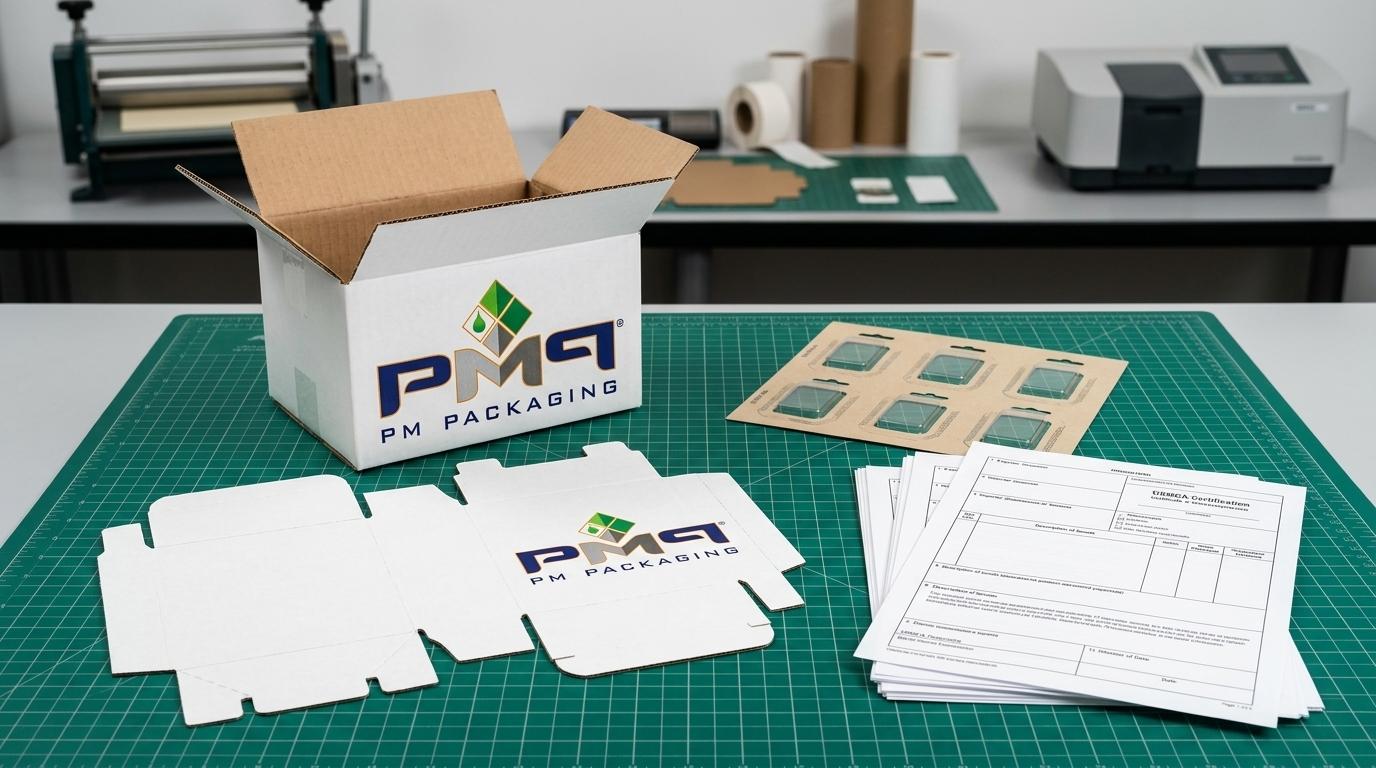
Substrate Origin & Performance Specification
| Substrate Type | Regional Origin | Caliper Range | Key Mechanical Strengths | Primary Packaging Fits |
|---|---|---|---|---|
| Solid Bleached Sulfate (SBS) | USA / Canada (Virgin) | 12pt to 28pt | 90+ GE Brightness, ultra-smooth print, zero odor | OTC Health, Cosmetics, Consumer Electronics |
| Coated Unbleached Kraft (CUK) | USA (Virgin Pine) | 14pt to 30pt | Extreme tear strength, wet-strength resistance | Beverage Can Packs, Heavy Auto Parts, Hardware |
| Clay Coated Newsback (CCNB) | USA / Mexico (Recycled) | 16pt to 32pt | Cost-effective, 100% recycled PCW, rigid density | Dry Food, Mass Retail Hardware, Household Goods |
| Single Face Laminate (SFL) | USA / Mexico (Litho Top) | E-Flute & F-Flute | Superior ECT & BCT crushing resistance | Club Store Trays, Display PDQs, Power Tools |
7. Structural Dieline Engineering & Co-Packer Line Speed Synchronization
Procuring USMCA-compliant packaging is only commercially viable if the folding cartons, blister cards, and SFL microflute displays run at peak mechanical efficiency on high-speed co-packing lines.
Straight Tuck End (STE) Automated Lines
- Continuous-motion horizontal cartoners at 250 to 450+ CPM
- 180° multi-station folder-gluer pre-broken creases (#1 & #3)
- Opening force calibrated to < 35 gf/cm for high-speed vacuum pickup
- Grain direction parallel to main body scores to prevent panel bulging
Auto-Bottom & Blister Card Solutions
- Pre-glued crash-lock bottom for hand assembly in < 1.0 second
- 75% labor reduction compared to manual 1-2-3 snap lock bases
- Proprietary qikCombo™ shared-run program for multi-SKU blister cards
- Water-based heat-seal varnishes calibrated for automated rotary carousels
Packaging Format & Line Velocity Performance
| Packaging Style | Substrate Range | Assembly Method | Operational Velocity / Line Speed |
|---|---|---|---|
| Straight Tuck (STE) Glued Cartons | 16pt - 24pt SBS / CUK / FBB | Fully Automated Inline Continuous Motion | 250 to 450+ cartons per minute |
| Auto-Bottom Cartons (Crash-Lock) | 18pt - 28pt SBS / CCNB / CRB | Semi-Automated / Hand-Erect Station | 30 to 45 units/min per manual operator |
| Litho-Laminated SFL Trays | F-Flute / E-Flute Single Face | Automated Case Packer / Bliss Former | 60 to 120 display trays per minute |
| qikCombo™ Blister Cards | 20pt - 26pt SBS + Heat-Seal Varnish | Rotary Heat-Seal Blister Carousel | 15 to 30 cycles/min (multi-cavity) |
8. Financial & Landed Cost Comparison: Offshore vs. USMCA Nearshore
When evaluating secondary packaging procurement, forward-thinking procurement directors evaluate Total Landed Cost of Ownership (TCO) rather than superficial FOB piece-part pricing.
Total Landed Cost Analysis: 500,000 Retail Folding Cartons
| Cost Component | Offshore Sourcing (Asia) | PM Packaging Nearshore Program |
|---|---|---|
| Unit FOB Cost | $0.240 | $0.270 |
| Ocean / Long-Haul Freight | $0.045 | $0.008 (Dedicated Ground) |
| Section 301 / MFN Tariff Exposure | $0.018 (7.5% MFN/Tariff) | $0.000 (100% USMCA Free) |
| Working Capital Carrying Cost | $0.012 (12 Wks Pipeline) | $0.001 (3 Days JIT) |
| Port Demurrage & Customs Clearance | $0.008 | $0.002 (Pedimento V1 FAST) |
| Risk Buffer Inventory Overhead | $0.022 (25% Safety Stock) | $0.003 (VMI Replenishment) |
| Co-Packer Line Scrap / Jams | $0.010 (4.0% Scrap) | $0.001 (< 0.5% Scrap) |
| Total Landed Net Cost / Unit | $0.355 | $0.285 |
| Annualized Program Spend (500k) | $177,500 (Baseline) | $142,500 (+19.7% Net Annual Savings) |
Strategic Sourcing Matrix: Asia vs. PM Packaging Nearshore
| Commercial Metric | Offshore Sourcing (Asia) | PM Packaging Nearshore Program |
|---|---|---|
| Total Supply Lead Time | 8 to 12 Weeks (Ocean Freight) | 1 to 3 Days (Ground Delivery) |
| USMCA Regional Origin | 0% (Classified as VNM) | 100% Originating Content |
| Working Capital Tie-Up | Massive container commitments | Minimal JIT replenishment |
| Mexican IVA Cash Exposure | 16% Cash Blocked at Port Entry | 0% Cash Impact via IMMEX Clave V1 |
| Retail Agility & Artwork Rev | Slow (8-week delay for packaging) | Rapid (Plates to press in 48 hours) |
| Quality & Color Standards | Inconsistent lot-to-lot shift | Certified G7 Master / ISO 9001:2015 |
| Sustainability & Traceability | High ocean carbon footprint | FSC / SFI Certified NA Mills |
9. Procurement Playbook: Step-by-Step USMCA Packaging Governance
To ensure enterprise-wide compliance, risk mitigation, and seamless nearshore pack-out, procurement and supply chain directors should deploy the following five-phase governance playbook.
Taxonomy & Classification Audit
Map all SKU secondary packaging components to precise 6-digit HS codes (HS 4819.10, 4819.20, 4819.50). Formally differentiate retail packaging (Article 4.14) from transport shipping packaging (Article 4.15).
RVC Impact Modeling & Stress Testing
Execute sensitivity modeling across all product lines under Transaction Value and Net Cost formulas to verify that promotional discounts or component cost fluctuations do not breach minimum RVC thresholds.
Substrate & Paperboard Mill Certification
Mandate North American origin certificates from primary board mills (SBS, CUK, CCNB) and secure FSC® / SFI® chain of custody documentation to prevent unverified offshore paper substitution.
IMMEX & Pedimento Clave V1 Synchronization
Align converter and contract packager customs brokers for digital Clave V1 virtual transfers. Ensure automated Annex 24 / Annex 30 crediting to eliminate 16% IVA cash flow blockages.
Machine Qualification & 5-Year Audit Defense
Conduct pre-break line qualification trials on co-packer continuous-motion cartoners, and archive USMCA 9-element origin certifications and production records in an auditable digital repository.
10. The PM Packaging Advantage: Dual-Border Nearshore Excellence
Navigating trade compliance, customs regulations, and high-speed packaging conversion requires a manufacturing partner with proven cross-border infrastructure and deep technical capabilities.
San Diego HQ & Engineering
- CAD Prototyping: Rapid structural dieline engineering & sample pilots.
- G7 Color Lab: Certified pre-press & multi-plant color consistency.
- Customs Hub: Cross-border compliance, trade documentation, & VMI.
- Account Management: Dedicated senior packaging engineering directors.
Baja California Converting Plants
- Large-Format Litho: 6-to-8 color presses with inline coating & foils.
- High-Speed Finishing: Bobst die-cutting & 180° pre-break folder-gluers.
- SFL & Blister Lines: Inline microflute lamination & heat-seal coating.
- IMMEX & Annex 30: Fully certified for 0% IVA virtual transfers (V1).
Master Your USMCA Packaging Compliance
In an era of supply chain volatility and aggressive retail execution deadlines, secondary packaging cannot be an afterthought. By aligning packaging engineering with USMCA Rules of Origin, multinational brand owners safeguard corporate profit margins, eliminate tariff vulnerabilities, unlock working capital, and guarantee flawless line performance.
Whether your program requires high-speed folding cartons running at 400 CPM, heavy-duty litho-laminated SFL club store displays, or multi-SKU blister card runs via qikCombo™, PM Packaging delivers the structural precision, color uniformity, and logistics agility your nearshore operations demand.
Contact PM Packaging today to schedule a comprehensive structural dieline review, RVC impact analysis, and nearshore supply chain audit.