
For enterprise food and beverage (F&B) conglomerates, emerging multi-brand portfolio companies, and high-growth consumer packaged goods (CPG) brands, scaling production requires a distributed manufacturing footprint.
Whether producing ready-to-drink (RTD) functional beverages, frozen culinary entrees, dry bakery goods, confectionery, or nutritional bars, enterprise brand owners routinely rely on a network of geographically dispersed Contract Packaging Organizations (CPOs / co-packers) to blend, bottle, bake, pouch, and pack-out finished goods across North America.
However, as F&B portfolios expand across multiple co-packers, a critical commercial and brand integrity failure mode emerges on the retail shelf: uncontrolled folding carton color drift and visual variance.
When multi-SKU product lines, brand extensions, or regional pack-outs are converted across disparate regional packaging suppliers chosen independently by individual co-packers, the visual outcome at retail is disastrous. A brand’s signature corporate red, beverage cyan, or heritage gold drifts noticeably between cartons filled in the Midwest, those packed in the Southeast, and those assembled along the US-Mexico nearshore corridor.
When consumers encounter two cartons of the same brand sitting side-by-side on a Walmart, Target, Kroger, or Whole Foods shelf with divergent hue, saturation, or gloss levels, they do not perceive “manufacturing variance”—they perceive old stock, tampered goods, compromised product quality, or counterfeit product. Furthermore, major national retailers enforce strict GMI (Graphic Measures International) and print-quality compliance scorecards; failing spectral color audits triggers severe financial chargebacks, de-listing, or rejected pallet shipments.
With over 45 years of specialized converting expertise, dual-border operations headquartered in San Diego, CA, high-capacity manufacturing facilities in Baja California, and comprehensive Idealliance G7 Master Printer, GMI, SQF Food Safety, and ISO 9001:2015 certifications, PM Packaging provides enterprise F&B brands with the centralized color architecture, technical precision, and Just-In-Time (JIT) supply chain network necessary to maintain absolute chromatic uniformity across complex, multi-facility co-packing networks.
1. The Physics and Chemistry of Color Drift Across Distributed Supply Chains
Color consistency in high-volume folding carton manufacturing is not a subjective visual assessment; it is an exact physical and chemical science governed by spectrophotometry, substrate thermodynamics, ink rheology, and surface energy.
1.1 Color Space Metrics: Moving from ΔE*ab to ΔE00 (CIEDE2000)
In historical packaging procurement, color tolerances were frequently specified using legacy CIE 1976 (ΔE*ab) formulas. However, the human visual system (HVS) does not perceive color differences uniformly throughout the CIELAB color space. The eye is substantially more sensitive to minor hue shifts in neutral greys and saturated corporate brand colors (such as reflex blues, warm reds, and bright oranges) than it is to equivalent shifts in luminance.
CIEDE2000 introduces weighting functions for lightness (SL), chroma (SC), and hue (SH), as well as an interactive rotation term (RT) to correct for human perceptual non-uniformities in the saturated blue region (275° hue angle).
CIEDE2000 (ΔE00) Industrial Threshold Matrix for F&B Cartons
| ΔE00 Range | Human Visual Perception | Commercial Acceptance & Retail Shelf Impact |
|---|---|---|
| ΔE00 < 0.8 | Imperceptible to human eye | Ideal match. Critical spot color standard for primary corporate brand logos. |
| 0.8 ≤ ΔE00 ≤ 1.5 | Perceptible only to trained colorists under D50 light | PM Packaging Standard Production Tolerance. 100% GMI & Target/Walmart compliance. Zero side-by-side shelf variance. |
| 1.6 ≤ ΔE00 ≤ 2.5 | Noticeable upon direct comparison | Marginal commercial threshold. Acceptable for secondary process backgrounds; unacceptable for primary brand spot colors. |
| 2.6 ≤ ΔE00 ≤ 4.0 | Obvious visual discrepancy to shoppers | Commercial Failure. Retail deduction risk. Consumers perceive product as faded, aged, or non-authentic. |
| ΔE00 > 4.0 | Severe color mismatch | Automatic GMI Audit Failure. Rejected lots, retailer de-listing, immediate financial chargebacks. |
1.2 Substrate Optical Physics: Base Whiteness, Porosity, and OBA Dynamics
A common procurement oversight in multi-co-packer networks is specifying paperboard strictly by caliper (e.g., “18pt Paperboard”) without defining the substrate’s exact optical, surface coating, and chemical parameters:
Solid Bleached Sulfate (SBS)
ISO 88-92%100% virgin bleached chemical pulp with double mineral blade coating. High ink holdout, neutral b* baseline, and ΔE00 shift < 0.5 vs digital target.
Clay Coated Newsback (CCNB)
ISO 70-76%Recycled newsprint core with thin clay coat. High porosity, grey/yellow base (+b* shift), causing an uncorrectable color shift of ΔE00 3.5 to 5.5 vs SBS.
Optical Brightening Agents (OBAs) and Metamerism: Paper mills incorporate OBAs to absorb invisible ultraviolet radiation (~300–400 nm) and re-emit it in the visible blue spectrum (~420–470 nm). When different converters procure paperboard with inconsistent OBA loadings, metamerism occurs: cartons match under standardized D50 pressroom lighting but clash violently under retail store LED or fluorescent illumination. PM Packaging eliminates metamerism by enforcing ISO 13655 Condition M1 daylight calibration across all pressrooms.
1.3 Pressroom Mechanics: Tone Value Increase (TVI) and Mechanical Dot Gain
Offset lithography transfers ink under hydraulic pressure, naturally causing halftone dots to expand (Tone Value Increase / TVI). Uncalibrated regional presses running differing TVI curves (e.g., 22% vs 14% at 50% tone) produce muddy, dark, and oversaturated food imagery. By strictly adhering to ISO 12647-2 and Idealliance G7 Neutral Print Density Curve (NPDC) calibration, PM Packaging linearizes tone reproduction from highlight (2%) to shadow (98%).
Substrate & Ink Interaction Matrix for F&B Cartons
| Substrate Type | Caliper Range | ISO Brightness / L* | Ink Holdout & Trap | Recommended F&B Application |
|---|---|---|---|---|
| Solid Bleached Sulfate (SBS) C1S | 12pt – 28pt | 88% – 94% / L*=94.5–96.0 | Ultra-High; maximum saturation | Premium confection, chilled dairy, dry foods, OTC health |
| Folding Boxboard (FBB / GC1 / GC2) | 14pt – 30pt | 84% – 90% / L*=92.0–94.5 | High holdout; superior bulk | Dry grocery, tea/coffee, frozen food multi-packs |
| Coated Unbleached Kraft (CUK / SUS) | 18pt – 32pt | 80% – 84% Top / Kraft Back | High holdout top; wet strength | Heavy beverage multipacks (4/6/12/24 cans and bottles) |
| Coated Recycled Board (CRB / CCNB) | 16pt – 32pt | 72% – 78% / L*=82.0–86.0 | Moderate; grey base cast | High-volume value grocery, club store master display PDQ |
| Single Face Laminate (SFL) Fluted | E-Flute & F-Flute | Liner Dependent (SBS/CCNB) | Full offset litho-laminated top | Heavy club-store master packs, institutional food kits |
2. The Structural Failure Modes of Decentralized Co-Packer Procurement
When procurement directors delegate secondary packaging purchasing to regional co-packers, the commercial and operational damage extends far beyond color variance:
Co-Packer Markups
Co-packers tack on 15% to 30% administrative markups and buy low localized volume brackets, forfeiting enterprise tier discounts.
Tooling Redundancy
Redundant prepress, proofing, and offset plate fees charged across 5+ regional printers for the exact same SKU catalog.
Cartoner Line Jams
Substrate grain mismatches and omitted 180° pre-breaking cause vacuum feeder drops on high-speed automated cartoning lines.
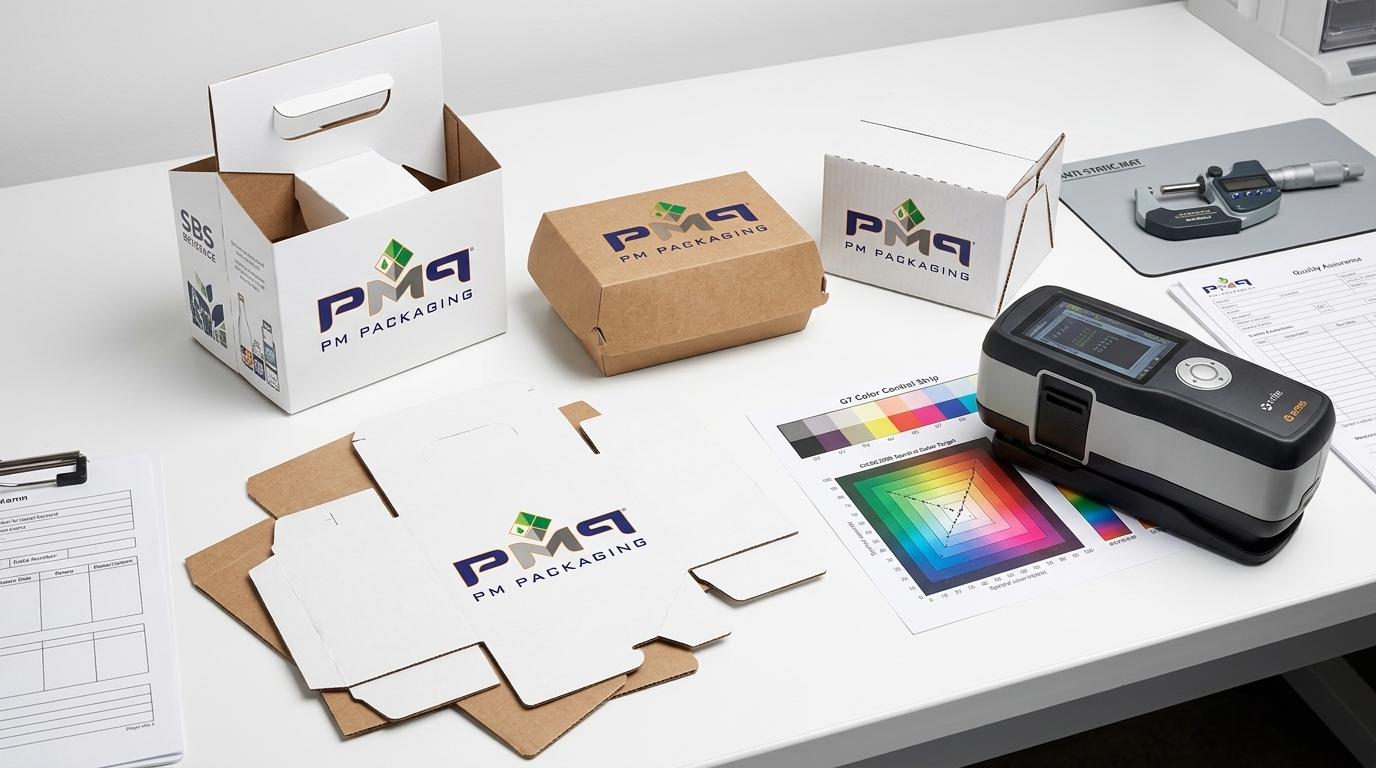
3. The Centralized Quality Management Ecosystem: G7, GMI, and CxF/X-4
To eliminate color drift across distributed co-packers, enterprise F&B brands must transition from physical paper swatches and localized visual approvals to a centralized digital color management architecture.
3.1 Idealliance G7 Master Printer Methodology
Traditional offset printing relied on solid ink density (SID) targets, which only measure ink film thickness, not perceived visual color or grey balance. Two presses operating at identical optical densities can produce wildly divergent visual results if their ink pigment chemistry or dot gain curves vary.
G7 Methodology calibrates the press to match human visual perception through Neutral Print Density Curves (NPDC) and precise CMY mid-tone grey balance (50% C, 40% M, 40% Y). As an Idealliance-certified G7 Master Printer, PM Packaging maintains calibrated Direct-to-Plate (CtP) laser imagers and closed-loop fountain systems to guarantee exact NPDC reproduction across every shift.
G7 vs. Traditional Print Calibration Comparison
| Metric / Feature | Traditional Density-Based Control | Idealliance G7 Master Standard (PM Packaging) |
|---|---|---|
| Primary Control Target | Solid Ink Density (SID) in Status T | Neutral Print Density Curves (NPDC) & Grey Balance |
| Visual Match Across Tech | Poor; varies by press age and ink type | Exceptional; visual grey balance match guaranteed |
| Process Tolerance Metric | Dot Gain Percentage (TVI at 50%) | CIEDE2000 (ΔE00 ≤ 1.5) + ΔChroma (wΔChroma ≤ 1.5) |
| Prepress Integration | Trial-and-error press curves | Mathematically linearized RIP curves via Curve4 |
| Retail Brand Compliance | High risk of shelf visual drift | Full compliance with Walmart / Target / Costco audits |
3.2 CxF/X-4 Digital Color Communication (ISO 17972-4)
Physical paper swatches fade and shift by up to ΔE00 = 2.0 to 3.5 over 12 months. PM Packaging operates under the Color Exchange Format (CxF/X-4 / ISO 17972-4) standard, defining brand colors as complete spectral reflectance curves (380 nm to 730 nm in 10 nm increments) along with opacity and overprint trapping data. Digital masters are fed directly into prepress and inline press scanners, eliminating all analog guesswork.
3.3 Closed-Loop In-Line Spectrophotometry on Offset Litho Presses
Automated scanning spectrophotometers on PM Packaging’s large-format 6-to-8 color offset presses read micro-color bars across the 40" to 56" sheet width every few hundred impressions. If ink zone drift exceeds ΔE00 = 1.0, motorized fountain keys adjust automatically within milliseconds, maintaining tight tolerances from sheet 1 to sheet 500,000.
3.4 Retailer Compliance: GMI Certification and Scorecard Management
Major national retailers (Target, Walmart, Walgreens, Lowe’s) enforce strict GMI (Graphic Measures International) audit standards. Scores below 80% result in rejected shipments and costly chargebacks. As a certified GMI converter, PM Packaging guarantees 100% audit-ready compliance across all retail channels.
4. Substrate and Dieline Optimization for Automated F&B Packaging Lines
High-speed cartoning lines operating at 200 to 450+ cartons per minute (CPM) require cartons engineered for zero opening resistance:
Straight Tuck End (STE) vs. Reverse Tuck End (RTE)
STE cartons fold both closures to the rear, presenting an unbroken, clean front face for retail shelves and enabling symmetrical plow folding on continuous-motion cartoners.
Auto-Bottom (Crash-Lock) Cartons
For semi-automated lines and manual pack-out stations, pre-glued auto-bottom cartons snap into rigid boxes in under 1 second, reducing pack-out labor by 70% to 80% compared to snap-lock bases.
180° Mechanical Crease Pre-Breaking
PM Packaging mechanically pre-breaks creases #1 and #3 to 180° on Bobst folder-gluers, reducing opening resistance by 45% to 60% so rotary vacuum cups erect blanks without hesitations or jams.
5. Strategic Procurement Architecture: Centralized Sourcing & Nearshore Logistics
Instead of permitting regional co-packers to buy packaging independently, enterprise brands negotiate a single master packaging contract with PM Packaging and provide cartons as customer-supplied inventory.
Procurement Model Comparison: Decentralized vs. PM Packaging
| Procurement Category | Decentralized Co-Packer Buying | Centralized Master Contract (PM Packaging) |
|---|---|---|
| Color Consistency (ΔE00) | Uncontrolled (ΔE00 = 2.5 – 5.5) | Strictly Locked (ΔE00 ≤ 1.5 via G7 / CxF/X-4) |
| Purchasing Leverage | Fragmented local quantities | Aggregated national volume tier pricing (15–28% savings) |
| Co-Packer Handling Markups | 15% to 30% added margin per carton | 0% (Customer-supplied inventory model) |
| Prepress & Tooling Expense | Redundant plates across 5+ printers | Single digital master + shared qikCombo™ gang runs (65% tooling savings) |
| Quality Certifications | Inconsistent (often uncertified) | G7 Master, GMI, SQF Food Safety, ISO 9001:2015 |
| Supply Chain Visibility | Zero; multi-vendor blind spots | Real-time VMI inventory & single-point supplier accountability |
USMCA & IMMEX Virtual Transfers
100% USMCA tariff-free compliance with North American raw materials. Seamless IMMEX Transferencias Virtuales eliminate 16% Mexican IVA tax outlays for Baja California contract packagers.
Vendor-Managed Inventory (VMI)
PM Packaging maintains 30 to 60 days of finished safety stock buffers. Co-packers pull stock via automated EDI/Kanban with 24–48 hour delivery, protecting working capital.
6. Enterprise Color Quality Audit Checklist for Packaging Procurement
Before onboarding or renewing contracts with folding carton suppliers for multi-co-packer F&B programs, corporate procurement and quality assurance teams should execute the following technical audit:
| # | Technical Audit Requirement | Standard Compliance Target | PM Packaging Standard |
|---|---|---|---|
| 01 | Idealliance G7 Master Qualification | Certified G7 Master Facility (Facility Level) | ✓ Certified |
| 02 | Retail Print Certification | Certified GMI Converter (Target / Walmart / Lowe's) | ✓ Certified |
| 03 | Digital Color Standard Exchange | CxF/X-4 (ISO 17972-4) Spectral File Architecture | ✓ Full Support |
| 04 | Production Color Tolerance Standard | CIEDE2000 (ΔE00) ≤ 1.5 on all brand spot colors | ✓ ΔE00 ≤ 1.5 |
| 05 | Spectrophotometer Measurement Condition | ISO 13655 M1 (D50 Daylight Matching) Protocol | ✓ M1 Standard |
| 06 | Pressroom Color Control Automation | Closed-Loop Inline Scanning Spectrophotometer | ✓ Automated |
| 07 | Food Safety & Quality Management | SQF (Safe Quality Food) & ISO 9001:2015 Certified | ✓ SQF + ISO |
| 08 | Substrate Chain of Custody | FSC (Forest Stewardship Council) & SFI Certified | ✓ FSC / SFI |
| 09 | High-Speed Cartoner Crease Pre-Breaking | 180° Mechanical In-Line Score Pre-Break | ✓ 180° Pre-Break |
| 10 | Cross-Border Regulatory & Trade | 100% USMCA Compliant + IMMEX Virtual Transfer Ready | ✓ USMCA/IMMEX |
7. Partnering with PM Packaging for Multi-Facility Precision
Managing folding carton color consistency and structural performance across a multi-brand, multi-co-packer food and beverage portfolio is a strategic business discipline. Allowing fragmented, regional purchasing to dictate brand presentation introduces severe commercial risks: damaged brand equity, costly retail compliance deductions, high co-packer packaging markups, and catastrophic automated line downtime.
By establishing a centralized packaging partnership with PM Packaging, enterprise brand owners and supply chain executives secure:
- Flawless Color Uniformity: G7 Master Printer precision, GMI compliance, and CxF/X-4 spectral workflows ensuring ΔE00 ≤ 1.5 across every SKU, carton, and co-packer destination.
- Structural Excellence and Zero Downtime: Precision-engineered folding cartons (STE, RTE, Auto-Bottom) with 180° crease pre-breaking, optimized grain direction, and tight dimensional tolerances engineered for 400+ CPM automated cartoning equipment.
- Aggregated Commercial Value: Elimination of co-packer markups, consolidation of prepress tooling through qikCombo™ gang runs, and enterprise volume-tier cost savings.
- Agile Nearshore Supply Chain: Dual-border San Diego and Baja California operations delivering 1–3 day ground transit, 100% USMCA tariff-free compliance, IMMEX virtual transfers, and dynamic VMI safety stock replenishment.
About PM Packaging
For over 45 years, PM Packaging has engineered and manufactured high-performance folding cartons, litho-laminated single-face laminate (SFL) microflute packaging, luxury rigid setup boxes, blister cards, and high-impact retail displays for North America’s leading consumer brands. Operating advanced manufacturing facilities in San Diego, CA and Baja California, PM Packaging combines certified G7 Master Printer lithographic quality, GMI compliance, SQF food safety certification, and seamless USMCA nearshore logistics to power national retail programs at scale.
Ready to Harmonize Color Consistency Across Your Co-Packers?
Achieving complete brand chromatic uniformity and eliminating retail GMI scorecard penalties requires centralized converting precision.
By locking in G7 Master spectral curves, enforcing CxF/X-4 digital masters, and deploying dual-border JIT distribution, enterprise F&B brands capture substantial margin savings while protecting brand equity on every retail shelf.
Contact PM Packaging today to schedule a technical folding carton portfolio audit, request substrate color drawdowns, or discuss nearshore high-volume manufacturing solutions for your brand.