
For Vice Presidents of Global Procurement, Directors of Supply Chain, Quality Assurance and Regulatory Affairs (QA/RA) Executives, and Senior Medical Packaging Engineers managing Class I, Class II, and Class III medical devices, secondary folding cartons and sterile barrier support packaging are regulated, mission-critical components of the finished medical system.
In medical device commercialization—spanning orthopedic implants, cardiovascular catheters, surgical instruments, in-vitro diagnostics (IVD), drug delivery auto-injectors, endoscopic devices, and sterile single-use disposables—packaging failure directly compromises patient safety and regulatory market access. A single micro-particulate contamination event, dimensional carton collapse that pinholes a primary sterile barrier, an unapproved chemical resin substitution, or an unreadable Unique Device Identification (UDI) barcode can instantly precipitate mandatory FDA recalls, multi-million-dollar inventory quarantines, Warning Letters, and severe commercial disruption across hospital networks and surgical centers.
As multinational medical device original equipment manufacturers (OEMs) aggressively de-risk global supply chains and nearshore sterile assembly, kitting, and secondary converting to North America’s premier medical manufacturing mega-cluster in Baja California (Tijuana and Mexicali), procurement and QA teams cannot treat paperboard converting as a generic commercial print trade. Auditing a nearshore folding carton, blister card, and single-face laminate (SFL) packaging facility requires a comprehensive, data-driven technical audit methodology bridging ISO 13485:2016 quality management, ISO 14644 cleanroom environmental controls, FDA Quality Management System Regulation (QMSR / 21 CFR Part 820), ISO 11607 sterile barrier protection, and uncompromising change control governance.
With over 45 years of specialized packaging engineering, precision converting excellence, and G7 Master certified manufacturing, operating dual-border design headquarters in San Diego, CA, and advanced production campuses in Baja California, PM Packaging engineers and manufactures validated folding cartons, rigid setup enclosures, medical blister cards, and secondary protective packaging for the world’s most demanding healthcare, biotechnology, and medical device enterprises.
This comprehensive technical guide provides medical device procurement, quality, and engineering leaders with the complete auditing architecture required to qualify, validate, and contractually manage high-velocity nearshore medical packaging converters.
1. The Commercial & Regulatory Stakes of Medical Packaging Audits
To build an effective audit framework, corporate procurement directors must understand how packaging interacts with international medical statutory mandates. In the medical technology domain, secondary cartons and protective card enclosures are not mere outer marketing sleeves; they are functional barriers engineered to preserve sterile barrier integrity, prevent mechanical shock damage, ensure aseptic presentation in surgical suites, and maintain unambiguous product identification.
- •FDA 21 CFR 820 Form 483 / Warning Letters
- •EU MDR / IVDR Notified Body Regulatory Holds
- •UDI / GS1 Barcode Non-Compliance Fines
- •Unapproved Raw Material Change Control Violations
- •Sterile Barrier Puncture, Tear, or Seal Creep
- •Bioburden & Bacterial Endotoxin Ingress
- •Particulate Shedding in Operating Rooms / ICUs
- •Catastrophic Patient Emboli or Surgical Site Infection
- •Class I / II Mandatory FDA Lot Recalls
- •Hospital Buying Group Vendor Blacklisting
- •Severe Brand Reputation Destruction
- •Multi-Million-Dollar Finished Inventory Scrapping
- •Cleanroom Automated Cartoner Line Jams
- •Transpacific Ocean Transit Moisture Degradation
- •Emergency Air Freight Surcharges ($50k–$200k)
- •Assembly Line Shutdowns at Baja OEM Campuses
1.1 The FDA QMSR, EU MDR, and Converter Co-Liability
Under the FDA Quality Management System Regulation (QMSR)—which harmonizes FDA 21 CFR Part 820 with ISO 13485:2016—and the European Union Medical Device Regulation (EU MDR 2017/745), device manufacturers bear direct statutory responsibility for the control of their critical component suppliers.
Purchasing controls require medical OEMs to evaluate, select, and continuously monitor suppliers based on their capability to meet specified requirements. If a folding carton converter delivers cartons with out-of-spec score lines that bow under automated cartoning, sheds paperboard dust onto sterile Tyvek® seals, or utilizes an unapproved mineral-oil-laden printing ink that migrates through blister packs, the OEM faces immediate regulatory sanctions, including FDA Form 483 inspection observations, Warning Letters, import alerts, and product seizure.
1.2 The Critical Difference Between Sterile Barrier Systems (SBS) and Protective Secondary Packaging
Medical device packaging consists of two interconnected subsystems governed by ISO 11607-1 and ISO 11607-2:
- Primary Sterile Barrier System (SBS): The minimum package that minimizes the risk of ingress of microorganisms and allows aseptic presentation of the sterile product at the point of use (e.g., thermoformed PETG trays with heat-sealed Tyvek® lids, foil-laminated pouches, or heat-sealed blister cards).
- Protective Secondary Packaging: The structural folding carton, rigid box, or litho-laminated corrugate master pack designed to protect the SBS and device from mechanical shock, vibration, puncture, stacking compression, light degradation, and climatic fluctuations throughout distribution.
High BCT / ECT compression strength to absorb dynamic transit shock & pallet vibration (ASTM D4169 / ISTA 3A).
Precision dimensional tolerances (±0.5 mm) preventing internal movement; particulate-free virgin fiberboard preventing abrasive micro-pinholing against Tyvek®; certified G7 Master graphics, UDI / 2D DataMatrix verification, tamper-evident security closures.
Thermoformed blister tray + heat-sealed Tyvek® lid or medical pouch providing direct microbial barrier maintaining sterile state until point of surgical opening.
If the secondary carton is engineered with inadequate caliper, improper grain direction, or abrasive interior surfaces, the dynamic vibration of transportation causes the primary pouch or Tyvek® lid to rub against the carton walls. This friction can result in micro-pinholing, seal creep, or puncture, destroying the sterile barrier before the product ever reaches the operating room. Secondary packaging auditing is therefore an indispensable component of the OEM’s sterility assurance validation.
1.3 Why Nearshoring to Baja California Eliminates Transpacific Packaging Failure Modes
Sourcing medical cartons and rigid boxes from overseas Asian suppliers introduces systemic risks that cannot be controlled via factory-floor audits alone:
- Transpacific Moisture Sweating & Mold Spores: 4 to 8 weeks of ocean transit across humid tropical maritime zones creates condensation within shipping containers ("container rain"). Paperboard absorbs ambient moisture, dropping Box Compression Test (BCT) strength by up to 45% and fostering fungal spore growth that violates hospital cleanroom entry protocols.
- Micro-Abrasion During Prolonged Ocean Transit: Continuous engine vibration and maritime heave over 6,000 miles accelerates surface scuffing between carton walls and primary sterile pouches.
- Port Fumigation Cross-Contamination: Intermodal shipping containers frequently undergo methyl bromide or phosphine fumigation at maritime transshipment hubs, creating chemical residual contamination risks on porous paperboard.
- Supply Lead Time Fragility: A 10-to-14 week overseas lead time prevents rapid response to hospital demand surges, forcing OEMs to hold massive, expensive safety stock that risks shelf-life expiration.
By partnering with PM Packaging’s dual-plant nearshore facilities in Tijuana and Mexicali, medical device brands achieve 1 to 3 days ground freight delivery to West Coast distribution hubs and Baja California cleanroom assembly plants, eliminating oceanic moisture exposure, eradicating fumigation risks, and slashing lead times by over 80%.
2. Deciphering the Medical Packaging Regulatory Architecture
When auditing packaging converters, procurement and QA teams must evaluate compliance across distinct international regulatory standards. A converter possessing only a generic ISO 9001 quality certificate is entirely inadequate for medical device supply chains.
| Compliance Scheme | Governing Authority | Core Focus & Scope | Audit Verification Focus |
|---|---|---|---|
| ISO 13485:2016 | ISO / Notified Bodies | Medical Device Quality Management System | Design controls, DHR lot traceability, strict change control, CAPA, risk analysis |
| FDA 21 CFR Part 820 (QMSR Harmonized) | US FDA | Current Good Mfg Practices (cGMP) | Purchasing controls, process validation (IQ/OQ/PQ), deviation tracking, DMR files |
| ISO 11607-1 / 11607-2 | ISO / ASTM | Packaging for Terminally Sterilized Devices | Physical protection, sterile barrier compatibility, transit simulation (ASTM D4169) |
| ISO 14644-1 (Class 7/8) | ISO | Cleanroom Air Cleanliness & Particulates | Particulate counts (0.5µm / 5.0µm), HEPA air exchange, positive pressure (10–15 Pa) |
| G7 Master / GMI Print | Idealliance / Retail / Brand Consortia | Colorimetric & Print Process Consistency | Spectrophotometry (ΔE < 2.0), grey balance calibration, UDI barcode grading |
2.1 ISO 13485 vs. ISO 9001: The Essential Converter Differences
While ISO 9001 focuses broadly on customer satisfaction and continuous commercial improvement, ISO 13485:2016 demands absolute regulatory compliance, patient risk management (ISO 14971), and exhaustive process control. When auditing a packaging converter, procurement teams must verify the specific operational differences:
- Document Control & Device History Records (DHR): Every single converting run must generate an immutable, fully traceable DHR documenting raw material roll/skid lot numbers, ink batch certificates of analysis (CoA), pressroom temperature/humidity logs, line clearance sign-offs, die-cutting inspection sheets, and final QA release authorizations.
- Change Control Agreements: Under ISO 9001, a printer can change paperboard mills, switch ink suppliers, or substitute adhesives if the finished carton meets basic commercial specifications. Under ISO 13485 and medical supply agreements, zero changes to raw materials, coatings, tooling, machine lines, or facility locations are permitted without formal, written Engineering Change Orders (ECO) approved by the OEM.
- Risk Management & Failure Mode Effects Analysis (FMEA): The converter must maintain an active Process FMEA (pFMEA) evaluating every risk in the converting stream—such as knife dust generation, ink rub-off, mixed-lot cross-contamination, or barcode scannability loss—with documented preventive control mechanisms.
3. Cleanroom & Controlled Environment Converting Standards
For medical device packaging, particulate contamination and foreign object debris (FOD) are severe patient risks. In ophthalmic surgery, orthopedic implants, and intravenous catheter kits, loose paperboard dust or airborne fibers entering the sterile field can cause fatal emboli, granulomas, or post-operative infections. Auditing the converter’s environmental cleanliness protocols is therefore paramount.
| Environment Class (ISO 14644-1) | Max 0.5 µm Particles (per m³) | Max 5.0 µm Particles (per m³) | Typical Packaging Operation Performed at Converter |
|---|---|---|---|
| ISO Class 7 (Class 10,000) | 352,000 | 2,930 | Primary blister card sealing, sterile pouch loading, direct device kitting |
| ISO Class 8 (Class 100,000) | 3,520,000 | 29,300 | Medical folding carton gluing, window patching, sterile barrier carton pack-out |
| Controlled Non-Classified (CNC) | Monitored Baseline (<10,000,000) | Monitored Baseline (<100,000) | Large-format offset printing, precision die-cutting, embossing, raw material staging |
| Standard Commercial Print Shop Floor | Uncontrolled (High Paper Dust) | Uncontrolled (High Paper Dust) | Strictly Disqualified for Medical Device Secondary & Primary Packaging |
3.1 Facility Air Handling, HEPA Filtration, and Pressure Cascades
During an on-site audit, packaging engineers must inspect the converter’s Heating, Ventilation, and Air Conditioning (HVAC) engineering:
- Positive Air Pressure Cascades: Cleanroom finishing and packing zones must maintain continuous positive air pressure relative to adjacent pressrooms and hallways (typically 10 to 15 Pascals / 0.04 to 0.06 inches of water column). This prevents contaminated air and paper dust from migrating into clean zones when access doors open.
- HEPA Filtration & Air Exchange Rates: Cleanroom areas must feature terminal HEPA filters (99.97% efficiency at 0.3 microns) providing a minimum of 20 to 30 Air Changes per Hour (ACH) for ISO Class 8, and 30 to 60 ACH for ISO Class 7.
- Environmental Monitoring Logs: Auditors must review continuous particle counter readouts, differential pressure gauges (Magnehelic gauges), and routine viable bioburden settle plates / swab test records.
3.2 Fiber Dust Extraction and Anti-Static Controls on Converting Lines
Standard commercial die-cutting and folding-gluing operations generate substantial airborne paper dust through mechanical shearing of cellulose fibers. In a certified medical packaging facility like PM Packaging, converters employ dedicated particulate mitigation technologies:
- Pneumatic Vacuum Shrouds: High-velocity vacuum nozzles positioned directly above steel-rule cutting, creasing, and automatic blanking stations capture fiber dust at the point of generation.
- Ionizing Air Knives & Anti-Static Bars: Static electricity causes microscopic paperboard dust to adhere magnetically to the printed sheets. Active ionizing bars neutralize electrostatic charges, allowing vacuum blowers to lift particulates cleanly from the carton surfaces prior to folding and gluing.
- Dust-Free Stripping Tools: Precision dynamic stripping dies engineered with laser-cut chamfered edges prevent fiber tearing and edge fraying during high-speed waste removal.
4. Medical-Grade Paperboard Substrates & Low-Migration Chemistry
Substrate selection in medical packaging is governed by strict biocompatibility, chemical extractable/leachable profiles, structural durability, and particulate shedding characteristics.
| Substrate Grade | Fiber Composition & Caliper Range | Chemical / Purity Profile | Medical Application Suitability |
|---|---|---|---|
| Solid Bleached Sulfate (SBS) Paperboard | 100% Virgin Bleached Chemical Pulp (12–28pt) | Ultra-Pure, Zero PFAS, Zero Phthalates/BPA | Gold Standard for Class I, II, & III Medical Folding Cartons & Blister Cards |
| Folding Boxboard (FBB / GC1 / GC2) | Virgin Pulp Core with Bleached Chemical Tops | Clean, High Bulk, Excellent Rigidity | Approved Alternative for European-Bound Devices & Lightweight Diagnostic Cartons |
| Coated Unbleached Kraft (CUK / SUS) | 100% Virgin Unbleached Kraft Fiber (16–30pt) | High Tear & Burst Strength, Zero Recycled | Approved for Heavy Master Shippers, Tray Reinforcements, & Heavy Surgical Tooling |
| Clay Coated Newsback (CCNB) / CRB | 100% Recycled Post-Consumer Waste | HIGH RISK: Contains Heavy Metals, Inks, MOSH/MOAH, Phthalates | STRICTLY DISQUALIFIED in Medical Device Secondary & Primary Packaging |
| Single-Face Laminated Microflute (SFL E/F-Flute) | Virgin Top Liner Litho-Laminated to Microflute | High Crush Strength (ECT/BCT), Clean Liner | Ideal for Bulky Diagnostics, Capital Equipment Accessories, & Surgical Packs |
4.1 Why Recycled Paperboard (CCNB/CRB) is Strictly Disqualified
While recycled paperboard (CCNB/CRB) is widely used in dry grocery packaging, it is strictly prohibited in medical device packaging. Recycled post-consumer fiber contains unquantified residual contaminants, including:
- Mineral Oil Saturated and Aromatic Hydrocarbons (MOSH/MOAH) from commercial printing inks.
- Heavy Metals (Lead, Cadmium, Mercury, Hexavalent Chromium) exceeding CONEG / RoHS limits.
- Bisphenol A (BPA), Phthalates, and Polyfluoroalkyl Substances (PFAS).
- Uncontrolled Microbial Bioburden embedded within recycled fiber matrices.
Under elevated humidity or temperature, these volatile compounds can outgas and migrate through plastic sterile barriers, leading to chemical leachables that fail ISO 10993 biocompatibility testing (cytotoxicity, systemic toxicity, sensitization). PM Packaging utilizes 100% virgin-fiber Solid Bleached Sulfate (SBS) sourced from certified sustainable mills (FSC / SFI certified), guaranteeing complete chemical traceability, exceptional brightness (88–94 GE), ultra-low particulate shedding, and pristine die-cutting cleanliness.
4.2 Low-Odor, Low-Migration Inks and Water-Based Aqueous Coatings
All printing inks, fountain solutions, overprint varnishes, and laminating adhesives used in medical converting must comply with rigorous chemical criteria:
- Low-Migration / Low-Odor Formulations: Inks formulated with highly refined vegetable oils or specialized low-migration UV photoinitiators that eliminate residual volatile organic compounds (VOCs).
- Zero-PFAS Water-Based Aqueous Coatings: Protective barrier coatings that provide scratch, scuff, and moisture resistance without fluorinated chemistries or heavy metal drying catalysts.
- Anti-Offset Spray Powder Control: In commercial printing, starch spray powder prevents freshly printed sheets from sticking. In medical carton manufacturing, excessive spray powder creates severe particulate contamination. PM Packaging utilizes high-efficiency IR drying and inline aqueous coating towers, minimizing or completely eliminating the need for starch spray powders.
4.3 Medical Blister Cards & qikCombo™ Program Integration
For medical devices packaged in blister cards (e.g., disposable diagnostic lances, catheter retainers, dental components, surgical suture kits), the heat-seal adhesive must create a validated, fiber-tearing bond with medical-grade thermoformed blisters (PETG, GAG, PVC, RPET) or Tyvek®.
Through PM Packaging’s qikCombo™ Program, multi-SKU medical hardware lines and fast-turn device launches group multiple part numbers onto standardized virgin SBS sheets with validated heat-seal coatings. This program delivers 5,000 to 100,000 unit runs with 10-day turnaround, eliminating steep custom tooling charges while maintaining full lot-specific QA documentation.
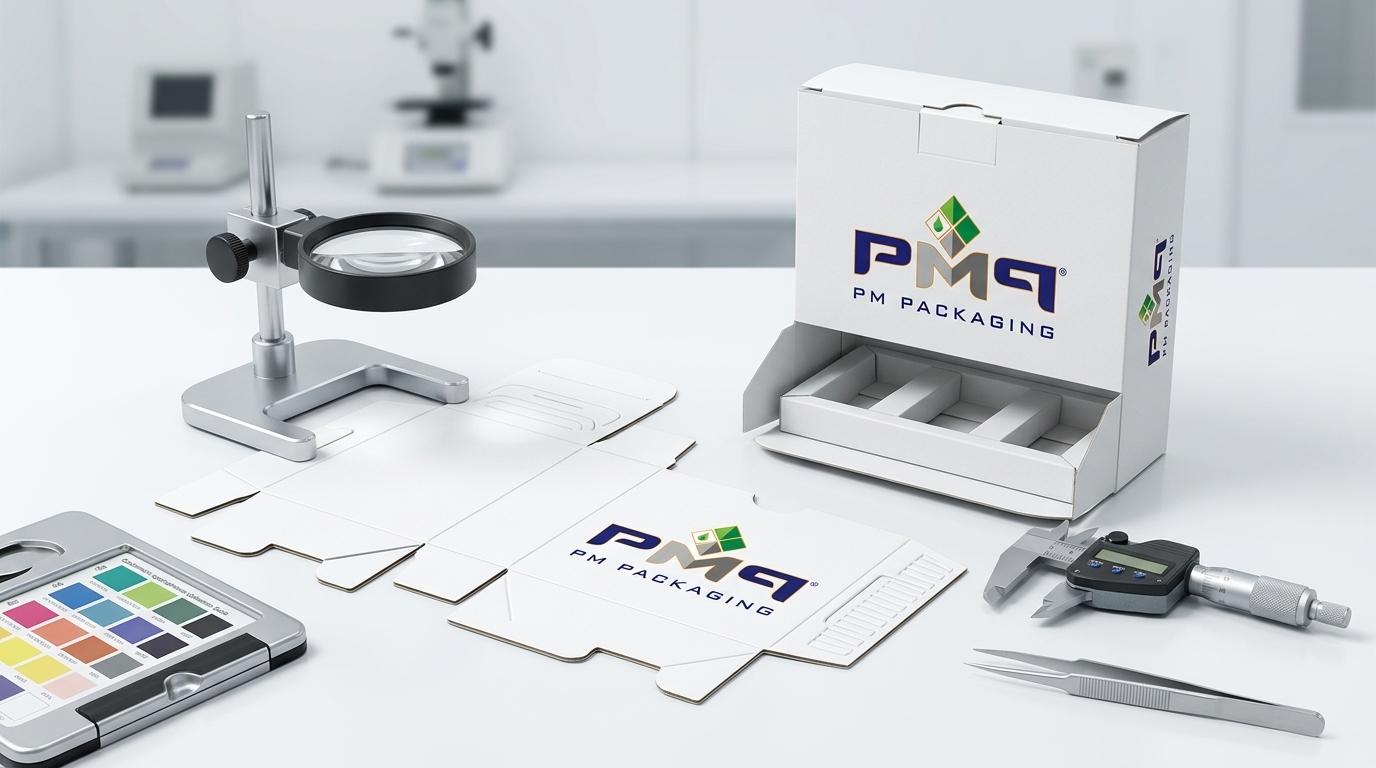
5. The Comprehensive 8-Pillar On-Site Facility Audit Protocol
When QA and procurement directors conduct an on-site audit of a nearshore packaging converter, they must execute an exhaustive, systematic walkthrough covering the entire manufacturing lifecycle.
ISO 13485, QMSR Manual, CAPA, DHR lot logs
Virgin Mill CoAs, Inks, Adhesive Quarantine
Positive Pressure, HEPA, Airlocks, Gowning
G7 Delta E < 2.0, Low-Odor Inks, Prepress
Vacuum Particulate Extraction, ±0.5mm dies
100% 2D/UDI Barcode Scan, Glue Detectors
Caliper, Mullen Burst, Cobb, Spectro
FAST Border Lanes, Climate Sealed Bags
Pillar 1: Quality Management System (QMS) & Document Control
- ✓Verification of ISO 13485:2016 and ISO 9001:2015 current accreditation certificates from an accredited registrar.
- ✓Review of the Device Master Record (DMR) and Device History Record (DHR) creation procedures.
- ✓Examination of the Corrective and Preventive Action (CAPA) log for the past 24 months, focusing on root-cause analysis methodologies (5-Why, Ishikawa fishbone) and closed-loop effectiveness checks.
- ✓Verification of internal audit schedules and management review meeting minutes.
- ✓Software validation records for automated prepress, CTP (Computer-to-Plate), and spectrophotometric measurement software under 21 CFR Part 11.
Pillar 2: Material Receiving, Quarantine, and Fiber Traceability
- ✓Physical inspection of the raw material intake dock: sealed doors, pest management traps, clean concrete floors.
- ✓Review of incoming Certificate of Analysis (CoA) verification procedures for every paperboard skid, ink batch, and adhesive tote.
- ✓Yellow "Quarantine" and Green "QC Approved" barcoded labeling systems physically preventing unreleased materials from entering the pressroom.
- ✓Chain-of-custody documentation tracing master paperboard rolls back to virgin timber mills (FSC / SFI tracking).
Pillar 3: Cleanroom / Controlled Environment & HVAC Infrastructure
- ✓Inspection of gowning airlocks: tacky walk-off mats, hands-free handwashing stations, air showers, and strict personal protective equipment (PPE) protocols (lint-free lab coats, hairnets, beard covers, powder-free nitrile gloves).
- ✓Review of differential pressure sensor calibrations (10–15 Pa positive pressure maintenance).
- ✓Inspection of terminal HEPA filtration housings, certification stickers, and ductwork hygiene.
- ✓Review of third-party airborne particulate certification records under ISO 14644-1 (Class 7 and Class 8 zones).
- ✓Pest control program inspection: exterior bait stations (non-toxic), interior electronic insect light traps (ILTs) mapped and recorded with zero open-pest vulnerabilities.
Pillar 4: Offset Lithographic Printing & G7 Colorimetric Controls
- ✓Inspection of large-format 6-to-8 color offset presses (Heidelberg Speedmaster / KBA Rapida).
- ✓Verification of Idealliance G7 Master Printer calibration data: grey balance alignment, target ink densities, and spectrophotometric Delta E tolerances maintained at Delta E < 2.0 across 100,000+ impression runs.
- ✓Storage and segregation of low-migration, low-VOC printing inks and food/medical-grade fountain additives.
- ✓Automated plate-scanning and prepress digital proof comparison systems that catch typographical errors or dieline shifts prior to plate exposure.
| Process Parameter | Target Standard | Medical Packaging Tolerance | Audit Verification Method |
|---|---|---|---|
| Critical Brand / Spot Color | Pantone / Lab Match | ΔE (CIELab) ≤ 1.5 | X-Rite eXact Spectrophotometer inline scan |
| Secondary Process Color | ISO 12647-2 / G7 | ΔE (CIELab) ≤ 2.0 | Closed-loop press console spectrophotometry |
| Print Registration | Keyline Alignment | ±0.05 mm (±0.002 in) | Optical 50x measuring microscope |
| Ink Rub / Scuff Resistance | ASTM D5264 (Sutherland) | 500+ Rubs (4 lb weight) | Sutherland Ink Rub Tester (post-aqueous dry) |
| UDI Barcode Print Grade | ANSI / ISO / GS1 | Grade A (3.5 to 4.0) | Inline Cognex / Microscan 100% Barcode Verifier |
Pillar 5: Precision Die-Cutting, Embossing, and Particulate Extraction
- ✓Inspection of Bobst automatic flatbed die-cutters equipped with dedicated continuous vacuum extraction hoods.
- ✓Review of die tooling storage: CNC-machined phenolic counterplates, dynamic stripping tools, and serialized steel-rule die chases stored in climate-controlled racking.
- ✓Dieline dimensional verification: dimensional tolerance checks on critical carton panels, tuck flaps, lock tabs, and hang holes (±0.5 mm / ±0.020 in tolerance).
- ✓Micro-perforation and score-line depth analysis: verifying consistent crease depth to ensure predictable opening and closing forces on high-speed automated cartoning lines.
Pillar 6: High-Speed Gluing, 100% Vision Inspection, and Line Clearance
- ✓Examination of high-speed folder-gluers equipped with electronic cold glue and hot-melt extrusion systems featuring inline optical glue detection sensors.
- ✓Verification of 100% inline vision inspection systems (e.g., Baumer HHS, Leary, EyeC) verifying 100% of cartons for print defects, ink smudges, color variation, and incorrect copy.
- ✓100% 2D DataMatrix and 1D UDI Barcode Scanners: Optical scanners that automatically eject any carton with an unreadable or non-conforming barcode, preventing mixed-SKU commingling.
- ✓Rigorous Line Clearance Protocols: Verification of written, two-person sign-off line clearance procedures ensuring 100% removal of all leftover cartons, labels, plates, and waste from previous production runs before a new job begins.
Pillar 7: Analytical Testing Laboratory & In-Process Quality Controls
- ✓Physical walkthrough of the on-site quality testing lab with active calibration logs and stickers on all equipment:
- Digital Micrometers: Caliper thickness verification across multiple board zones.
- Mullen Burst Tester (ASTM D3786): Bursting strength resistance.
- Cobb Sizing Tester (ASTM D3285): Water absorption of paperboard surface over 60 seconds (critical for sterile barrier protection in varying humidity).
- Elmendorf Tear Tester (ASTM D1922): Internal tearing resistance.
- Coefficient of Friction (COF) Tester (ASTM D1894): Static and kinetic COF verification ensuring smooth passage through automated hospital packing machines.
- Sutherland Ink Rub Tester (ASTM D5264): Scuff resistance under 4-lb test blocks.
Pillar 8: Warehousing, Segregation, C-TPAT Security, and Shipping
- ✓Segregated finished goods holding area with physical and electronic barcode release gating.
- ✓Packaging of finished folding cartons: lined corrugated master cartons with sealed heavy-gauge virgin polyethylene bags that prevent particulate or moisture ingress during transport.
- ✓Verification of C-TPAT (Customs-Trade Partnership Against Terrorism) and OEA (Authorized Economic Operator) certifications: 24/7 CCTV surveillance, biometric access control, perimeter fencing, and 17-point container inspection protocols ensuring rapid, tamper-free FAST border clearance into the United States.
6. Process Validation, Statistical Process Control (SPC), and Traceability
In medical packaging manufacturing, processes must be proven capable and repeatable through rigorous validation protocols before commercial production begins.
| Validation Stage | Core Focus & Purpose | Key Activities & Deliverables | Acceptance Criteria & Documentation |
|---|---|---|---|
| Installation Qualification (IQ) | Verify equipment is installed per OEM specifications. | Physical utility verification, safety interlocks, pneumatic pressure, HEPA airflow checks. | Calibration certificates logged, electrical schematics verified, SOPs and maintenance schedules set. |
| Operational Qualification (OQ) | Verify equipment runs reliably across upper & lower process limits. | Challenging operating limits: speed, temperature, adhesive viscosity, die pressure bounds. | Process window defined; zero machine alarms; critical dimensions within spec across full range. |
| Performance Qualification (PQ) | Verify long-term capability under true production conditions. | Consecutive commercial runs (typically 3 lots) at full volume with standard operators. | Statistical capability demonstrated: Cpk ≥ 1.33 (Standard) or Cpk ≥ 1.67 (Critical UDI/Lock) |
6.1 Statistical Process Control (SPC) Metrics
Auditors must examine the converter’s SPC data on critical product characteristics:
- Cpk ≥ 1.33: Minimum capability index for standard commercial packaging dimensions.
- Cpk ≥ 1.67: Mandatory capability index for critical-to-quality (CTQ) dimensions, including auto-lock bottom glue flap placement, tuck-end insertion resistance, critical window-patch cutouts for device serial number viewing, and overall carton depth and width.
6.2 Mock Recall and Upstream/Downstream Traceability Protocols
Under ISO 13485 and FDA QMSR, packaging converters must prove 100% bidirectional traceability in the event of a quality defect or material recall. During an audit, QA teams should execute an unannounced Mock Traceability Challenge:
- Identify the exact master paperboard roll/skid lot number and virgin pulp mill CoA.
- Identify the specific batch numbers for all inks, aqueous coatings, and glues used.
- Identify the specific printing press, die-cutter, and folder-gluer machine lines utilized.
- Provide the exact date, shift, operator sign-offs, and environmental temperature/humidity logs.
- Provide the calibration records of the spectrophotometer and vision cameras on that production date.
- Identify all other medical device cartons manufactured from that same master raw material lot.
7. Contractual Governance: Quality Technical Agreements & Change Control
The technical foundation established during an on-site audit must be codified in a legally binding Quality Technical Agreement (QTA) signed by both executive leadership teams.
Key Provisions of the Medical Packaging Quality Technical Agreement
- •Absolute Change Control (Zero Unapproved Modifications): No changes to paperboard mill, caliper, basis weight, ink systems, coatings, adhesives, dies, or facility locations without 90–180 days advance written ECO authorization from OEM QA.
- •Non-Conformance, Deviation & CAPA Governance: Formal notification of any out-of-specification event within 24 hours; containment plan delivered within 48 hours; closed-loop 8D root-cause investigation completed in ≤ 30 days.
- •Tooling Ownership & Sample Retention: 100% OEM ownership of specialized cutting dies, embossing tools, and prepress artwork masters; retention samples archived in climate control for 7+ years.
7.1 The Absolute Change Notification Rule
In standard consumer packaging, converters frequently optimize supply chains by switching paperboard mills or altering ink suppliers to lower costs. In the medical device industry, this practice is a catastrophic compliance violation.
A change in paperboard sizing chemistry can alter gas permeability during ethylene oxide (EtO) sterilization, resulting in unsterile devices. A change in adhesive formulation can cause packaging to pop open inside sub-zero cryo-storage chambers.
A world-class medical converter operates under rigid Change Control: No raw material, coating, adhesive, ink, die tooling, pressline, or manufacturing campus can be changed without formal written notification (minimum 90–180 days in advance) and formal re-qualification by the OEM packaging engineering team.
8. Nearshore Logistics & Baja California Supply Chain Integration
Sourcing packaging from PM Packaging’s nearshore manufacturing campuses in Tijuana and Mexicali provides unmatched speed, security, and supply chain continuity compared to transpacific alternatives.
| Supply Chain Metric | Transpacific Overseas Supply (Asia) | PM Packaging Nearshore (Tijuana / San Diego) |
|---|---|---|
| Order-to-Delivery Time | 10 to 16 Weeks (Ocean + Customs + DC) | 1 to 3 Days (Dedicated Clean Ground Freight) |
| Maritime Moisture & Mold Exposure | HIGH RISK: 30–60 days in humid marine containers ("container rain") | ZERO RISK: Direct climate-controlled ground transit in sealed heavy-gauge poly bags |
| Port Congestion & Demurrage | Vulnerable to port strikes, container shortages, & demurrage fees | Zero port exposure; direct border crossing via dedicated C-TPAT / FAST lanes |
| Tariff & Trade Status | Vulnerable to Section 301 tariffs & currency fluctuations | 100% Tariff-Free under USMCA / T-MEC; IMMEX virtual transfer certified |
| Inventory Holding & Working Capital | High working capital tied up in 90–120 days of buffer safety stock | JIT Cleanroom Replenishment; Vendor Managed Inventory (VMI) with daily kanban |
| Engineering Collaboration & Prototyping | 15-hour time zone difference; remote sampling takes 3–4 weeks | Same-day on-site collaboration; San Diego design HQ creates CAD samples in 24 hours |
8.1 Supplying North America’s Largest Medical Device Cluster
The Tijuana-Mexicali border corridor hosts North America’s highest concentration of medical device manufacturing operations, employing over 50,000 specialized technicians across 80+ global OEMs (including leaders in cardiovascular, orthopedic, IV administration, respiratory, and surgical technologies).
By locating converting operations directly within this ecosystem, PM Packaging provides medical OEMs with seamless Vendor Managed Inventory (VMI) and Just-In-Time (JIT) cleanroom replenishment:
- IMMEX Virtual Transfers: Packaging manufactured in PM Packaging’s Baja California plants can be transferred directly to nearby OEM cleanroom assembly plants under Mexican IMMEX virtual transfer protocols without incurring import duties or export VAT complications.
- Direct Cross-Border Supply to US Distribution Hubs: Packaging destined for US-based packaging lines ships across the border via FAST lanes (Free and Secure Trade) under C-TPAT certification, reaching San Diego, Los Angeles, Phoenix, and Dallas distribution centers in 24 to 48 hours.
9. The Medical Packaging Audit Scorecard & Evaluation Rubric
Enterprise procurement and quality auditing teams can utilize the following objective 100-Point Audit Scoring Rubric during on-site converter evaluations.
| Cat# | Evaluation Category | Points | Critical Verification Items & Compliance Focus |
|---|---|---|---|
| 01 | Quality Management System & ISO 13485 Compliance | 15 pts | ISO 13485/9001 certs, DMR/DHR files, CAPA closed-loop process |
| 02 | Cleanroom & Controlled Environment Infrastructure | 15 pts | ISO 14644-1 certification, HEPA, positive pressure cascade logs |
| 03 | Raw Material Traceability & Virgin SBS Purity | 10 pts | 100% virgin pulp CoAs, zero CCNB, low-VOC ink batch documentation |
| 04 | Offset Litho Pressroom & G7 Color Controls | 10 pts | G7 Master certification, Delta E < 2.0, densitometry logs |
| 05 | Precision Die-Cutting & Particulate Extraction | 10 pts | Vacuum hoods, anti-static ionizers, ±0.5mm dimensional limits |
| 06 | 100% Vision Inspection & UDI Barcode Scanning | 15 pts | Inline optical defect cameras, 100% UDI scanning, ejection flipper |
| 07 | In-House Analytical Testing Lab & Calibration | 10 pts | Caliper, Mullen burst, Cobb, rub tester calibration records |
| 08 | Process Validation & Statistical Control (SPC) | 05 pts | IQ/OQ/PQ protocols, Cpk ≥ 1.33/1.67 capability validation |
| 09 | Change Control Governance & QTA Agreement | 05 pts | Strict notification protocol, signed ECO sign-off workflows |
| 10 | Warehouse, C-TPAT Security & Nearshore Logistics | 05 pts | Sealed poly-bag packaging, FAST lanes, VMI replenishment model |
| TOTAL | TOTAL AUDIT SCORE | 100 pts | ≥90: Approved Tier-1 Medical Converter | 80–89: Conditional Approval (Minor CAPA Required) | <80: Disqualified Supplier |
Categorization of Audit Findings
- Critical Finding (Immediate Disqualification / Stop-Shipment): Use of recycled paperboard (CCNB/CRB) in medical packaging; absence of line clearance protocols resulting in mixed-SKU commingling; unapproved change of substrate mill, coating, or adhesive without OEM authorization; complete failure of cleanroom positive air pressure or uncertified HEPA filtration.
- Major Finding (Conditional Approval — 30-Day CAPA Required): Calibration overdue on analytical testing lab equipment (e.g., micrometer, spectrophotometer); incomplete DHR documentation or missing raw material lot CoA; Cpk on critical dimensions falling between 1.10 and 1.32 without active containment.
- Minor Finding (Observation — Continuous Improvement Tracking): Minor wear on gowning airlock tacky mats requiring more frequent change schedules; slight labeling ambiguity on non-critical secondary tooling storage racks.
10. Partnering with PM Packaging for Medical Packaging Excellence
For over four decades, PM Packaging has served as the trusted commercial packaging partner for North America’s leading medical device, diagnostic, pharmaceutical, and high-reliability industrial manufacturers.
The PM Packaging Advantage at a Glance
- ✓45+ Years Manufacturing Excellence: Large-Format 6-to-8 color offset litho presses (Heidelberg / KBA).
- ✓Dual-Border Infrastructure: San Diego Design HQ + Advanced Baja California Converting Campuses.
- ✓ISO 13485 / ISO 9001 / G7 Master: Rigorous Medical QMS, G7 Color Consistency, 100% Vision Verification.
- ✓100% Virgin SBS / Low-Migration Chemistry: Pure Chemical Integrity, Zero PFAS, Validated Heat-Seal Blister Chemistries.
- ✓1–3 Day Nearshore Ground Freight: Rapid Delivery to West Coast & Baja Cleanrooms; Zero Ocean Transit Risk.
- ✓qikCombo™ Medical Blister Program: Multi-SKU Shared Runs (5,000–100,000 units) with 10-Day Turnaround.
Whether you are auditing suppliers for an upcoming Class II / Class III product line rollout, transitioning away from high-risk transpacific suppliers to secure USMCA-compliant nearshore redundancy, or scaling high-speed automated cartoning lines, PM Packaging provides the structural engineering depth, regulatory discipline, and high-volume converting scale your enterprise demands.
About PM Packaging
For over 45 years, PM Packaging has engineered and manufactured validated folding cartons, litho-laminated single-face microflute packaging, medical blister cards, and precision structural packaging for global healthcare, biotechnology, and consumer brands. Operating dual-border headquarters in San Diego, CA and advanced manufacturing campuses in Baja California, PM Packaging combines certified G7 Master Printer lithographic precision, ISO 13485-aligned quality controls, and rapid USMCA nearshore logistics to power regulated medical programs at scale.
Request a Technical Audit or Medical Packaging Consultation
Contact PM Packaging’s technical engineering and medical procurement consulting team to schedule an on-site audit of our Baja California converting facilities, request comprehensive regulatory compliance dossiers, or initiate rapid CAD dieline prototyping for your medical device packaging programs.
Partner with PM Packaging to secure certified ISO 13485-aligned medical carton manufacturing, eliminate transpacific shipping hazards, and de-risk your nearshore medical device supply chain.