
For brand directors, procurement executives, and packaging managers distributing through major retailers like Walmart, Target, The Home Depot, and Costco, packaging format decisions carry multi-million-dollar implications.
Scaling commercial hardware packaging requires targeted engineering: Hardware packaging must endure heavy metal tool weight, rough customer handling in big-box retail environments, and high-humidity warehouse storage without card delamination. PM Packaging partners with high-volume brands to ensure G7 color consistency, structural durability, and predictable replenishment.
Today, enterprise suppliers are systematically transitioning from bulky all-plastic clamshells to printed paperboard blister card packaging. When calculating the return on investment (ROI) of this shift, leading brands evaluate four financial and operational pillars: material cost savings, logistics density, labor throughput, and retail brand equity.
1. Direct Material Savings and Plastic Reduction
The most immediate line item on a packaging procurement audit is raw material expense. Plastic clamshells require substantial thermoformed plastic volume to maintain structural rigidity. In contrast, blister card packaging pairs a minimal, form-fitting front contour with a sturdy, high-yield paperboard backing card.
By replacing thick plastic enclosures with premium paperboard made from certified sustainable sources, suppliers routinely achieve a 20% to 35% reduction in direct packaging material costs. Furthermore, with national retailers expanding strict plastic-reduction mandates and extended producer responsibility (EPR) regulations gaining traction, reducing plastic mass directly shields brands from emerging packaging fees and compliance penalties.
2. Freight Optimization and Cube Efficiency
Freight and warehousing economics often deliver the largest financial ROI when switching from clamshells to blister cards.
All-plastic clamshells consume excess volumetric space. Their wide perimeter flanges and nesting limitations waste critical space inside master cartons, on pallets, and in freight trailers.
Blister card packaging streamlines the product profile:
- Higher Pallet Density: Flatter geometry allows brands to fit 30% to 50% more finished units on standard 48x40 retail pallets.
- Lower Freight Costs: Shipping more sellable units per truckload slashes per-unit transportation expenses across nationwide distribution networks.
- Reduced Warehouse Footprint: Unfilled blister cards ship flat in compact cases, freeing up staging space on manufacturing floors compared to pre-formed clamshells.
3. Packing Line Speed and Operational Labor
Pack-out speed and manual touchpoints dictate operational margins during national rollouts. Traditional clamshell packaging often demands labor-intensive manual closing, snaps, or dedicated ultrasonic sealing equipment that bottlenecks high-speed fulfillment.
Modern blister card packaging architectures—such as heat-seal backing cards, fold-over cards, and trapped blister cards—integrate smoothly with semi-automated rotary tables and high-speed automated sealing lines. With predictable cycle times and automated card feeding, packaging lines achieve faster throughput, lower labor costs per unit, and fewer assembly defects during peak production surges.
4. Comparing Clamshells vs. Blister Cards
The table below highlights key operational trade-offs enterprise brands evaluate during packaging audits:
| Strategic Metric | Traditional Plastic Clamshells | Printed Paperboard Blister Cards | Business Impact |
|---|---|---|---|
| Material Cost | High (Heavy plastic thermoforming) | Economical (High-yield paperboard backing) | 20%–35% direct unit savings |
| Pallet & Cube Density | Bulky profiles; low units per pallet | Slim profile; optimized case pack density | 30%–50% freight efficiency gain |
| Graphic Real Estate | Limited to small loose paper insert cards | Dual-sided, vibrant full-bleed printing | Greater shelf impact & brand billboard |
| Retail Sustainability | Heavy single-use plastic footprint | Recyclable paperboard from certified sources | Aligns with Tier-1 retailer ESG goals |
| Unboxing Experience | Frustrating "wrap rage" requiring shears | Clean, intuitive push-through or tear-strip | Reduced returns & higher customer loyalty |
| Multi-SKU Flexibility | Dedicated tooling; high inventory MOQs | Gang-run programs (qikCombo™) | Low minimums & zero obsolete inventory |
5. Merchandising Impact and Brand Elevation
Beyond direct savings, blister cards deliver superior marketing power at the point of sale.
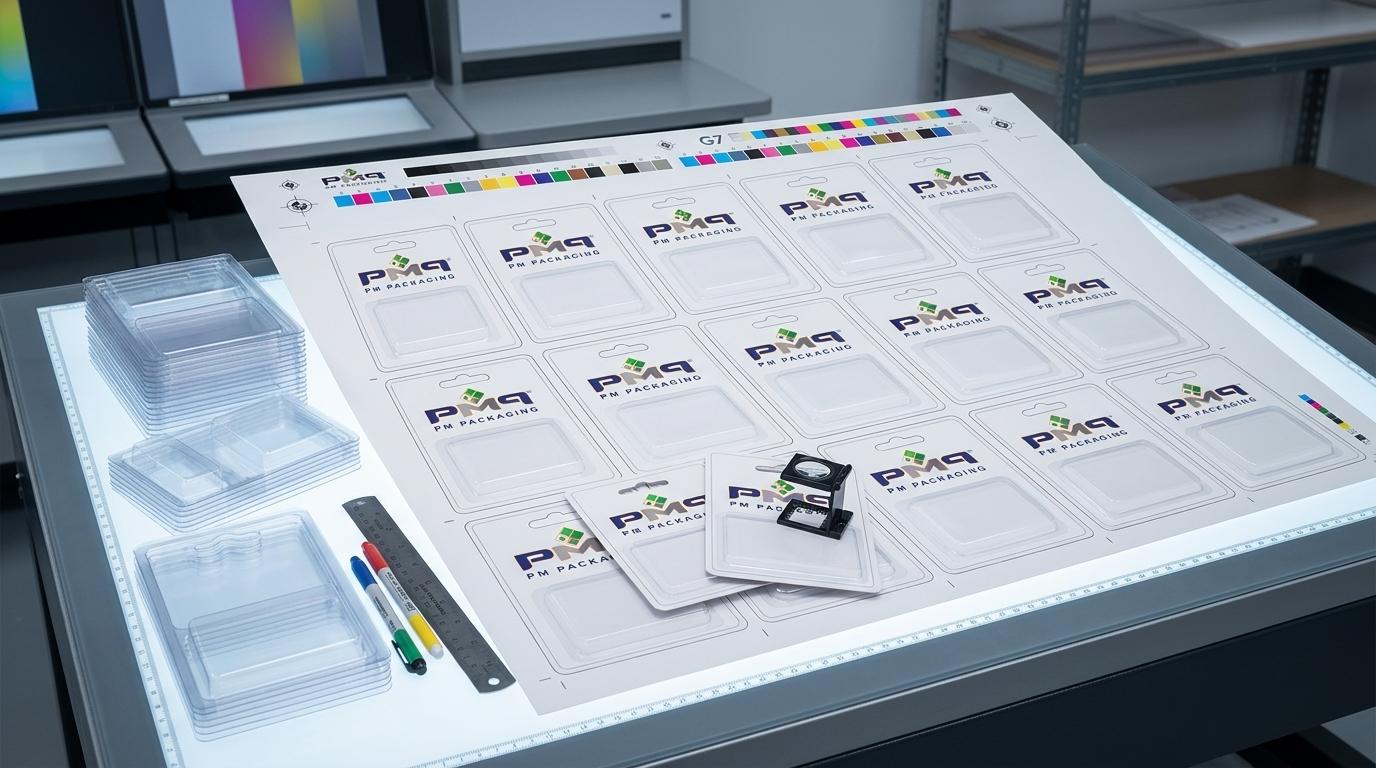
Clamshell packaging relies on loose paper inserts that can shift or obscure the product. In contrast, printed paperboard blister cards serve as vibrant, dual-sided billboards on retail pegboards. Leveraging G7 Master certified color consistency, inline UV coatings, and soft-touch finishes, brands showcase bold lifestyle imagery and clear feature callouts that drive conversion.
Equally important is the consumer unboxing experience. Eliminating hazardous "wrap rage" in favor of an intuitive, clean-opening paperboard backing fosters brand loyalty and reduces negative customer reviews.
6. Multi-SKU Agility with the qikCombo™ Program
For corporate suppliers managing diverse lines across 10 to 50+ retail SKUs, managing packaging inventory can lock up working capital. Traditional custom print runs often impose rigid minimum order quantities that lead to costly obsolescence when retail graphics change.
PM Packaging solves this catalog complexity through our proprietary qikCombo™ gang-run blister card program. By grouping multiple SKU designs onto shared production sheets, brands enjoy:
- Low Economic Minimums: Cost-effective runs starting as low as 5,000 units per SKU.
- Fast 10-Day Turnaround: Rapid production cycles that keep high-velocity replenishment on schedule.
- Eliminated Obsolescence: Freedom to update graphics, barcodes, or compliance copy without discarding massive inventory reserves.
7. Nearshore Speed and Tariff-Free Supply Chains
Sourcing packaging overseas introduces long ocean lead times, container volatility, and import tariffs that erode margins.
PM Packaging operates an agile nearshore manufacturing model combining engineering headquarters in San Diego with high-capacity converting facilities in Baja California (Tijuana and Mexicali). This cross-border advantage delivers:
100% Tariff-Free USMCA Compliance
Eliminates transpacific freight risks, port bottlenecks, and import tariffs.
Rapid Ground Transit
1 to 3 days ground shipping to West Coast and Southwest hubs (3 to 5 days nationwide), replacing 6 to 12 weeks of ocean transit.
Responsive Replenishment
Real-time inventory agility to scale up during retail promotional spikes without port delay risks.
Dedicated Engineering Support
Turnkey structural dieline optimization and rapid physical prototyping for retail planogram validation.
Calculate Your Packaging ROI with PM Packaging
Switching from plastic clamshells to custom blister card packaging protects unit margins, accelerates fulfillment speed, and elevates brand presence across national retail aisles.
With over 45 years of packaging expertise, PM Packaging partners with procurement teams and brand leaders to model total cost of ownership (TCO) and engineer high-impact blister card programs tailored for retail success.
Ready to calculate your brand's transition ROI? Contact PM Packaging today to review your catalog, evaluate structural samples, and explore our fast-turn qikCombo™ program.