
For procurement executives, brand directors, and packaging buyers managing high-velocity retail lines, evaluating packaging bids solely on individual unit price is an outdated approach. While an overseas converter might quote an attractive factory-gate price, that number ignores downstream friction that erodes gross margins before packaging reaches a fulfillment center or contract packager.
Transpacific container volatility, extended ocean lead times, port demurrage, customs fees, and tariff liabilities often inflate the true cost of offshore packaging well beyond initial budgets. To protect margin integrity and meet delivery schedules for national retail partners like Walmart, Target, Costco, Sam’s Club, and The Home Depot, enterprise brands rely on Total Landed Cost (TLC) modeling.
By shifting commercial packaging production to a tariff-free nearshore manufacturing ecosystem under the United States-Mexico-Canada Agreement (USMCA), consumer brands consistently unlock double-digit savings on landed spend while boosting supply chain agility.
Beyond the Factory Gate: Deconstructing Total Landed Cost
A comprehensive landed cost analysis accounts for every dollar spent to move finished packaging from the manufacturing floor into active production lines:
Comprehensive sourcing calculation capturing baseline converting, freight transit, trade tariffs, carrying capital, and risk multipliers.
Offshore sourcing models often appear cost-effective because initial unit prices look lower. However, once ocean freight spikes, customs duties, safety stock carrying costs, and production delays enter the equation, landed economics shift heavily in favor of regional nearshore production.
The 5 Pillars of Landed Cost Sourcing Analysis
Enterprise procurement teams evaluate five primary operational categories when calculating landed savings across multi-facility packaging conversions:
1. 100% Tariff Elimination Under USMCA
Import tariffs on overseas packaging materials can add 7.5% to 25% or more in landed penalties. Under USMCA rules of origin, qualified packaging manufactured across North America enters the United States completely tariff-free, eliminating duty surprises and stabilizing cost forecasting.
2. Freight Rate Predictability and Reduced Drayage
Ocean container rates fluctuate wildly with shipping demand and port congestion. In contrast, cross-border ground freight operates on predictable line-haul rates with fixed schedules. Eliminating port drayage, container chassis fees, and demurrage penalties significantly lowers logistics costs.
3. Reduced Working Capital and Inventory Holding Costs
Overseas packaging requires 6 to 12 weeks of ocean transit, forcing brands to commit capital to 90 to 120 days of buffer inventory. Nearshore sourcing shortens replenishment cycles to days, allowing procurement teams to operate with lean 15- to 30-day safety stock levels and free up substantial cash flow.
4. Mitigation of Artwork and Planogram Obsolescence
National retail buyers regularly update merchandising standards, warning labels, promotional graphics, and SKU assortments. When brands hold months of offshore packaging inventory, mandatory revisions turn excess stock into costly write-offs. Nearshore agile production runs allow brands to update graphics swiftly without scrapping large volumes of obsolete packaging.
5. Protection Against Retail Stockout Fines
Leading mass merchants and club stores enforce strict On-Time, In-Full (OTIF) delivery benchmarks with heavy vendor chargebacks for late shipments. Shorter nearshore supply chains insulate brands from overseas port bottlenecks, protecting retail shelf placements and vendor scorecards.
Sourcing Model Comparison: Evaluating True Landed Economics
Comparing sourcing strategies across the supply chain lifecycle reveals the operational advantages of an integrated nearshore model:
Sourcing Model Lifecycle Comparison
| Sourcing Dimension | Overseas Transpacific Sourcing | Traditional Domestic Sourcing | Integrated Nearshore USMCA (PM Packaging) |
|---|---|---|---|
| Tariff & Duty Exposure | High (Subject to tariffs & customs fees) | None (Domestic production) | Zero (100% Tariff-Free under USMCA) |
| Transit Lead Time | 6 to 12 weeks (Ocean freight + port drayage) | 2 to 5 days (Standard ground freight) | 1 to 3 days (West Coast/Southwest hubs) |
| Working Capital Tie-Up | 90 to 120 days of buffer stock committed | 30 to 45 days average | 15 to 30 days (Lean, just-in-time delivery) |
| Artwork & Revision Agility | Very slow (High risk of obsolete inventory) | Agile, but premium unit pricing | Rapid pre-press revisions & plate changes |
| Freight Cost Stability | Highly volatile container & port rates | Stable, but high domestic carrier rates | Predictable cross-border ground transport |
| Total Landed Cost Predictability | Unpredictable with high hidden multipliers | High base price with low volatility | Optimal balance of low cost and high speed |
Multi-Format Efficiencies Across High-Volume Catalogs
Maximizing landed cost savings requires partnering with a converter capable of supporting a brand’s entire packaging ecosystem under a unified quality system:
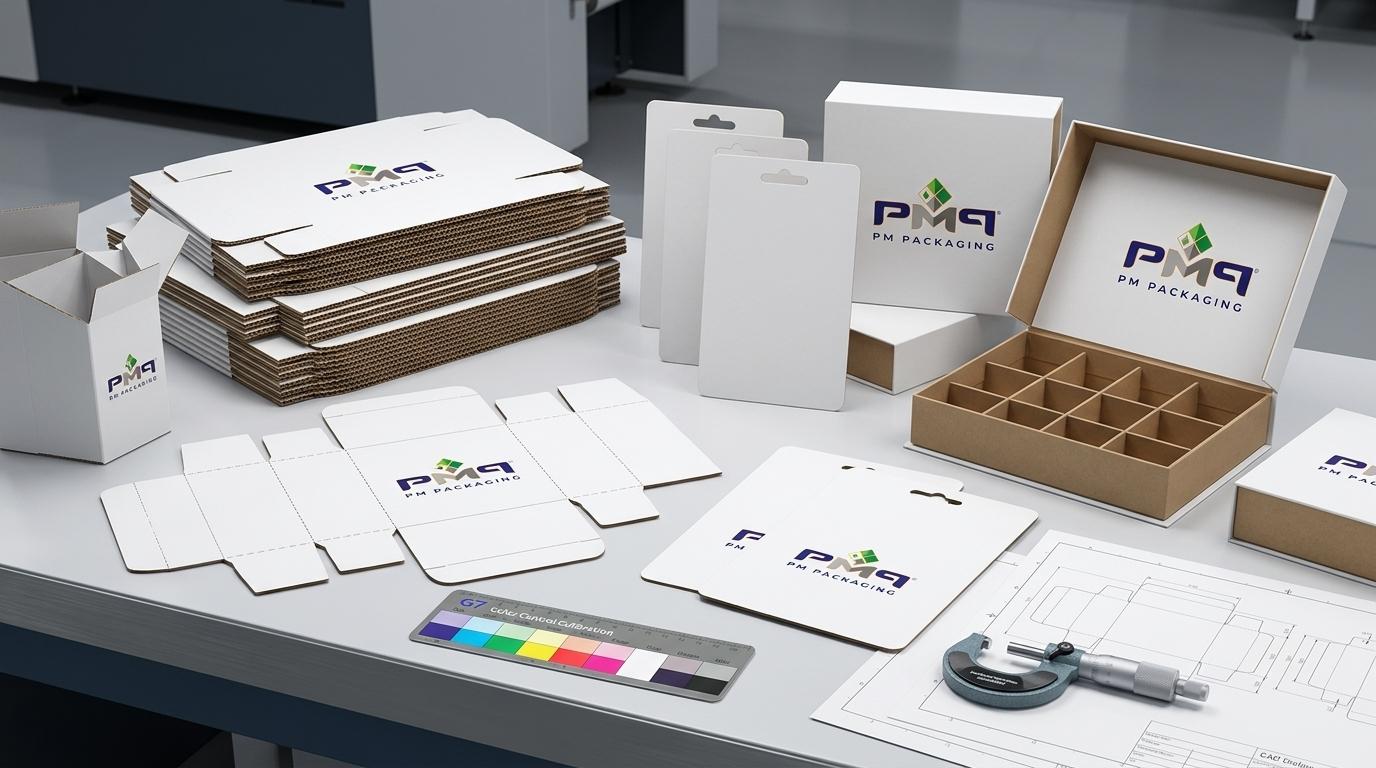
Custom Folding Cartons
High-impact retail cartons across virgin bleached paperboard, eco-friendly kraft, and recycled board engineered for high-speed automated cartoning lines.
Laminated Microflute Packaging
Combining photographic retail graphics with structural strength for heavy hardware, beverage multipacks, and club store pallet displays.
Luxury Rigid Setup Boxes
Magnetic-closure gift boxes, two-piece rigid boxes, and custom insert trays delivering premium unboxing experiences.
Printed Paperboard Blister Cards
Heat-seal backing cards, fold-over cards, trapped blister cards, and insert cards. High-volume brands leverage our qikCombo™ program to gang-run multi-SKU product lines for fast 10-day turnarounds and shared tooling economies.
The PM Packaging Nearshore Advantage
With more than 45 years of packaging expertise, PM Packaging provides high-volume consumer brands with an integrated cross-border manufacturing advantage.
Headquartered with centralized design, structural engineering, and pre-press prep in San Diego, California, combined with high-capacity converting facilities in Baja California (Tijuana and Mexicali), PM Packaging delivers manufacturing excellence:
Twin-Plant Redundancy
Facilities in Tijuana and Mexicali share synchronized equipment and quality standards, eliminating single-facility bottlenecks.
G7 Master Certified Print Consistency
Advanced color management protocols ensure exact brand consistency across every packaging format and production run.
Rapid Ground Delivery
Finished packaging arrives at West Coast and Southwest distribution centers in 1 to 3 days (3 to 5 days nationwide).
100% Tariff-Free USMCA Compliance
Full North American trade compliance shields your brand from import duties and customs delays.
Calculate Your Landed Cost Savings Today
Transitioning to a tariff-free nearshore packaging program allows enterprise consumer brands to lower total landed costs, eliminate ocean freight risks, and maintain the packaging agility demanded by modern retail channels.
Ready to evaluate your landed packaging costs and strengthen your supply chain? Connect with the packaging specialists at PM Packaging to request a landed cost comparison and dieline evaluation today.
Why Enterprise Brands Partner With PM Packaging
- Direct USMCA Duty Elimination: Zero import tariffs on qualifying folding cartons, microflute, and blister cards.
- Dual-Plant Converting Scalability: Synchronized production across Tijuana and Mexicali facilities.
- qikCombo™ Multi-SKU Efficiencies: Gang-run tooling economies for rapid retail rollouts.